Soothe a tickly throat
Grandma’s remedies for a sore throat: rest your voice, drink water in small sips, gargle with warm salt water and have a cup of thyme and honey tea, hot but never scalding. Most of the time, it clears up on its own in a few days.
Reviewed by Ruosi Wu, PhD in Pharmacy, MD in Traditional Chinese Medicine
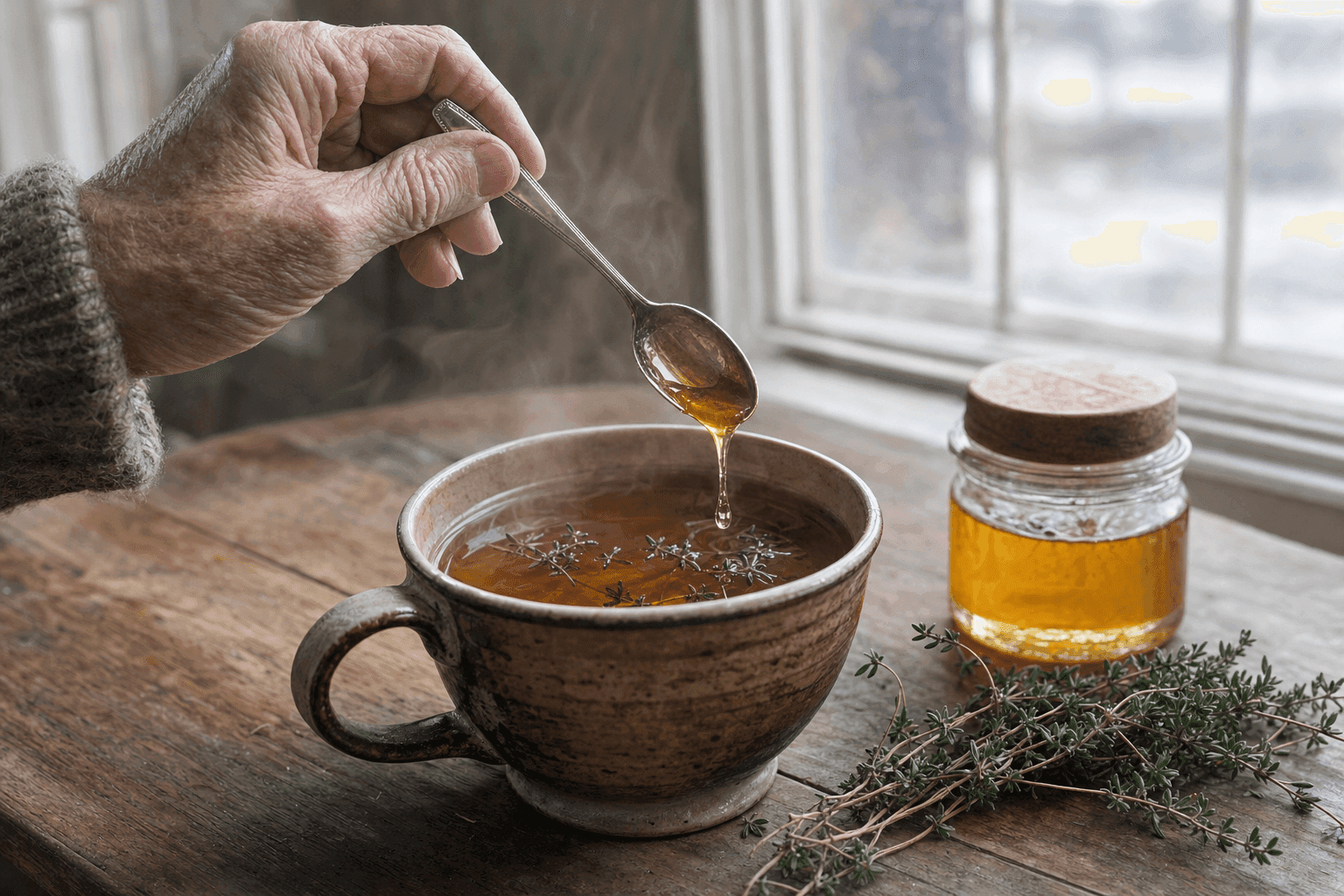
For a sore throat, start with the simplest things: let your voice rest, drink water in small sips and suck on a honey drop. In the evening, a warm salt-water gargle and a cup of thyme and honey tea, hot but not scalding. If it’s no better after five days, it’s time for the doctor, and if you find it hard to breathe or swallow, call 15 right away.
Key takeaways
- Most of the time, a sore throat is a virus or air that’s too dry, and it clears up on its own in a few days.
- The very first grandma’s remedy: leave your voice in peace and drink water in small sips.
- The warm salt-water gargle, half a teaspoon of salt in a glass, gets spat out, and it’s not for children.
- Thyme and honey tea is drunk hot, never scalding, and honey is never for a baby under one year old.
- If you find it hard to breathe or swallow, this isn’t a job for herbal tea anymore: you call 15 or 112.
Granny’s little steps
- Let your voice rest
Don’t strain your voice and don’t clear your throat, even if it’s scratchy: it hurts more afterwards. A day of talking softly never did anyone any harm.
- Water in small sips, and a honey drop
Drink plenty of water, in small sips, all day long. In between, suck on a honey drop: it makes your mouth water, and saliva calms the throat. No hard candy for little ones, they could choke.
- The warm salt-water gargle
Dissolve half a teaspoon of salt in a glass of warm water. Gargle, then spit it out, without swallowing. This one isn’t for children.
- A cool, airy bedroom
Keep the room between 18 and 20 °C and open the window for a good while every day. Air that’s too warm and too dry irritates the throat, and cold or drafts are no better.
- The sage gargle, for adults
Pour 100 ml of boiling water over 2.5 g of dried sage leaves, let it steep for ten minutes and strain. Gargle with it while it’s still warm but not scalding, three times a day, for a week at most. Not during pregnancy or breastfeeding.
A recipe to try
The evening cup of thyme and honey
In the evening, when your throat is scratchy
What you’ll need
- 1 to 2 g of dried thyme
- 150 ml of water
- 1 teaspoon of honey
How I go about it
- Bring the water to the boil.
- Put the thyme in your cup and pour the boiling water over it.
- Cover with a saucer and let it steep for 10 minutes.
- Strain, then wait a few minutes until the tea is hot but not scalding.
- Add the honey, stir and drink in small sips.
- You can have three or four cups a day, for a week at most.
For a sore throat, my grandma’s remedy doesn’t come to much: I leave my voice in peace, I drink water in small sips, I gargle with warm salt water and, in the evening, I make myself a cup of thyme and honey tea. Nothing new. It’s what my mother did, one hand on the kettle, the other on the honey jar. And most of the time, in a few days, the throat settles down by itself.
Why your throat hurts
You know, most of the time when your throat stings, it’s a virus passing through. A cold, a runny nose, a little dry cough, a slightly hoarse voice, and a scratchy throat along with it. At my house, it always started with one of the little ones’ noses, and three days later, it was my throat.
But that’s not all. The dry air of a well-heated house, cigarette smoke, dust, fumes from paint or glue, all of that irritates. A throat can sting because you talked too much or shouted too much (after a family dinner where I’d sung too much, I had no voice left the next day). It can also get scratchy when you sleep with your mouth open, when you snore, or when your stomach sends acid back up.
And when it pulls on just one side when you swallow? The medical books say that when only one tonsil swells, with a painful lump in the neck on the same side and no cough, it looks more like bacterial tonsillitis. That’s not something you can guess on your own in your kitchen: your pharmacist or your doctor is the one who can tell you.
Grandma’s plants for a sore throat
In my cupboard, for the throat, there are three jars that don’t move all winter: sage, thyme and marshmallow root. And next to them, the honey jar.
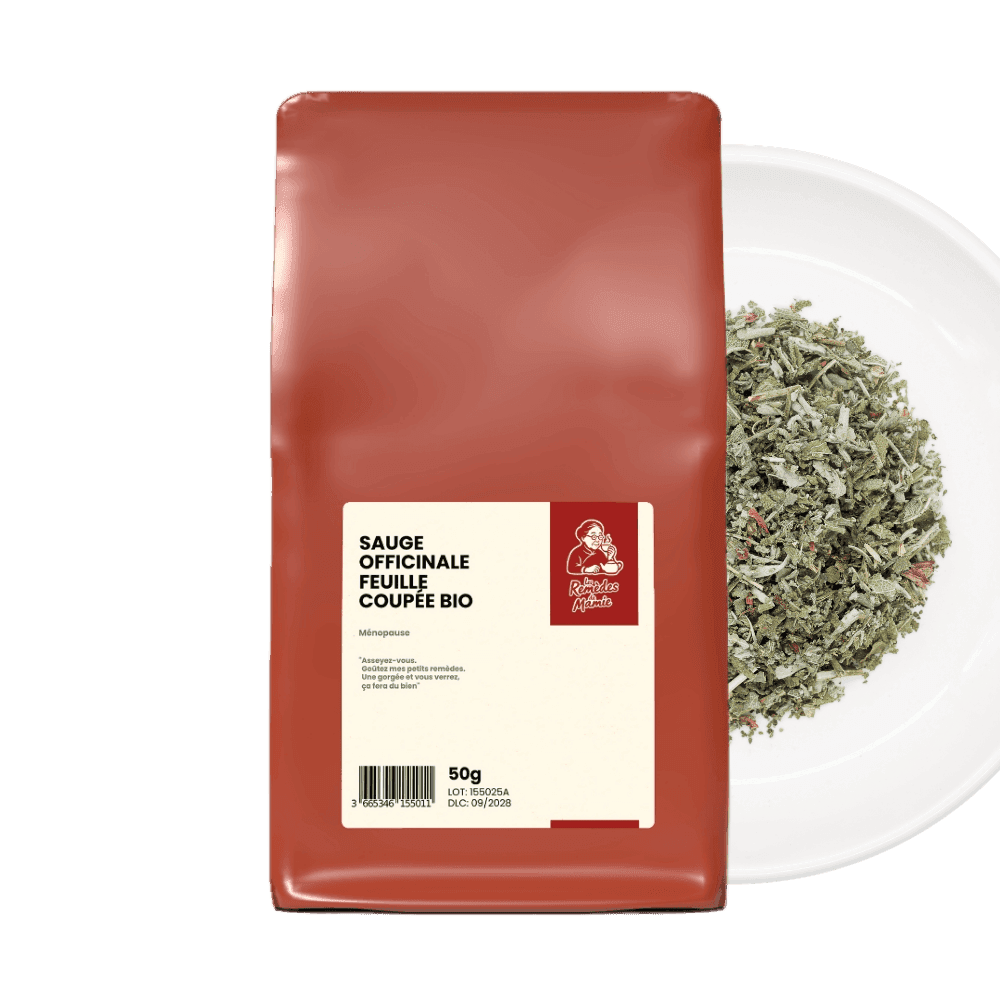
Sage is my gargling plant. The old handbooks have long given it for the mouth and throat when they’re inflamed. I pour 100 ml of boiling water over 2.5 g of dried leaves, let it steep for ten minutes, and gargle with it while it’s still warm, three times a day. No more than a week: if the throat hasn’t let go by then, it’s not my business anymore. If you want to know everything I do with sage, I’ve told you all about it.
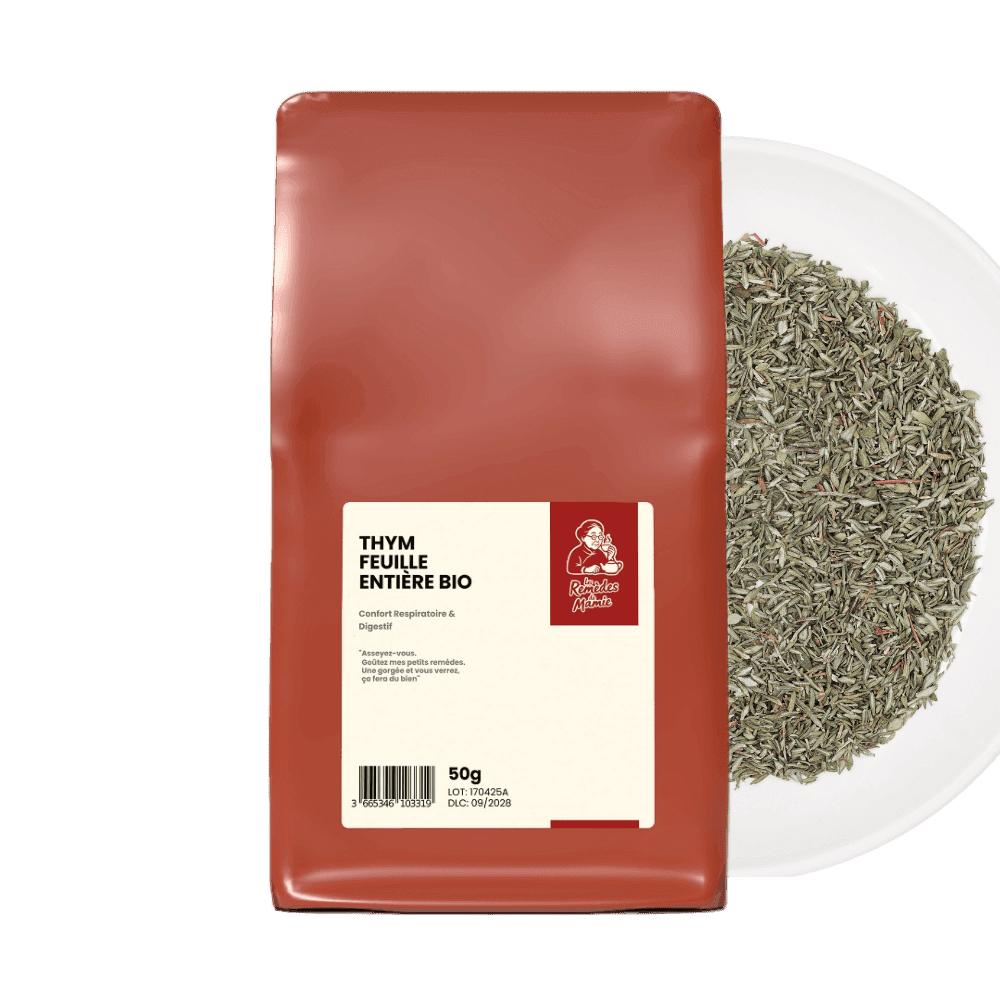
Thyme, I drink. The books keep it for the chesty cough that comes with a cold, and since at my house a sore throat rarely comes alone, it’s often thyme that ends up in the cup: 1 to 2 g of dried thyme for 150 ml of boiling water, three or four cups a day. I’ve already told you a lot about my thyme, and if you have a bit of garden, I showed you how to dry it in July so you have it all winter.
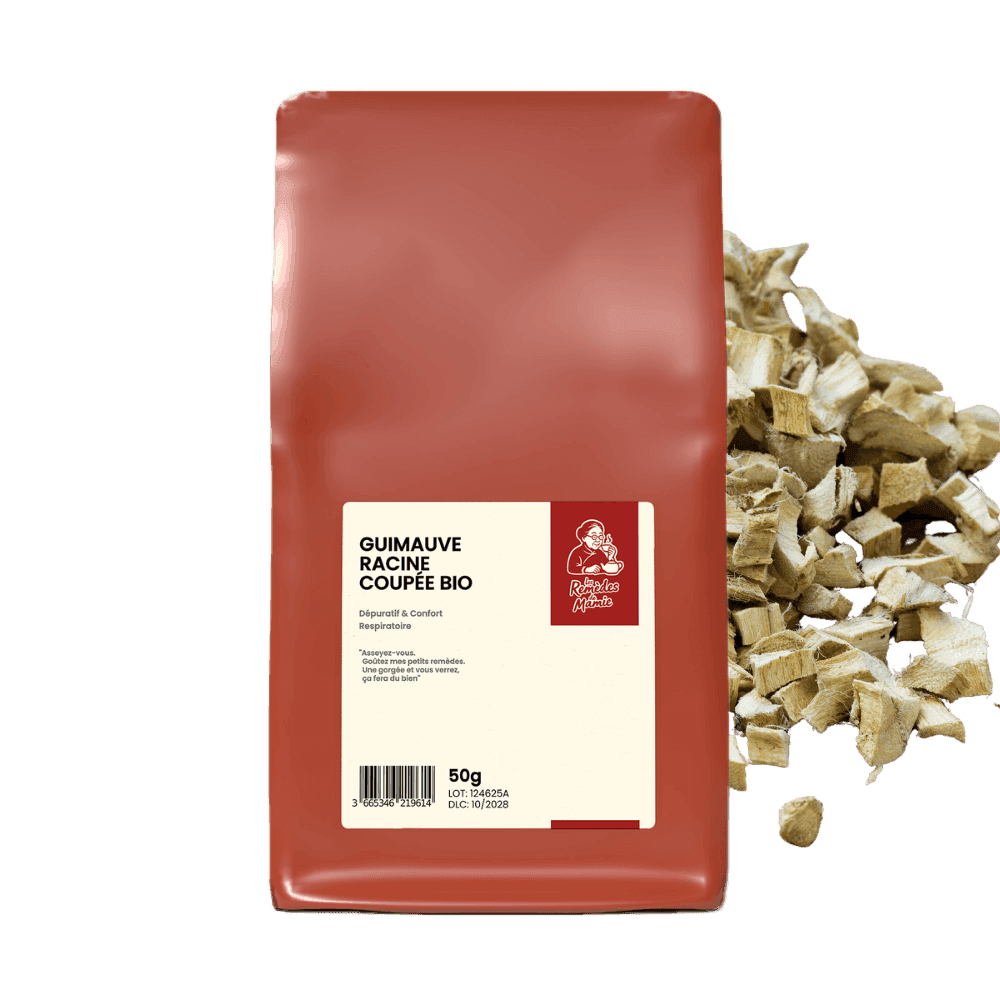
Marshmallow root is the gentlest of the three. It’s made cold, and that always surprises my neighbors: you soak it in room-temperature water for half an hour, and you drink it straight away, without keeping it for later. For an adult or a teenager, it’s 0.5 to 3 g of cut root in 150 ml of water, several times a day, no more than 15 g in a day. The books give it when the mouth or throat is irritated and it brings on a dry cough. You can drink it, or rinse your throat with it. The cut marshmallow root I keep in my cupboard works well for this.
Honey, last of all. An herbal tea sweetened with honey, a honey drop to suck on: it’s nothing fancy, but it calms a stinging throat. Sucking on a drop makes your mouth water, and it’s the saliva that does the throat good.
And echinacea? People often ask me about it. It isn’t one of my three jars for the throat: my books give it for a cold, from the first signs, when the scratchy throat comes with a runny nose, and only for a few days, never under 12. It isn’t right for everyone, so I explain when to take echinacea, for how many days, and who it isn’t for.
“A stinging throat can’t be rushed. You give it water, quiet and a little honey, and you let it run its course.”
Easing a sore throat at home, without rushing anything
People often ask me how to ease a sore throat fast. I’ll tell you how it is: there’s no magic fix. What there is, is little things you do that make the days easier while it passes.
First, your voice. Don’t strain it, don’t clear your throat, even if it’s scratchy: it hurts more afterwards. Next, water. Lots of it, but in small sips, all through the day. And what you eat should go down easily: a soup, stewed fruit, semolina, a purée. When my throat is on fire, I bring back my mother’s purée, the one we mashed with a fork.
Watch out for two habits we think are good. Lemon, first: when your throat burns, the books say to avoid anything acidic, citrus fruit, tomato, vinegar, and anything too salty. So I leave it aside. And scalding tea: we all want to drink it steaming, but a drink that’s too hot irritates. Hot, yes. Scalding, no. I wait for it to cool down a little, just long enough to stir in the honey.
And then the bedroom. Not too warm: between 18 and 20 °C, so the air doesn’t get dry. I open the window for a good while every day, even in the middle of winter, well wrapped up in my cardigan, but I don’t stay out in the cold or in drafts. If someone smokes in the house, now’s the time to stop, and never in front of a child.
Wondering if it’s tonsillitis? Your pharmacist can do a quick little test, without you having to see a doctor first, from age 10.
Sore throats in little ones
With a child, I’m more careful than I am for myself. Honey, never before age one: not in the bottle, not on the pacifier, not on a finger. No plants for little ones either: marshmallow root isn’t for under-3s, thyme tea waits until 12, and the sage gargle I keep for adults. The salt-water gargle, same thing, not for children. And no hard candy for little ones who could choke.
If your little one has a sore throat, offer them something to drink often, keep an eye on their fever, and if it’s no better after two days, take them to the doctor. If they refuse to drink, turn very pale or have trouble breathing, don’t wait: call 15. The signs to watch for are written below, one per line.
Grandma helps with the little everyday aches. The real worries are your doctor’s job. And a stinging throat, most of the time, mostly needs patience, a scarf and a hot cup.
Which plants?
MulleinVerbascum thapsus
Mullein, bouillon blanc in French, is a tall woolly plant of dry banks, with yellow flowers on a long spike. I steep its flowers when a cold gives me a dry cough, and I strain them well.
Black radishRaphanus sativus var. niger
Black radish is the big winter radish with black skin and hot white flesh: raw in thin slices, cooked in soup, and as a honey syrup when the winter cough settles in.
MarshmallowAlthaea officinalis
Common marshmallow is the tall, soft plant of the water's edge whose root gave its name to the sweet: a cold glass when your throat feels scratchy, and homemade marshmallows for the afternoon snack.
Ribwort plantainPlantago lanceolata
The five-seam herb of the paths: its young leaves in salad, its tea when your throat is scratchy, a crushed leaf on a nettle sting. And what to know first.
ElderSambucus nigra
The hedgerow shrub with white flower umbrellas: flower tea and syrup, jam from cooked berries. How to tell it from dwarf elder, and what you never eat.
EchinaceaEchinacea purpurea
The big purple flower with a hedgehog heart: three echinaceas you don't take the same way, the root tea for the first days of a cold, and what to know first.
SageSalvia officinalis
Common sage is the little shrub with soft grey leaves that we keep near the kitchen: for the roast, for the cup after a meal, for a tickly throat.
ThymeThymus vulgaris
Thyme is the little grey, bushy shrub that smells of sunshine: a sprig in the stewpot, and a cup with honey when a cold gives you a chesty cough.
LindenTilia cordata / Tilia platyphyllos
Linden is the big tree on village squares. Its dried flowers, with their bract, make the evening cup and the one for days when you've caught a chill.
ChamomileMatricaria chamomilla L.
Chamomile means two little flowers for your cup: German chamomile, mild, and Roman chamomile, bitter. For a bloated tummy, an irritated throat, skin that's got too hot.
What to know first
The plants on this page aren’t for everyone. I’ll tell you everything, plant by plant.
Pregnancy and breastfeeding: no sage, no thyme, no marshmallow root. There isn’t enough experience yet to know whether it’s safe, so the books say to go without.
Children: never any honey before age one, in any form, not on the pacifier and not on a finger. No marshmallow root before age 3. No thyme tea before age 12. No sage gargle before age 18. No salt-water gargle for children, and no hard candy for little ones, because of the risk of choking.
Allergies: if you’re allergic to thyme or to plants in its family (the mint family, Lamiaceae), don’t take it. Same for sage or marshmallow if you’re allergic to them.
If you’re on any treatment: marshmallow root can slow down how your body takes in medicines taken at the same time. Leave half an hour to an hour between the marshmallow and your medicines. For everything else, ask your doctor or your pharmacist.
How long: sage, thyme and marshmallow, a week at most. If the discomfort lasts longer, or gets worse, go and see your doctor. If you have trouble breathing, a fever or phlegm with pus in it while you’re taking thyme or marshmallow, that’s the doctor too.
Salt: the salt-water gargle gets spat out, not swallowed.
When to see your doctor
- If you find it hard to breathe or swallow: call 15 or 112 right away.
- If you feel very thirsty, your mouth is dry, you pee very little or you feel dizzy when you stand up (these are signs of dehydration): call 15 or 112.
- If your child stops eating or refuses to drink: call 15 or 112.
- If your child turns very pale, their lips or fingers turn blue, or their breathing becomes irregular: call 15 or 112.
- If your child is restless, drowsy, confused or extremely tired: call 15 or 112.
- If your fever or your child’s goes above 39 °C: see your regular doctor the same day.
- If your sore throat comes with other symptoms, like vomiting or headaches: see your regular doctor the same day.
- If a rash of spots appears on the body: see your regular doctor the same day.
- If you have swollen glands in your neck: see your regular doctor the same day.
- If your immune system is weakened (HIV infection, ongoing cancer treatment, autoimmune disease): see your regular doctor the same day.
- If your sore throat is no better after five days of home care (two days for a child): make an appointment with your regular doctor in the next few days.
- If your sore throat keeps coming back: make an appointment with your regular doctor in the next few days.
- If heavy tiredness lasts more than a week: make an appointment with your regular doctor in the next few days.
- If your sore throat won’t go away and gets worse, especially if you smoke or drink alcohol: talk to your doctor without putting it off.
Your questions
What’s the grandma’s remedy for a sore throat?
Mine is patience and four simple things: I rest my voice, I drink water in small sips, I gargle with warm salt water and I have a cup of thyme and honey tea, hot but not scalding. For an adult, I sometimes add a sage gargle. Most sore throats clear up on their own in a few days.
How can I ease a sore throat fast?
There’s no magic fix, I’d rather tell you straight. Sucking on a honey drop makes your mouth water, and saliva calms the throat. Water in small sips, a warm soup, no lemon and no scalding drinks, and your voice at rest: that’s what makes the day easier while it passes.
How do I gargle for a sore throat?
For salt water, dissolve half a teaspoon of salt in a glass of warm water, gargle and spit it out, without swallowing. For sage, pour 100 ml of boiling water over 2.5 g of dried leaves, let it steep for ten minutes and gargle with it while it’s still warm, three times a day, for a week at most. Neither one is for children.
Why does my throat hurt on just one side when I swallow?
When only one tonsil swells, with a painful lump in the neck on the same side and no cough, it points more toward bacterial tonsillitis. That’s not something you can guess on your own. Your pharmacist can do a quick test from age 10, otherwise go and see your doctor.
What should I do if my one-year-old has a sore throat?
Offer them something to drink often and keep an eye on their fever. No plants at that age, and no honey until they’ve had their first birthday. If their fever goes above 39 °C, it’s the doctor the same day, and if it’s no better after two days, it’s the doctor too. If they refuse to drink, turn very pale or have trouble breathing, call 15 or 112.
How do I know if it’s tonsillitis?
Not every sore throat is tonsillitis, and tonsillitis can hurt only a little, so I don’t play guessing games. Tonsillitis is often a throat that hurts when you swallow, with a fever between 38 and 39 °C. To know for sure, your pharmacist can do a quick test from age 10, or your doctor can look at your throat.
Also worth reading
- The LetterMy evening grog, with lemon and honey, for when you come in frozenMy grog recipe for the evenings you come home frozen: a glass of hot water, lemon, honey, one measure of rum, my thyme version, an alcohol-free version, and what to know before you drink.
- The LetterMy grandma's mulled wine recipe, for cold December eveningsMy grandma's mulled wine recipe, the one for evenings when the neighbours drop in: the wine, the orange, the spices, the measures, an alcohol-free version, and what to know before serving.
- The LetterMy autumn plants: what I put away in jars before winterMy autumn plants are habits: thyme drying, elderberry jelly, a few cups for the first days of a cold. No promises, just what I've always done.
- The LetterMy sage, a honey plant, and its bees: come listen to summer with meMy sage is in flower and it hums from morning to night. Let me tell you about its bees, the cup and the gargle I make from it, and what I think of burning sage.
- The LetterDrying your herbs in July: my little bunches up in the atticIn July, I cut my herbs in the morning, once the dew has gone, and hang them up in the attic. Come and see how I do it, plant by plant, so I have my herbal teas all winter.
- The LetterMy mother's notebook: her old grandma recipes, with measurementsI opened my mother's notebook again. Her grandma recipes had no grams and no minutes: here are the ones I've kept, measured, and her page on vinegar.
What I’ve made with
References
- Mal de gorge : que faire et quand consulter ? · Assurance Maladie (ameli.fr), 2026
- Le mal de gorge et ses causes · Assurance Maladie (ameli.fr), 2026
- Angine et mal de gorge de l’adulte · Santé.fr, Service Public d’Information en Santé, 2026
- European Union herbal monograph on Salvia officinalis L., folium · European Medicines Agency (HMPC), 2016
- Community herbal monograph on Thymus vulgaris L. and Thymus zygis L., herba · European Medicines Agency (HMPC), 2013
- European Union herbal monograph on Althaea officinalis L., radix · European Medicines Agency (HMPC), 2016
- Glossary on herbal teas · European Medicines Agency (HMPC), 2010
- Pas de miel pour les enfants de moins d’un an · Anses, 2023
- Sore throat · NHS, 2024
Information. This information is provided for general knowledge and doesn’t replace medical advice. Check with a healthcare professional before any use.
Health Disclaimer