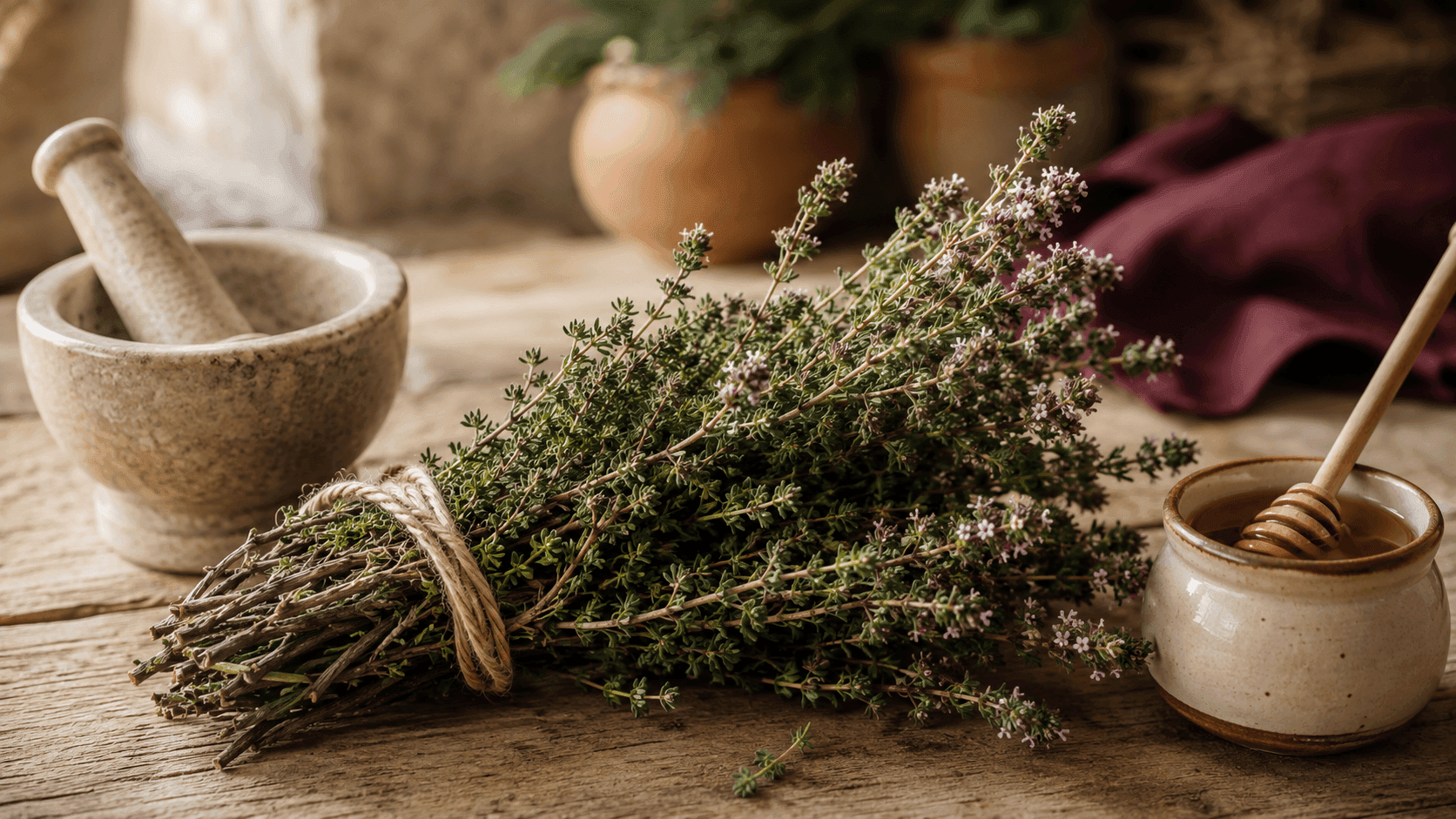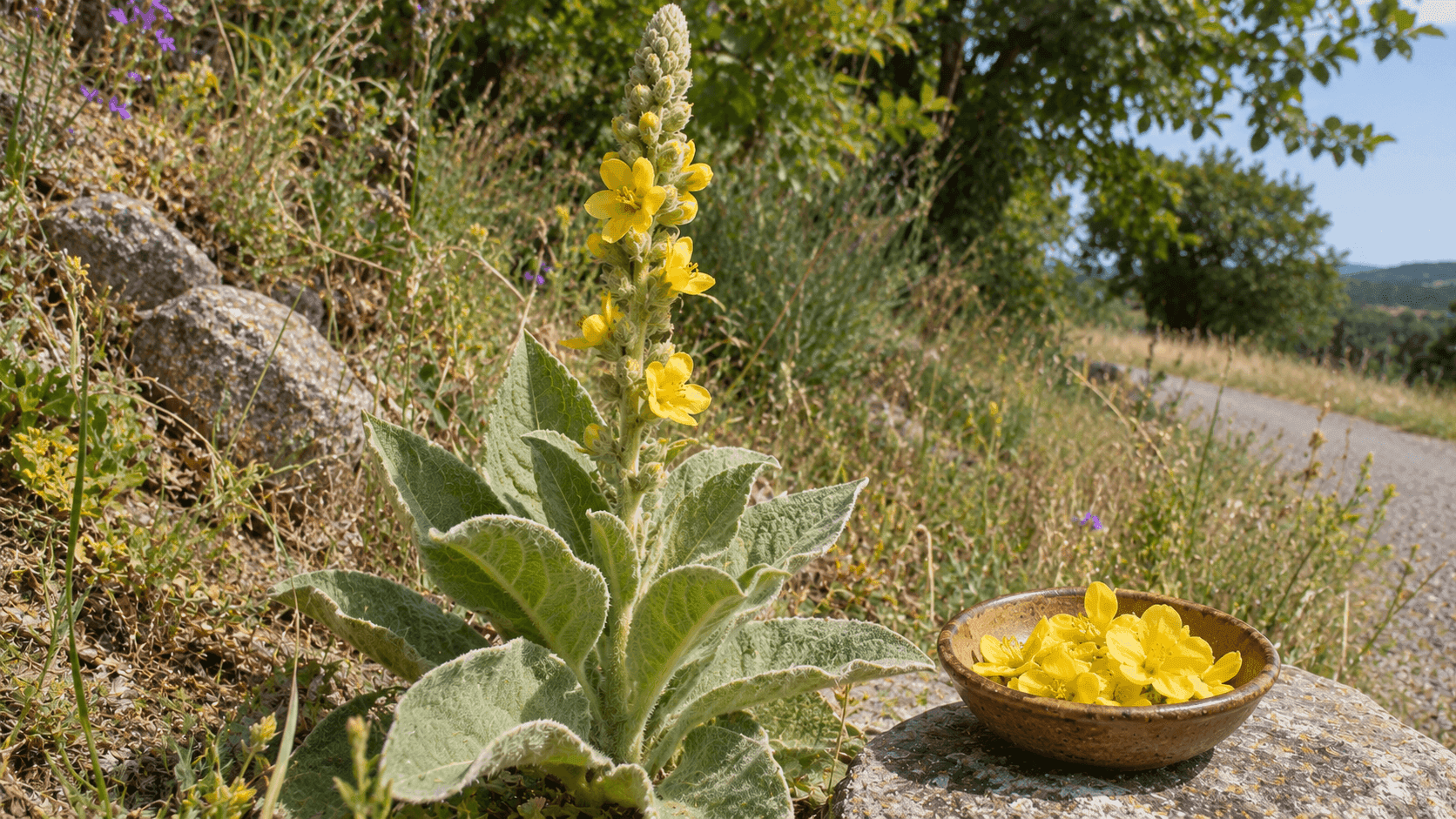
Mullein, bouillon blanc in French, is a tall woolly plant of dry banks, with yellow flowers on a long spike. I steep its flowers when a cold gives me a dry cough, and I strain them well.
Who she really is
Family: Figwort family (Scrophulariaceae). Mullein grows wild from Europe to Siberia and the Himalayas. Where I live, you see it on banks, waste ground and path edges, in dry soil.
Part used: the yellow flowers, dried.
Mullein, molène or bouillon blanc in French, is a tall plant covered in down, which makes a rosette of woolly leaves in its first year and, in its second, a stem one to two metres tall loaded with yellow flowers. What we keep are its flowers. I steep them when a cold gives me a dry cough and my throat stings, and I always strain the cup through a fine cloth.
Her story
Mullein, the plant the French call molène or bouillon blanc, is a tall, woolly plant that grows on dry banks and lifts a long spike of yellow flowers to the sky. It's the flowers we keep. I steep them when a cold gives me a dry cough and my throat stings, and I strain them carefully.
Mullein, the plant: a tall yellow candle on the banks
Its scientific name is Verbascum thapsus. In French we call it molène, bouillon blanc or molène bouillon-blanc, and it belongs to the figwort family (Scrophulariaceae). Mullein, to tell the truth, is the name of a whole genus of tall plants, the Verbascum: there's also dark mullein, moth mullein, dense-flowered mullein. But when people say bouillon blanc, she's the one they think of first.
It's a plant that takes its time. In the first year, all it makes is a rosette of big leaves lying flat on the ground, up to 50 cm long. They're covered in down so thick they look silvery: when you touch them, it feels like flannel. In the second year, a single stem shoots straight up, usually one to two metres tall, and its whole top part fills with five-petalled yellow flowers, packed tight together. Once the seeds are made, the plant dies: it has lived its life in two years.
Its flowers have a funny habit. Each one lasts only a day: it opens before dawn and closes in the afternoon, and there are only ever a few open at once on the spike. They start at the bottom and climb little by little, from June to August, sometimes into September or October when summer lingers. And they have a sweet smell, a bit like honey.
It grows wild from the Azores right across Europe, as far as Siberia and the Himalayas, and it has travelled much further: to North America, to Australia, and even to Japan, where it arrived around 1870. It loves light and dry ground, sandy or stony: banks, waste ground, path edges, clearings. Wherever the soil is bare, it turns up on its own. Its seeds are tiny and countless, more than a hundred thousand on a single plant, and they can wait for decades in the ground before sprouting.
Bouillon blanc, Our Lady's candle: the old names of mullein
The French word molène comes from « mol », soft, like its leaves. In the 13th century it was spelled moleine, and that's where the English name, mullein, comes from. Bouillon blanc, on the other hand, has nothing to do with soup (bouillon means broth in French), even if you'd think so. The word comes from an old Gaulish plant name, and it drifted towards « bouillon » because people boiled the flowers for chest teas. The « blanc », white, is the down on the leaves.
It has plenty of other French names: Saint Fiacre's herb, Our Lady's candle, great candlestick flower, little old man, Saint Cloud's ear, wolf's tail. The candle names didn't come by chance. In the Middle Ages, people stripped the leaves off the tall dry stem and coated it in pitch to make a torch. And the down on the leaves, once good and dry, served as wicks for lamps and caught fire like tinder.
When the French revolutionaries remade the calendar, they gave it a day of its own: 2 Thermidor, which falls around 20 July. That's right in the middle of its flowering, and it always makes me smile.
Me, I like its look of a tall sentry. There's one that sowed itself on the bank at the end of the garden. The first year, all I saw was a grey rosette at my feet. The next summer, it stood a head taller than me.
What mullein is good for, according to the books
I'm not going to promise you the moon. For mullein, today's books keep only one traditional use, just one: when a cold gives you a dry cough and your throat stings, you drink an infusion of its flowers to soothe it. It's based on long-standing use, nothing more, and that suits me fine. For the days when it scratches, I have other little habits I tell you about for a stinging throat.
People were already using it for the chest two thousand years ago, and in the old days they took its leaves as much as its flowers; today's books keep only the flowers. In France, herbalists put it in the « fleurs pectorales », the chest flowers, a blend people called the « four flowers » that actually counted seven: mullein, corn poppy, marshmallow, common mallow, cat's foot, coltsfoot and violet. My mother still said « a four-flower tea » for the evening cup when someone was coughing. But since then, things have been sorted out. Coltsfoot, they don't want it any more: taken over a long time, it can harm the liver, and it has been taken out of several cough teas. So that blend, I tell you as a story. For my cup, I only use mullein, because it's for its flowers that my books give amounts.
Here's how I make it. I weigh 1.5 to 2 g of dried flowers, pour 150 ml of boiling water over them, cover and leave to steep for ten to fifteen minutes. And then comes the step you must never forget with this one: I strain it through a fine cloth, a piece of muslin. The plant is covered in little hairs, right down into its flowers: the petals have them, and three of its five stamens are all woolly. If they get into the cup, they scratch your throat instead of soothing it.
An adult or a teenager over 12 drinks three to four cups a day, no more. For younger children, the books lack data, so we go without, and the same when pregnant or breastfeeding. If the cough lasts more than a week, or gets worse, it's no longer a matter for flowers: go and see your doctor. All the details are further down, in what to know first.
When my throat stings, I don't count on mullein alone. My thyme, the first thing I reach for when my throat feels scratchy, waits right next to it in the cupboard, and each has its own cup.
« Mullein, you steep it, and above all, you strain it. The rest is patience. »
Picking mullein, the plant, in summer, and growing it in the garden
If you have a mullein near you, you can gather your own supply. You pick the flowers on the second-year plant, when it's in full bloom, from June to August. Since each flower opens before dawn and closes in the afternoon, I go round in the morning with a little basket, and I only take the yellow flowers wide open that day.
I spread them in a thin layer on a drying rack or a clean tea towel, somewhere airy, out of direct sun. It takes about a week for them to be properly dry and crisp. Then I put them away in a tightly closed glass jar, away from light and damp: otherwise they go mouldy fast or turn all brown. For everything I dry at home, I've given you my tips for drying herbs in July.
But be careful when you pick. You only gather what you recognise without the slightest doubt. Before they flower, plenty of plants make big leaves that look alike: foxglove, which is very toxic, has already been mistaken for comfrey. That's why I only pick mullein in flower, one plant at a time, never by the armful. And I don't touch its seeds: in the old days, people threw them in the water to stun fish. If you're in doubt, leave it, and buy your flowers from a herbalist or a pharmacy, where in France they're sold as bouillon blanc.
Growing it is almost too easy. It likes full sun and poor, chalky soil that drains well. You sow from March to May: mix the seeds with a little sand and scatter them, without covering them, because they need light to sprout. It handles cold down to -20 °C. And after that, believe me, it reseeds itself, wherever it fancies.
In the garden, I also love it for its visitors. Little wild bees and hoverflies come to its flowers, and some bees even carry off its down to line their nests. A plant that lends its wool to the bees, you'll admit that's not common.
What I use her for
- · 01When a cold gives me a dry cough and my throat stings: a cup of steeped flowers, strained through a fine cloth, three to four times a day, from age 12.
- · 02In summer, I dry its morning flowers so I have my supply for winter.
- · 03In the garden, I let it reseed on a dry bank: wild bees and hoverflies come to visit.
How I prepare her
Granny’s little recipes
The mullein cup, when a cold gives you a dry cough
During the day, three to four times, when your throat stings with a cold
What you’ll need
- 1.5 to 2 g of dried mullein flowers (for an adult or a teenager over 12)
- 150 ml of boiling water
- A fine cloth, a piece of muslin, for straining
How I go about it
- 01Put the flowers in a cup and pour the boiling water over them.
- 02Cover and leave to steep for ten to fifteen minutes.
- 03Strain through the fine cloth to catch all the plant's little hairs: they're what scratch your throat.
- 04Drink it hot. Three to four cups a day, no more than 8 g of flowers in a day, and never before 12. If the cough lasts more than a week, go and see your doctor.
My mullein flowers for drying
A summer morning, from June to August, when the day's flowers have just opened (about a week of drying)
What you’ll need
- The wide-open yellow flowers of a second-year mullein you recognise without any doubt
- A drying rack or a clean tea towel
- A good dry glass jar that closes tightly
How I go about it
- 01In the morning, pick only that day's open flowers, one plant at a time. Leave the seeds alone.
- 02Spread them in a thin layer on the rack or tea towel, somewhere airy, out of direct sun.
- 03Leave to dry for about a week, until they're properly dry and crisp.
- 04Put them away in the tightly closed jar, away from light and damp. Go back and pick on the following mornings: each flower only opens for a day.
What to know first
This information doesn’t replace advice from a healthcare professional. Health Disclaimer →
Her identity card
- Name
- Great mullein (molène bouillon-blanc)
- Other names
- Bouillon blanc, Our Lady's candle, Saint Fiacre's herb
- Latin name
- Verbascum thapsus L.
- Family
- Figwort family (Scrophulariaceae)
- Part used
- The flowers
- Harvest
- Flowers from June to August, in the morning, on the second-year plant
- Form
- Dried flowers, as a well-strained infusion
- Origin
- Azores, Europe to Siberia and the Himalayas; naturalised in North America, Australia and Japan
- Storage
- Flowers well dried, in a tightly closed jar, away from light and damp
If you remember just one thing
- 01Mullein, the plant the French call molène, is bouillon blanc, Verbascum thapsus: a tall woolly plant of dry ground, with yellow flowers packed on a long spike.
- 02It's the flowers we keep: dried, they're made into an infusion.
- 03When a cold gives you a dry cough and your throat stings: 1.5 to 2 g of flowers for 150 ml of boiling water, three to four times a day, from age 12.
- 04A cup of mullein is always strained through a fine cloth: its little hairs scratch the throat.
- 05Not before 12, not when pregnant or breastfeeding; and if the cough lasts more than a week, it's the doctor you need to see.
Your questions
Yes, more or less. Molène, mullein in English, is the name of a whole genus of tall plants, the Verbascum, and bouillon blanc, Verbascum thapsus, is the best known, with its woolly leaves and yellow flowers. The French pharmacopoeia groups three very close mulleins under the name bouillon blanc. And the English word mullein is the same word: it comes from our old French moleine.
I'm not promising you anything, I'm telling you what people have done with it for a long time. The books give it just one traditional use: soothing a stinging throat when a cold gives you a dry cough. You take its flowers as an infusion, well strained, and that's all I expect from it.
You pour 150 ml of boiling water over 1.5 to 2 g of dried flowers, leave it to steep for ten to fifteen minutes, then strain it through a fine cloth to catch the little hairs. An adult or a teenager over 12 drinks three to four cups a day. If the cough lasts more than a week, go and see your doctor.
For the flowers as a tea, the books know of no side effects, but that doesn't mean zero risk. Its little hairs scratch the throat, hence the fine cloth. Its seeds, though, were once used to stun fish: you don't touch them. And not before 12, not when pregnant or breastfeeding.
I'm not going to tell you it cleans your lungs: the books don't say so. They give it the stinging throat and dry cough of a cold, nothing more. If you're short of breath, have a fever or you're coughing up pus-filled phlegm, it's not a matter for tea: go and see your doctor without waiting.
In the wild, on banks, waste ground and path edges, in dry soil, and you spot it from June to August when it flowers. For your cup, better to get the dried flowers from a herbalist or a pharmacy, where in France it's sold as bouillon blanc. If you pick it yourself, only take the flowers of a plant you recognise without any doubt.
References
- European Union herbal monograph on Verbascum thapsus L., V. densiflorum Bertol. (V. thapsiforme Schrad) and V. phlomoides L., flos (EMA/HMPC/611537/2016) · European Medicines Agency, HMPC, 2018
- Verbasci flos: herbal medicinal product (Mullein flower, summary) · European Medicines Agency, 2018
- Assessment report on Verbascum thapsus L., V. densiflorum Bertol. (V. thapsiforme Schrad) and V. phlomoides L., flos (EMA/HMPC/611531/2016) · European Medicines Agency, HMPC, 2018
- Addendum to Assessment report on Verbascum thapsus L.; V. densiflorum Bertol.; V. phlomoides L., flos (EMA/HMPC/438161/2024) · European Medicines Agency, HMPC, 2025
- European Union herbal monograph on Species pectorales (EMA/HMPC/239465/2024) · European Medicines Agency, HMPC, 2025
- Public statement on the use of herbal medicinal products containing toxic, unsaturated pyrrolizidine alkaloids (EMA/HMPC/893108/2011 Rev. 1) · European Medicines Agency, HMPC, 2021
- Liste A des plantes médicinales utilisées traditionnellement (Bouillon blanc) · ANSM, Pharmacopée française, 2024
- Tisanes (Ptisanae), Pharmacopée française · ANSM, 2013
- Molène (plante) · Wikipédia, 2026
- Bouillon-blanc · Wikipédia, 2026
- Verbascum thapsus · Wikipedia, 2026
- Pectoral (définition, Trésor de la langue française informatisé) · CNRTL, 2026
- Mullein, Great (A Modern Herbal) · M. Grieve, botanical.com, 1931
- Cet été, à quelles plantes faire attention pour éviter les intoxications ? · ANSES, 2022
- Fiche espèce : le Bouillon-blanc · Gentiana, Société botanique dauphinoise, 2026
- Où acheter les plantes médicinales ? · VIDAL, 2012
- Verbascum thapsus L. · Plants of the World Online, Royal Botanic Gardens, Kew, 2026
- Königskerze: majestätische Erkältungsheilpflanze · PTA heute (Deutscher Apotheker Verlag), 2022