The hedgerow shrub with white flower umbrellas: flower tea and syrup, jam from cooked berries. How to tell it from dwarf elder, and what you never eat.
Who she really is
Family: Viburnaceae (older books put it in the Adoxaceae).
Parts used: The flowers, and the fully ripe berries, always cooked. The rest of the shrub is not to be eaten.
Black elder (Sambucus nigra) is the big shrub of hedgerows and woodland edges that covers itself in white flower umbrellas in spring, then in clusters of small black berries at the end of summer. Its flowers go into tea or syrup. Its berries are eaten cooked, as jam or jelly, never raw.
Her story
Black elder, Sambucus nigra by its Latin name, is the big hedgerow shrub that gives white flowers for syrup in May and June, and black berries for jam at the end of summer. It grows everywhere around here. I'll tell you straight away: raw, it's not to be eaten. Cooked, and only the flowers and fully ripe berries, that's another story.
Black elder, the hedgerow shrub you know by its smell
It's a shrub with often arching branches, usually four or five metres tall. Its leaves come in pairs, facing each other, made of five to nine pointed leaflets. Crush one: the smell isn't nice at all, and that's a good way to recognise it. Snap a young branch and you'll see a soft white pith inside.
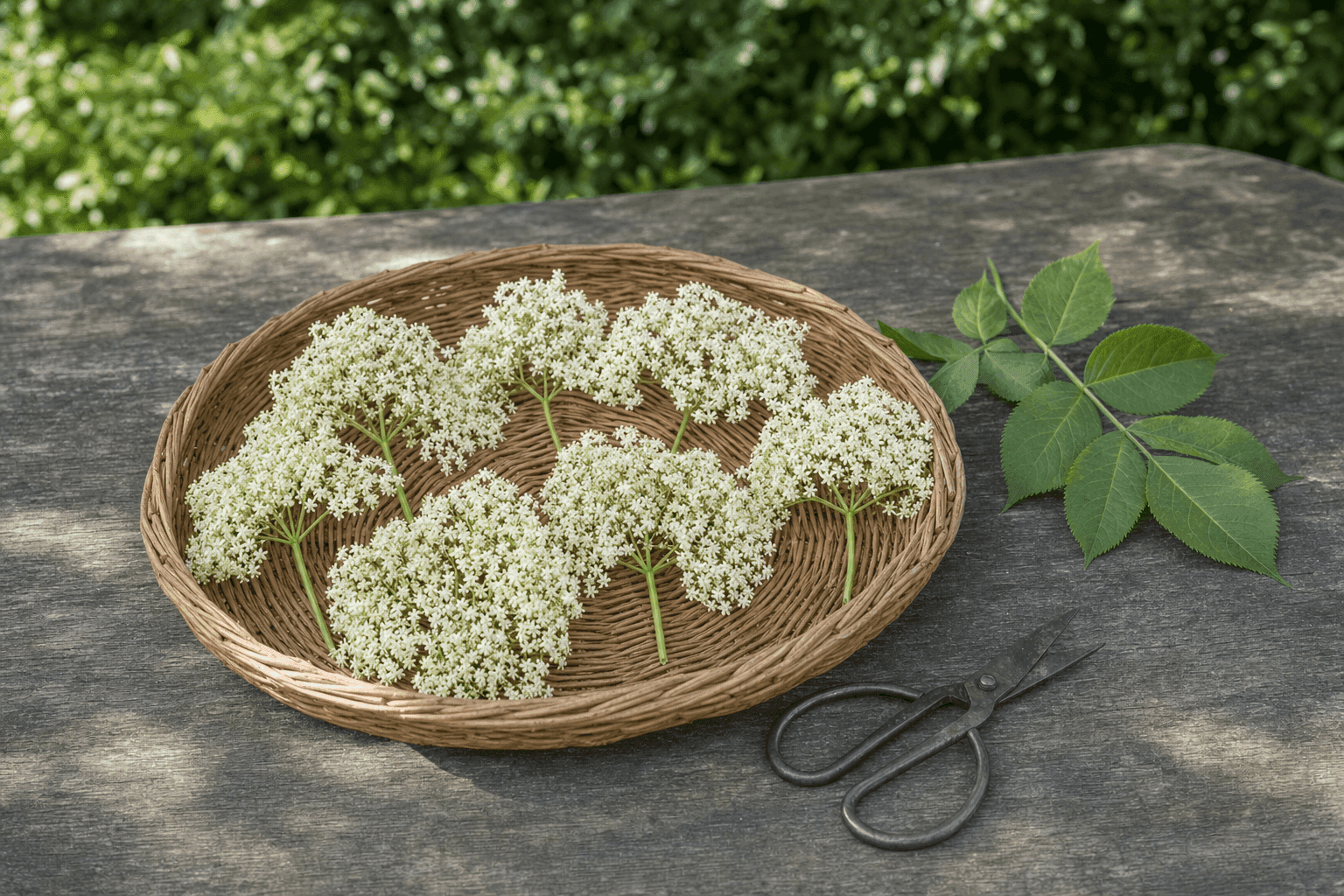
In May and June it covers itself in wide, creamy white flower heads, very fragrant, and the bees love them. At the end of summer come clusters of small purplish black berries that hang down towards the ground. The blackbirds and thrushes often get there before me.
Its name has some age to it. The French name, “sureau”, comes from the Old French seu. Its Latin name, Sambucus, is said to come from a Greek word for a small harp. With its hollow stems, it has always had something to do with music: they say the druids made flutes from it. Pliny the Elder was already writing about it. In some places it's also called sampéchier.
People sometimes ask me about the magical powers of elder. It's had plenty. For the Celts, it was the tree linked with death. But people also nailed its branches over doors to ward off bad luck. And woe to anyone who burned it: they said it dried up the cows' milk. My grandmother never put a piece of it in the stove, and we didn't ask why. Andersen even wrote a tale about it, The Elder-Tree Mother.
Is black elder toxic? What you can eat, and what you can't
It's the question I get asked most, so I'll answer you plainly. Yes, a good part of black elder is toxic. The leaves, bark, branches, roots, berries that are still green and raw berries can cause nausea, vomiting or bad diarrhoea. The books even say never to crush the leaves or stems together with the fruit: crushing them is when things go wrong.
What you can eat is the flowers, and the fully ripe berries, cooked. Cooking gets rid of what causes trouble in the little seeds. So in my house the rule never changes: the berries get stripped and cooked. Never a raw handful as you walk past the hedge, even when they're shining in the sun.
Stripping means taking the berries off their little stalks, because the green bits, we don't want. I run a fork through the cluster and the berries drop off on their own. And I put on an old apron: elder juice stains terribly.
The other danger is mixing it up. Dwarf elder, which you'll also hear called danewort, looks a lot like black elder, but its berries are toxic, even cooked. Dwarf elder is a tall herb that never grows past two metres, makes no wood and disappears in winter. It smells bad, its leaves have two little ear-like flaps at their base, and its clusters stand up straight, facing the sky. Black elder has real wood, and its clusters hang down. If you're not sure, you don't pick. There'll be other hedges.
Elderflower: the syrup, the tea and its old-time benefits
I pick the flowers in May and June, in the morning, when the heads are fully open. A trick I got from my neighbours: run the hollow of your hand over them, and you should have yellow pollen on your skin. That's what gives the flavour. I leave the ones full of greenfly, I gently shake the others to get the little creatures off, and I don't wash them: the pollen would go with the water.
For elderflower syrup, the flowers soak for two days in the cool with water and lemon, then I strain, add the sugar and boil for one minute. The recipe is further down. How do you keep a homemade syrup? This one lasts three to four weeks in the fridge, and for longer, you freeze it. The old folks also made lemonade, wine and fritters with the flowers.
And the benefits of elder syrup? I'll be honest: flower syrup is sugar and fragrance. It's a pleasure, not a remedy.
The tea is something else. The old handbooks give dried elderflower, as an infusion, when a cold is starting and you feel it coming on. In the old days people drank it as hot as they could, in the afternoon or evening, to bring on a sweat. My cup is 2 to 5 grams of dried flowers (two heaped teaspoons make about 3 to 4 grams) in 150 ml of boiling water, ten minutes covered. Up to three cups a day. If you're not better after a week, or if it gets worse, it's the doctor you need, not tea.
The old books also talk about using it as a gargle when your throat is scratchy. For those evenings I also have my thyme, always close at hand, and I've written down what I do when my throat is scratchy.
To have some all winter, I dry a few flower heads. I hang them by the stalk in a dark, airy room for six to ten days, then the flowers go into a tightly closed jar. It's the same idea as the herbs I dry in July.
Black elderberries: jam, jelly and old-fashioned syrup, always cooked
The berries ripen in August and September. I pick them good and black, shiny and a little soft, away from roads and sprayed fields. I strip them, sort them, and everything goes into the pan.
My elderberry jam, I make it with wild blackberries picked from the same hedge. To my taste, the blackberries round out the flavour and the elder gives the colour. For a jelly, I cook the berries for twenty minutes in a little water and keep only the juice. Both recipes are further down.
And then there's the old berry syrup, the “rob” of the old English books: ripe berries cooked with sugar until they're as thick as honey. In England and Holland, people took one or two spoonfuls in a small glass of hot water in the evening, when they'd caught a chill. I like that idea of an evening syrup. But I'm not promising you anything with it.
Berries taken as a remedy, by the spoonful, as juice or syrup: the books don't advise them during pregnancy, breastfeeding, or under 18, for lack of data. Jam for an afternoon snack, though, that's just cooking.
Planting a black elder, and 'Black Lace' with its almost black leaves
Black elder isn't fussy. It grows in shade as well as sun, in poor or rich soil, damp or dry: woodland edges, copses, stream banks, farmyards. Give it room, a grown one easily reaches four or five metres.
At the garden centre you'll also see black elder 'Black Lace', an ornamental variety with finely cut leaves of a purple that's almost black, and pinkish flowers in summer. It stays around three metres and doesn't mind being cut back hard. I look at it, and I pick my flowers from the elder in the hedge.
Its hollow stems make nests for little wasps. Some gardeners even make a brew from its leaves against mildew and greenfly, a bit like with the big stinger at the bottom of the garden. And in June, it's the one that tells me summer's here, along with my lime tree.
So trust it for the flowers, and be wary of it for the rest. Properly identified, fully ripe, well cooked: that's all it asks of you.
What I use her for
- · 01In spring, the fresh flowers go into syrup, which I drink diluted with cold water all summer.
- · 02The dried flowers as a piping hot tea, when a cold is starting, as the old handbooks say.
- · 03At the end of summer, the fully ripe berries, stripped and cooked, as jam with blackberries or as jelly.
- · 04I dry a few flower heads to have my flowers all winter, in a tightly closed jar.
- · 05And I keep it in the hedge for the bees and the blackbirds.
How I prepare her
Granny’s little recipes
The elderflower cup for days when you feel a cold coming on
When a cold is starting, in the afternoon or evening
What you’ll need
- 2 to 5 g of dried elderflowers (2 heaped teaspoons make about 3 to 4 g)
- 150 ml of boiling water
How I go about it
- 01Pour the boiling water over the flowers and cover.
- 02Leave to infuse for 10 minutes, then strain.
- 03Drink it good and hot. Up to 3 cups a day, and not under 12.
- 04If you're not better after a week, or if it gets worse, go and see your doctor.
Late spring elderflower syrup
In May or June, to drink cool all summer
What you’ll need
- 7 fresh black elder flower heads (or 10 to 12 g of dried flowers)
- 600 ml of water
- 1 lemon
- 500 g of sugar
How I go about it
- 01Gently shake the flower heads without washing them, then pick off the flowers, keeping as little green stalk as possible.
- 02Put the flowers in a bowl with the water and the lemon cut into slices. Cover with a cloth and leave to steep for 48 hours in the fridge.
- 03Strain through a fine sieve, pressing the flowers well, and take out the lemon.
- 04Add the sugar, bring to the boil, then let it bubble gently for 1 minute.
- 05Let it cool, pour into a glass bottle and keep it 3 to 4 weeks in the fridge.
- 06To drink it, dilute it with water to your taste, or allow 5 to 6 tablespoons for a litre of sparkling water.
Elderberry and blackberry jam (4 jars)
In August or September, for winter toast
What you’ll need
- 800 g of fully ripe black elderberries, stripped
- 700 g of blackberries
- 1 kg of sugar
- The juice of one lemon
How I go about it
- 01Strip the berries with a fork. Take out every little stalk and every green or red berry.
- 02Cook the elderberries and blackberries together for about fifteen minutes.
- 03Put them through a food mill to remove the seeds.
- 04Add the sugar and lemon juice, and keep cooking, stirring, until it's nice and thick.
- 05Put a drop on a cold plate: if it sets, it's ready. Pot it straight away.
Old-fashioned elderberry jelly
At the end of summer, when the hedge is black with berries
What you’ll need
- 1 kg of fully ripe black elderberries, stripped
- 500 ml of water
- 700 g of sugar per litre of juice you get
How I go about it
- 01Strip the berries and take out all the green ones.
- 02Cook them in the water for 20 minutes.
- 03Strain through a clean cloth and weigh the juice.
- 04Add the matching amount of sugar and cook until a drop sets on a cold plate.
- 05Pot while still hot and seal straight away.
What to know first
This information doesn’t replace advice from a healthcare professional. Health Disclaimer →
Her identity card
- Name
- Black elder, sampéchier
- Latin name
- Sambucus nigra L.
- Family
- Viburnaceae (formerly Adoxaceae)
- Parts used
- Flowers; ripe berries, cooked
- Harvest
- Flowers in May and June; berries in August and September
- Form
- Dried flower tea; flower syrup; jam and jelly from cooked berries
- Origin
- Europe, Western and Central Asia, North Africa; common all over France
- Storage
- Dried flowers in an airtight jar; homemade syrup 3 to 4 weeks in the fridge
If you remember just one thing
- 01Black elder is the hedgerow shrub: you drink its flowers, and you eat its fully ripe berries, but always cooked.
- 02The leaves, bark, stems, roots and green or raw berries: you never eat those.
- 03Dwarf elder looks like it, but it's a tall herb with upright clusters, and its berries stay toxic even cooked.
- 04For flower tea, 2 to 5 grams in 150 ml of boiling water, up to three cups a day, not under 12.
- 05Elderflower syrup is a summer pleasure: seven flower heads, one lemon, two days in the cool, and it keeps three to four weeks in the fridge.
Your questions
Partly, yes. The leaves, bark, stems, roots and green or raw berries can cause nausea, vomiting or bad diarrhoea. The flowers, and fully ripe berries once cooked, can be eaten. In my house, the berries always go through the saucepan.
The “false” one is dwarf elder, and its berries are toxic even cooked. Black elder is a shrub with wood, and its berry clusters hang down towards the ground. Dwarf elder is a tall herb that never grows past two metres, disappears in winter and holds its clusters upright towards the sky. If you're at all unsure, don't pick.
Take 7 fresh flower heads, shaken but not washed, and pick off the flowers with as little stalk as possible. Leave them to steep for 48 hours in the fridge in 600 ml of water with a sliced lemon. Strain, add 500 g of sugar, boil for one minute and bottle. It keeps three to four weeks in the fridge.
Yes, on two conditions: fully ripe and cooked. You pick it in August and September, good and black, you strip it with a fork, taking out the little stalks and the green berries, then you cook it into jam, jelly or syrup. Raw, it isn't to be eaten.
The old handbooks give the dried flower tea, piping hot, when a cold is starting, to bring on a sweat. That's all it is, and it doesn't replace your doctor. If you're not better after a week, or if you have a fever or trouble breathing, go and see them.
Flower syrup is drunk diluted with water, like any drink: if you're allergic to elder, go without. Berry syrup is always made with ripe, well-cooked berries. Taken as a remedy, by the spoonful, the books don't advise it during pregnancy, breastfeeding, or under 18, for lack of data.
References
- European Union herbal monograph on Sambucus nigra L., flos, Revision 1 (EMA/HMPC/611512/2016) · European Medicines Agency, HMPC, 2018
- Assessment report on Sambucus nigra L., flos, Revision 1 (EMA/HMPC/611504/2016) · European Medicines Agency, HMPC, 2018
- Assessment report on Sambucus nigra L., fructus (EMA/HMPC/44208/2012) · European Medicines Agency, HMPC, 2014
- Sambuci flos, herbal medicinal product · European Medicines Agency, 2026
- Sambucus nigra L., 1753 · INPN, Muséum national d'Histoire naturelle, 2026
- Sambucus nigra · Wikipédia, 2026
- Sureau hièble · Wikipédia, 2026
- Sureau noir · LPO, 2026
- Sambucus nigra Black Lace · Royal Horticultural Society, 2026
- Plante comestible et plante toxique : gare aux confusions · Anses, 2026
- Sirop de fleurs de sureau · Île aux épices, 2021
- Recette du sirop de fleurs de sureau sans acide citrique · Du bocal à l'assiette, 2026
- Fleur de sureau · consoGlobe, 2026
- Baies de sureau noir : 5 recettes sauvages et gourmandes · consoGlobe, 2026
- Gelée de sureau · Jardiner malin, 2026