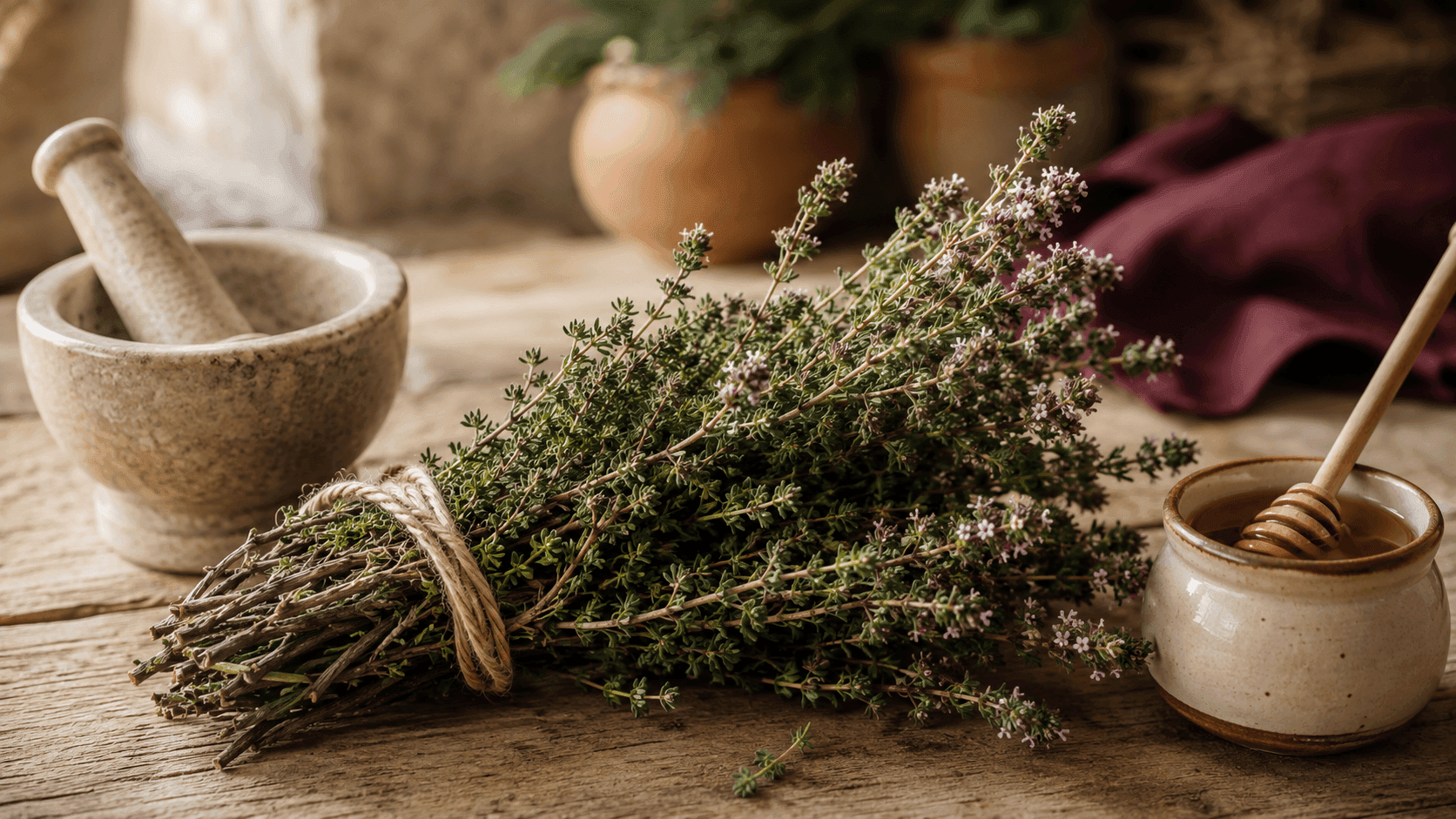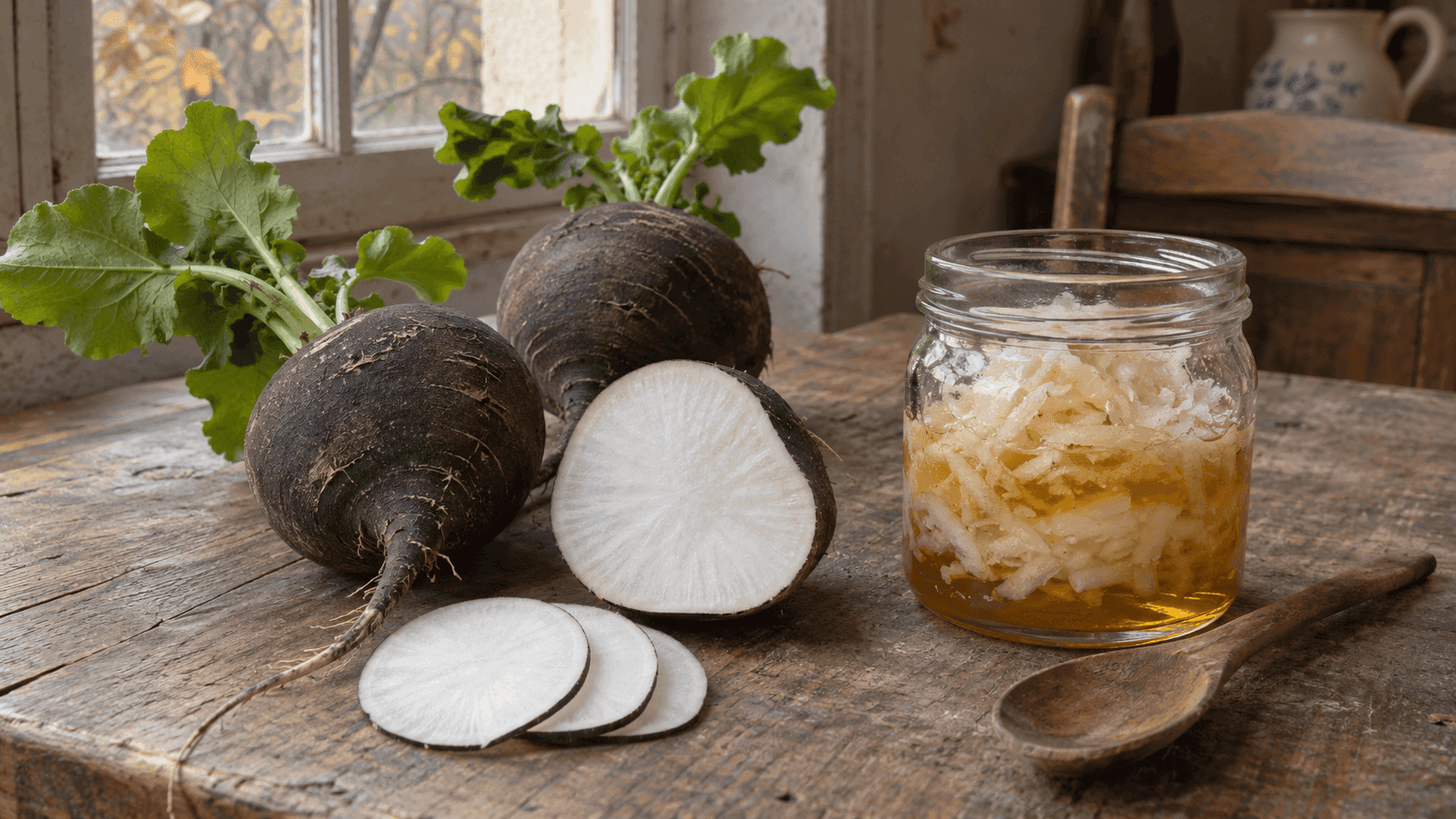
Black radish is the big winter radish with black skin and hot white flesh: raw in thin slices, cooked in soup, and as a honey syrup when the winter cough settles in.
Who he really is
Family: Mustard family (Brassicaceae). The cultivated radish probably comes from Asia, but nobody is sure. Black radish has been in Europe's vegetable patches since the sixteenth century.
Part used: the root, raw or cooked. The leaves can be eaten too.
Black radish is a winter radish: a big root with rough black skin and white flesh that bites. It's also called winter radish or Black Spanish. I eat it raw in thin slices, cooked in soup, and when the winter cough settles in, I make a honey syrup with it.
His story
Black radish is the big winter radish: rough black skin, white flesh with a bite. In my house it comes to the table when the days draw in. Raw in thin slices, cooked in soup, and as a honey syrup when the winter cough settles in. It's a vegetable before anything else, and that's how I cook it.
Black radish: what exactly is it?
Its scientific name today is Raphanus raphanistrum subsp. sativus, the name for all the radishes we grow; in old books you'll find it as Raphanus sativus var. niger. It's a radish, the same species as the other radishes, but the winter kind. It belongs to the Brassicaceae family, the family of cabbages, watercress and mustard.
What you eat is the root. Under the rough black skin, the flesh is white, and it has a kick. There are round ones and long ones, and the root can reach about twenty centimetres. If you let it run to seed, the plant puts up very branched stems 60 to 80 cm tall, with hairy leaves.
In France it's also called winter radish or Spanish radish, and in English, Black Spanish. In the old days, people in France even called it « Parisian horseradish », which muddles everyone: real horseradish, the one you grate instead of mustard, is a different plant.
The French seed catalogue lists three varieties of black radish: the big long Paris winter black, the big round winter black, and the long market-garden black, also called « clock weight ». I'm fond of that name: hanging from the end of its leaves, it looks like the weight of an old pendulum clock.
Where black radish comes from, an old winter vegetable
Nobody really knows where the radish comes from: it has left almost no traces for archaeologists. The books lean towards Southeast Asia, where truly wild radishes have been found. What is certain is that nearly two thousand years ago, Greek and Roman farming writers were already describing small and big radishes, round and long, mild and hot.
Black radish itself is recorded in Europe in 1548. By the early nineteenth century it was a perfectly ordinary garden radish, in France as in England. It's a patient vegetable: it's sown in summer, it keeps through the winter, and it's there when the vegetable patch has little left to give.
On market stalls it turns up in autumn and stays until the end of winter, with the height of the season from September to January. When I don't have any in the garden, I buy it at the market. I pick it firm, small or medium, an even black, with no bruises or cracks.
My mother had her black radish syrup recipe in her notebook in purple ink, between two jam recipes. I still make it the way she did, and I'll give it to you below.
How to eat black radish, raw or cooked
Black radish is eaten raw, peeled, in slices or grated. That's how I like it best: in very thin slices, with a drizzle of olive oil, a little lemon and some salt. I peel it when the skin is thick; if it's organic and well scrubbed, you can leave the skin on.
It's hot, that's its character. To soften it, I have three ways. The first: I grate it finely and let it sweat for a few minutes with a little salt. The second: I cook it, because cooked black radish loses most of its heat. The third, for sensitive stomachs: a quick steaming before it goes into the recipe.
Cooked, it turns mild. I put it in winter soup with potatoes, I mash it with them, or I roast it in the oven with honey and thyme. For my grandchildren, soup or mash is how it goes down best: it gets them used to the taste without rushing them.
What goes well with it? Lemon, olive oil, parmesan, a tart apple, honey, thyme and potatoes. For a pre-dinner nibble, you can also make pickles: thin slices in a jar, covered with a hot mix of water, cider vinegar and a little sugar. And don't throw the leaves away too fast: with black radish, everything can be eaten, from root to leaves.
To keep it, I put it in the vegetable drawer, unwashed and well wrapped: it lasts a good week. If it starts to go soft, I don't throw it out, I cook it.
What black radish is good for, according to the books
I'm not going to sell you a dream. Black radish is a vegetable first. But it also has its place in the old handbooks, for two things.
The first is digestion. The books list it among the plants people took when digestion was sluggish, on the bile side of things, and that's where its reputation for the liver comes from. I won't tell you it cleans anything out: I'm telling you what people did with it. When my stomach feels heavy after a meal, I also have my simple habits for sluggish digestion.
The second is the winter cough. Black radish syrup is a grandmother's recipe that has been passed along for a long time: you hollow out the radish, fill it with honey or sugar, and collect the juice the next day. It's a family recipe, not a pharmacy syrup: I won't give you an amount to take, and for a child, ask the doctor first. For a scratchy throat, I keep it next to my thyme tea and my other habits for a sore, prickly throat.
Honey itself is soothing, especially in the evening before bed. But never before age 1: not in a syrup, not on a dummy, not from the tip of a finger.
As for black radish courses in ampoules, with artichoke and all the rest, they aren't my department: I don't take anything I can't taste. If you do one, follow the leaflet, ask your pharmacist, and read carefully what I put further down, especially if you have gallstones.
« Black radish is a vegetable first. The syrup is for the evenings when the cough hangs on. »
When to sow black radish, and how to keep it through winter
Black radish doesn't like being transplanted: it's sown straight into the ground, from May to early August, and harvested two months later. I sow mine in high summer, so I have my radishes in autumn. It's often one of the last sowings of my August in the garden.
It needs loose, well-drained soil enriched with compost, and a sunny spot. I sow in rows 20 to 30 cm apart, and when the seedlings have a few leaves, I thin them to keep one every 10 cm. I water regularly, without drowning them: that's what keeps it crisp and juicy.
I don't wait too long to pull it up, or it turns hard and woody. I cut off the leaves, and whatever I don't eat straight away, I store somewhere cool and dark, in damp sand: it keeps there for several weeks. When I dig through the sand box in the middle of winter and still find a radish, it gives me the same pleasure as a jar forgotten at the back of the cupboard.
What I use him for
- · 01As a winter starter: raw, in very thin slices or grated, with lemon, olive oil and salt.
- · 02When the bite is too much: cooked in soup, mashed with potatoes, or roasted in the oven with honey and thyme.
- · 03When the winter cough settles in: black radish syrup with honey or sugar, my mother's old recipe; for a child, I ask the doctor first.
- · 04After the heavy meals at the end of winter: a few raw slices at the table, since the old handbooks list it among the plants for digestion.
- · 05In the vegetable patch: a summer sowing for radishes all winter, kept in damp sand.
How I prepare him
Granny’s little recipes
Black radish carpaccio
As a starter on winter evenings (serves 2 to 3, 10 minutes)
What you’ll need
- 1 black radish
- The juice of half a lemon
- 2 tablespoons olive oil
- Salt and black pepper
- 2 tablespoons grated parmesan (if you like)
How I go about it
- 01Wash the radish, and peel it if the skin is thick.
- 02Cut it into very thin slices, on a mandoline if you have one, and spread them on a plate.
- 03If it's too hot for you, sprinkle the slices with a little salt and let them sweat for a few minutes before going on.
- 04Drizzle with lemon juice and olive oil, add salt (less if you let them sweat) and pepper.
- 05Scatter the parmesan on top if you're using it, and serve straight away.
Black radish and potato soup
For supper on cold evenings (4 bowls, 10 minutes to prepare, 20 minutes to cook)
What you’ll need
- 4 medium black radishes
- 4 potatoes
- 1 vegetable stock cube, with the water it calls for
- 1 portion of processed cheese
- A little parsley
- A little pepper
How I go about it
- 01Make the stock with the cube.
- 02While it heats, wash and peel the radishes and potatoes, then cut them into pieces.
- 03Cook them in the stock for 20 minutes.
- 04Add the processed cheese and blend well.
- 05Add pepper, scatter with parsley, and serve hot, or cold if you prefer.
Black radish and honey syrup
When the winter cough settles in (make it the day before, one night to drip)
What you’ll need
- 1 black radish
- Honey, sugar or rock sugar: about as much as chopped radish
- 1 glass
- 1 small clean screw-top bottle (about 100 ml)
How I go about it
- 01Cut the top off the radish, hollow it out, and make a small hole in its tip, at the bottom.
- 02Finely chop what you scooped out, and mix it with about the same amount of honey or sugar.
- 03Fill the radish with this mixture, and keep the rest in a bowl.
- 04Stand the radish tip down in the glass: the syrup will drip. Add the rest of the mixture as soon as there's room, and let it drip all night.
- 05In the morning, pour the syrup into the bottle. I won't give you an amount to take: it's a family recipe, not a pharmacy syrup. For a child, ask the doctor first, and never honey before age 1; with a stomach ulcer, ask the doctor first too; and if you're still coughing after three weeks, go and see your doctor.
Elsewhere: how others know him
My friend Keiko in Tokyo wrote to tell me that in Japan, the winter radish is daikon: the same species as my black radish, but long, white, and much milder. There, they grate it into daikon oroshi to go with their dishes.
She also sent me her recipe for hachimitsu daikon, daikon in honey. She cuts the radish into one-centimetre cubes, covers them with honey in a clean jar, and waits half a day. She drinks it as it is or topped up with hot water when her throat is tired, and keeps it in the fridge for about a week. It made me smile: on the other side of the world, the same idea as my mother's.
Me, I stay faithful to my hollowed black radish, dripping all night in its glass. Its bite is what winter tastes like at home.
What to know first
This information doesn’t replace advice from a healthcare professional. Health Disclaimer →
His identity card
- Name
- Black radish
- Other names
- Winter radish, Black Spanish, « Parisian horseradish » (old French name)
- Latin name
- Raphanus raphanistrum subsp. sativus (formerly Raphanus sativus var. niger)
- Family
- Mustard family (Brassicaceae)
- Part used
- The root; the leaves in cooking
- Harvest
- Two months after sowing from May to early August; autumn into winter
- Form
- Fresh root, raw or cooked; homemade syrup
- Origin
- Europe's vegetable patches since the sixteenth century; cultivated radish probably from Asia
- Storage
- Vegetable drawer for a good week; damp sand somewhere cool for several weeks
If you remember just one thing
- 01Black radish is a winter vegetable first and foremost: a root with black skin and hot white flesh, eaten raw or cooked.
- 02To soften its bite, I grate it and let it sweat in salt for a few minutes, or I cook it.
- 03Black radish and honey syrup is an old family recipe for the winter cough, not a pharmacy syrup: for a child, ask the doctor first, and never honey before age 1.
- 04With gallstones, no juice and no course; with a stomach ulcer, ask your doctor first; pregnant or breastfeeding, stick to the amounts you'd eat at the table.
- 05It's sown from May to early August, harvested two months later, and kept through the winter in damp sand.
Your questions
Raw or cooked, like any vegetable. Raw, I peel it if the skin is thick and cut it into thin slices or grate it, with lemon, olive oil and salt. Cooked, I put it in soup, mash it with potatoes, or roast it in the oven with honey and thyme.
Grate it finely and let it sweat for a few minutes with a little salt. Or cook it: cooked black radish loses most of its heat. For sensitive stomachs and little ones, a quick steaming before it goes into the recipe, and it goes down easily.
I won't promise you anything, I'll tell you what people did with it. First of all, it's a winter vegetable. The old handbooks also list it among the plants people took when digestion was sluggish, and its honey syrup recipe has been handed down from grandmother to granddaughter for the winter cough.
I won't tell you it cleans out your liver. The books file it under digestion and bile, and that's where its reputation comes from. And precisely because of the bile, if you have gallstones, no black radish juice and no black radish course.
In large amounts, it can irritate the stomach and gut. No juice or course if you have gallstones, with a stomach ulcer or for a child, ask the doctor before the syrup, and if you're pregnant or breastfeeding, stick to the amounts you'd eat at the table. If you have a thyroid problem and you're thinking about a course, talk to your doctor.
Ampoules aren't my department: I don't take anything I can't taste. For juice courses, I haven't found a serious book that gives how long; some pharmacists suggest a break of a few days after three days of juice, to spare the stomach. Follow the leaflet, and ask your pharmacist.
References
- Raphani sativi radix (Kommission-E-Monographie) · Altmeyers Enzyklopädie, Naturheilkunde, 2024
- Radish: Health Benefits, Side Effects, Uses, Dose & Precautions · RxList (WebMD), 2024
- Cruciferous Vegetables · Linus Pauling Institute, Oregon State University, 2024
- Pas de miel pour les enfants de moins d'un an · ANSES, 2026
- Quand consulter et comment calmer la toux ? · Assurance Maladie (ameli.fr), 2026
- Rettich · aponet.de (ABDA, Bundesvereinigung Deutscher Apothekerverbände), 2026
- Raphanus sativus niger, radis noir (Pharmacopée française) · ANSM, 2010
- Radis noir · Wikipédia, 2026
- Radish · Wikipedia, 2026
- Daikon · Wikipedia, 2026
- Raifort · Wikipédia, 2026
- Radis noir · Fondation Louis Bonduelle, 2026
- Comment cuisiner le radis noir · Maréchal Fraîcheur, 2026
- Le radis en pratique · LaNutrition.fr, 2026
- Radis noir : recettes · consoGlobe, 2026
- Velouté de radis rose et velouté de radis noir · consoGlobe, 2026
- Radis noirs : deux recettes pour retrouver une bonne digestion · Allodocteurs, 2026
- Radis noir : plantation et entretien · Truffaut, 2026
- はちみつ大根(レシピ:江別友の会) · 江別市 (Ebetsu City), 2026
- Raphanus sativus var. niger (Mill.) J.Kern., synonyme de Raphanus raphanistrum subsp. sativus (L.) Schmalh. (World Checklist of Vascular Plants, base de POWO) · Royal Botanic Gardens, Kew, via GBIF, 2026