The big purple flower with a hedgehog heart: three echinaceas you don't take the same way, the root tea for the first days of a cold, and what to know first.
Who she really is
Family: Asteraceae, the daisy family. It comes from North America, where it grows in prairies and open woods.
Parts used: The root, and the fresh flowering tops of purple echinacea, pressed for juice.
Echinacea is a big purple flower with a domed, prickly heart, the kind you plant in the garden for summer. Under that name there are actually three cousins: the purple one (Echinacea purpurea), the narrow-leaved one (Echinacea angustifolia) and the pale one (Echinacea pallida). My books give them from the first signs of a cold, for a few days only, and each in its own way.
Her story
Echinacea is a big purple flower from North America, with a domed heart in the middle that prickles like a hedgehog. In the garden, people plant it for its summer flowers. In my books, you take its root, or the juice of the fresh plant, from the first signs of a cold, and only for a few days. I'll tell you everything, the good and the not so good.
Purple echinacea, the flower with a hedgehog heart
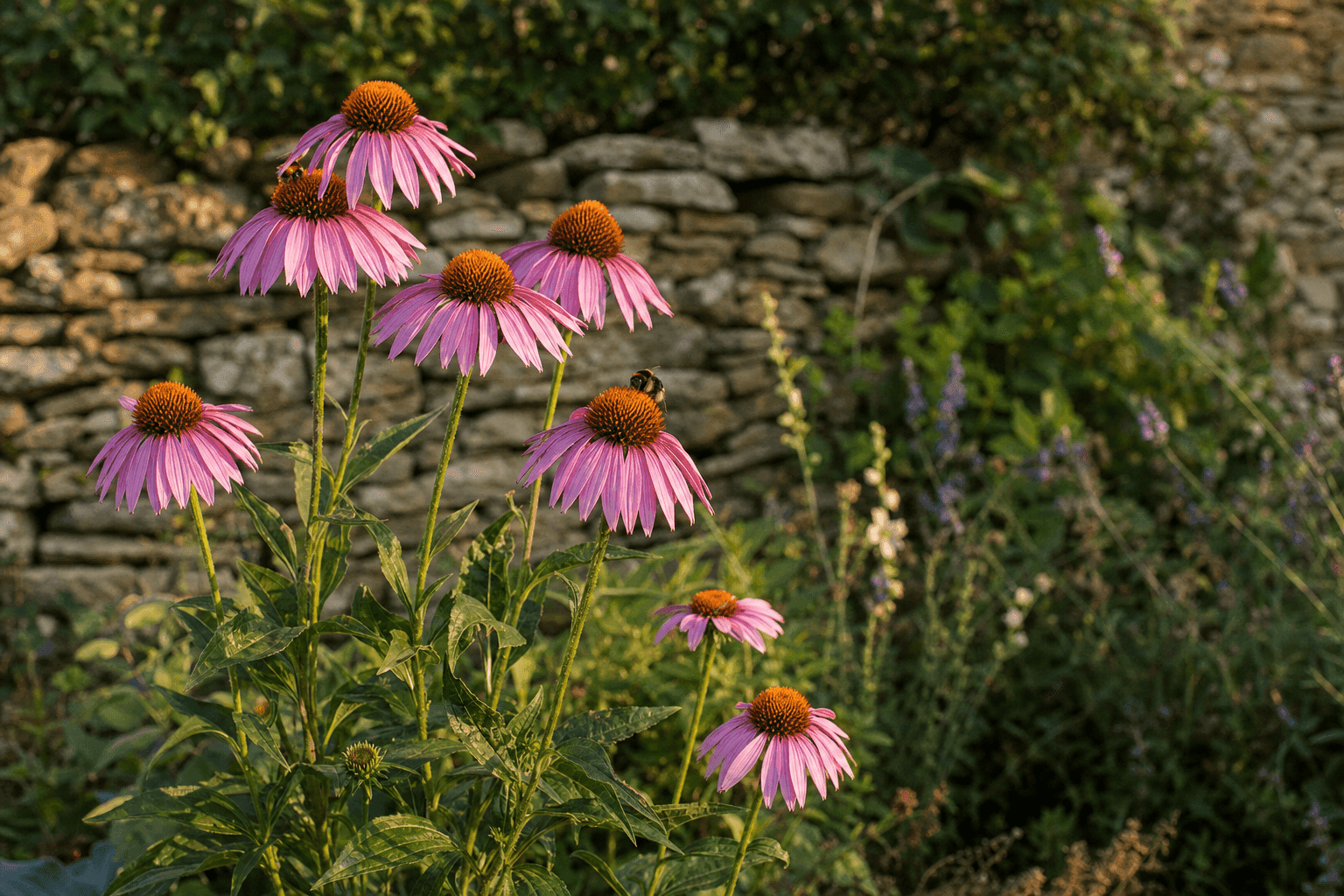
Its name comes from Greek: echinos means hedgehog, or sea urchin. Look at the heart of the flower and you'll see why straight away. A big orange bump, all bristling with tiny tight-packed flowers, and around it a crown of pink or purple petals. For a long time it was called “purple rudbeckia”, and some people still call it that.
It's a perennial in the Asteraceae family, the family of ox-eye daisies, common daisies and dandelions. It grows up to one metre twenty and flowers in high summer, from July to September, sometimes into October. At home in North America, it grows in prairies and in dry, open woods.
In the garden, it doesn't ask for much. Sun, above all: that's a must. Deep soil that drains well, not too heavy. Once it's settled in, it couldn't care less about dry spells. Cold doesn't scare it either: in open ground, it holds out down to about minus twenty degrees, with nothing to cover it. In a pot it's another story, the roots are more fragile, so I protect the pot. In winter the stems dry out, but the root stays and starts again in spring. I like to plant it in autumn, so it can take root before its first summer, and I divide the clump every three or four years.
For winter care, I keep it simple. I leave the faded heads standing: they look pretty under the frost, and the birds come for the seeds. I only cut it back at the end of winter. In summer it's covered in butterflies, bumblebees and bees. These days you can find it in all sorts of colours, like the pink 'Magnus' or the white 'White Swan' with its bronze heart. Me, I stick with the plain purple one.
Echinacea or rudbeckia: what's the difference?
People mix them up all the time, and no wonder. They're two cousins from the daisy family, and purple echinacea was first filed among the rudbeckias, as Rudbeckia purpurea, before it got a genus of its own in 1794: that's where its nickname comes from. In the garden, look at the colours. Rudbeckia most often has yellow or orange petals around a dark brown heart, almost black. Purple echinacea has pink to purple petals around a spiky orange heart. And for the cup, it's simple: my books only give the echinaceas, never rudbeckia. That one, I keep for bouquets.
Where echinacea comes from: an American story
This isn't one of my grandmother's plants. It comes from the eastern and central United States, and it took its time crossing the ocean. Over there, the Plains peoples used it in a thousand ways, the books say: on wounds, burns and stings, and they chewed the root when their teeth or throat hurt.
The first time anyone wrote about purple echinacea, in 1787, it was for the sores saddles made on horses' backs. I like that horse story. Then, around 1880, a man called Meyer sold it in bottles as a “blood purifier”, for snake bites and aches. You know the kind of do-everything remedy they had back then. I've always been a bit wary of those bottles.
It reached us later. By the end of the 19th century you could already find it in Germany. Then, at the end of the 1930s, they started growing it on a large scale there, and that's how it became known all over Europe. It was German doctors who made it popular. Today, purple echinacea is the one grown the most.
Echinacea purpurea, angustifolia, pallida: three echinaceas, three ways of doing things
When people say “echinacea”, they actually mean three cousin plants. And it matters, because my books don't take them the same way, or use the same part.
Purple echinacea (Echinacea purpurea) is the one in my garden. You use its flowering tops, but fresh: you press the juice out of them. That juice is a ready-made product, taken when colds come round, never for more than ten days. Its root is used too, as a ready-made extract, at the start of a cold, and another extract of the root is given for the little spots of mild acne. Lastly, there are ointments made with the fresh juice, for small grazes, for no more than a week.
Narrow-leaved echinacea (Echinacea angustifolia) is the one people valued most in the old days. It's trickier to grow. Its root is the only one my books give as a tea, by the cup.
Pale echinacea (Echinacea pallida) doesn't flower in its first year, but it makes fleshier roots. Its root is taken as a tincture or a ready-made extract, also at the start of a cold.
So when you buy echinacea, look at the Latin name on the packet, and the part of the plant. You often find dried flowers and leaves of purple echinacea, sold for tea. My books don't mention that tea: for those parts, they only know the juice of the fresh plant. For my cup, I take the narrow-leaved root.
The benefits of echinacea: what my books say
You read everywhere that echinacea is for the whole winter. That's not what my books say. They give it to help the body get through a cold, and that's all. You start at the first signs, when your nose starts running or your throat feels scratchy, and you take it for a few days. It's not a plant to drink all year round, or a course lasting several weeks.
My cup is one gram of cut root, about half a level teaspoon, for 150 ml of boiling water. At least ten minutes covered, I strain it, and I drink it good and hot, between meals. Three cups a day, no more. If it hasn't cleared up after ten days, if it gets worse or if the fever climbs high, I stop fiddling about and go and see my doctor. And when it's mostly the throat playing up, I have my other ways for a scratchy throat.
When to take echinacea, and when to stop
When should you take echinacea? Right at the start, when a cold is on its way: your nose starts running, the sneezing, the scratchy throat. That's when my books say to begin, and not as a course all winter long. I drink my cups between meals, three a day at most, and it's not for children under 12.
And for how many days? Just a few, as long as the cold lasts: once it's gone, I put the jar away. The fresh plant juice is never taken for more than ten days. For my root tea, if it hasn't cleared up after ten days, I stop and go and see my doctor, and I don't wait if it gets worse or the fever climbs high. At the slightest spot, itch or swelling, I stop straight away. If your face, lips or tongue swell, or you have trouble breathing, call 15 or 112.
People also ask me if echinacea helps you sleep. My books say nothing about it, not a word. It's not an evening plant. For the nights when sleep won't come, I'll tell you what I do.
Echinacea contraindications and downsides: who it isn't for
Now the not so good, because you have a right to know. Echinacea belongs to the daisy family. If you're allergic to chamomile, arnica or another plant in that family, you don't take it. If you get allergies easily, talk to your doctor first. It can bring on spots, itching, and more rarely a swollen face or trouble breathing. Then you stop everything and call 15.
It's not for children under 12. Nor for you if you're pregnant or breastfeeding, unless your doctor has advised it. And not when the body turns against itself (what they call autoimmune), when its defences are weakened, or if you already take something on a doctor's orders. In those cases, it's your doctor or pharmacist who decides. It's all written further down, in what to know first.
There you are. A lovely plant, useful a few days a year, and not for everyone. Me, I love it first of all in the garden, in the middle of August, when the butterflies fight over its prickly heart.
What I use her for
- · 01At the first signs of a cold, a cup of narrow-leaved echinacea root, three times a day, for a few days only.
- · 02For fresh plant juice, tincture or root extracts, I buy ready-made products and follow the leaflet, never going past ten days without advice.
- · 03In the garden, I plant it in full sun: all summer long, butterflies, bumblebees and bees come to visit.
- · 04In winter, I leave its dry heads standing for the birds, and only cut it back at the end of winter.
How I prepare her
Granny’s little recipes
The first-cold cup
From the first signs of a cold, between meals
What you’ll need
- 1 g of cut narrow-leaved echinacea root (Echinacea angustifolia), about half a level teaspoon
- 150 ml of boiling water
How I go about it
- 01Pour the boiling water over the root and cover.
- 02Leave to infuse for at least 10 minutes, then strain.
- 03Drink it good and hot, between meals.
- 04No more than three cups a day. If it hasn't cleared up after ten days, go and see your doctor.
The simmered root for sniffly days
When a cold is on its way, if you'd rather have the root well simmered
What you’ll need
- 1 g of cut narrow-leaved echinacea root (Echinacea angustifolia)
- 150 ml of cold water
How I go about it
- 01Put the root in the cold water, in a small pan.
- 02Bring to a simmer, then let it simmer for 10 minutes.
- 03Strain and drink hot, between meals.
- 04Three times a day at most, all cups counted, and ten days at most without your doctor's advice.
What to know first
This information doesn’t replace advice from a healthcare professional. Health Disclaimer →
Her identity card
- Name
- Purple echinacea (purple rudbeckia), narrow-leaved echinacea, pale echinacea
- Latin name
- Echinacea purpurea (L.) Moench; E. angustifolia DC.; E. pallida (Nutt.) Nutt.
- Family
- Asteraceae
- Parts used
- Root; fresh flowering tops of purple echinacea
- Harvest
- Root at the end of autumn, 2nd or 3rd year; flowering tops in summer
- Form
- Cut root as a tea (narrow-leaved); ready-made fresh juice, tincture, extract
- Origin
- North America; the purple one, from the eastern and central United States
- Storage
- Dried root in a tightly closed jar, away from light, damp and heat
If you remember just one thing
- 01Echinacea is a purple flower from North America with a prickly heart like a hedgehog: lovely in the garden, and known in the books for colds.
- 02There are three echinaceas, the purple one, the narrow-leaved one and the pale one, and you don't take them the same way: always check the Latin name.
- 03For a cup, it's the root of narrow-leaved echinacea: 1 gram for 150 ml of boiling water, three times a day at most.
- 04You take it from the first signs of a cold, for a few days only: if it drags on for more than ten days, see your doctor.
- 05No echinacea under 12, when pregnant or breastfeeding, or if you're allergic to the daisy family or your body's defences are in question.
Your questions
My books give it for one thing: helping the body get through a cold, starting at the first signs, for a few days only. It's not a plant to take all winter, and not a plant for sleep. On the downside, it's mostly allergies: spots, itching, and more rarely a swollen face or trouble breathing. Then you stop and call 15.
No echinacea if you're allergic to the daisy family (chamomile, arnica, dandelion…), under 12, or when pregnant or breastfeeding, unless your doctor says so. And not if you have an autoimmune condition, weakened defences, or if you already take something on a doctor's orders. And if you get allergies easily, ask your doctor first.
From the first signs of a cold, when your nose runs or your throat feels scratchy, and only for a few days, not as a course all winter. For the root tea, three cups a day at most, between meals, and not under 12. The fresh plant juice, never more than ten days. If it hasn't cleared up after ten days, if it gets worse or if the fever climbs high, you stop and see your doctor.
They're three cousins you don't take the same way. The purple one, the garden one, comes as ready-made fresh plant juice or root extract. The narrow-leaved one is the only one whose root my books give as a tea. The pale one comes as a tincture or root extract. Always check the Latin name on the packet.
They're two cousins from the daisy family, and purple echinacea was first called Rudbeckia purpurea, hence its nickname “purple rudbeckia”. In the garden, rudbeckia most often has yellow or orange petals around a dark brown heart; purple echinacea has pink to purple petals around a spiky orange heart. For the cup, my books only give the echinaceas, never rudbeckia.
My books say nothing about it. They give it for colds, not for sleep, and it's not an evening plant. For hard nights, I use other plants.
Yes, it's a perennial that comes back every year, and it holds out down to about minus twenty degrees in open ground. Plant it in full sun, in deep soil that drains well, ideally in autumn. In winter, leave the dry heads for the birds and only cut it back at the end of winter.
References
- European Union herbal monograph on Echinacea purpurea (L.) Moench, herba recens (EMA/HMPC/48704/2014 Corr 1) · European Medicines Agency, HMPC, 2015
- European Union herbal monograph on Echinacea purpurea (L.) Moench, radix, Revision 1 (EMA/HMPC/424583/2016) · European Medicines Agency, HMPC, 2017
- Community herbal monograph on Echinacea angustifolia DC., radix (EMA/HMPC/688216/2008) · European Medicines Agency, HMPC, 2012
- European Union herbal monograph on Echinacea pallida (Nutt.) Nutt., radix, Revision 1 (EMA/HMPC/737380/2018) · European Medicines Agency, HMPC, 2018
- Assessment report on Echinacea purpurea (L.) Moench., herba recens (EMA/HMPC/557979/2013) · European Medicines Agency, HMPC, 2014
- Purple coneflower herb: summary for the public (EMA/481797/2015) · European Medicines Agency, 2015
- Échinacées (Echinacea angustifolia) · Vidal, 2018
- Echinacea purpurea (L.) Moench · Plants of the World Online, Royal Botanic Gardens, Kew, 2026
- Échinacée pourpre · Wikipédia, 2026
- Asteraceae · Wikipédia, 2026
- Rhinopharyngite ou rhume de l'adulte : que faire et quand consulter ? · Ameli, Assurance Maladie, 2026
- Œdème de Quincke · Ameli, Assurance Maladie, 2026
- Fiche technique n°3 : l'échinacée · Mouvement de l'agriculture bio-dynamique (projet AEP PAM, Région Bretagne), 2024
- Echinacée : fleur superbe et vertueuse · Jardiner malin, 2026
- Rudbeckia et échinacée : variétés et culture · Truffaut, 2026
- Échinacée séchée · Île aux épices, 2026