Drying your herbs in July: my little bunches up in the attic
In July, I cut my herbs in the morning, once the dew has gone, and hang them up in the attic. Come and see how I do it, plant by plant, so I have my herbal teas all winter.
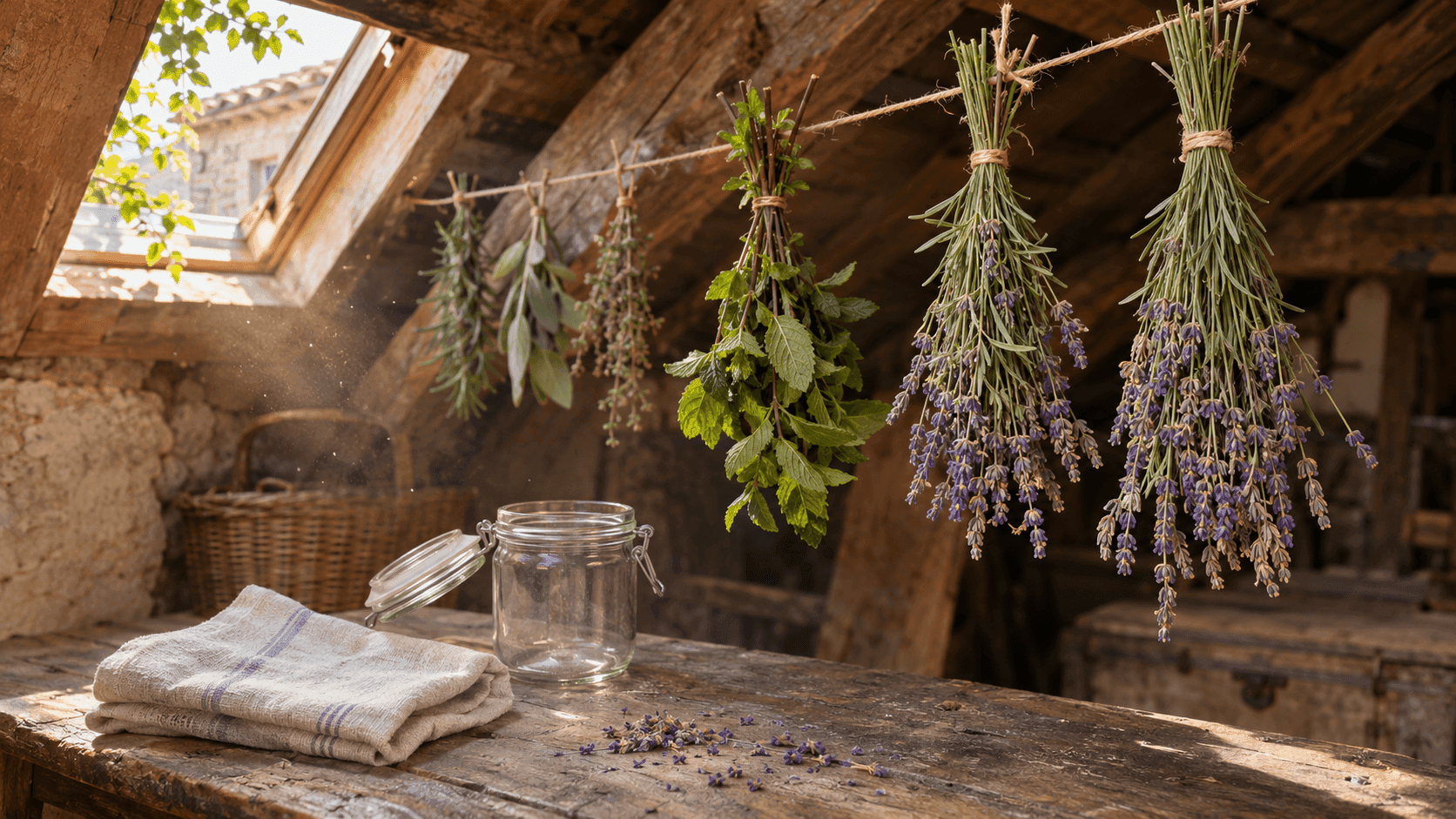
Come up to the attic with me. Under the skylight, I've strung my line from one wall to the other, like every summer, and five bunches hang from it upside down: thyme, lemon verbena, rosemary, sage and lemon balm. When you open the door, it smells of hay and lemon. On the shelf, the empty jars are waiting their turn. It's my store of herbal teas for the winter, and I'm going to show you how I make it.
Why I dry my herbs in July
July is the month when nearly my whole herb patch is ready to cut at the same time. Most herbs taste best just before they flower, and that's when I take the most. Lemon verbena, from June to September, just before it flowers. Lemon balm, its young leaves, all through spring and summer. Rosemary, the young summer shoots. Sage, the spring and summer leaves, which taste best.
Thyme does things its own way. I cut it at the end of May or early June, when it starts to flower, and a second time in September. The one hanging in the attic is the June one: it's finishing drying.
To cut, I pick a dry morning, once the dew has gone and before the real heat. I take my secateurs, I cut the stems without pulling up the plant, and never by the side of a path. If it rained the day before, I wait: wet leaves that stick together dry badly and end up going mouldy.
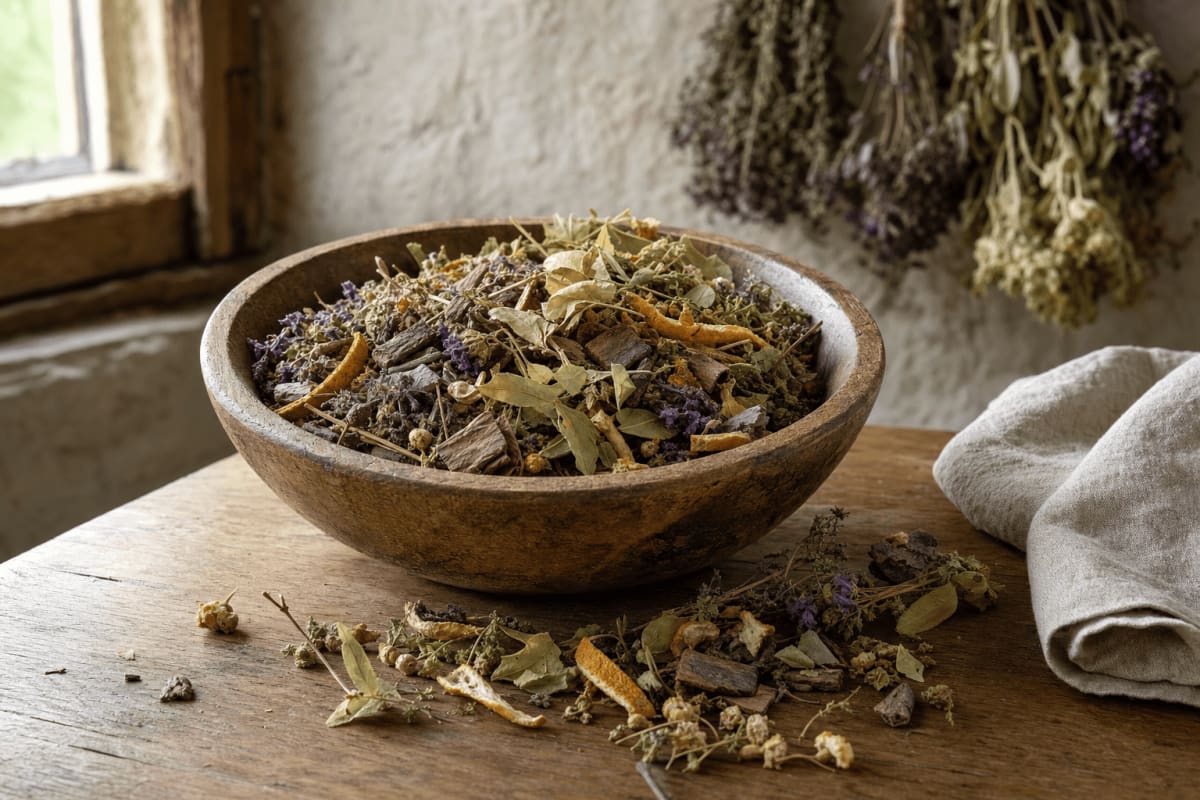
A herb is ready when the leaf crumbles between your fingers. If it bends without a sound, give it a few more days in the attic.
Drying your herbs: what I do in the attic
I make small bunches, not too tight, tied at the stem end with string, so the air gets through the middle. I hang them upside down in the warmest, darkest corner of the attic, in the shade, where the air moves. Never in full sun: all my plants dry in the shade. When there's dust about, I slip them into a big paper bag with a few holes in it.
After that, you need patience. Sage needs two to three weeks, thyme a few weeks, and it depends on the weather. German chamomile flowers I don't hang: I spread them in a single layer on a tray, for one to two weeks.
To know if it's ready, take a leaf between your fingers and squeeze. If it crumbles, it's done. If it bends without a sound, give it a few more days.
And if a leaf goes brown, turns black or smells musty, no arguing: the bunch goes on the compost, and you start again.
Once they're dry, I rub the stems over a clean tea towel to knock the leaves off. I keep them whole, and only crumble them when I make the cup. They go into tightly closed glass jars, not plastic, kept out of the light. On each jar, I write the name and the month. I keep them for about a year: the next July, we start again.
What I do with my dried herbs when winter comes
Lemon verbena is for the evening, half an hour before bed: 1 to 2 g of leaves in 200 ml of boiling water, a saucer on top, 10 minutes. It's my cup for the nights when sleep takes its time, and I tell you all about lemon verbena here.
Lemon balm I drink after a meal, when my tummy bloats: 1.5 to 4.5 g of leaves for 150 ml of boiling water, 10 minutes covered, up to three times a day. My lemon balm has its own page, and if your garden doesn't have any, my cut lemon balm leaves make the same cup.
Rosemary is for after a meal that was too heavy, when digestion drags: 1 to 2 g of leaves for 150 to 250 ml of boiling water, two or three cups a day at most. For digestion that drags, I have other ideas.
Sage I keep for a prickly throat, as a gargle: 2.5 g of leaves for 100 ml of boiling water, 10 minutes covered, strained, lukewarm, and I spit it out. Three times a day. And thyme, when a cold gives you a chesty cough and your throat is scratchy: 1 to 2 g for 150 ml of boiling water, 10 minutes, a teaspoon of honey once it has cooled a little, three or four cups a day, for a week at most. Everything I know about thyme, I've written down.
What you need to know before you drink any
- Pregnancy and breastfeeding: none of these five herbs, not in a cup and not as a gargle, during those months. The books have nothing reassuring to say.
- Children: thyme, lemon verbena, lemon balm and rosemary, not before age 12; sage, not before age 18. And never honey for a baby under one year old.
- Behind the wheel: lemon verbena and lemon balm can make you drowsy. If that happens to you, don't drive.
- Rosemary: if you have a liver or gallbladder problem, or gallstones, ask your doctor first. Lemon balm: if you have a thyroid problem, same thing.
- If you already take something on a doctor's orders, especially for sleep or for your nerves, talk to your doctor or pharmacist before drinking them regularly.
- How long: if things aren't better after two weeks, or after one week for a cough and the throat, or if it gets worse, go and see your doctor.
- Only pick what you're sure you recognise: lemon verbena isn't common vervain, and ornamental sages don't go in the cup.
This evening, I went back up to look at my bunches before closing the skylight. The sage is starting to crackle, the lemon verbena not yet. In September, I'll tell you about the second cutting of the thyme.