My grandma's mulled wine recipe, for cold December evenings
My grandma's mulled wine recipe, the one for evenings when the neighbours drop in: the wine, the orange, the spices, the measures, an alcohol-free version, and what to know before serving.
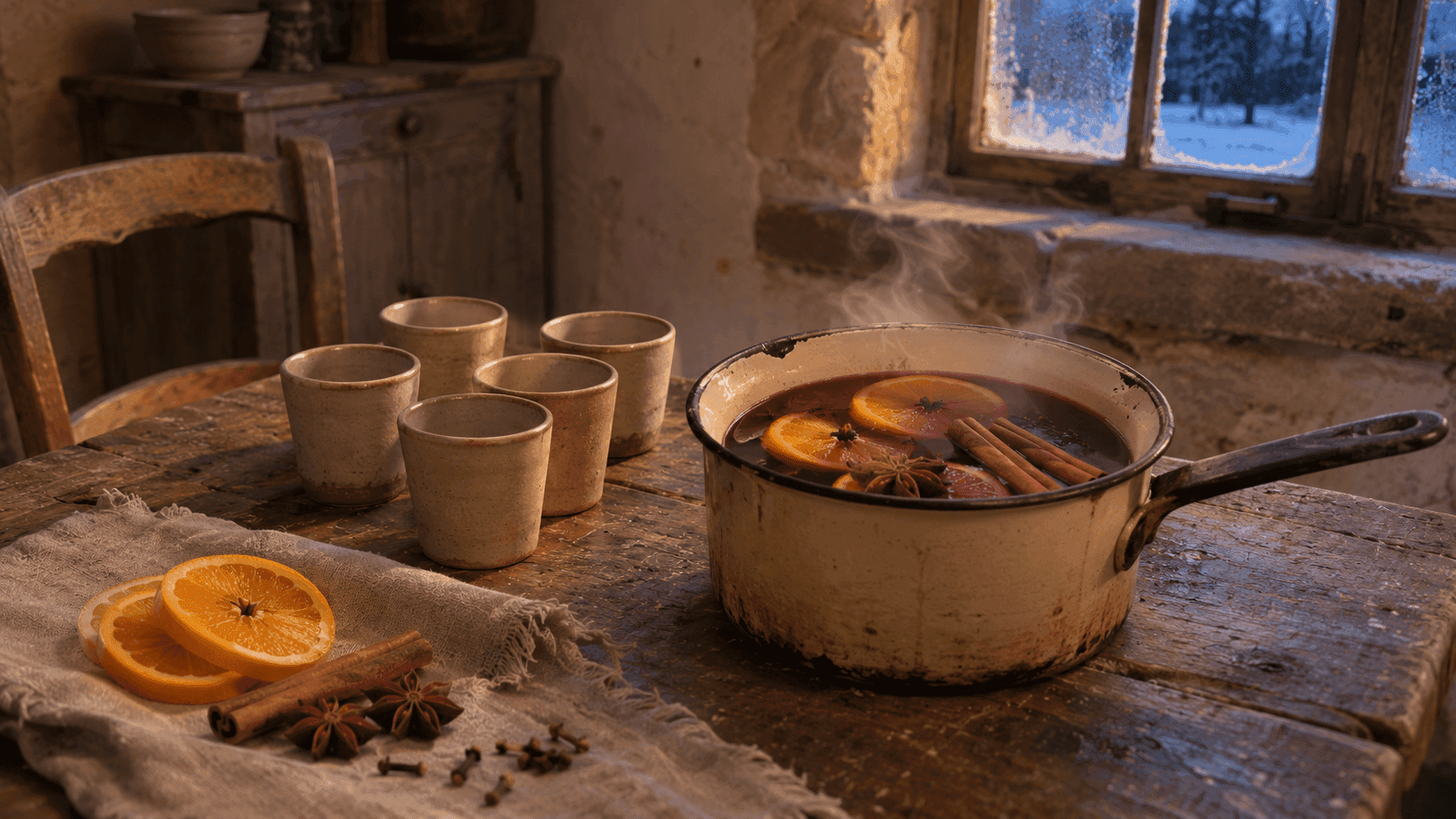
My grandma's mulled wine recipe fits on one page of my mother's recipe notebook, between the quince jelly and the fritter batter. A bottle of red, an orange, a few spices and a very low flame. I'm giving it to you with the measures, with its alcohol-free version, and with what you need to know before you fill the cups.
Why I bring out the mulled wine pan in December
At the end of November, the frost whitens the vegetable garden in the morning, and on village squares the little huts of the Christmas market go up one after another. You smell cinnamon and orange before you even see the lights. That's my signal: I take the big enamel pan down from the top of the dresser.
At our house, mulled wine was never something you drank alone in your corner. My mother made a panful on the evening we decorated the tree, and the neighbours came by for "just five minutes", cheeks red, hands wrapped around the cups. I do the same today: one bottle, six or seven small cups, and we talk about everything and nothing while night falls at five.
I'll tell you straight away: mulled wine is a seasonal pleasure, not a remedy. When my throat scratches, it's not what I take out of the cupboard, and I've written separately what I do when my throat stings.
My mother used to say a mulled wine that boils is a wine wasted. So we heat it gently, cover it, and wait while we set the cups on the table.
The spices in mulled wine, and where the recipe comes from
My mulled wine spices fit in the hollow of my hand. A cinnamon stick, that rolled bark that smells of gingerbread. Three cloves, which are dried flower buds, even if they look like little nails. One star anise, with its eight points and a shiny seed in each. And an organic orange cut into slices with its peel, since it's the peel that gives the scent.
I add three thin slices of fresh ginger. Ginger, I've told you its story separately; in mulled wine, it stings just enough. When I have some left, I also slip in a little piece of dried mandarin peel, about 3 g, for a slightly bitter note I'm fond of.
This spiced wine is nothing new. The books say the Romans already boiled honey in their wine, with spices. In the Middle Ages, people drank hypocras, a sweet spiced wine, and Montpellier traded in those wines as early as the 13th century. Today, at Christmas markets, you also hear its German name, Glühwein, from glühen, to glow. A glowing wine suits it well, in the cups, under the lanterns.
My mulled wine recipe step by step, and its alcohol-free version
For six or seven small 10 cl cups:
- 75 cl of red wine (one bottle), young and fruity: a pinot noir or a red from the Loire, not your oldest bottle;
- 1 organic orange, sliced;
- 1 cinnamon stick, 3 cloves and 1 star anise;
- 3 thin slices of fresh ginger;
- 60 to 80 g of brown sugar, or 2 tablespoons of honey;
- 3 g of dried mandarin peel, if you have some.
- Put everything in a pan, the wine last, and stir until the sugar melts.
- Heat over a low flame for about ten minutes, until it steams and tiny bubbles rise at the edge. Never let it boil: my mother used to say a mulled wine that boils is a wine wasted.
- Turn off the heat, cover and leave to infuse for 10 minutes.
- Strain, and serve in small cups with a slice of orange.
For the alcohol-free version, I replace the bottle with 75 cl of pure red grape juice, or apple juice if that's what I have. Same spices, same orange, same low flame without boiling, same ten minutes covered. The juice is already sweet, so I add nothing, or one spoonful of honey at most. In that pan, I leave the mandarin peel out: the books don't know enough about it for pregnancy and children. That way the mother-to-be, the children and whoever is driving home have their steaming cup too. Babies don't touch it: star anise, never for the very little ones, not even in a herbal tea.
Before you fill the cups: the alcohol doesn't fly away
People often ask me whether the alcohol goes away when you heat it. No, not the way you think. Those who measured it are clear: even after a quarter of an hour simmering, about 40% is left, and after an hour, still a quarter. My mulled wine, which heats for ten minutes without boiling, keeps a good part of it. A 10 cl cup, count it as a glass of wine.
So there are people for whom it's the alcohol-free cup, and nothing else: a pregnant woman, because no amount is risk-free for the baby, and a woman who is breastfeeding; children and teenagers; whoever has to drive; and anyone who already takes something on a doctor's orders, as long as their pharmacist hasn't said the two go together.
For everyone else, it's the rule for any wine: two glasses a day at most, and not every day. The holidays are long, so I keep some evenings without. And if you're allergic to citrus, make it without orange or mandarin.
There. The pan is cooling on the corner of the stove, the orange has scented the whole kitchen, and the neighbour across the road has already asked me which evening I'll make it again. Outside, it's freezing on the cabbages. I'm going to switch on the little lamp in the window. Until the next letter.