Common marshmallow is the tall, soft plant of the water's edge whose root gave its name to the sweet: a cold glass when your throat feels scratchy, and homemade marshmallows for the afternoon snack.
Who she really is
Family: Mallow family (Malvaceae). Marshmallow grows wild in Europe, in Asia as far as China, and in North Africa. In France, you mostly find it in the west, on the Atlantic side, wherever it's damp.
Part used: the root, dried and cut. The young leaves, in the kitchen.
Before it was ever a sweet, marshmallow was a plant: a tall perennial herb with leaves as soft as velvet, fond of seashores, salt meadows and riverbanks. What we keep is its root. I soak it in cold water when my throat feels scratchy and the cough is dry, or when my tummy is a little upset.
Her story
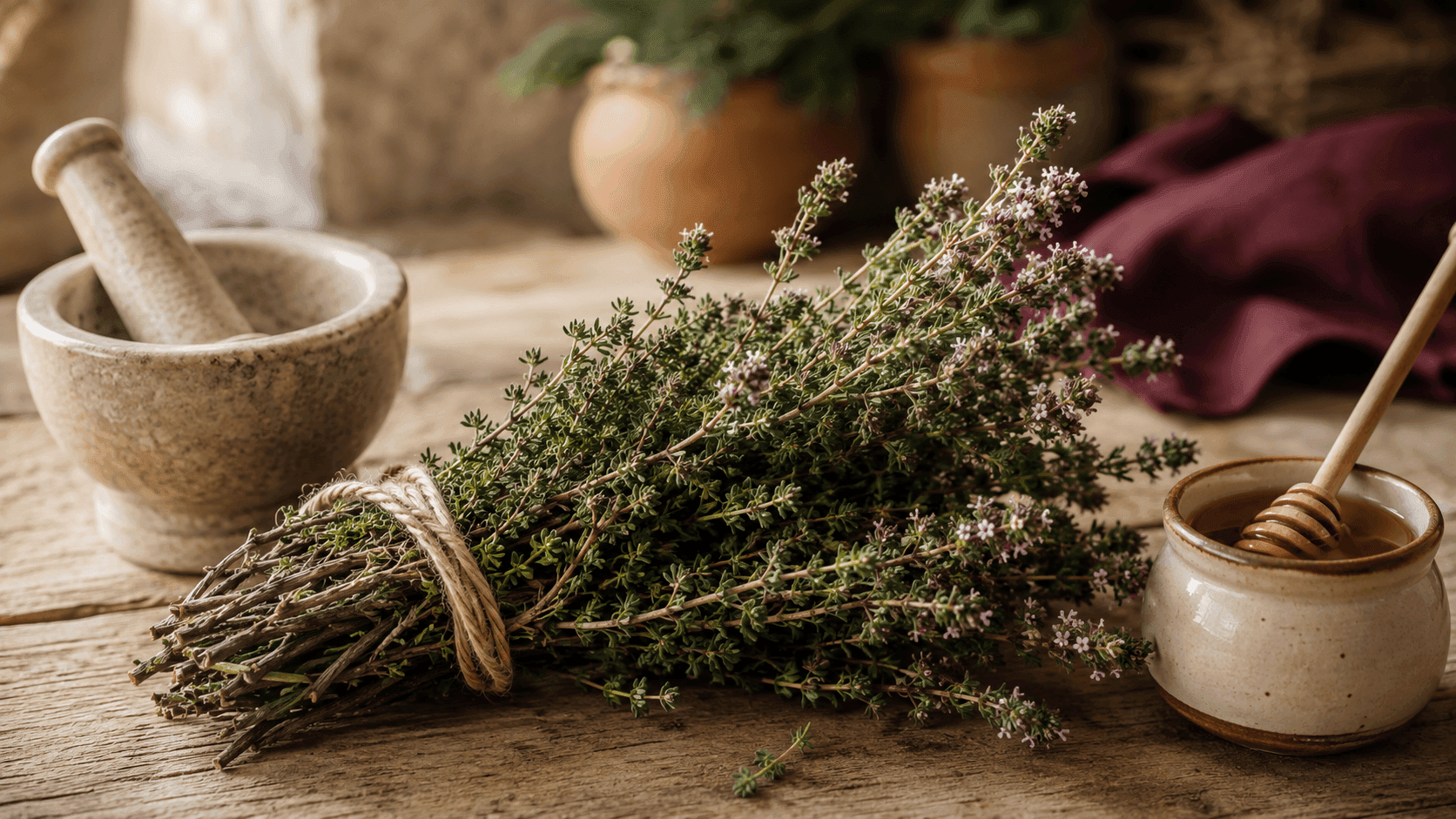
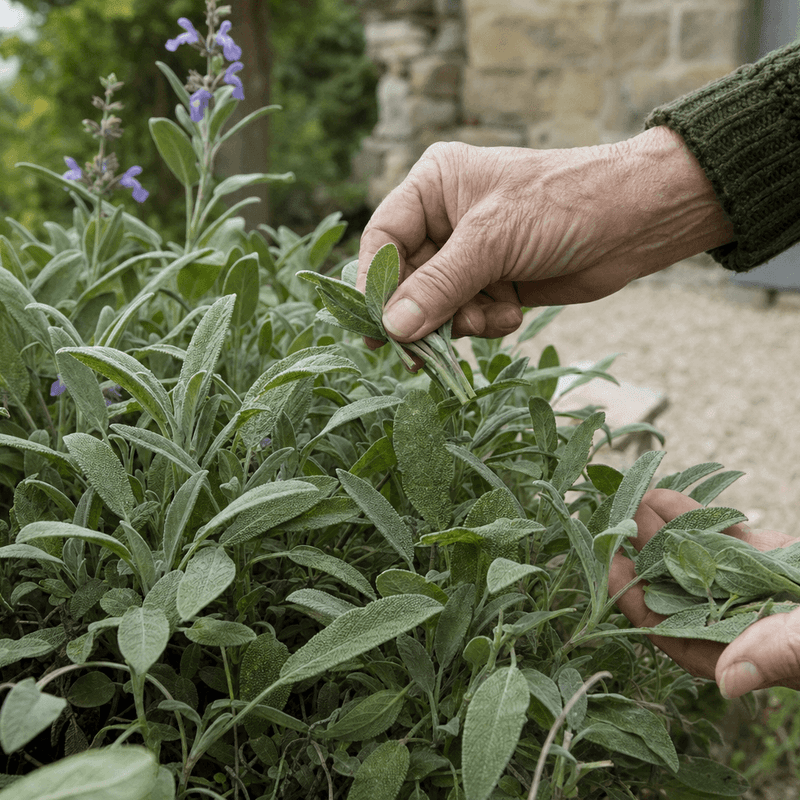
Marshmallow is a plant first: a tall perennial herb of wet places whose root gave its name to the sweet. In my cupboard, the cut root has its own jar, next to the thyme and the sage. I soak it in cold water when my throat feels scratchy. And for my grandchildren's afternoon snack, I make sugar marshmallows that have nothing left of the plant.
Marshmallow the plant: a tall, soft herb of the water's edge
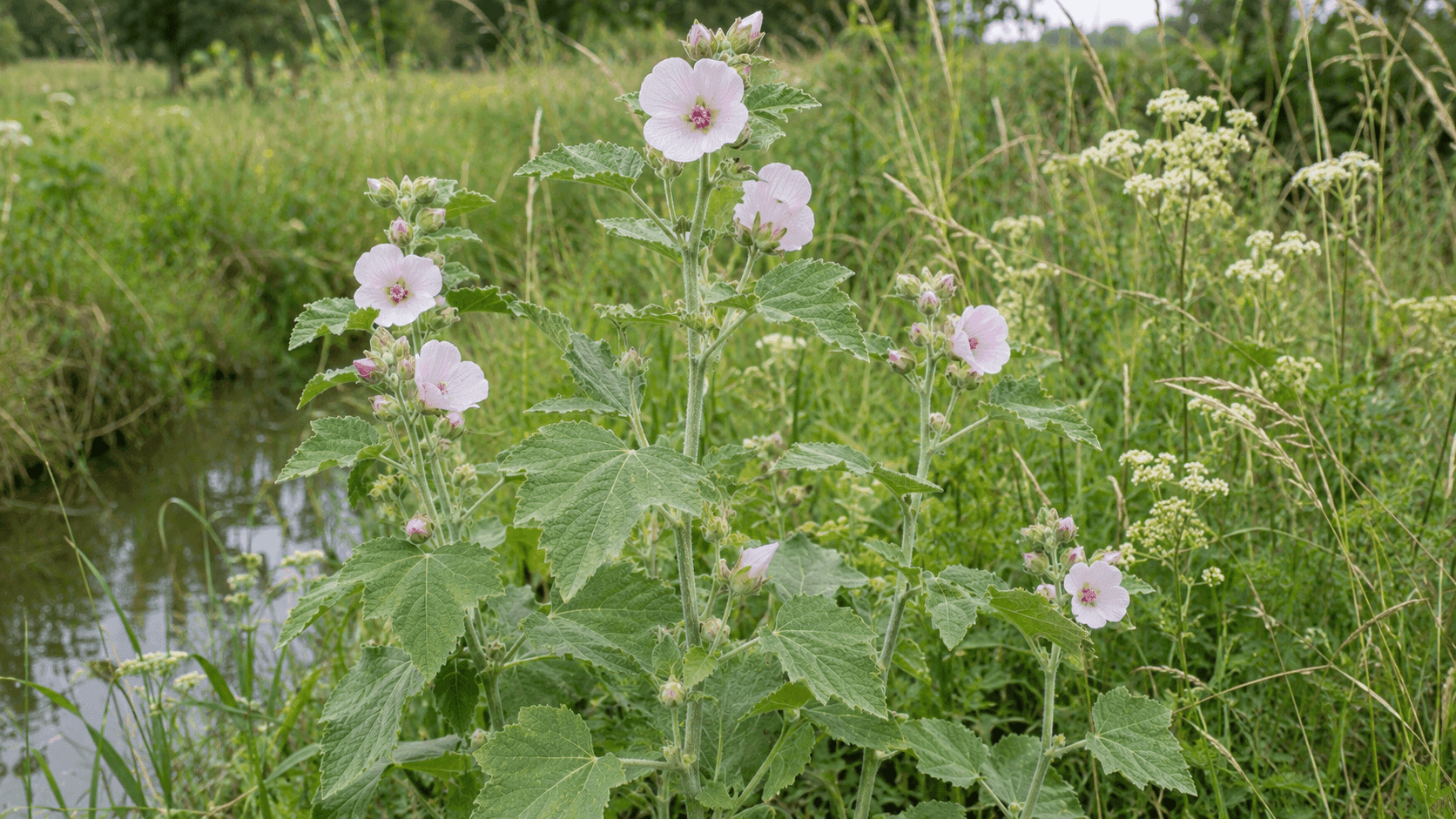
Her botanical name is Althaea officinalis. She's also called common marshmallow, wild marshmallow or white mallow. She belongs to the mallow family, like common mallow and like hibiscus.
She's a perennial: she comes back every year from her rootstock. Her stems grow nice and straight, about a metre tall, sometimes a metre and a half. Her leaves are grey-green, almost whitish, covered in a soft down: when you touch them, it feels like velvet. Around July, she makes pale pink flowers, one at a time or in little clusters where the leaves meet the stem. And underground, her roots go down deep.
She grows wild in Europe, from Denmark to Spain, in Asia as far as China, and in North Africa. In France, you mostly find her in the west, on the Atlantic side, in damp places: seashores, salt meadows, riverbanks, marshes. In the north of France, in Picardy and in Lorraine, she's protected: there, you look at her and you don't pick her.
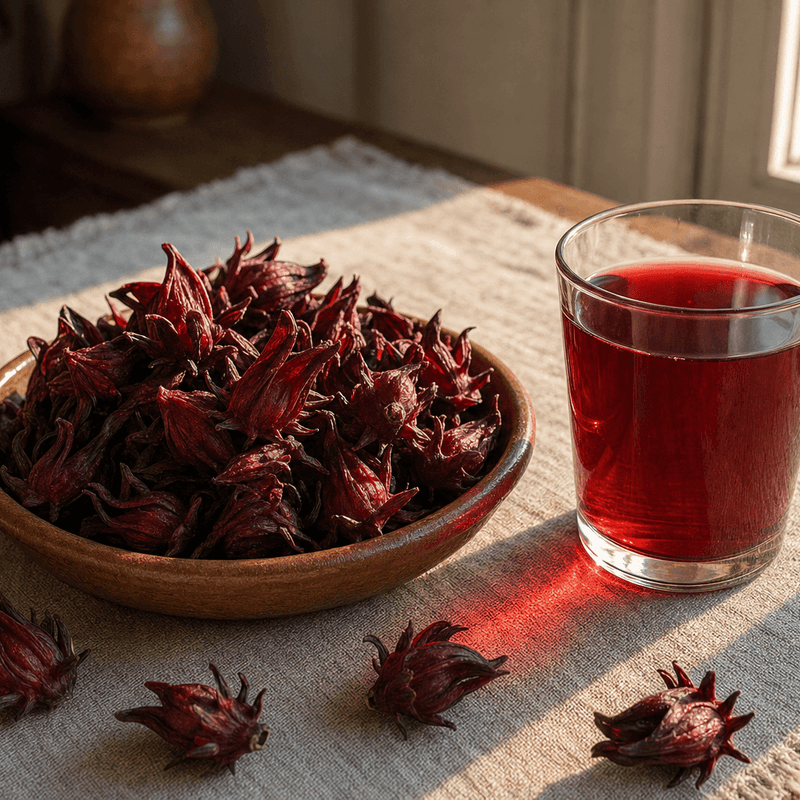
And her name? In French she's guimauve. The start of the word comes from an old Latin word, hibiscum, which already meant marshmallow. The end is mauve, the mallow. Hibiscum, does that ring a bell? My hibiscus, the one I drink iced in summer, carries the same old Latin name. And since people often ask me: in French, the word is feminine, une guimauve, for the plant and the sweet alike.
Marshmallow has old papers. Charlemagne put her on the list of plants to grow in the gardens of his estates, along with about a hundred others. And when the French revolutionaries remade the calendar, they gave her a day of her own, 16 Thermidor, which falls around 3 August.
From marshmallow root to the sweet: the story of marshmallow paste
You surely know marshmallow sweets, all soft, white or pink. Well, at the start, they were made with the root of this very plant. The story goes that as far back as Antiquity, people sweetened the root with honey, for the throat and also simply because it was good.
In the early 19th century, French confectioners swapped the honey for sugar, and started beating the paste to give it volume. It was patient work. By the end of the century, they'd found something simpler: egg white whisked into peaks, gelatine and starch, often scented with rose water. Marshmallow paste was already known before that: it turns up in a letter from 1779, and Zola has one of his characters gobbling it by the handful in L'Assommoir.
Today, marshmallow sweets are sugar, gelatine and often egg white. The root has left the recipe, but the name has stayed. In France, chamallow is a brand name people use for them: it sounds like the English name, marshmallow. And the little chocolate-coated marshmallow bears were born in 1962, in a chocolate factory in the north of France, in Villeneuve-d'Ascq.
I'm not against a marshmallow with the afternoon snack, I even give you my recipe further down. But don't mix things up: that sweet is for pleasure. The plant is something else, and she's the one I want to tell you about.
What marshmallow root is good for, according to the books
I'm not going to promise you the moon. The books give marshmallow root two traditional uses, not one more. People in Europe have used it since Antiquity, and the old pharmacopoeias all had their marshmallow syrup.
The first is when your mouth or throat is irritated and it makes you cough dry. The root softens, it coats, that's all. You can drink it, or rinse your throat with it. For the days when it stings, I also have other little gestures for a scratchy throat.
The second is when your tummy is a little upset, a small bit of nothing. There too, a glass of soaked root. I keep it with what I do when digestion is hard going.
The secret of marshmallow is that it's made cold. Not in the saucepan, not with boiling water. I put the cut root in 150 ml of room-temperature water, leave it to soak for half an hour, strain it, and drink it straight away: it doesn't keep. The old handbooks say that cold, it's nicer, less thick and less syrupy than hot.
For the throat, an adult or a teenager takes 0.5 to 3 g of root for 150 ml of water, several times a day, no more than 15 g in all. For the tummy, it's 2 to 5 g for 150 ml, three times a day, from 12 years old. A little kitchen scale and it's quickly done. For children, the amounts are smaller, and never before 3 years old: I've put it all further down, in what to know first.
One thing I never forget: I drink it apart from everything else, half an hour to an hour before or after whatever else I'm taking. And if the throat drags on for more than a week, or the tummy for more than two, it's no longer a job for a root: go and see your doctor.
And the flowers, and the leaves? In the old days, herbalists put marshmallow flowers in their mixtures of chest flowers, for teas for the chest. Today, the books I follow only keep the root, so that's what I keep in my cupboard. The cut marshmallow root in my jar is made exactly the way I told you.
“Marshmallow root is made cold and drunk straight away. The rest is patience.”
Growing marshmallow and lifting its root in autumn
Marshmallow isn't fussy, as long as you give her what she likes: sun or light shade, and rich soil that stays cool and a little damp. She hates being thirsty: when summer is dry, you have to water her, and often. She copes with our winters, down to -10 or -15 °C. You plant her from March to June, in open ground, not in a pot.
I have one plant in the coolest corner of my garden, near the tap. It grows tall, it makes its pale pink flowers in high summer, and the bees come to visit them. I keep it mostly for the pleasure of seeing it, and for its leaves.
The young leaves, you can pick as you go, from June to September. They're eaten cooked like spinach, and the most tender ones, raw, add flavour to a salad. The root can be eaten too, blanched in boiling water to soften it, but there isn't much flesh on it.
Root for drying is another story. You dig it up in autumn, from plants at least two years old. You peel it before drying it: it dries better and stays nice and white. Drying is tricky, so you take your time. Then you store it bone dry, away from light and damp.
I'll be honest with you: for my cold glasses, I buy my root ready cut. Digging up a two-year-old plant for one jar, I'd rather let it flower.
What I use her for
- · 01When my throat feels scratchy and the cough is dry: a glass of root soaked in cold water, to drink or to rinse the throat.
- · 02When my tummy is a little upset: 2 to 5 g of root soaked in cold water, three times a day, from 12 years old.
- · 03In the kitchen: the young leaves cooked like spinach, the most tender ones raw in a salad.
- · 04For the afternoon snack: homemade sugar and vanilla marshmallows, with no root in them, just for the pleasure.
How I prepare her
Granny’s little recipes
The cold glass, when your throat feels scratchy
During the day, when your throat feels scratchy and the cough is dry
What you’ll need
- 0.5 to 3 g of cut marshmallow root (for an adult or a teenager)
- 150 ml of room-temperature water
How I go about it
- 01Put the root in a glass and pour the water over it.
- 02Leave it to soak for half an hour.
- 03Strain it, and drink it straight away, or rinse your throat with it: it doesn't keep.
- 04You can do it again several times a day, no more than 15 g of root in all, and always half an hour to an hour apart from whatever else you're taking. For a child aged 3 to 5, it's 0.5 to 1 g per glass, three times a day; from 6 to 11, 0.5 to 1.5 g, three times a day. If it drags on for more than a week, go and see your doctor.
The cold glass, when your tummy is upset
When your tummy is a little upset, up to three times a day
What you’ll need
- 2 to 5 g of cut marshmallow root
- 150 ml of room-temperature water
How I go about it
- 01Put the root in a glass and pour the water over it.
- 02Leave it to soak for half an hour.
- 03Strain and drink straight away.
- 04No more than three glasses a day nor 15 g of root in a day, and only from 12 years old. Keep half an hour to an hour apart from whatever else you're taking, and if it lasts more than two weeks, go and see your doctor.
Homemade marshmallows for the afternoon snack
For the grandchildren's afternoon snack (15 minutes to make, at least 2 hours to set)
What you’ll need
- 250 g of sugar
- 80 ml of water
- 6 sheets of gelatine
- 90 g of egg whites
- 1 pinch of salt
- The seeds of 2 vanilla pods
- 1 teaspoon of vanilla extract
- 50 g of icing sugar
- 40 g of cornflour
- A kitchen thermometer
How I go about it
- 01Mix the icing sugar and the cornflour. Set a square frame on a tray lined with baking paper, and dust it with this mixture.
- 02Soften the gelatine sheets in a big bowl of cold water.
- 03Whisk the egg whites with the salt into firm peaks.
- 04Bring the sugar and water to the boil over a medium heat, until it reaches 130 °C on the thermometer: allow about 6 minutes after it starts boiling. The syrup burns, so the little ones watch from a distance.
- 05Off the heat, add the well-squeezed gelatine and stir to melt it.
- 06Straight away, pour this syrup in a thin stream down the side of the bowl onto the whites, whisking without stopping until the mixture is lukewarm. Add the vanilla seeds and extract.
- 07Pour into the frame, dust with a little of the icing sugar and cornflour mixture, and leave to set for at least 2 hours at room temperature.
- 08Cut into cubes with a plain-edged knife and roll them in the rest of the mixture. Keep them in a tightly closed tin, at room temperature, with baking paper between the layers: in the fridge, they turn sticky.
What to know first
This information doesn’t replace advice from a healthcare professional. Health Disclaimer →
Her identity card
- Name
- Common marshmallow
- Other names
- Wild marshmallow, white mallow
- Latin name
- Althaea officinalis L.
- Family
- Mallow family (Malvaceae)
- Part used
- The root; the young leaves in the kitchen
- Harvest
- Roots in autumn, from plants at least two years old; young leaves from June to September
- Form
- Cut root, soaked in cold water; leaves in the kitchen
- Origin
- Europe, temperate Asia, North Africa; in France, mostly the Atlantic west
- Storage
- Dried root, away from light and damp
If you remember just one thing
- 01Before it was a sweet, marshmallow was a tall plant of damp places, Althaea officinalis, and it's the root we keep.
- 02Marshmallow root is made cold: half an hour soaking in room-temperature water, and you drink it straight away.
- 03When your throat feels scratchy and the cough is dry: 0.5 to 3 g of root for 150 ml of water, several times a day, no more than 15 g in a day.
- 04Not before 3 years old, not when pregnant or breastfeeding. And you drink it half an hour to an hour apart from whatever else you take.
- 05Today's marshmallow sweets are sugar, gelatine and often egg white: there's no root left in them.
Your questions
Both, but the plant came first. Common marshmallow, Althaea officinalis, is a tall perennial of damp places, and the sweet used to be made with its root. Today, marshmallow sweets are made of sugar, gelatine and often egg white, with no root.
I'm not promising you anything, I'm telling you what people have done with it for a long time. The books give it two traditional uses: soothing an irritated mouth and throat when the cough is dry, and settling small tummy troubles. A marshmallow tea, at my house, is a glass of root soaked in cold water.
Cold. You put the cut root in 150 ml of room-temperature water, leave it to soak for half an hour, strain it and drink it straight away. For the throat, an adult takes 0.5 to 3 g per glass, several times a day, no more than 15 g in a day.
They're two cousins from the mallow family, but not the same plant. Marshmallow, Althaea officinalis, has grey-green velvety leaves and pale pink flowers, and it likes damp places. Common mallow, Malva sylvestris, has purplish-pink flowers with darker stripes and dark green leaves.
None, or nearly: chamallow is a brand name used in France for marshmallow sweets, and it sounds like the English name, marshmallow. It's the same sweet of sugar, gelatine and egg white. Neither of them has any marshmallow root left in it.
The books don't know of any side effects, but that doesn't mean zero risk. Not before 3 years old, not when pregnant or breastfeeding, and if you're allergic to marshmallow, you go without. It can slow down the uptake of what you swallow at the same time: take it half an hour to an hour before or after everything else.
References
- European Union herbal monograph on Althaea officinalis L., radix (EMA/HMPC/436679/2015) · European Medicines Agency, HMPC, 2016
- Marshmallow root: summary for the public (EMA/570566/2016) · European Medicines Agency, HMPC, 2016
- Assessment report on Althaea officinalis L., radix (EMA/HMPC/436680/2015) · European Medicines Agency, HMPC, 2016
- Addendum to Assessment report on Althaea officinalis L., radix (EMA/HMPC/301260/2025) · European Medicines Agency, HMPC, 2025
- Glossary on herbal teas (EMA/HMPC/5829/2010 Rev.1) · European Medicines Agency, HMPC, 2010
- Althaea officinalis L. · Plants of the World Online, Royal Botanic Gardens, Kew, 2026
- Guimauve officinale · Wikipédia, 2026
- Guimauve (confiserie) · Wikipédia, 2026
- Grande Mauve · Wikipédia, 2026
- guimauve · Wiktionnaire, 2026
- Fiche technique n°4 : la guimauve officinale · Mouvement de l'agriculture biodynamique (projet AEP PAM, Région Bretagne), 2024
- Guimauve officinale AB, godet 9 cm · Truffaut, 2026
- L'ourson au chocolat, doudou gourmand des Français · Sud Radio, 2026
- Guimauves à la vanille · Demotivateur Food, 2026
- Recette de la guimauve maison · Patissland, 2026