The five-seam herb of the paths: its young leaves in salad, its tea when your throat is scratchy, a crushed leaf on a nettle sting. And what to know first.
Who she really is
Family: Plantain family (Plantaginaceae).
Parts used: The leaves, fresh or dried.
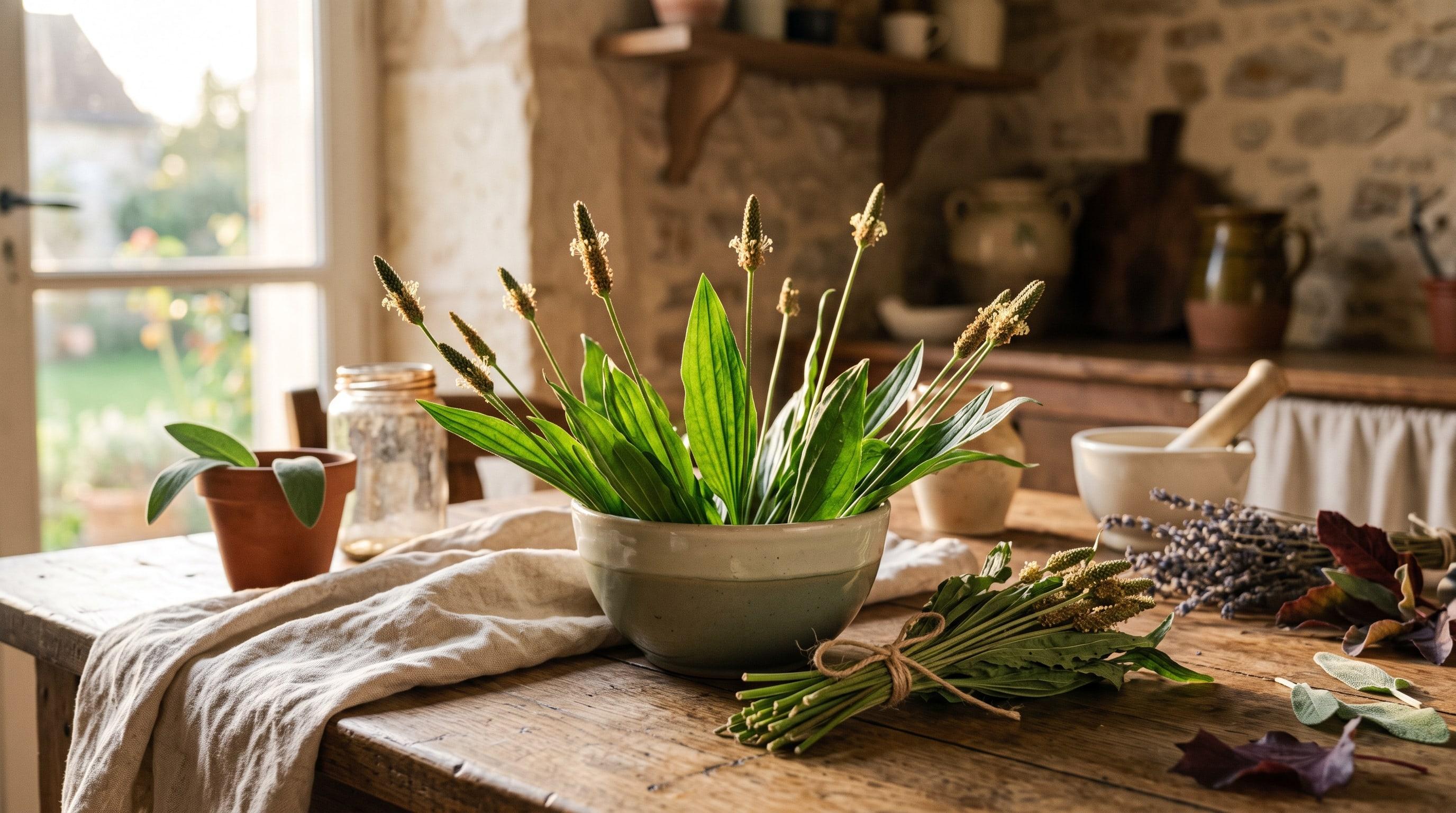
Ribwort plantain (Plantago lanceolata) is that little herb of paths and meadows with long, pointed leaves in a rosette, the one you tread on without seeing it. Its young leaves are eaten in salad. Dried, they make a gentle tea that the old handbooks give when the throat is irritated and the cough is dry. And on a nettle sting, a crushed leaf is the age-old gesture.
Her story
Ribwort plantain, Plantago lanceolata by its Latin name, is the five-seam herb: a little plant of the paths with spear-shaped leaves, eaten young in salad, and whose dried leaf makes a tea for scratchy throats. You surely have some under your feet right now without knowing it. Come on, I’ll show you.
Ribwort plantain (Plantago lanceolata), the five-seam herb of our paths
It’s a perennial plant of the plantain family (Plantaginaceae), of medium height: fifteen to fifty centimetres, depending on the soil and the sun it’s given. Its leaves all start from the base, in a rosette, long and narrow like a spearhead. Turn one over: you’ll see three to five well-marked veins, almost parallel, like seams. That’s where its nicknames come from: narrowleaf plantain, five-seam herb or five-ribbed herb.

Its flowers are tiny. They huddle into a little brown spike at the end of a long leafless stalk, the scape, which sticks up above the grass. Depending on where you are, it flowers from April to October. It’s said to have come from the Middle East, but it has settled everywhere here: meadows, lawns, path edges. It doesn’t mind being trampled or grazed by animals, so you find it precisely where people walk. Its leaves also feed the caterpillars of a butterfly, the Glanville fritillary.
Its name has quite a story. In an old journal of folk traditions, I read the one about a tailor who had sold his soul to the devil for ten years of prosperity. He would only be saved if he sewed a hem the devil couldn’t see. A fairy helped him join blades of grass with an invisible stitch, and that’s how our countryside is said to have inherited the five-seam herb. People also say that our very distant ancestors read the future in its veins, depending on whether they snapped or not when you pulled on the leaf.
And country children made a catapult out of it: a loop with the stalk under the spike, a sharp tug, and the little head flies off. I showed my grandson one summer. He emptied half the meadow.
Is ribwort plantain edible? Yes, and it tastes of mushroom
The whole plant can be eaten. The tender young leaves are eaten raw in salad, and they have a funny little taste of mushroom, almost of porcini. The first time, I didn’t believe it. The older leaves get harsh: those I put in soup, or cook like a vegetable, and the cooking takes the harshness away. The little flower buds, before they open, are used like the leaves, and they’re even less bitter.
The best time is spring: you can easily pick the whole rosette, and I keep the leaves from the heart, the youngest ones, for salad. I cut them into thin strips, across the veins, otherwise they’re a bit stringy between your teeth. My spring salad is further down, with the other recipes.
The seeds have their use too. They turn into a sort of jelly when you wet them, and some people use them in the kitchen to lighten a mayonnaise. Me, I leave them to the birds.
Ribwort plantain’s virtues in the old handbooks: the throat, the cough, the skin
People often ask me what the virtues of ribwort plantain are. I answer the way the books do, without adding anything. The old handbooks give its dried leaf as a tea, as a soothing drink, when the mouth or throat is irritated and a little dry cough sets in. They also give it when you’re coughing with a cold. It’s a recognised use because it’s been done for a very long time, not because anyone promised you anything.
My cup is 1.4 to 2 grams of cut dried leaves in 150 to 250 ml of boiling water, ten minutes with a lid on. Two or three cups a day, no more than 6 grams of leaves in the day. Not under 12. If it isn’t better after a week, or if you have a fever, trouble breathing, or you’re coughing up yellow or green, it’s no longer a job for a tea: go and see your doctor. For those evenings when the throat stings, I also have my thyme, always within reach, and I’ve written down everything I do when my throat is scratchy.

For the skin, there are two gestures. The first is the one for walks. A nettle, mosquito or wasp sting, and it itches? You pick a plantain leaf, crush it between your fingers and rub it on the sting. My mother did it without even stopping walking. That’s why I never worry when someone gets stung at the bottom of the garden: the big stinger and plantain often grow side by side.
The second gesture is at home, and the books describe it well: you soak 1.4 grams of cut dried leaves in 150 ml of cold water for half an hour, then lay a clean compress soaked in this liquid on the small irritation. Three to four times a day, from 3 years old, and you make a fresh one each time, because it doesn’t keep. For the other little creatures of summer, I’ve written what I do when a bite itches.
The old folks also made syrups and poultices of crushed leaves out of it. People say a fresh leaf stops a small cut from bleeding. That, I haven’t found anything certain about in my books, so a cut, I wash it and cover it with a plaster, and that’s that.
Picking, drying and keeping Plantago lanceolata, my ribwort plantain
I pick the leaves from March to October. For tea, I take nice green leaves in good shape, away from where the dogs go, and I leave the youngest for salad. I never pull up the whole plant: I take a few leaves from each one and leave the rest.
To dry them, I spread them on a tea towel, in a warm, dry, dark room. If you use the oven or a dehydrator, don’t go above 40 degrees. When they snap cleanly between your fingers, I cut them into small pieces and they go into a tightly closed jar, at the back of the cupboard. It’s the same way I do the herbs I dry in July.
If you don’t have a meadow handy, get your dried plantain from someone you trust. It has already happened that a batch sold as plantain was actually foxglove, a very toxic plant. Once is enough to make you wary.
What I love about plantain is that it asks for nothing. It grows where people walk, it lets itself be picked, and it’s there the day you need it. A modest herb, just the way I like them.
What I use her for
- · 01In spring, the young leaves raw in salad, for their little mushroom taste.
- · 02The dried leaves as a tea, when the throat is scratchy and the cough stays dry, as the old handbooks say.
- · 03A leaf crushed and rubbed on a nettle sting or a mosquito bite, by the side of the path.
- · 04At home, a compress of leaves soaked in cold water, on a small skin irritation.
- · 05The older leaves, cooked in soup with the other herbs from the garden.
How I prepare her
Granny’s little recipes
The plantain cup for scratchy throats
When the throat is irritated and the cough stays dry, two or three times during the day
What you’ll need
- 1.4 to 2 g of dried, cut ribwort plantain leaves (weigh them the first time, after that you’ll know by eye)
- 150 to 250 ml of boiling water
- 1 teaspoon of honey, if you like it sweeter
How I go about it
- 01Pour the boiling water over the leaves, in your cup.
- 02Cover and leave to infuse for 10 minutes, then strain.
- 03Add the honey if you like, and drink it hot, in little sips.
- 04Two or three cups a day, no more than 6 g of leaves in the day, and not under 12.
- 05If it isn’t better after a week, or if you have a fever or trouble breathing, go and see your doctor.
The plantain compress for itchy skin
At home, after a sting or on a small skin irritation
What you’ll need
- 1.4 g of dried, cut ribwort plantain leaves
- 150 ml of cold water
- A compress or a small clean cotton cloth
How I go about it
- 01Put the leaves in the cold water, in a bowl.
- 02Leave them to soak for half an hour at room temperature, then strain.
- 03Soak the compress, wring it out a little and lay it on the itchy skin.
- 04Use it straight away: the soaking water doesn’t keep, you make a fresh one each time.
- 05Three to four times a day, not under 3. If it isn’t better after a week, show it to your doctor.
Spring salad with young plantain leaves (for 2)
In spring, for lunch
What you’ll need
- 2 handfuls of young ribwort plantain leaves, picked from the heart of the rosette
- 2 good handfuls of lamb’s lettuce or lettuce
- A few flower buds that haven’t opened yet, if you find any
- 1 tablespoon of cider vinegar
- 3 tablespoons of walnut or olive oil
- Salt and pepper
How I go about it
- 01Wash the plantain leaves and the salad, then dry them well in a tea towel.
- 02Cut the plantain leaves into thin strips, across the veins: they’re nicer between your teeth.
- 03In the salad bowl, mix the vinegar, salt and pepper, then the oil.
- 04Add the salad, the plantain and the flower buds, and toss at the last moment.
What to know first
This information doesn’t replace advice from a healthcare professional. Health Disclaimer →
Her identity card
- Name
- Ribwort plantain, narrowleaf plantain, five-seam herb
- Latin name
- Plantago lanceolata L.
- Family
- Plantain family (Plantaginaceae)
- Parts used
- Leaves
- Harvest
- Leaves from March to October; the young ones in spring
- Form
- Tea of dried leaves; compress; young leaves in salad
- Origin
- Came from the Middle East; common in Europe and Asia, in meadows and along paths
- Storage
- Dried leaves at no more than 40 °C, in a tightly closed jar
If you remember just one thing
- 01Ribwort plantain is the five-seam herb of the paths: spear-shaped leaves, with three to five nicely parallel veins.
- 02Its young leaves are eaten raw in salad, with a little mushroom taste; the older ones, you cook.
- 03For the tea, 1.4 to 2 g of dried leaves in 150 to 250 ml of boiling water, two or three times a day, and not under 12.
- 04On a nettle sting, by the side of the path, a crushed leaf; at home, a compress of leaves soaked for half an hour in cold water.
- 05Not during pregnancy or breastfeeding, not if you’re allergic to its pollen, and if it isn’t better after a week, it’s the doctor.
Your questions
The old handbooks give its dried leaf as a tea when the mouth or throat is irritated and the cough is dry, or when you’re coughing with a cold. On the skin, they lay it as a compress on small irritations. It’s a traditional use, not a promise, and if it isn’t better after a week, it’s the doctor.
Yes, the whole plant can be eaten. The tender young leaves are eaten raw in salad and have a little mushroom taste. The older ones are harsh: you cook them, in soup or as a vegetable. The flower buds that haven’t opened yet are eaten like the leaves.
The books don’t know of any for the leaf, so far. But if you’re allergic to plantain or its pollen, you go without. No tea during pregnancy or breastfeeding, or under 12, for lack of data. And if something doesn’t feel right, you stop and talk to your doctor.
Count 1.4 to 2 g of cut dried leaves for 150 to 250 ml of boiling water. Cover, leave to infuse for ten minutes, strain. Two or three cups a day, no more than 6 g of leaves in the day, and not under 12.
By the side of the path, you pick a leaf, crush it between your fingers and rub it on the sting: that’s the age-old gesture. At home, I soak 1.4 g of dried leaves for half an hour in 150 ml of cold water and lay on a compress, three to four times a day, from 3 years old.
Its leaves all start from the base, in a rosette, long and pointed like a spearhead, with three to five almost parallel veins. Its flowers form a little brown spike at the end of a long leafless stalk. Greater plantain, its cousin, has wider, oval leaves.
References
- European Union herbal monograph on Plantago lanceolata L., folium, Revision 1 (EMA/HMPC/887979/2022) · European Medicines Agency, HMPC, 2025
- Plantaginis lanceolatae folium, herbal medicinal product · European Medicines Agency, 2025
- Glossary on herbal teas (EMA/HMPC/5829/2010) · European Medicines Agency, HMPC, 2010
- Plantago lanceolata · Wikipédia, 2026
- Le plantain lancéolé · Cueilleurs sauvages, 2026
- Plante comestible et plante toxique : gare aux confusions · Anses, 2020
- Contamination of botanical dietary supplements by Digitalis lanata · New England Journal of Medicine, 1998