Soothe your bloated tummy
Grandma’s remedies for a bloated tummy: eat slowly, leave the bubbles aside, take a little walk and have a cup of fennel seed tea. And know when it’s time to see your doctor.
Reviewed by Ruosi Wu, PhD in Pharmacy, MD in Traditional Chinese Medicine
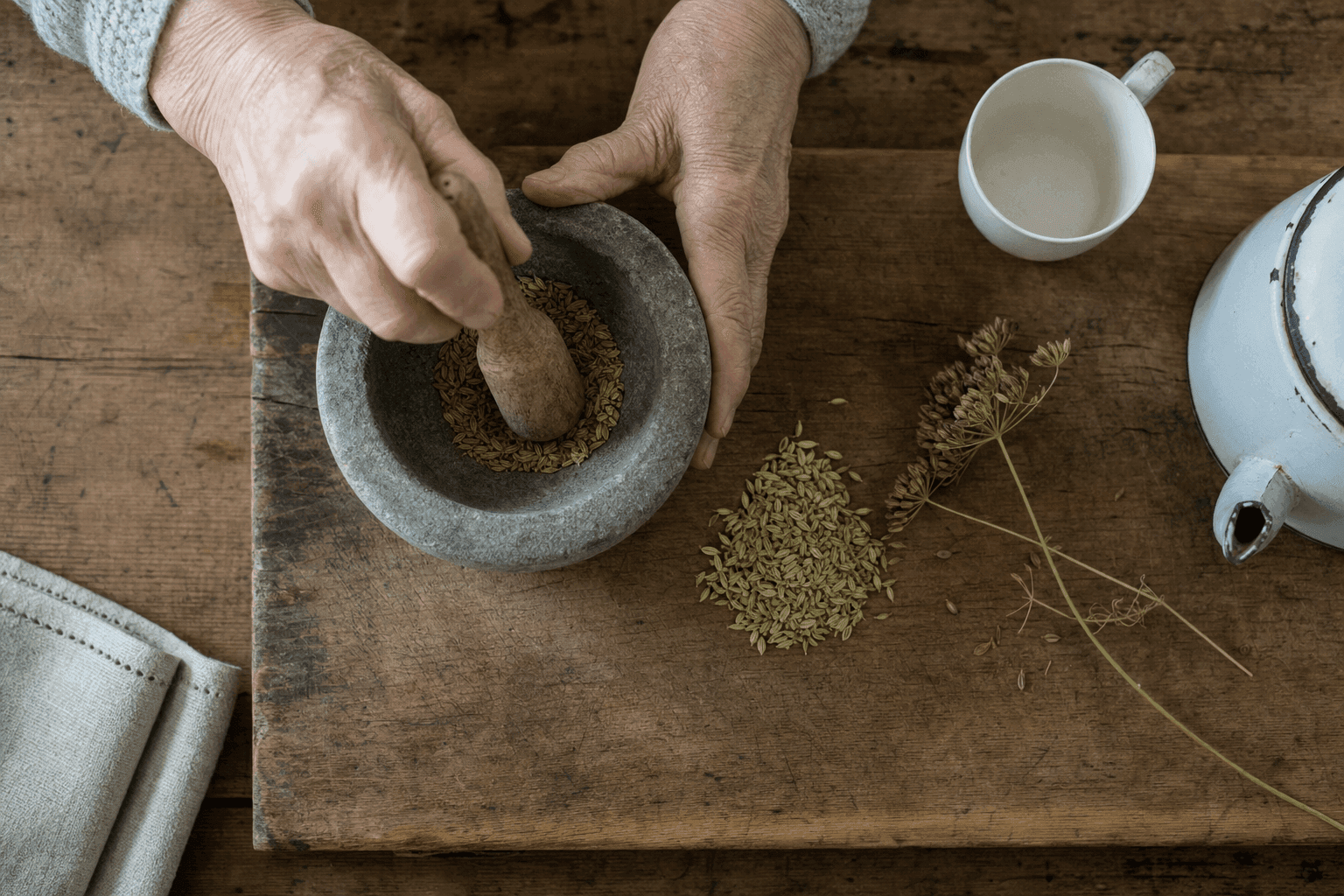
For bloating, my grandma’s remedies come down to three things: eat slowly, leave the bubbles aside and walk a little after your meal. Then a cup of fennel seed or peppermint tea: that’s what my books give for a swollen belly and wind. If it lasts, if it hurts a lot or if gas won’t pass anymore, go and see your doctor.
Key takeaways
- Bloating often comes from air swallowed while eating and from the gas your gut makes with certain foods, like beans or cabbage.
- Eating slowly, chewing well and leaving fizzy drinks and chewing gum aside: that’s the first thing to do for a swollen belly.
- Fennel seeds, peppermint, German chamomile, lemon balm and lemon verbena are given by tradition, as herbal teas, for a bloated belly and wind.
- A hot-water bottle won’t make your belly go down, but the warmth helps it hurt less.
- A very hard belly, gas that won’t pass anymore, blood in your stool or bloating that has lasted more than three months: show it to a doctor.
Granny’s little steps
- Eat slowly and chew well
In peace, with no screen and no newspaper, and every mouthful chewed well. The less air you swallow, the less your stomach swells.
- Leave the bubbles aside
Fizzy drinks and chewing gum let air in for nothing. Drink still water during the day instead, and go easy on coffee and alcohol.
- Spot the foods that bloat you
Beans, lentils, cabbage, onions, leeks, stone fruit: for a few weeks, write down the ones that bother you, and eat them less often, without cutting out everything.
- Walk a little after your meal
Don’t lie down straight away, loosen your belt and take a turn around the garden or the block. Moving a little every day helps your belly.
- The hot-water bottle when it pulls
Nice and hot, not boiling, wrapped in a tea towel and laid on your belly. It won’t make your belly go down, but the warmth helps it hurt less.
A recipe to try
The tea for after a meal that leaves you bloated
After lunch or dinner, when your belly swells and pulls
What you’ll need
- 1.5 g of dried fennel seeds (weigh them the first time, after that you’ll know by eye)
- 250 ml of water, a big bowl
How I go about it
- Boil the water.
- Put the seeds in the bottom of the bowl and pour the boiling water over them.
- Put a saucer on top and let it steep for 15 minutes.
- Strain and drink it hot, slowly.
- Up to three bowls a day, no more than two weeks in a row, and only from age 12.
Bloating settles down first at the table: you eat more slowly, you leave the bubbles aside, and you have a hot cup of fennel seeds after your meal. I’ll tell you what I do when my belly swells, what my books say, and the point where it’s no longer a job for herbal tea.
Why we get bloated: swallowed air and gas in the belly
A swollen, tight belly often comes from two things at once. The first is air. We swallow it all day long without thinking, while eating, while drinking. The books say that swallowing two to four liters a day is perfectly normal. But when you swallow too much (you eat fast, you chew gum, you drink fizzy drinks), your stomach swells and it pulls at the top of your belly. Part of that air comes back out through your mouth, as little burps. The rest goes down and adds to the gas. That’s what they call aerophagia, a big word for a very ordinary thing.
The second is the gas your gut makes. In your belly, there are bacteria that break down what you’ve eaten, and as they work, they make gas. Some foods make more than others, everyone knows that: beans, cabbage, and starchy foods in general. My mother used to say that you paid for the lunchtime cassoulet in the evening. When this gas doesn’t get out, it makes your belly swell and gurgle, and sometimes it hurts.
Your belly doesn’t like being rushed. Me, when I eat lunch standing up between two jars, I feel it all afternoon.
Bloating and wind: what to do at home
The first step happens at the table. Eat slowly, in peace, without the television or your phone next to your plate, and chew every mouthful well. The less air you swallow, the less your stomach swells.
Next, look at what you drink. Fizzy drinks and chewing gum let air in for nothing: I leave them aside. Coffee and alcohol, I cut down on when my belly is acting up. Still water, yes, during the day, a liter to a liter and a half.
Then there’s what goes on your plate. The books list the foods that make the most gas: onions, cabbage and sauerkraut, beans, lentils, radishes, horseradish, leeks, stone fruit, bran and sweeteners. See which ones bloat you, you in particular, write them in a notebook for a few weeks, and eat them less often. Every belly is different. Don’t cut out everything, though: if you take a lot of things out of your meals, talk to your doctor.
After your meal, don’t go and lie down straight away, and loosen your belt: a waistband that squeezes doesn’t help. A little walk does you good, and so does moving a bit every day. No need to run, a turn around the garden is enough.
And when it really pulls, the hot-water bottle. Fill it with nice hot water, not boiling, wrap it in a tea towel and lay it on your belly. I’ll tell you how it is: it won’t make your belly go down. But the warmth helps it hurt less, and that’s something.
At the pharmacy, there are also products for gas, and their effect isn’t always proven. Ask your pharmacist for advice, especially if you already take something on a doctor’s orders.
Grandma’s plants for bloating
For a belly that swells and for wind, my books give several plants, one at a time, as herbal teas. I’m giving them to you with the amounts, because an herbal tea gets measured.
Fennel. Not the bulb you make into a gratin, the seeds. It’s my first cup when my belly swells and pulls after eating. You use 1.5 grams of seeds for a big bowl of boiling water (250 ml), fifteen minutes covered, up to three bowls a day, and no more than two weeks in a row, from age 12. I give you my recipe further down, and everything I know about fennel is over here.
Peppermint. The one from the garden, which I dry in bunches in summer. The books give it for hard digestion and wind. For an adult, 1.5 to 3 grams of dried leaves in 100 to 150 ml of boiling water, ten minutes covered, three times a day. But if you have heartburn or acid coming back up, leave it be: it can make them worse. I tell you about my peppermint there.
German chamomile. The one that’s mild in the cup, not the Roman one, which is bitter. The books give it for a belly that swells and knots up in little cramps. You put 1.5 to 4 grams of dried flowers in 150 ml of boiling water, ten minutes covered, three or four cups a day. If things aren’t better after a week, you go and see your doctor. What else I do with chamomile, I tell you here.
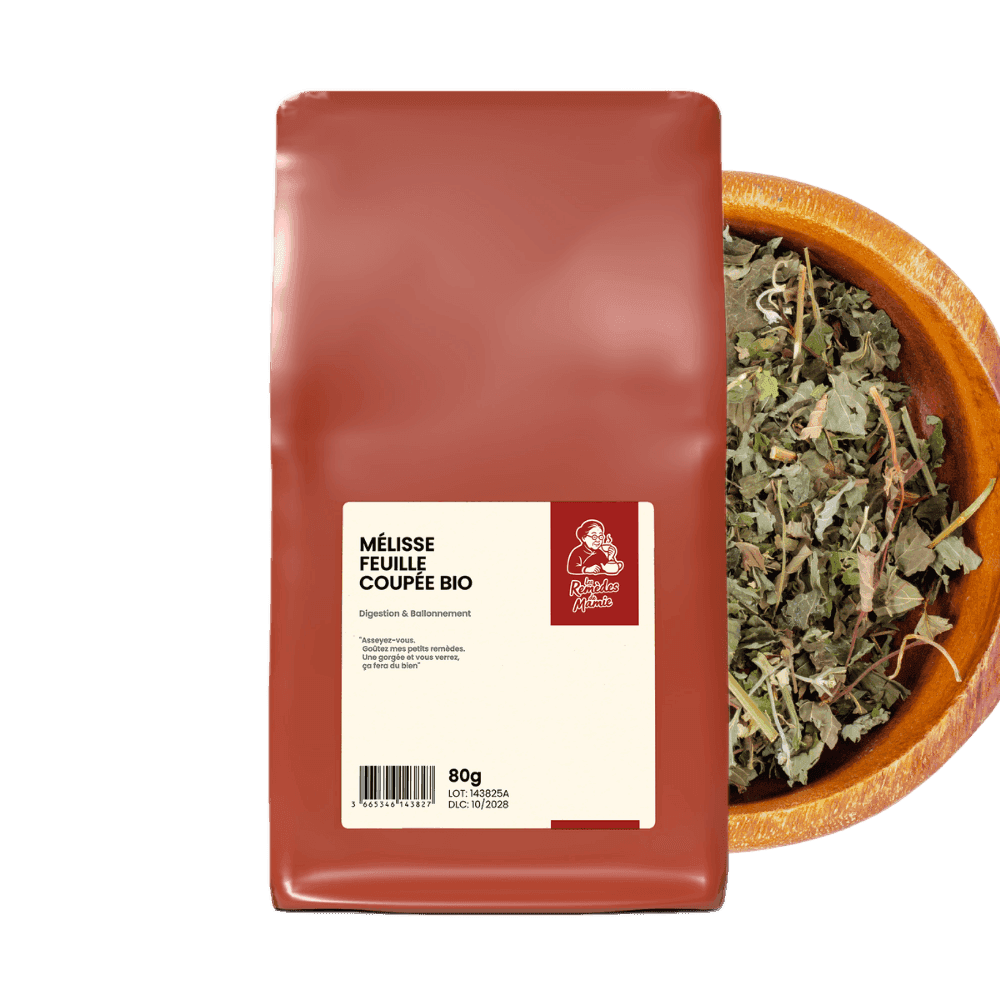
Lemon balm. We know it for evenings when we’re on edge, but the books also give it for a bloated belly and wind. 1.5 to 4.5 grams of dried leaves in 150 ml of boiling water, ten minutes covered, up to three cups a day. It can make you a little sleepy, so not right before you get behind the wheel. I tell you about my lemon balm here.
Lemon verbena. The one whose leaves smell strongly of lemon when you crumple them. The books give it for a bloated belly and wind, and to help you sleep. For the belly, you use 2 to 3 grams of leaves in 200 ml of boiling water, ten minutes covered, one to three times a day. It can make you drowsy too. Let me introduce you to my verbena there.
Not all of these plants can be taken during pregnancy, or given to children: I’ve put it all further down, plant by plant. And if it’s more a heavy stomach that bothers you, for hard digestion, I have other things to try.
“The herbal tea is the end of the meal. The real trick is eating slowly.”
Swollen belly: knowing when it’s no longer a small ache
A belly that swells after a good meal passes. My teas and my little habits are for that. But bloating that has lasted for months, or that comes with something else, is your doctor’s department.
The books say that about 5 people in 100 in France have an irritable bowel, and that a bloated belly is often part of it. If you’ve recognized yourself in that for more than three months, make an appointment with your regular doctor.
And some signs shouldn’t wait: a very hard belly, stool and gas that won’t pass anymore, blood in your stool, fever, vomiting. I’ve put the list just below, sign by sign. Read it once, calmly.
Which plants?
AnisePimpinella anisum
Green anise means the little grey-green seeds of a Mediterranean umbellifer: I steep them when my tummy bloats or when I cough with a cold, and I put some in my biscuits.
Ceylon cinnamonCinnamomum verum
Ceylon cinnamon is true cinnamon: the thin bark of a tree from Sri Lanka, in sticks of many layers, with far less coumarin than cassia. I put it in rice pudding, and in a cup when my tummy bloats.
TurmericCurcuma longa
The yellow root in curry, a cousin of ginger from India. How I use it in cooking and in a little cup after meals, and why I'm wary of concentrated supplements.
FennelFoeniculum vulgare Mill.
Fennel is the tall plant that smells of anise: its seeds go into a tea when your tummy bloats, the Florence bulb goes into the kitchen, and wild fennel grows along the roadsides.
Lemon verbenaAloysia citrodora
Lemon verbena is the little shrub from the Andes with leaves that smell of lemon: a cup in the evening before bed, a cup when your belly bloats, and a syrup over summer melon.
PeppermintMentha x piperita
Peppermint is the mint with the stinging cold taste, born from water mint and spearmint: a cup of the leaves after a meal that sits heavy, and the essential oil kept apart.
ChamomileMatricaria chamomilla L.
Chamomile means two little flowers for your cup: German chamomile, mild, and Roman chamomile, bitter. For a bloated tummy, an irritated throat, skin that's got too hot.
Lemon balmMelissa officinalis
Lemon balm is the perennial garden herb that smells of lemon when you crush it: a cup in the evening, a cup when your tummy bloats, and a few leaves over summer fruit.
What to know first
Fennel: not during pregnancy or breastfeeding. No fennel tea before age 4, not even for baby colic. Between 4 and 12, the books give a smaller cup (1 g of seeds in 100 ml of boiling water, 15 minutes, up to three times a day, for less than a week), but only with seeds known to be suitable for children: ask your pharmacist first. No fennel if you’re allergic to fennel, anethole, anise, caraway, celery, coriander, dill or mugwort pollen. No more than two weeks in a row.
Peppermint: not during pregnancy or breastfeeding, and not before age 4. Between 4 and 11, and for teenagers, you use less: 1 to 2 g of leaves in 100 to 150 ml of boiling water, three times a day. If you have heartburn or acid coming back up (reflux), avoid it, it can make them worse. If you have gallstones or another bile problem, be careful: ask your doctor first. No mint if you’re allergic to peppermint or menthol.
German chamomile: it belongs to the daisy family (Asteraceae), like ragweed, chrysanthemums and marigolds. If you’re allergic to one of these plants, go without. Serious allergic reactions have been reported: if you have trouble breathing, or if your face or throat swells, call emergency services right away. During pregnancy and breastfeeding, the books allow a simple German chamomile tea, in the usual amounts. For children, not before 6 months, and smaller amounts depending on age: 0.5 to 1 g of flowers from 6 months to 2 years, 1 to 1.5 g from 2 to 6 years, 1.5 to 3 g from 6 to 12 years, two to four times a day. Interactions have been reported with warfarin (an anticoagulant), with certain medications processed by the liver, and in kidney transplant patients who drank a lot of it over a long time: if you’re on a long-term treatment, ask your doctor or your pharmacist before drinking it regularly.
Lemon balm: not during pregnancy or breastfeeding, and not before age 12. It can make you drowsy: if it does that to you, don’t drive or use machines. If you have a thyroid problem or a treatment for it, ask your doctor before drinking it regularly. The books have no data on mixing it with other products: if you take something on a doctor’s orders, especially for sleep or for your nerves, talk to your doctor or your pharmacist.
Lemon verbena: not during pregnancy or breastfeeding, and not for children, for lack of data. Not if you’re allergic to lemon verbena or to a plant in its family (Verbenaceae). It can make you drowsy: if it does that to you, don’t drive or use machines.
How long: if your belly isn’t better after a week of chamomile, or two weeks with the other plants, or if it gets worse along the way, stop and go and see your doctor. For fennel, peppermint and verbena, the books report no interactions with a treatment; if you already take something on a doctor’s orders, ask your pharmacist anyway.
Vegetable charcoal, which you find at the pharmacy for gas, can stop your body from properly taking in other medications. If you’re on a treatment, ask your doctor or your pharmacist for advice before taking it.
When to see your doctor
- A very hard, painful, tensed belly: call 15 or 112 right away.
- A sudden, intense pain in the belly, like a stab: call 15 or 112 right away.
- A pain at the top of the belly that spreads to your chest, neck or shoulders: call 15 or 112 right away.
- Being out of breath without any effort, or trouble breathing that lasts or gets worse: call 15 or 112 right away.
- A bellyache and you’re vomiting blood or a brownish liquid: call 15 or 112 right away.
- A bellyache with feeling faint and a fever: call 15 or 112 right away.
- A bellyache with nausea and vomiting when you have diabetes: call 15 or 112 right away.
- You’re pregnant and you have a pain in your belly you’ve never felt before: call 15 or 112 right away.
- A child whose belly becomes swollen, tight and painful, or who keeps vomiting: take them to the emergency room or call 15 or 112 without delay.
- You can’t open your bowels anymore and you’re not passing any gas: see your doctor the same day.
- A bellyache with nausea, vomiting or fever: see your doctor the same day.
- Red blood in your stool, or black stool: see your doctor the same day.
- Your skin or the whites of your eyes turning yellow: see your doctor the same day.
- A bellyache with a period that is unusually late: see your doctor the same day.
- A new pain in your belly that won’t let up and stops you doing what you usually do: see your doctor the same day.
- Bloating that comes on all at once, with a bellyache: see your doctor in the next few days.
- A bellyache that doesn’t calm down, or gets worse, after two days of painkillers: see your doctor in the next few days.
- You’re losing weight without trying: see your doctor in the next few days.
- A bellyache and you’re constipated when you weren’t before: see your doctor in the next few days.
- Bloating and belly troubles for more than three months: make an appointment with your regular doctor.
- Digestive troubles for the first time, especially after 50, or that have changed recently: make an appointment with your regular doctor.
- Belly troubles that show up at night: make an appointment with your regular doctor.
- Belly troubles that started after a trip abroad: make an appointment with your regular doctor.
- Colon or rectal cancer in a close family member, and belly troubles: talk to your regular doctor about it.
Your questions
How do I get rid of bloating?
Start by eating slowly, chewing well, and leaving fizzy drinks and chewing gum aside. After your meal, walk a little instead of lying down, and loosen your belt. A cup of fennel seeds, 1.5 g in 250 ml of boiling water, is what my books give for a bloated belly. A hot-water bottle won’t make it go down, but it helps it hurt less.
Why does my belly swell up?
Often for two reasons: the air you swallow when you eat fast, chew gum or drink fizzy drinks, and the gas your gut makes with certain foods, like beans, cabbage or starchy foods. Swallowing a little air is normal: it’s when you swallow too much that your stomach swells. If it doesn’t pass, talk to your doctor, because there are other causes.
Which herbal tea should I drink for bloating?
Fennel seeds: 1.5 g in 250 ml of boiling water, 15 minutes covered, up to three times a day and no more than two weeks. Or peppermint: 1.5 to 3 g of leaves in 100 to 150 ml of boiling water, three times a day, unless you have heartburn. German chamomile, lemon balm and lemon verbena are also given for a bloated belly. If you’re expecting a baby, the only one the books allow is a simple German chamomile tea.
Is a swollen stomach the same as a swollen belly?
Not quite. When you swallow too much air, it’s your stomach that swells: it pulls at the top of your belly and some of the air comes back up as little burps. Gas from the gut, on the other hand, makes your belly swell, gurgle, and sometimes hurt. What to do is the same: eat slowly, no fizzy drinks, and a hot cup after your meal.
Does irritable bowel make your belly swell?
Yes, a swollen, tight belly is often part of it, and it affects about 5 people in 100 in France. But only your doctor can tell if that’s what it is. If your bloating has kept coming back for more than three months, make an appointment with your regular doctor, and sooner if you’re losing weight without trying, if there’s blood in your stool or if you have a fever.
When should I worry about a swollen belly?
A very hard, painful, tensed belly, or a sudden pain like a stab: call 15 or 112 right away. Stool and gas that won’t pass anymore, blood in your stool, fever or vomiting: see your doctor the same day. And if you’re losing weight without trying, or if it has been going on for months, make an appointment.
Also worth reading
- The LetterAs the seasons change, my bitter plants from the garden to the tableAt every change of season, my mother brought out her bitter plants: dandelion in spring, artichoke and milk thistle in autumn. I'll tell you how I take them, and what they don't do.
- The LetterHeavy digestion: the cup I drink after the big Sunday lunchHeavy digestion after the big Sunday lunch, at our house, always ended with a bowl of fennel seeds. I'll tell you about my mother's tin box, with the measures.
- The LetterWhat ginger is good for, and my cup for the cold daysGinger, that rhizome that tingles on your tongue, comes out as soon as the first cold days arrive. I'll tell you where it comes from, what my books say about it, my lemon cup, and what to know first.
- The LetterWhat to plant in August? Come and see my garden this monthIn August, I sow lamb's lettuce and pansies, I pick lemon verbena, sage and lemon balm in the morning, I water in the evening and I let the fennel go to seed. Come and see.
- The LetterFatima's mint tea and my evening cup: come and have a tasteMy friend Fatima sent me a photo of her mint tea tray. I'll tell you her Marrakech recipe, my after-dinner peppermint, and why they aren't the same thing.
- The LetterMy sage and lemon lemonade: here's my summer jug for youWhen summer heats up the yard, out comes my jug: sage from the jar, a lemon, water. Here's my sage lemonade for you, with the right measurements, and who should go without it.
- The LetterYour peppermint tea: how I make it, and when to skip itPeppermint tea is my cup after a meal that sits heavy. I'll tell you how I make it, when I go without, and why its essential oil stays put away on its own.
- The LetterLinden flowers in June: come and pick them with me in the gardenIn June, my linden tree blooms above the terrace. I’ll show you when to pick linden flowers, how to dry them, and the cup I make with them in the evening.
What I’ve made with
References
- Ballonnement, flatulence et aérophagie · Santé.fr, ministère de la Santé, 2026
- Mal de ventre : que faire et quand consulter ? · Ameli, Assurance Maladie, 2026
- Syndrome de l'intestin irritable : que faire pour être soulagé et quand consulter ? · Ameli, Assurance Maladie, 2025
- Reconnaître le syndrome de l'intestin irritable · Ameli, Assurance Maladie, 2025
- Dyspepsie ou mauvaise digestion : quand consulter et que faire ? · Ameli, Assurance Maladie, 2026
- Constipation de l'enfant : que faire et quand consulter ? · Ameli, Assurance Maladie, 2025
- Ceintures, bouillottes, gaines : quels objets utiliser contre les ballonnements ? · Allodocteurs, France Télévisions, 2024
- European Union herbal monograph on Foeniculum vulgare Miller subsp. vulgare var. vulgare, fructus (Rev. 1) · EMA, HMPC, 2024
- European Union herbal monograph on Mentha x piperita L., folium (Rev. 1) · EMA, HMPC, 2020
- European Union herbal monograph on Matricaria recutita L., flos · EMA, HMPC, 2015
- Community herbal monograph on Melissa officinalis L., folium · EMA, HMPC, 2013
- European Union herbal monograph on Aloysia citrodora Paláu, folium · EMA, HMPC, 2021
- Glossary on herbal teas · EMA, HMPC
- Chamomile · NCCIH, National Institutes of Health
Information. This information is provided for general knowledge and doesn’t replace medical advice. Check with a healthcare professional before any use.
Health Disclaimer