As the seasons change, my bitter plants from the garden to the table
At every change of season, my mother brought out her bitter plants: dandelion in spring, artichoke and milk thistle in autumn. I'll tell you how I take them, and what they don't do.
When the seasons changed, my mother had two habits with her bitter plants: dandelion in spring, and in autumn, the cups after the big family meals. She used to say that with every season the table changes, and your tummy with it. I've kept her habits. But I'll tell you frankly what these plants do, and what they don't.
Dandelion spring, on the plate and in the cup
Dandelions grow all over my garden, and I let them. Their French name, pissenlit, is found written down as early as the 15th century, and it comes from their reputation for making you pee: “wet the bed”, simple as that. My mother would laugh about it with us children while she picked them.
In spring, I gather the young rosettes before they flower, while they're tender, and make a salad with hot lardons, the way they do it in the Ardennes. It's bitter, I won't hide that from you, but to me it's the taste of spring.
In a cup, the books use the whole dandelion, the parts above ground together with the root, dried and cut. They give it for a sluggish digestion, a tummy that's too full, wind, and when your appetite goes off for a while. They count 4 to 10 g steeped in boiling water, up to three times a day, from 12 years old.
Seasonal plants, I don't ask them to wash me out from the inside. Just to keep me company when a meal is too rich.
Artichoke and milk thistle autumn, after the big family meals
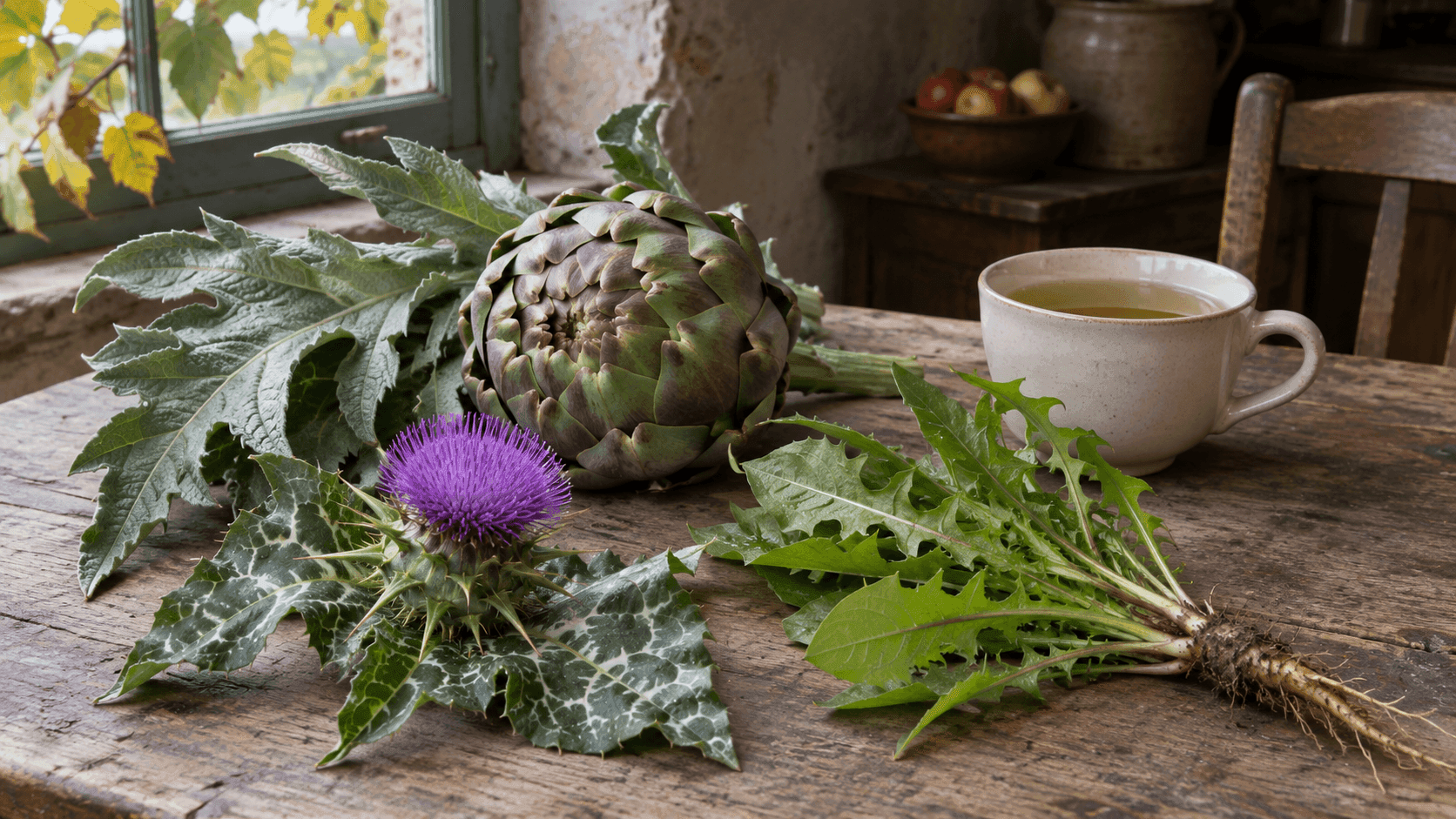
In autumn, meals get richer, and that's when I bring out my other bitter cups. In the vegetable patch, the big artichoke leaves, grey and deeply cut, are still there. Those leaves, dried, are what the books give when digestion is hard going, when you feel too full, bloated, with wind. A cup is 1.5 g of cut leaves in 150 ml of boiling water, covered for about ten minutes, up to four times a day, or else 3 g once or twice. It's for over 12s, and it's even more bitter than dandelion.
And then there's milk thistle, that tall thistle with white-marbled leaves. That one I don't grow: I buy its whole seeds. I bring it out for the holidays and family meals, when I know in advance I'll leave the table too full. I crush 3 to 5 g of seeds in the mortar, pour 100 ml of boiling water over them, cover for a quarter of an hour, strain, and drink this little cup before the meal. Two or three times a day at most, for adults only, and for a few days, not the whole season. Its whole story is in my page about milk thistle.
“Seasonal plants, I don't ask them to wash me out from the inside. Just to keep me company when a meal is too rich.”
What these plants don't do
Everywhere you hear about “cleansing” your body every season. I won't tell you that. Neither dandelion, nor artichoke, nor milk thistle washes out your liver or your kidneys, and none of them makes you lose weight. The books recognise very simple uses for them, on the strength of long use: a sluggish digestion, a tummy that's too full, an appetite that wanders off. That's already something.
When the seasons change, what I mostly change is what's on my plate: the first bitter salads in spring, vegetable soup when autumn comes, and a walk round the garden even when it's grey. For the days when digestion is sluggish and for a bloated, tight tummy, I have other very simple habits.
What to know first
These three plants are in the same family as ragweed, chrysanthemums and chamomile: if you're allergic to one of them, you go without. No cup of dandelion, artichoke or milk thistle if you have gallstones, if your bile ducts are blocked or if your liver is giving you trouble: then it's the doctor first. Dandelion is also best avoided with a stomach ulcer, and if your kidneys or your heart aren't working well, or if you keep an eye on your blood sugar, you don't take it without your doctor's advice.
Not during pregnancy or breastfeeding, for any of the three. Dandelion and artichoke, not under 12; milk thistle, not under 18. Dandelion can give you heartburn; artichoke, a little diarrhoea, nausea or heartburn; milk thistle, a dry mouth or an upset stomach. If you take something on a doctor's orders, talk to your doctor or your pharmacist before drinking them regularly.
If you still feel just as heavy after two weeks, or if it gets worse, go and see your doctor. The same if you get a fever, pain when you pee or blood in your urine while you're drinking dandelion. And if your skin or the whites of your eyes turn yellow, or if your urine or stools change colour, you stop everything and call your doctor straight away.
This morning I raked up the leaves from the apple tree, and at the foot of the wall I saw the dandelion rosettes already starting again. They'll wait for spring. The jar of milk thistle seeds, for its part, has come out of the cupboard for the holidays. I'll write again soon.