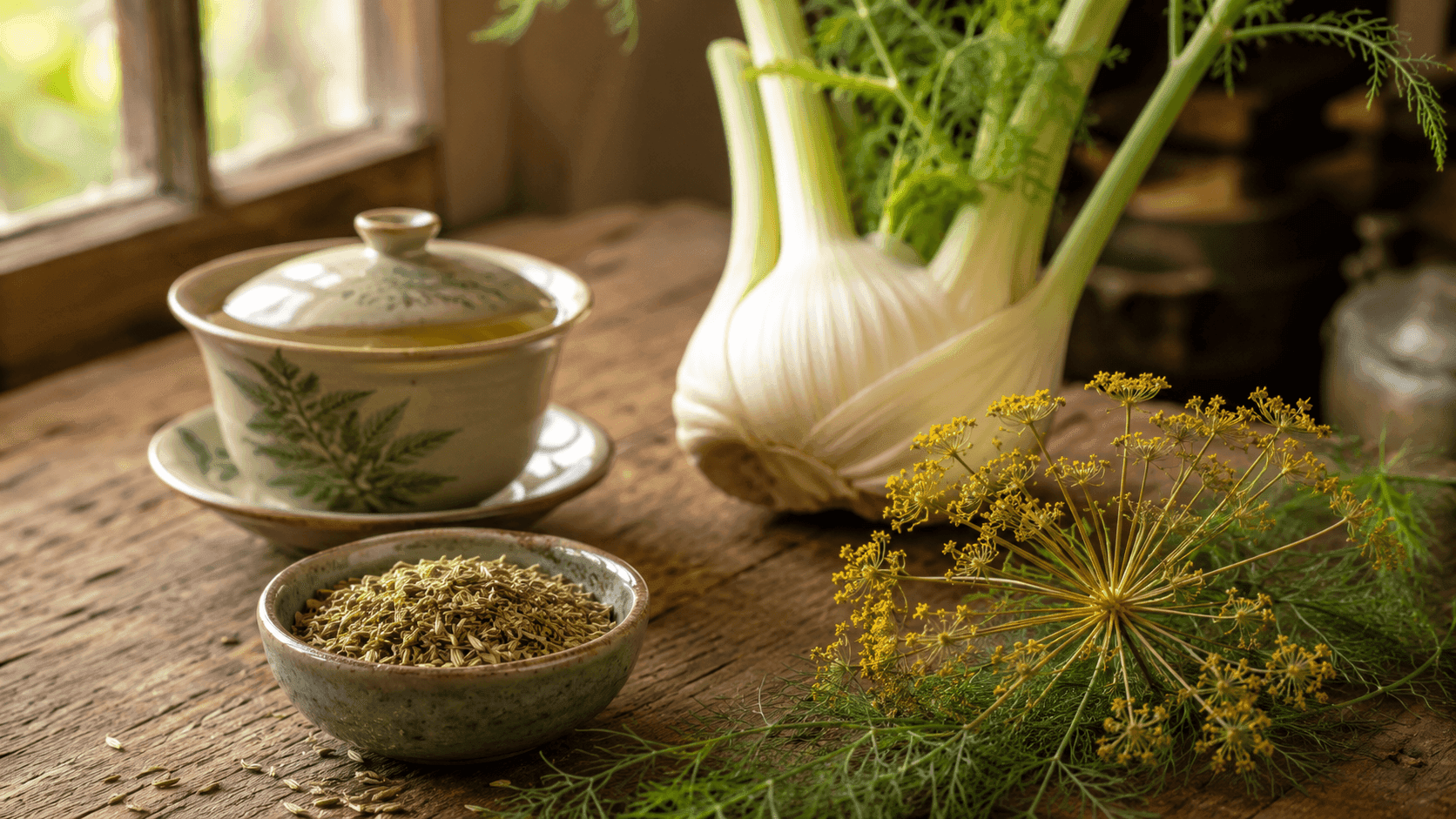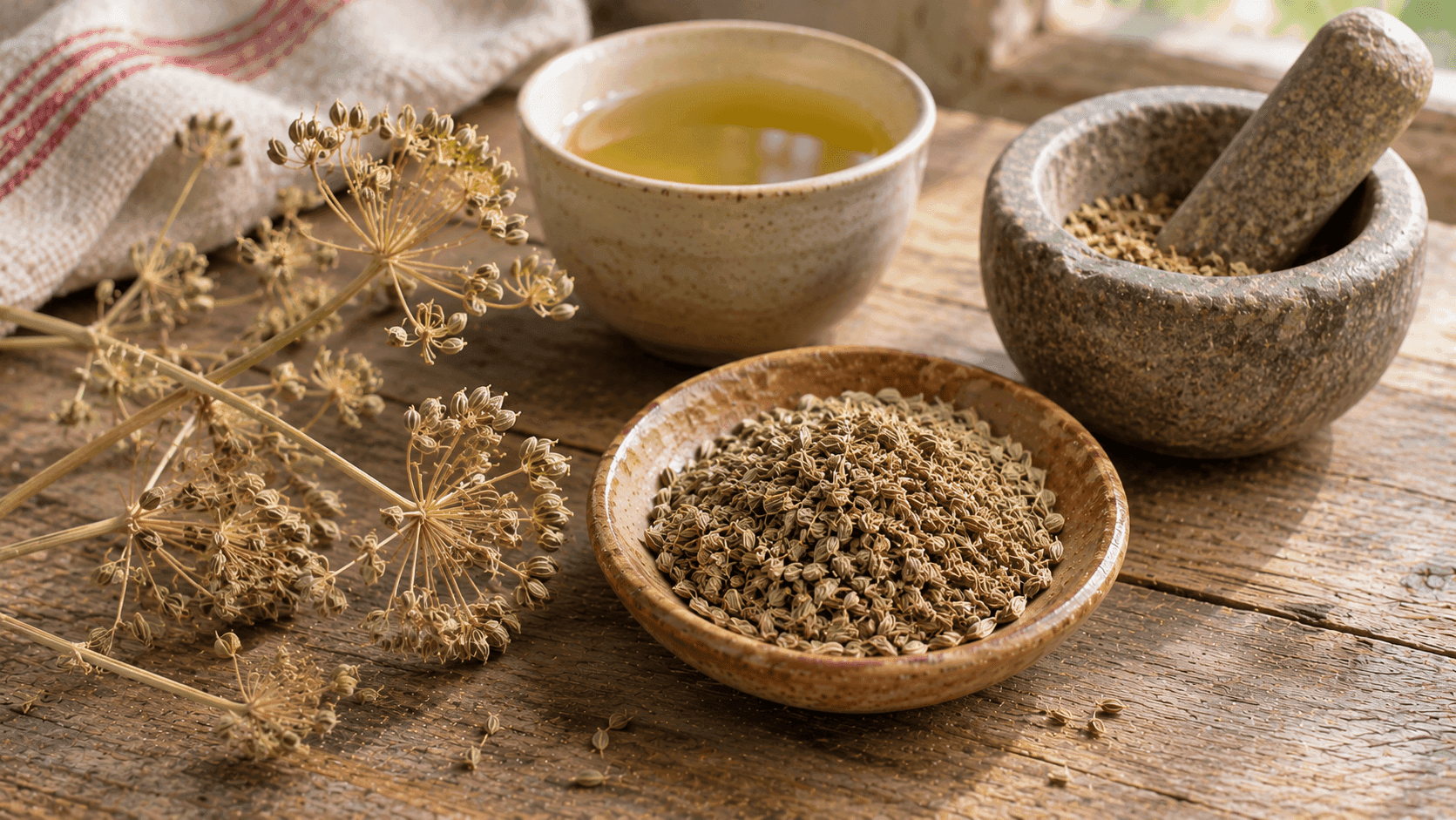
Green anise means the little grey-green seeds of a Mediterranean umbellifer: I steep them when my tummy bloats or when I cough with a cold, and I put some in my biscuits.
Who he really is
Family: Apiaceae, the umbellifers. Green anise comes from the eastern Mediterranean: from south-eastern Türkiye down to Israel, and Cyprus. Today it's grown in many places with a mild climate.
Part used: the dried fruits, which we call aniseeds.
Green anise is a small annual herb with white flowers in umbels, from the same family as carrot and fennel. What we keep are its grey-green seeds, tiny and very fragrant. Me, I steep them when my tummy bloats after a meal, and I put some in my December biscuits.
His story
Anise, or green anise as the French say so nobody gets mixed up, is a little Mediterranean herb we keep for its seeds. In my kitchen they have their own jar, right next to the fennel. But when people say "anise", they often mean something else, so let me tell you the whole thing in order.
Green anise: what kind of plant is it?
Its learned name is Pimpinella anisum. In French we call it anis vert, or just anis. It belongs to the umbellifer family, like carrot, parsley, coriander and fennel.
It's an annual: you sow it in spring, it flowers in summer, it gives its seeds and then it's gone. It grows 50 to 80 centimetres tall, on straight, hollow stems. At the bottom, its leaves are round and toothed; higher up, they turn fine and finely cut. In summer it covers itself in tiny white flowers, packed into umbels like little open umbrellas.
What we call aniseeds are really its little dried fruits. They're grey-green, oblong, 3 to 5 millimetres long, a bit downy when you look up close, and they smell strongly of anise. The whole plant smells good, mind you, leaves and flowers alike.
The French word "anis" comes from the Latin anisum, taken from Greek, and it turns up in French as early as the 13th century. In French it's mostly said "a-neess"; in Burgundy, Franche-Comté and Belgium you also hear "a-nee". Me, I don't correct anybody.
Where anise comes from: from the eastern Mediterranean to Charlemagne's gardens
Anise comes from the eastern Mediterranean. In the wild, at home, it grows from south-eastern Türkiye down to central Israel, and on Cyprus. People have grown it for a very long time: the Egyptians, the Greeks and the Romans already knew it.
According to Pliny, the Romans chewed it in the morning with a little honey to freshen their breath. That I can believe: one aniseed under your tooth and your whole mouth smells nice. For a long time people also said it brought in young mothers' milk. Today's books are more careful, and I'll come back to that further down.
Here in France, green anise is on the list in the capitulary De Villis, around the year 800: the plants Charlemagne wanted growing on his estates. Fennel is on it too.
And then there are the anis de Flavigny, from Burgundy. Each of those little round sweets is a single green aniseed coated in sugar, layer after layer. It takes fifteen days for a two-milligram seed to become a one-gram sweet. They've been made in Flavigny-sur-Ozerain since at least 1591, and you're told to let them melt without crunching. I never manage it.
Green anise, star anise, fennel: don't mix them up
When people say "anise", many think of star anise. It's not the same plant. Star anise, also called badiane, is the fruit of a tree, Illicium verum, grown mostly in China. This dried, reddish-brown fruit is shaped like an eight-pointed star, with a shiny seed in each point. It has the same scent as green anise, only stronger. And since it costs less, it has slowly taken its place in lots of drinks and sweets.
Chinese star anise doesn't worry me in itself. What worries me is its cousin, Japanese star anise, Illicium anisatum. It's toxic, and in France it's allowed neither in cooking nor in herbal tea. Whole, you can still tell it apart: its fruits are smaller and smell less of anise. But broken or ground, there's no telling them apart by eye.
At the end of 2001, people found that batches of Chinese star anise sold in France had some in them. People had seizures, among them very small children who had been given star anise tea. The authorities pulled batches, suspended the sale of star anise teas in pharmacies, and asked people to stop drinking those teas and not to use the mulled wine spice mixes that contained it. Babies and young children were the first concerned. Two years later in America, about forty people, around fifteen of them babies, were taken very ill after star anise teas, and the same advice was given there.
So in my house the rule is simple: never star anise tea for a baby or a young child, not even for colic. I buy my star anise as whole stars, never ground. A star goes in the pear compote, not in the baby's bottle.
My friend Keiko in Tokyo knows Japanese star anise well. There they call it shikimi: it's a shrub planted near temples and burned as incense. It isn't eaten.
And fennel? It's a cousin of green anise, with the same taste. But it's a tall perennial with yellow flowers, while green anise is a small annual with white flowers and smaller seeds. For the cup, neither the amounts nor the ages are the same: fennel, I tell you about on his own page. Tarragon and liquorice also have a taste that recalls anise; anise and liquorice often go together, in sweets as in pastis.
The benefits of green anise, what the books say
People often ask me whether anise is good for you. The books recognise two traditional uses for green aniseed tea, not one more.
The first is when your tummy bloats, pulls a little and there's wind, often after too big a meal. That's the cup I keep with my little steps for a swollen, tight tummy, for a tummy that pulls and for meals that won't go down. The second is when you cough with a cold: the tea helps clear things.
The cup is 1 to 3.5 g of seeds, whole or crushed in a mortar just before, in 150 ml of boiling water. I cover it, let it steep about ten minutes, and strain it. Up to three cups a day. I weighed the first time; now I can judge by eye.
And there are limits, which I respect. The anise cup is from age 12: for younger ones, the books don't have enough data. No more than two weeks in a row. If it doesn't settle, or if it gets worse, you stop and go and see your doctor. Pregnant or breastfeeding, you go without too: people may have said for centuries that anise brought in the milk, but today's books don't advise it while breastfeeding, since nobody knows whether it's free of risk.
"Green anise is a cup for grown-ups, not a bottle for little ones."
Green aniseeds in the garden and in the kitchen
Green anise is sown in April or May, once the soil has warmed up well, straight where it's going to grow: it doesn't like being moved. It needs sun and light soil that drains well. You thin it out to leave 15 to 20 centimetres between plants.
The seeds are harvested in August and September, when the umbels turn from green to pale yellow and then brown. I cut the stems in the morning, hang them head down in a dry, airy corner with a dish underneath so nothing's lost, and once everything is good and dry, I shake them. Then into a well-closed jar, kept dry and out of the light.
The leaves can be eaten too, finely chopped into a salad or a soup. But in the kitchen it's mostly the seed you use, in gingerbread, biscuits and sugared sweets. In Alsace, for Advent, they make anisbredele, little pale anise biscuits left to dry overnight before baking. I'll give you my recipe below.
And aniseed drinks, pastis, anisette? They're made with green anise, star anise or fennel. Anisette is a liqueur, often colourless, sweeter, with no liquorice; pastis has liquorice and is at least 40 percent alcohol. That's strong drink, not a tea, and it has no place in my plant cupboard.
What I use him for
- · 01After too rich a meal, when my tummy bloats and pulls: a cup of aniseed, up to three a day, from age 12.
- · 02When I cough with a cold: the same cup, to help clear things, never more than two weeks in a row.
- · 03In the kitchen: a pinch of seeds in gingerbread or biscuits, and the young leaves chopped into a salad.
- · 04In the garden: a few plants sown in April or May, in the sun, so I can harvest my seeds at the end of summer.
How I prepare him
Granny’s little recipes
The after-dinner anise tea
After lunch or dinner, when your tummy bloats and pulls
What you’ll need
- 1 to 3.5 g of green aniseeds (weigh them the first time, after that you'll judge by eye)
- 150 ml of water, a small cup
How I go about it
- 01Crush the seeds in a mortar, or with the back of a spoon, just before.
- 02Boil the water and pour it over the seeds.
- 03Cover with a saucer and let it steep about ten minutes.
- 04Strain and drink it hot, nice and slowly.
- 05Up to three cups a day, no more than two weeks in a row, and only from age 12.
The anise cup for cold days
When you cough with a cold, up to three times in the day
What you’ll need
- 1 to 3.5 g of green aniseeds
- 150 ml of water
- 1 teaspoon of honey, if you like it sweeter
How I go about it
- 01Crush the seeds just before and put them in your cup.
- 02Pour the boiling water over, cover and let it steep about ten minutes.
- 03Strain, add the honey if you like, and drink it hot.
- 04No more than three cups of anise in the whole day, even if you also drink the after-dinner one. Only from age 12.
- 05If the cough lasts or gets worse, or after two weeks, you stop and go and see your doctor.
Advent anisbredele
In December, for an afternoon snack (start the day before, makes 3 and a half trays)
What you’ll need
- 3 good eggs
- 250 g of light cane sugar
- 275 g of plain flour (French T55)
- 15 g of green aniseeds
How I go about it
- 01The day before, whisk the sugar and eggs with a mixer for 17 minutes. Yes, 17.
- 02Meanwhile, pick over the aniseed, crush it a little if you like, and mix it into the sifted flour.
- 03Tip the flour into the eggs and sugar all at once and whisk at medium speed, just until the batter is smooth.
- 04With a piping bag and a plain 10 mm nozzle, pipe little mounds like macarons, staggered, onto trays lined with baking paper.
- 05Leave them to dry overnight at room temperature.
- 06Next day, heat the oven to 200 °C, turn it down to 180 °C as you put them in, and bake 8 to 10 minutes: they mustn't brown.
- 07Let them cool before lifting them off the paper.
Elsewhere: how others know him
Fatima, my friend in Marrakech, calls aniseeds habbat hlawa. In books written in Arabic, you'll more often read yansoun. She laughs when I tell her that in English it's anise, and the seeds are aniseed: so many words for such a tiny seed.
At her place, anise goes into krachel, little round brioche buns with anise, sesame and orange flower water, served at breakfast or at tea time. She let me taste them once, still warm, next to her tray of mint tea.
Me, what I love is simpler: an anis de Flavigny melting ever so slowly, and my after-dinner cup on the days I've eaten too much.
What to know first
This information doesn’t replace advice from a healthcare professional. Health Disclaimer →
His identity card
- Name
- Green anise (anise)
- Other names
- Aniseed; anis, anis cultivé, boucage, pimpinelle anisée (in French)
- Latin name
- Pimpinella anisum L.
- Family
- Apiaceae, umbellifers
- Part used
- The dried fruits (aniseeds)
- Harvest
- August and September, when the umbels turn yellow then brown
- Form
- Whole or crushed seeds, as a tea, in cooking
- Origin
- Eastern Mediterranean: south-eastern Türkiye to central Israel, Cyprus
- Storage
- Whole seeds, in a closed jar, kept dry and out of the light
If you remember just one thing
- 01Green anise means the little dried fruits, grey-green and fragrant, of Pimpinella anisum, an umbellifer from the eastern Mediterranean.
- 02For the cup: 1 to 3.5 g of crushed seeds in 150 ml of boiling water, up to three times a day, from age 12 and no more than two weeks.
- 03Green anise and star anise share only their scent: one is a Mediterranean herb, the other the star-shaped fruit of an Asian tree.
- 04Never star anise tea for a baby or a young child. And no green anise tea before age 12, nor when pregnant or breastfeeding.
- 05Anise essential oil isn't the tea: never under 18, and a few millilitres swallowed have already caused nausea and seizures.
Your questions
They're not the same plants at all, they just share the same scent. Green anise, Pimpinella anisum, is a small herb from the carrot family, kept for its grey-green seeds. Star anise, or badiane, Illicium verum, is the dried eight-pointed star fruit of a tree grown mostly in China.
I'm not promising you anything, I'm telling you what the books say. They recognise two traditional uses for aniseed tea: when your tummy bloats and pulls after eating, with wind, and when you cough with a cold, to help clear things. It's for grown-ups, from age 12, and no more than two weeks in a row.
I crush 1 to 3.5 g of seeds just before, pour 150 ml of boiling water over them, cover and let it steep about ten minutes. I strain it and drink it hot. Up to three cups a day, no more than two weeks, and only from age 12.
Chinese star anise is a spice you find everywhere. The danger is its cousin, Japanese star anise: it's toxic, it's allowed in France neither in cooking nor in herbal tea, and you can't tell it apart once broken or ground. In 2001, very small children had seizures after star anise teas that contained it, so never star anise tea for a baby or a young child.
Not as a tea before age 12: the books lack data for younger ones. Not when pregnant or breastfeeding either, since nobody knows whether it's free of risk, even though people long said anise brought in the milk. And if you're allergic to anise, fennel, caraway, celery, coriander or dill, you go without.
In Arabic, in books, it's yansoun, and my friend Fatima in Marrakech calls the seeds habbat hlawa. In English, the plant is anise and the seeds are aniseed. And in France, most people say "a-neess", but in Burgundy, Franche-Comté and Belgium you often hear "a-nee".
References
- Community herbal monograph on Pimpinella anisum L., fructus (EMA/HMPC/321184/2012) · European Medicines Agency, HMPC, 2013
- Community herbal monograph on Pimpinella anisum L., aetheroleum (EMA/HMPC/321185/2012) · European Medicines Agency, HMPC, 2013
- Aniseed: summary for the public (EMA/305345/2016) · European Medicines Agency, HMPC, 2016
- Glossary on herbal teas (EMA/HMPC/5829/2010 Rev.1) · European Medicines Agency, HMPC, 2010
- Pimpinella anisum L. · Plants of the World Online, Royal Botanic Gardens, Kew, 2026
- Badiane interdite de délivrance · Le Moniteur des pharmacies, 2001
- Contamination de lots d'anis étoilé (badiane de Chine) et risque convulsif · Caducée.net (communiqué du ministère de la Santé), 2001
- FDA warning on star anise teas · NutraIngredients, 2003
- Anis vert · Wikipédia, 2026
- Badiane chinoise · Wikipédia, 2026
- Badiane japonaise · Wikipédia, 2026
- Anis de Flavigny · Wikipédia, 2026
- Pastis · Wikipédia, 2026
- Anisette · Wikipédia, 2026
- anis · Wiktionnaire, 2026
- Anise · Wikipedia, 2026
- アニス · Wikipedia(日本語版), 2026
- Anis vert (Vilmorin) : conseils de culture · Truffaut, 2026
- Anis vert : semis, culture, récolte · Jardiner malin, 2026
- Biscuits alsaciens à l'anis · La cuisine de Mercotte, 2024
- Anis vert · L'île aux épices, 2026
- Krachel recipe: Moroccan sweet rolls with anise, sesame and orange flower water · Taste of Maroc, 2026