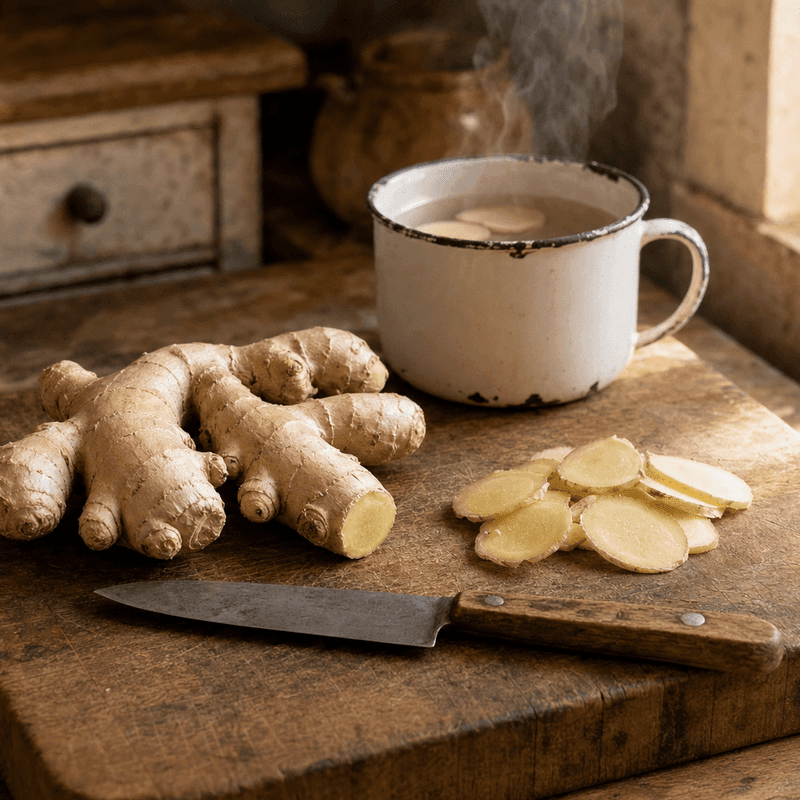
The yellow root in curry, a cousin of ginger from India. How I use it in cooking and in a little cup after meals, and why I'm wary of concentrated supplements.
Who she really is
Family: Zingiberaceae, the ginger family.
Parts used: The rhizome, the thick stem that grows underground, fresh or dried and ground.
Turmeric (Curcuma longa) is the orange root that gives curry its yellow colour. You won't find it in the wild anymore: it's a cultivated plant, born in India. Dried and ground, it's an everyday spice; in a little cup, the old handbooks give it for a belly that's too full after a meal.
Her story
Turmeric is the yellow root of a big plant that's a cousin of ginger, Curcuma longa, which is dried and ground to make the golden spice in curry. In my house it lives in a jar next to the stove, and it stains everything it touches. I'll tell you where it comes from, how I use it, and what you need to know before having it every day.
Curcuma longa, ginger's yellow cousin
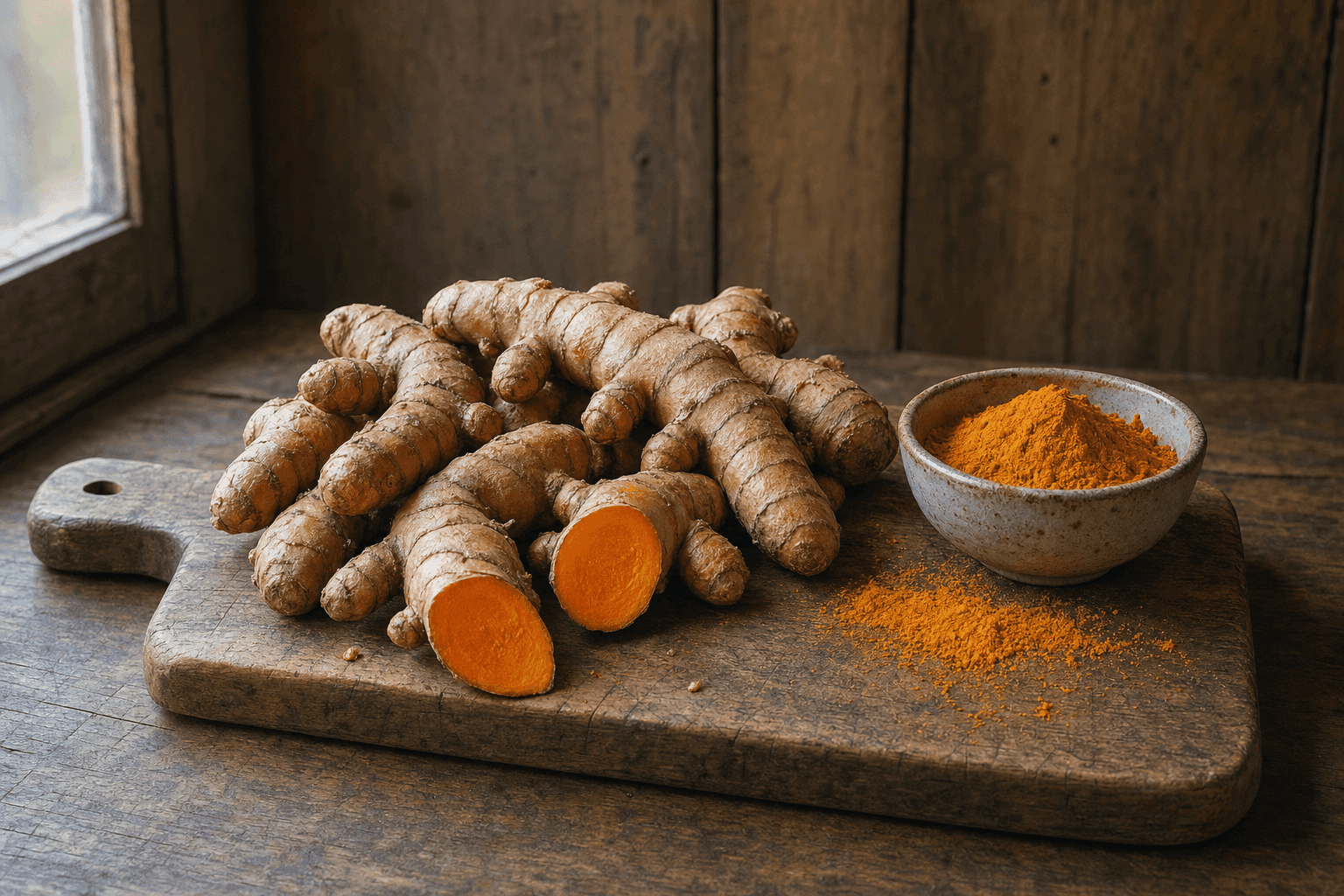
Turmeric belongs to the ginger family, the Zingiberaceae. It's a big perennial herb, about a metre tall, with long green leaves and spikes of whitish yellow flowers. But what interests us grows underground: the rhizome, a thick, knobbly stem with “fingers” branching off a central piece. Cut it open and it's bright orange inside.
It has a funny story, this one. You won't find it growing wild anywhere. Its flowers don't make seeds that come up: it only multiplies through its rhizomes, which people have been replanting from one garden to the next for centuries. The botany books say it was probably born in India from a cross between a wild turmeric and a neighbouring plant, which people kept and replanted. A plant that only exists because someone looks after it: I can relate to that.
India is still its great homeland: it grows, eats and sells more of it than anywhere else in the world. It's also grown in Bangladesh, China, Thailand and Indonesia.
People often ask me whether turmeric comes back year after year. Yes, it's a perennial. But here it doesn't like the cold, so we keep it in a pot, sheltered. You sprout a piece of rhizome at the end of winter, only put it outside once the frosts are over, and dig it up when the leaves turn yellow and dry out. Keep a few pieces somewhere dry, and you replant the next year. I have a pot of it on the windowsill. The harvest is meagre, but I like seeing those big leaves above the sink.
Turmeric through history: from Indian saffron to safran péi
In India it's been used for at least 2,500 years. At first it was surely mostly a dye, and then it found its way into the cooking pot. In the north it's called haldi; in the south, manjal. It has travelled far: it was known in China around the year 700, in East Africa around 800, in West Africa around 1200.
Over there, yellow is a festive colour. Before a wedding, the bride's face and body are rubbed with it, for luck. You give a rhizome when you visit a woman who's expecting a baby. And in some kitchens, people used to tie a little piece of it to the pots, for the happiness of the home.
In the 13th century, Marco Polo was already surprised by a plant that looked so much like saffron. In the Middle Ages, in Europe, it was called Indian saffron. But it isn't saffron: the real thing comes from a flower, a crocus, and doesn't taste the same at all.
And we have an island where it grows: Réunion. There they call it “safran”, or “safran péi”, the local saffron, and the most famous comes from the hills of Saint-Joseph. It's what gives cari, the island's curry, its colour.
My friend Li, who grew up in Hunan, taught me its Chinese name: jiānghuáng, word for word “yellow ginger”. She told me it's dug up in winter, when the stems and leaves have withered, then boiled or steamed before being dried in the sun. But what I like best is still the pinch you toss into the casserole.
Fresh or powdered turmeric: how I use it at home
The powder is the rhizome boiled, dried and then ground. It has a warm taste, a little bitter, a little peppery. It's the main spice in curry powders, and it's long been used to colour rice instead of saffron. I put a pinch in the rice so it comes out yellow as the sun, and in lentil soups.
You can find fresh turmeric at the market now, in little orange fingers. You grate it like ginger. But it stains: wear gloves, or your fingers will be yellow until the next day. It keeps in the fridge, like ginger, and you finish it within four weeks. Otherwise, in the freezer.
Turmeric and ginger go very well together, naturally, they're from the same family. In my red lentil dal I put both, with a bit of cumin and coconut milk. If you want to know what I do with its cousin ginger, I told you about it the other day.
The old handbooks give turmeric for the belly: when you feel too full after a meal, digestion is dragging and you're bloated. It's something for grown-ups, and for a few days. For meals that sit heavy on your stomach or a swollen, tight belly, I have other habits too.
And then there's golden milk. In India they drink haldi doodh: hot milk with turmeric, black pepper and a little ghee, clarified butter. Turmeric and honey are a lovely match: with a spoonful of honey it's even better. But I'd rather tell you straight: my books give turmeric for digestion, not for sleep. My evening golden milk is a pleasure, not a promise.
And the skin? In India, women used to rub it on their cheeks for a golden glow. But my books promise nothing for the skin. What I do know is that it turns it yellow, and that in some people it can cause itchy patches. So I keep it on the plate.
Is it good to have turmeric every day?
It depends how. In cooking, as a spice, yes: that's how people have eaten it for centuries, and what you swallow at the table is very little.
In a little cup for the belly, it's another matter. It's for adults, two or three cups a day at most. If after two weeks you're no better, or it's getting worse, you go and see the doctor. Not before 18, not when you're expecting a baby, not when you're breastfeeding.
And as a food supplement, concentrated, every day… that's where I put the brakes on. Those products are nothing like my pinch. Many are made on purpose to get into the blood more easily, and the body takes in far more than with ordinary powder. If you take one, talk to your doctor or pharmacist first, and don't mix several supplements.
Is turmeric dangerous for the liver? What the books say
You've probably heard about it, and I'll tell you how it is. Liver damage has been reported in people who were taking turmeric supplements. In France and Italy, more than forty cases were recorded between 2002 and 2021, including nine where the link with turmeric looks likely. It's rare, but it happens.
These cases mostly involve concentrated products, made to get into the blood more easily, taken in large doses, and often together with other products. With the small amounts my books give for the cup after a meal, none have been reported.
So, is turmeric a toxic plant? It's not the plant that's frightening, it's the dose and the form. If you're taking a supplement and you feel very tired, you're nauseous, you've lost your appetite, your urine is dark, or your skin and the whites of your eyes are turning yellow, you stop and go and see your doctor right away. And if you have gallbladder or bile trouble, no turmeric as a remedy, and ask your doctor about the rest.
Me, I stick to my pinch in the rice and my golden milk now and then. Nothing new.
What I use her for
- · 01In the kitchen, nearly every day: a pinch in the rice, in lentil soups, in the cari.
- · 02After a meal that was too heavy, when your belly feels too full and bloated, a little cup, as the old handbooks say.
- · 03In the evening, now and then, a golden milk with honey, for the pleasure of a hot cup.
- · 04Fresh, grated like ginger, with gloves on so you don't end up with yellow fingers.
- · 05In a pot on the windowsill, for its big leaves, and a little bit of harvest in autumn.
How I prepare her
Granny’s little recipes
The little after-meal cup
After a heavy meal, for adults
What you’ll need
- A level 1/4 teaspoon of turmeric powder (about 0.75 g)
- 150 ml boiling water
How I go about it
- 01Put the powder in the bottom of your cup and pour the boiling water over it.
- 02Stir well, cover and let it stand for 5 minutes.
- 03Stir again before drinking, the powder sinks to the bottom.
- 04Two or three cups a day at most. If your belly is no better after two weeks, go and see your doctor. Not before 18, not while pregnant or breastfeeding.
Evening golden milk
In the evening, for the pleasure of a hot cup
What you’ll need
- 250 ml milk (cow's or plant-based)
- 1/2 teaspoon turmeric powder
- 1 pinch of cinnamon
- 1 small pinch of ground black pepper
- 1 teaspoon honey (if you like it)
How I go about it
- 01Mix the turmeric into a splash of cold milk, so there are no lumps.
- 02Add the rest of the milk and the cinnamon, and heat gently for about 5 minutes, without letting it boil.
- 03Off the heat, add the pepper and honey, stir, and drink it hot.
Red lentil dal (serves 4)
For dinner, when it's cold
What you’ll need
- 200 g red lentils
- 1 large onion and 3 cloves of garlic
- 2 tomatoes
- 1 small can of coconut milk
- 1 teaspoon turmeric powder
- 1 teaspoon ground ginger
- 1/2 teaspoon cumin
- A drizzle of olive oil, salt
How I go about it
- 01Rinse the lentils and cook them over a low heat in the same volume of water, about 15 minutes, until they're nice and tender.
- 02Meanwhile, brown the sliced onion in the oil, then add the garlic and the tomatoes cut into small pieces.
- 03Add the turmeric, ginger and cumin, and mix well.
- 04Tip the lentils into the pan, then the coconut milk, and leave for 3 to 4 minutes over a very low heat. Salt to taste.
What to know first
This information doesn’t replace advice from a healthcare professional. Health Disclaimer →
Her identity card
- Name
- Turmeric, Indian saffron; safran péi on Réunion
- Latin name
- Curcuma longa L.
- Family
- Zingiberaceae (the ginger family)
- Parts used
- Rhizome
- Harvest
- When the leaves turn yellow and dry out, in autumn or winter
- Form
- Dried rhizome powder; fresh rhizome; a cup of powder steeped in hot water
- Origin
- India; known only in cultivation, now grown in every warm country
- Storage
- Powder in a closed jar, away from heat and light; fresh in the fridge, four weeks
If you remember just one thing
- 01Turmeric is the rhizome of a ginger cousin born in India: dried and ground, it gives curry its yellow colour.
- 02You won't find it growing wild anywhere anymore: it has travelled from garden to garden by its rhizomes, for centuries.
- 03As a spice in cooking, even every day, what you eat of it is very little.
- 04In a little cup for a heavy belly, it's for adults, two or three times a day at most, and if you're no better in two weeks, you go and see the doctor.
- 05The liver damage reported involves concentrated supplements: with those, ask your doctor or pharmacist first.
Your questions
It's the rhizome, the stem that grows underground, of a big plant in the ginger family, Curcuma longa. It's only known in cultivation, and it comes from India. Dried and ground, it gives the yellow spice in curry; it used to be called Indian saffron, but it isn't saffron.
As a spice, in cooking, yes: that's how people have eaten it for centuries, and the amounts stay small. In a little cup for the belly, it's for adults, two or three times a day at most, and no more than two weeks without seeing the doctor if it doesn't settle. As a concentrated supplement every day, ask your doctor or pharmacist first.
Rare cases of liver damage have been reported with turmeric supplements, mostly concentrated products made to get into the blood more easily and taken in large doses. None have been reported with the small amounts in the old handbooks. If you're taking a supplement and your skin or the whites of your eyes turn yellow, your urine gets dark or you feel worn out, stop and go and see your doctor right away.
As a remedy, not before 18, not during pregnancy or breastfeeding, and not at all if you have gallbladder, bile or liver trouble. If you take something on a doctor's orders, especially to thin your blood, no turmeric supplement without talking to your doctor. During pregnancy and breastfeeding, the spice in your food is still just cooking.
In India, the bride's face is rubbed with it, and women used to put it on their cheeks for a golden glow. But my books promise nothing for the skin. It turns it yellow, and in some people, put on the skin, it can cause itchy patches.
Yes, it's a perennial that grows back from its rhizomes. Here it doesn't like the cold: you grow it in a pot, put it outside after the frosts and dig it up when the leaves turn yellow and dry out. Keep a few pieces somewhere dry to replant the next year.
References
- European Union herbal monograph on Curcuma longa L., rhizoma (EMA/HMPC/329755/2017) · European Medicines Agency, HMPC, 2018
- Addendum to Assessment report on Curcuma longa L., rhizoma (EMA/HMPC/81467/2025) · European Medicines Agency, HMPC, 2025
- Avis relatif à l'évaluation des risques liés à la consommation de compléments alimentaires contenant du curcuma (saisine 2019-SA-0111) · Anses, 2022
- Turmeric · NCCIH, National Institutes of Health, 2025
- Curcuma (Curcuma longa) · Vidal, 2022
- Curcuma longa L. · Plants of the World Online, Royal Botanic Gardens, Kew, 2026
- 姜黄 Curcumae Longae Rhizoma (Pharmacopée chinoise 2020, NMM-0017) · ShennongAlpha, Westlake University, 2026
- Curcuma · Wikipédia, 2026
- Turmeric · Wikipedia, 2026
- Carry · Wikipédia, 2026
- Curcuma · Noovo Moi, 2026
- Planter du curcuma chez soi : les bons gestes · consoGlobe, 2026
- Plants de Curcuma : pot 1L · Truffaut, 2026
- Tulipe thaïlandaise (Curcuma) · Jardiner malin, 2026
- Golden Milk, la boisson dorée : recette du lait d'or · Île aux épices, 2017
- Lait d'or · ÉquipeNutrition, 2026
- Dal aux épices (lentilles) · Île aux épices, 2013