Ceylon cinnamon is true cinnamon: the thin bark of a tree from Sri Lanka, in sticks of many layers, with far less coumarin than cassia. I put it in rice pudding, and in a cup when my tummy bloats.
Who she really is
Family: Laurel family (Lauraceae). The Ceylon cinnamon tree comes from Sri Lanka, the old Ceylon, which still grows almost all of the world's crop.
Part used: the inner bark of the young shoots, dried into sticks, or ground into powder.
Ceylon cinnamon is true cinnamon: the thin inner bark of a tree from Sri Lanka, rolled into sticks of several layers. It's gentler than cassia, the Chinese cinnamon, and it holds far less coumarin. Me, that's the one I keep for everyday cooking, and for my after-dinner cup.
Her story
Ceylon cinnamon is the bark of a tree from Sri Lanka, the Ceylon cinnamon tree, dried into little rolls. It's the "true" cinnamon, the one in the old books. At my house there's always a jar of sticks in the spice cupboard, and I use it nearly every day in winter.
Ceylon cinnamon: what is it, exactly?
Its learned name is Cinnamomum verum. The old books also say Cinnamomum zeylanicum, after Ceylon, the old name for Sri Lanka. Linnaeus put it among the laurels, as Laurus cinnamomum. He wasn't wrong: it's the same family.
Left alone, it's a tree 10 to 15 metres tall, with shiny green evergreen leaves. But on the plantations, nobody lets it grow. After two years it's cut down to the ground, and the next year it comes back as a dozen young shoots. Those are what get harvested, in the rainy season.
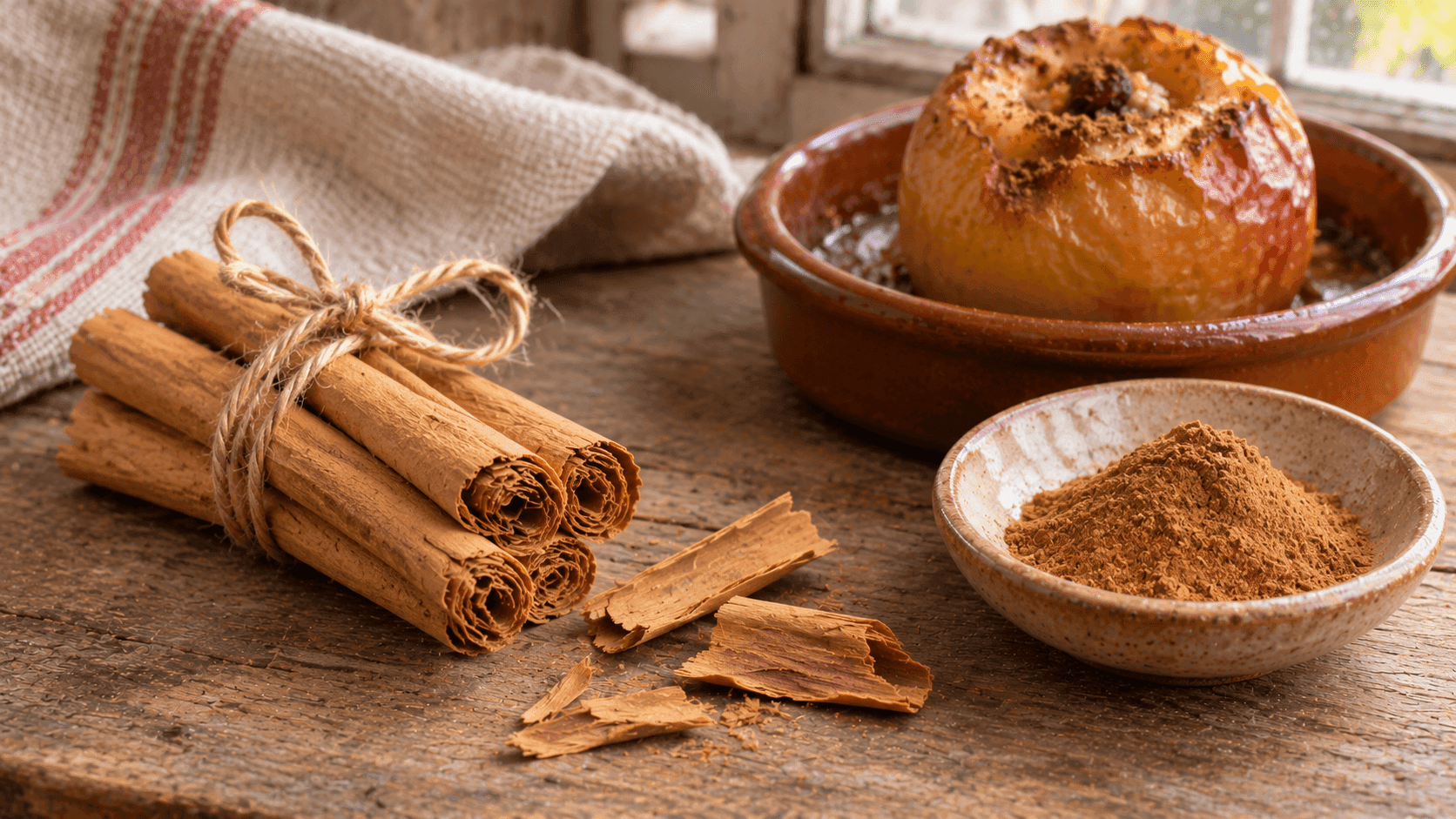
After that, it's patient work, all done by hand. They scrape off the outer bark, tap the branch to loosen the layer underneath, and keep only a skin half a millimetre thick, which rolls up as it dries. They slip these strips one inside the other, and that gives you Ceylon cinnamon sticks, full of thin layers.
The French word for cinnamon, "cannelle", comes from "canne", a reed, a little pipe, because of the shape the bark takes as it dries. It's been written in French since the 12th century. You have to admit, it's well found.
Ceylon cinnamon or cassia: how to tell the real one
I have to tell you something: most of the cinnamon sold in the world isn't Ceylon, but cassia, the Chinese cinnamon, or its cousins from Indonesia and Vietnam. Same family, but not the same bark, and above all a lot more coumarin. I'll explain further down why that matters.
With a stick, it's easy. Snap one in two and look at the cut end. Ceylon cinnamon looks like a cut cigar: lots of thin layers, rolled up tight. It's light brown, it crumbles, and a little coffee grinder gets through it with no trouble. Cassia is a single thick bark, 2 or 3 mm, reddish brown, hard as wood.
Ground, you can hardly see the difference by eye. So I read the label: I look for "Ceylon", or the Latin name Cinnamomum verum. If it only says "cinnamon", I'm wary. True cinnamon costs more, and that's why it's so often swapped for cassia in shop-bought cakes and drinks.
And then there's the taste. Ceylon cinnamon is mild, warm, fragrant, finer than cassia, which is stronger and sharper. It loses some of its scent in cooking: me, I let it steep in the milk, or I sprinkle it on at the end.
A spice for kings, legendary birds and banquet wine
Cinnamon has been known since the dawn of time. The Egyptians were bringing it in as early as 2000 years before our era, and they used it to embalm their dead. It cost so much that it was given to kings.
What I love are the stories the merchants told to keep their secret. Herodotus, the old Greek historian, believed it grew in Arabia, guarded by winged serpents, and people said huge birds gathered the cinnamon sticks to build their nests. And still in the 13th century, Joinville, who had followed Saint Louis to Egypt, reported in good faith that it was fished up in nets at the source of the Nile, at the end of the world.
In the Middle Ages, cinnamon is on every fine table. It goes into cameline sauce, one of the most common sauces of the time, and into hypocras, that wine sweetened with honey or sugar and scented with spices. The old hypocras recipes all put in cinnamon and ginger (I told you about ginger over here). People drank it before the meal, or after, to help it go down.
It's only in the 13th century that someone finally writes that cinnamon grows in Ceylon. After that, the island passes from the Portuguese to the Dutch, who end up planting their own cinnamon trees, then to the British in 1796. A Dutch captain said that when the wind came off the island, you could smell cinnamon eight leagues out to sea.
The benefits of Ceylon cinnamon: what the old books say
People often ask me what Ceylon cinnamon is good for, apart from rice pudding. I'll tell you how it is. Today's books give it for two small things, and only because it's been done for a long time: when your tummy bloats, gets gassy and cramps a little after a meal, and for a mild bout of diarrhoea. That's all. For the rest, I've heard all sorts at the market, and I'm not promising you anything.
In a cup, the books say 0.5 to 1 g of crushed bark, steeped in boiling water, up to four times a day, for adults. That's really not much: the first time, weigh it on the kitchen scales, after that you'll have the knack. I let it steep ten minutes, covered, and drink it warm. When my tummy's tight after a feast, that's my cup (for a bloated tummy, I have other little steps too).
For mild diarrhoea, careful: the most important thing is to drink, water, broth. If it lasts more than two days, if it keeps coming back, or if there's blood, you go and see the doctor without waiting. Same for the tummy: if the discomfort is still there after two weeks, or if it gets worse, it's not a matter for a cup any more. What I do when digestion drags, I've written down elsewhere, and also for the days your tummy pulls.
Those cups are for grown-ups. The books don't give them before 18, or during pregnancy or breastfeeding, for lack of data.
"Ceylon cinnamon isn't a fix for everything: it's a gentle spice, and a cup when your tummy bloats. That's already something."
The dangers of cinnamon: coumarin, the liver, and the right cinnamon for every day
Now, the important part. Cinnamons hold a fragrant substance called coumarin, the same one that smells of fresh-cut hay. Ceylon cinnamon has very little. Cassia has a lot more: around 3 g per kilo on average, and sometimes as much as 10 g.
Why does it matter? Because in some more sensitive people, coumarin can wear on the liver, even in fairly small amounts; most of the time it settles once you stop. So the books give a limit: 0.1 mg of coumarin per kilo of body weight per day, to keep to for life. With cassia, an adult of 60 kg reaches it with about 2 g a day, less than a level teaspoon. A small child of 15 kg, with 0.5 g, a good pinch.
I don't want to scare you, though. The books say that going a little over for a week or two isn't serious, and that no one has described a liver harmed by kitchen cinnamon. A cinnamon rice pudding twice a week, even with cassia, stays well under the limit for a small child. What you want to avoid is lots of cassia, every day, for a long time. So if, like me, you put cinnamon in everything, use Ceylon cinnamon.
Two more things. If you've ever had liver trouble, or if you take something on a doctor's orders that can tire the liver, the manuals say to avoid foods rich in cinnamon and cinnamon food supplements. Those supplements can hold a lot of cassia, or cinnamon essential oil: they're behind most of the problems that have been reported.
Rice pudding was the Sunday dessert at our house. My mother made it without weighing a thing, like everything in her old recipe notebook. Me, I weigh: you'll find my measures below.
What I use her for
- · 01In a cup, after a heavy meal, when the tummy bloats: 0.5 to 1 g of steeped bark, up to four cups a day, for adults.
- · 02For mild diarrhoea, in a cup too, but drinking plenty alongside, and off to the doctor if it lasts more than two days.
- · 03In winter rice pudding: a stick of Ceylon cinnamon steeping in the milk.
- · 04On baked apples: half a teaspoon of powder for four apples, with the honey and the butter.
- · 05For everyday cinnamon: Ceylon only, and cassia just now and then.
How I prepare her
Granny’s little recipes
The after-dinner cinnamon cup
After a meal that was too much, when the tummy bloats (a quarter of an hour)
What you’ll need
- 0.5 to 1 g of Ceylon cinnamon bark, in small pieces
- 150 ml of water
How I go about it
- 01Weigh the cinnamon the first time, then break it into small pieces in your cup.
- 02Bring the water to the boil and pour it over.
- 03Cover with a saucer and leave to steep for 10 minutes.
- 04Strain and drink it warm. Up to four cups a day, for adults only; if your tummy still bothers you after two weeks, go and see your doctor.
Rice pudding with Ceylon cinnamon
A Sunday afternoon, for 6 (45 minutes)
What you’ll need
- 1 litre of whole milk
- 150 g of round pudding rice
- 100 g of sugar
- 1 stick of Ceylon cinnamon
How I go about it
- 01Rinse a heavy-bottomed pan without drying it, pour in the milk, add the cinnamon stick and bring to the boil.
- 02Sprinkle in the rice and stir.
- 03When it boils again, turn down to a very low heat, cover and cook for about 40 minutes, stirring now and then so it doesn't stick.
- 04The rice should be nicely swollen, with a little milk still around it. Take out the stick, add the sugar and stir.
- 05Pour into little pots and leave to cool a little, or all the way.
Baked apples with cinnamon
An autumn evening, for 4 (40 minutes)
What you’ll need
- 4 large apples
- 4 teaspoons of honey
- Half a teaspoon of ground Ceylon cinnamon
- 50 g of butter
- A little water for the dish
How I go about it
- 01Heat the oven to 180 °C.
- 02Wash the apples and take out the cores with an apple corer. Set them in an ovenproof dish with a little water in the bottom.
- 03Put a teaspoon of honey in the middle of each apple, sprinkle with cinnamon and lay pieces of butter on top.
- 04Bake for 30 minutes, until the apples are soft and caramelised.
Elsewhere: how others know her
My daughter, who lives in Shanghai, made me laugh: over there, kitchen cinnamon is cassia. They call it ròuguì, it grows in the south of the country, in Guangxi, Guangdong and Yunnan, and it goes into the five-spice mix that gets rubbed on Cantonese roast duck. She brought me back a piece: a big thick bark, hard as wood, nothing like my Ceylon sticks.
Fatima, my friend in Marrakech, puts cinnamon even into pastilla, that big flaky pie of pigeon and almonds, sweet and savoury at once, served on feast days before the main course. The first time, I was surprised. The second time, I asked for more.
Me, what I love is simpler: a stick of Ceylon cinnamon steeping in the milk for rice pudding, on a November Sunday, while the whole house smells good.
What to know first
This information doesn’t replace advice from a healthcare professional. Health Disclaimer →
Her identity card
- Name
- Ceylon cinnamon
- Other names
- True cinnamon, Ceylon cinnamon tree
- Latin name
- Cinnamomum verum J.Presl (syn. Cinnamomum zeylanicum)
- Family
- Laurel family (Lauraceae)
- Part used
- The inner bark of the young shoots
- Harvest
- Young shoots cut in the rainy season, bark dried into sticks
- Form
- Sticks, powder, as an infusion
- Origin
- Sri Lanka
- Storage
- In a closed jar, somewhere cool and out of the light
If you remember just one thing
- 01Ceylon cinnamon is the dried inner bark of the Ceylon cinnamon tree, Cinnamomum verum, a tree from Sri Lanka: it's "true" cinnamon.
- 02As a stick, you can tell it at once: lots of thin layers rolled like a cigar, whereas cassia is a single thick, hard bark.
- 03Cassia, or Chinese cinnamon, is much richer in coumarin: an adult reaches the limit with roughly 2 g a day, a small child with 0.5 g. For everyday cinnamon, I use Ceylon.
- 04The books give it in a cup when your tummy bloats after a meal: 0.5 to 1 g of bark, up to four times a day, for adults.
- 05If you've ever had liver trouble, no foods rich in cinnamon and no cinnamon supplements; and the essential oil is never taken neat.
Your questions
With a stick, look at the cut end: Ceylon cinnamon looks like a cut cigar, with lots of thin rolled layers, light brown, and it crumbles easily. Cassia is a single thick bark, reddish brown, hard as wood. Ground, you can hardly see the difference: read the label and look for "Ceylon" or "Cinnamomum verum".
I'm not promising anything. By tradition, the books give it in a cup when the tummy bloats and gets gassy after a meal, and for mild diarrhoea, in adults: 0.5 to 1 g of bark as an infusion, up to four times a day. If the discomfort lasts more than two weeks, or the diarrhoea more than two days, you go and see the doctor.
The worry is coumarin, and cassia holds far more of it than Ceylon cinnamon. In sensitive people, a lot of coumarin over a long time can wear on the liver. With cassia, an adult of 60 kg reaches the limit with about 2 g a day, a child of 15 kg with 0.5 g. If you've ever had liver trouble, avoid foods rich in cinnamon and cinnamon supplements.
In cooking, if you use it often and a lot, choose Ceylon cinnamon: it holds very little coumarin. Cassia you keep for now and then. In a cup, it's up to four times a day for an adult, and if your tummy still bothers you after two weeks, you ask the doctor.
It's mild, warm and fragrant, finer than cassia, which is stronger and sharper. It loses some of its scent when it cooks a long time: I let it steep in the milk, or sprinkle it on at the end.
Me, I don't use it at home. It's very concentrated: neat, it irritates the mouth, and the books don't give it before 18. The supplements that contain it are behind most of the problems reported with cinnamon. If you really want to, ask your pharmacist first.
References
- Community herbal monograph on Cinnamomum verum J.S. Presl, cortex (EMA/HMPC/246774/2009) · European Medicines Agency (HMPC), 2011
- Addendum to assessment report on Cinnamomum verum J.S. Presl, cortex (EMA/HMPC/601683/2020) · European Medicines Agency (HMPC), 2021
- Community herbal monograph on Cinnamomum verum J.S. Presl, corticis aetheroleum (EMA/HMPC/706229/2009) · European Medicines Agency (HMPC), 2011
- Glossary on herbal teas (EMA/HMPC/5829/2010 Rev.1) · European Medicines Agency (HMPC)
- FAQ on coumarin in cinnamon and other foods · Bundesinstitut für Risikobewertung (BfR), 2012
- Compléments alimentaires à base de plantes contenant de la coumarine : attention à la surconsommation · Anses, 2021
- Coumarin in flavourings and other food ingredients with flavouring properties · EFSA Journal, 2008
- Cinnamomum verum J.Presl · Plants of the World Online, Royal Botanic Gardens, Kew, 2026
- Cannelle (étymologie) · CNRTL (ATILF, CNRS)
- Cannelier de Ceylan · Wikipédia, 2026
- Cannelle · Wikipédia, 2026
- Cinnamon · Wikipedia, 2026
- Cinnamomum verum · Wikipedia, 2026
- Cinnamomum cassia · Wikipedia, 2026
- Hypocras · Wikipédia, 2026
- Five-spice powder · Wikipedia, 2026
- Pastilla · Wikipédia, 2026
- Cannelle · Liebherr FreshMAG, 2026
- Riz au lait · Cuisine Culinaire, 2026
- Des pommes au four comme chez mamie · Demotivateur Food, 2026