My cherry stone heat bag, made with the stones of summer
The stones from June's cherries, washed, dried in the sun and sewn into a cotton bag: that's my dry winter heat bag. I'll tell you how to make it, and how to heat it without burning yourself.
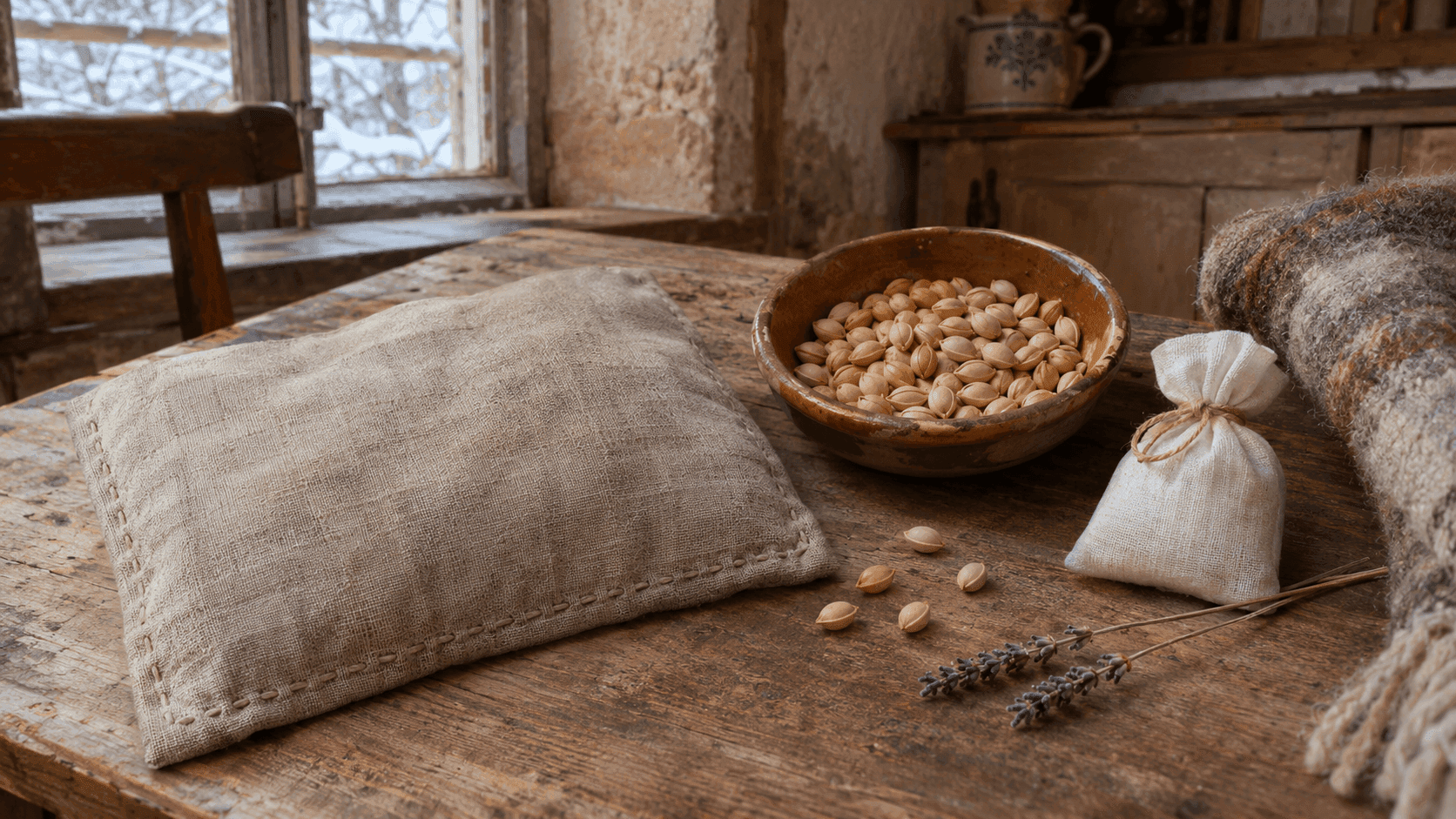
A cherry stone heat bag is a little cotton bag filled with very clean, very dry cherry stones, heated briefly in the microwave and laid on your knees or your tummy. I sewed mine with the stones of summer. I'll tell you how I wash them, how I sew the bag, and above all how I heat it without burning myself.
The stones of summer: how I clean them for my heat bag
In June, when the cherries come, I put a big bowl in the middle of the table. My grandson spits his stones into it, aiming from a distance, and I pretend not to see. By the end of the season, there are enough to fill a bag.
- I leave them to soak for a few hours in a basin of cold water.
- I rub them between my hands until there isn't a scrap of flesh or stalk left.
- I rinse them in clean water, two or three times, until the water stays clear.
- I spread them in a single layer on a tea towel, in the sun, and stir them now and then. I leave them several days, until they are dry right through and smell of nothing.
If any flesh or damp is left, the bag ends up smelling stale.
A dry heat bag: you heat it a little, you always test it, and you never fall asleep with it. The rest is pure pleasure.
Sewing a dry cherry stone heat bag, with the lavender on the side
I need:
- two rectangles of thick cotton or linen, about 20 by 25 cm (an old tea towel does the job very well);
- strong cotton thread;
- enough to fill the bag about two thirds: in my house, the stones of a whole summer.
- Lay the two rectangles one on top of the other, right sides together, and sew three sides, twice, with small tight stitches, so not a single stone escapes.
- Turn the bag right side out and fill it two thirds: it has to stay soft, to fit around the neck or the tummy.
- Fold the edges of the last side inwards and close it with small stitches, twice as well.
No zip, no button, no forgotten pin: nothing metal, since the bag goes in the microwave. I also sew a cotton cover, a little bigger, that goes in the washing machine.
And the lavender? I don't put the flowers in with the stones: they would go through the microwave with them, and I don't want to toast them. All summer, the heat bag waits in the wardrobe, next to my sachets of true lavender: two or three heaped tablespoons of very dry flowers in a square of cotton. I dry the flowers in bunches, heads down, like all my July herbs. In winter, once the heat bag is warm, I slip one of those sachets into the cover, against the bag. It's for the smell, nothing more. Never essential oil on the heat bag: the oil soaks into the fabric, and it catches fire more easily.
If you haven't kept any stones, a flaxseed heat bag is sewn the same way, in a tightly woven fabric, because the seeds are tiny. To heat it, the same rules apply.
Heating your cherry stone heat bag without burning yourself
This is where you need to listen to me. A dry heat bag heated too long can burn the skin, and the stones can even start to smoulder and catch fire. So in my house, it's always the same:
- A shop-bought heat bag, I follow its instructions and I keep them. If I'm not sure of my microwave's power, I take the shortest time given.
- A homemade heat bag has no instructions, and nobody can say in advance how long it needs. So I start short, one minute, then add a little at a time, feeling it in between, and I never go over three minutes in all.
- I put a bowl of water next to it in the microwave, I check the turntable turns properly, and I stay in front of it the whole time. I check the timer too: thirty minutes instead of three is easy to key in by mistake.
- When I take it out, I shake it and knead it, because the heat is never the same all over, and the stones keep heating for a while afterwards.
- Before putting it on me, I test the heat: in my hands first, then against the inside of my wrist. And always in its cover, never straight on the skin.
- To heat it again, I wait until it is completely cold, which can take two hours. I leave it to cool on the draining board, not on the bed or the sofa, and I only put it away cold.
- In the oven, I don't heat it: I haven't found a safe time or temperature anywhere for a homemade heat bag, so I'm not going to make one up for you.
In the evening, I put it on my knees in the armchair, under my feet, on my tummy when my tummy is tight, or low on the belly on period days. But I don't slip it into the bed to warm the sheets, and I don't fall asleep with it. Under the duvet, the heat stays trapped, the heat bag keeps heating, and that's how beds catch fire. For the bed, I have an extra blanket and wool socks.
No dry heat bag for babies or young children. For very old people, and for anyone who doesn't feel heat well on their skin, you need a great deal of care: they can burn without feeling it, or without being able to take it off in time. If that's you, or someone you look after, another person checks the heat, and nobody is ever left to sleep with it. If you're allergic to lavender, leave the sachet out.
And look at your heat bag now and then: fabric wearing thin, a seam giving way, that's the time to sew a new one. If it smells burnt, if it smokes or if the fabric has scorched, stop everything, let it cool on the draining board, and throw it away.
Tonight, the rain is on the roof tiles and the stove is purring. The heat bag is on my knees, and when I move, I hear the stones rolling inside, like a little sound of gravel. It smells of lavender, and a little of June. Until the next letter.