My grandma's eggnog, lait de poule, the warm bowl before bedtime
My grandma's lait de poule recipe for one bowl, alcohol-free: an egg yolk, sugar, hot milk and a pinch of nutmeg. With where this old eggnog comes from, and what to know about the egg.
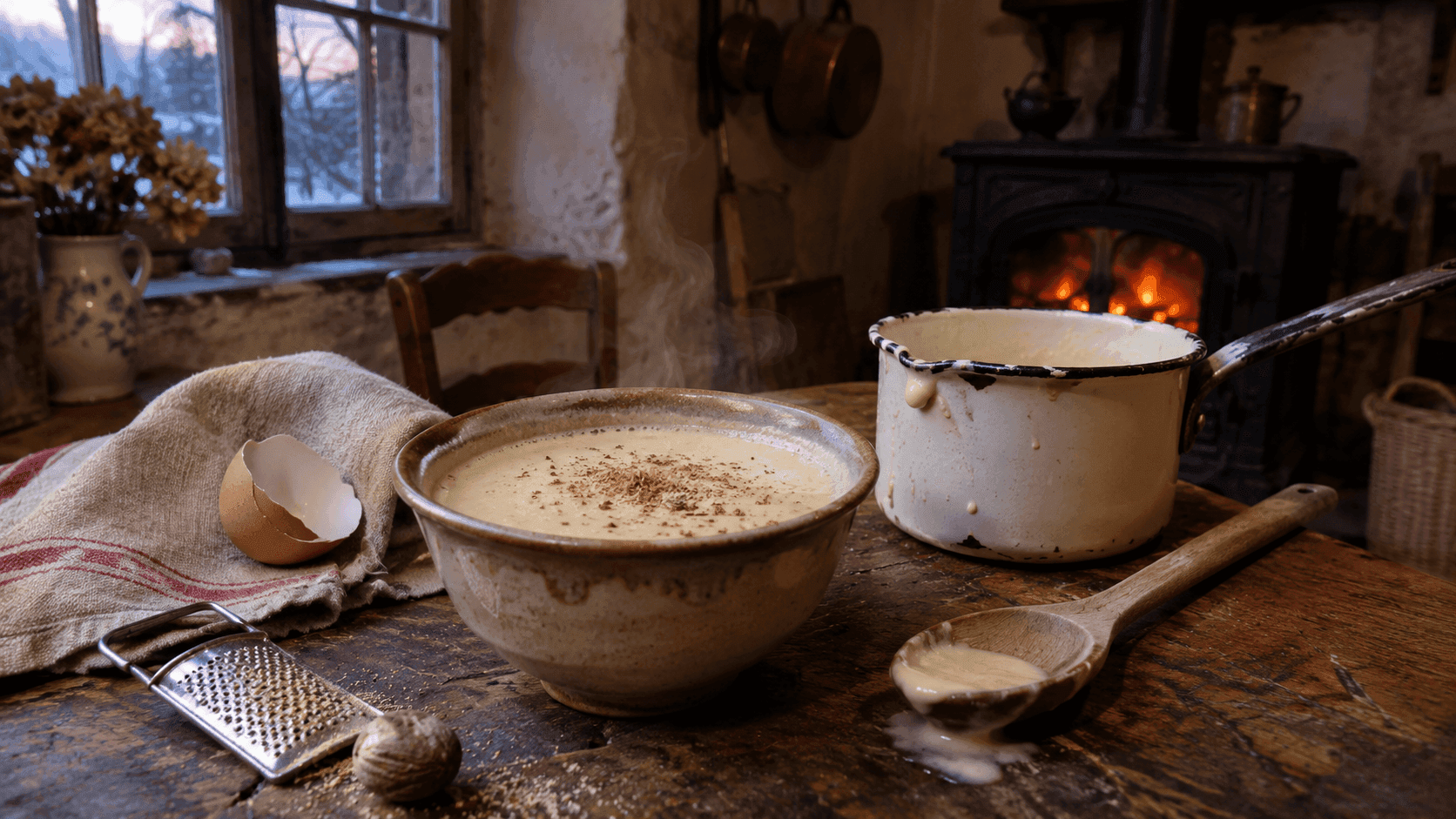
Lait de poule, in my house, is an egg yolk whisked with a little sugar, hot milk poured over it, five minutes on low heat and a pinch of grated nutmeg. It's the French cousin of eggnog. I'll give you my grandma's recipe for one bowl, alcohol-free, where this old drink comes from, and what to know about the egg before you drink it.
My mother's lait de poule, on winter evenings
At the end of November, night falls before five. We bring in the logs, close the shutters early, and the kitchen becomes the only room that's really warm. That's the season when my mother took out the little enamel saucepan, the one with a chip on the rim, to make the evening lait de poule.
She made it on evenings when we came home from school soaked, or when one of us dawdled at the table without finishing their soup. An egg from the hen house, a drop of milk, the sugar, and the nutmeg grater she kept in the drawer of the dresser. We drank it sitting by the stove, in our nightclothes, both hands around the bowl. After that, it was bed, no arguing.
I'm not going to tell you it makes you sleep: I don't know that, and the books don't say so. It's a warm, gentle bowl at the end of the day, that's all. On evenings when sleep is slow to come, I have other habits, and I told you about them separately: what I do when sleep won't come. And on evenings when I don't feel like milk, it's a cup of linden, or my evening tea with three plants.
We drank it sitting by the stove, in our nightclothes, both hands around the bowl. After that, it was bed, no arguing.
The tradition of lait de poule: kings, a pharmacist and Christmas
Lait de poule is much older than my mother. The books say nobody knows exactly where it comes from. One idea has it born in the east of England, from a hot milk of the Middle Ages, curdled with ale or wine, sweetened and spiced, called a posset. Eggs were supposedly added from the 13th century, and it became a winter drink.
In France too, it has its little story. They say that in 1270, Saint Louis, on his deathbed, refused a lait de poule because it was a fast day, and that Philip the Fair did the same in 1314. In Madame Bovary, the pharmacist Homais makes some, and in Anouilh, Antigone's nurse talks about the laits de poule she made for the girls "to make them strong".
Today it's mostly a Christmas drink, for the English and the Americans who call it eggnog. Over there, they often add cream, and many pour in rum, bourbon or whisky. It has even been sold without alcohol since the 1960s. Mine is my mother's: hot, no cream, no alcohol, the children's bowl before bed.
My grandma's lait de poule recipe, alcohol-free
For one bowl:
- 1 egg yolk, very fresh;
- 2 teaspoons of sugar, about 10 g;
- 200 ml of whole milk;
- 1 small pinch of grated nutmeg, no more.
- In a bowl, whisk the yolk with the sugar for a good minute, until the mixture turns pale and a little frothy.
- Heat the milk in a small saucepan until it just starts to simmer, then take it off the heat.
- Pour the hot milk over the yolk, little by little, whisking without stopping: otherwise the egg cooks into lumps.
- Pour everything back into the saucepan and cook on low heat for about 5 minutes, stirring all the time, until the milk thickens a little and coats the spoon. Above all, don't let it boil.
- Pour it into the bowl, grate the pinch of nutmeg on top, and drink it straight away, nice and hot.
If you like, add a pinch of cinnamon with the nutmeg, or heat the milk with a little piece of split vanilla pod, which you take out before pouring it over the egg. My mother only used nutmeg, and that's still how I like it best. For two bowls, double everything and allow a few more minutes on low heat.
For the holidays, some people add a spoonful of rum. I don't: my mother's lait de poule was the children's drink, and I keep it that way.
Before you drink your lait de poule: the egg, the nutmeg and the alcohol
A raw egg can carry salmonella, even when its shell is intact, and eggs and dishes made with raw eggs are behind nearly half of the group food poisonings caused by these bacteria. That's why my lait de poule is always cooked, until it coats the spoon: at that point, it reaches about 71 °C. I never make it with a yolk simply beaten into lukewarm milk.
For pregnant women, children up to 5, older people and anyone with weakened defences, it's this cooked version and no other: no raw egg, and no barely cooked egg. For everyone, use very fresh eggs, kept at a steady temperature (always in the cold, or always at room temperature), and don't wash them before putting them away. Drink your lait de poule as soon as it's ready: you don't keep it for the next day. And if someone is allergic to egg or milk, this bowl isn't for them.
Nutmeg is a spice: a small pinch per bowl, not a spoonful. Swallowed in large amounts, it's toxic, and the manuals put that, for an adult, at one to three whole nutmegs. Keep the nutmegs and the grater up high, away from little hands.
And if, for the holidays, someone pours rum into it, that bowl isn't for a pregnant woman or one who is breastfeeding, nor for children and teenagers, nor for whoever has to drive.
There. My enamel saucepan is soaking in the sink, the bowl is empty, with a little ring of nutmeg at the bottom. Outside, frost is forming on the panes of the shed. I'm going up to bed. Until the next letter.