My iced hibiscus tea, the bissap of summer afternoons
The jug comes out of the fridge all misted up, a deep red. Here's my iced hibiscus tea, bissap, with my measurements, and what you need to know before you drink it.
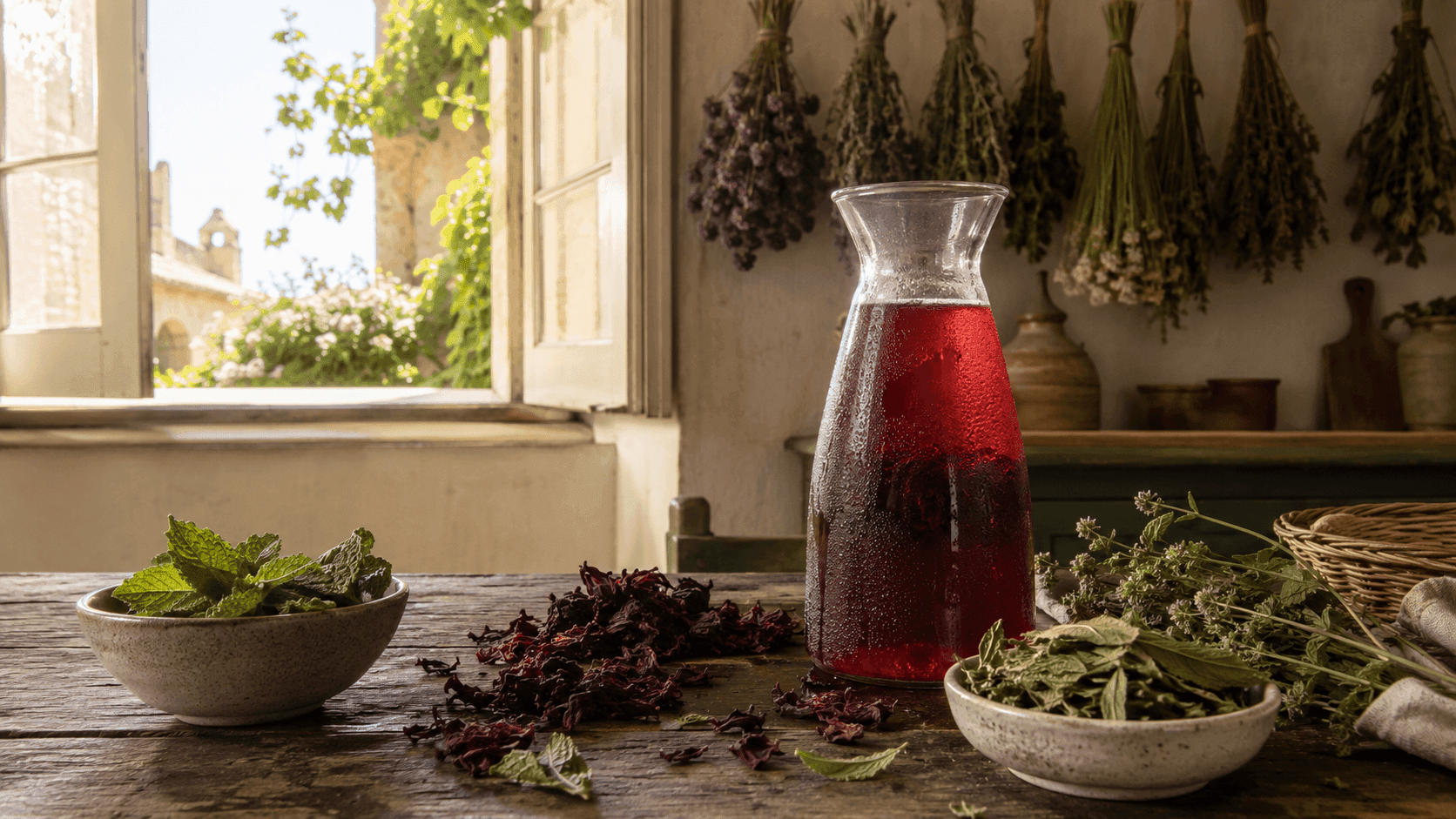
See that jug on the table, all covered in mist? That's my iced hibiscus tea, bissap. It's just come out of the fridge. The window is open onto the garden, and there are still dried calyces scattered on the board, next to the bowl of mint. Sit down, I'll pour you a glass and tell you about it.
Bissap, the iced hibiscus tea that came from Africa
The hibiscus in my jug isn't the one in hedges, or the one you keep in a pot in the living room. It's Hibiscus sabdariffa, also called Guinea sorrel. And you don't drink the flower: you drink the calyx, that little red, fleshy cup that swells around the fruit once the petals have dropped. Dried, it turns a bit tough, a purple that's almost black, and it smells of tart fruit as soon as you open the bag.
The books say it probably comes from Africa, and that it has made its way round every hot country. Each one gave it a name. In Senegal, it's bissap. In Egypt, karkadé, often drunk hot, like tea. In Mexico, flor de Jamaica, which they turn into a cool drink. In the Caribbean, groseille pays. In Senegal and Mali, the iced juice is sold along the roads and in the markets, and when they boil the calyces, they sometimes add mint or ginger. Me, it's mint.
It doesn't grow at my place: it needs far more warmth than my garden can give it. So I buy it dried, by weight, and keep it in a well-closed jar, away from heat, light and damp. If you'd like to know more about it, I've written down everything I know about hibiscus.
Hibiscus doesn't promise you anything. It quenches your thirst on an August afternoon, it looks beautiful in the glass, and that's already a lot.
My iced hibiscus tea recipe, step by step
For six glasses, you need 80 g of dried hibiscus calyces, 1.5 litres of water, 150 g of cane sugar (less if you like it tarter), a few fresh mint leaves, and ice cubes to serve.
- Rinse the calyces quickly in cold water.
- Bring the water to the boil, add the calyces and let them simmer 10 to 15 minutes over a low heat.
- Take it off the heat and strain, pressing the calyces well.
- Add the sugar while it's hot, and stir until it has melted.
- Add the mint, let it cool, then put it in the fridge for at least 2 hours. Serve with ice cubes.
Let's talk about the sugar. Hibiscus is very tart, so bissap gets a lot of it. I put in a little less than the recipe, I taste, and I adjust. If you find it too sharp, one more leaf of my garden mint often does the trick. Bissap keeps three to five days in the fridge, in a well-closed bottle. At my house, it never lasts that long.
For the whole summer, I also make a syrup. In a saucepan I put 25 g of calyces, 350 g of brown sugar and 350 ml of water, I bring it to the boil, stirring until the sugar has melted, then I let it simmer 15 minutes on a low heat. I let it cool completely, strain it, and pour it into a glass bottle: in the fridge, it easily lasts a month. My grandson tops it up with cool water when he comes to see me; he says it's prettier than grenadine. He's not wrong.
What I promise you, and what you need to know first
I'll be straight with you. You'll read everywhere that hibiscus does this or that. In my books, I found nothing solid enough to promise it to you, so I don't. Bissap is a drink: it quenches your thirst, it looks beautiful in the glass, and it wakes up your mouth. When it's very hot, it doesn't replace water. Water, you drink regularly, without waiting to be thirsty, and bissap comes on top.
Now the precautions, and I'm not leaving any out. If you're pregnant or breastfeeding, you go without: we don't know enough about whether it's safe. For children, the books give nothing precise: before giving it to them regularly, ask your doctor or your pharmacist. If you take something on a doctor's orders for blood pressure, for blood sugar or for cholesterol, talk to your doctor before drinking it regularly: the handbooks say hibiscus can interfere, and that blood pressure and blood sugar then need watching. No hibiscus in the two weeks before a planned operation. And if you're allergic to plants in its family, the Malvaceae, you go without.
A word about quantity. The handbooks that look at hibiscus as a health plant count on a light cup, 1.25 to 1.5 g of calyces, up to three times a day, and no more than six weeks in a row. My bissap is much stronger than that, and much sweeter. So I keep it for pleasure: a glass now and then, not a jug every day. In some people, it upsets the stomach a little. If something isn't right, you stop and ask your doctor or your pharmacist for advice.
Before I let you go
Yesterday, I opened the bag too fast and everything spilled onto the table. There were calyces everywhere, even under the bowl of mint, and the kitchen smelled of tart fruit. I picked them up one by one, with the window open and the wasps circling the vine trellis outside. If you'd like other jugs for afternoons when the heat hits hard, I wrote you my cold teas for the hottest days. Until the next letter.