Ease a blocked nose
Grandma's remedies for a blocked nose and a cold: saline in your nose, water to drink and your head a little higher at night. And know when it's time to see a doctor.
Reviewed by Ruosi Wu, PhD in Pharmacy, MD in Traditional Chinese Medicine
For a blocked nose, start by washing it with saline, blow your nose, drink water and keep the bedroom cool, between 18 and 20 °C. At night, sleep with your head a little higher (a baby, though, always flat). Most of the time it's a cold that clears up on its own in about ten days. If the fever climbs, if your face swells or if it won't go away, don't go looking for a herbal tea: go and see a doctor.
Key takeaways
- A blocked nose gets washed first: saline or sea water in each nostril, then you blow your nose into a disposable tissue.
- At night, I sleep with my head a little raised, in a bedroom at 18-20 °C, aired, with no air conditioning and no tobacco smoke.
- A baby, though, always sleeps flat on its back, with no pillow and no head wedge: you wash its nose before feeds and just before bed.
- No eucalyptus or peppermint essential oil in a child's steam: under 2, they can cause a spasm of the throat that stops breathing.
- A fever over 38.5 °C with a swelling face or eye, or a baby under 3 months with a fever: get urgent medical help.
Granny’s little steps
- Wash the nose with saline
Saline or a sea-water spray in each nostril, then a disposable tissue. For a child, single-dose vials, never tap water.
- Blow your nose and wash your hands
Blow your nose as often as you need to, into disposable tissues, and wash your hands often, or use hand gel.
- Drink water regularly
Water all through the day, so you don't get dehydrated. Offer children a drink too, even if they don't ask.
- A cool, aired bedroom
Around 18 to 20 °C, aired every day, with no air conditioner and no tobacco smoke. And don't wrap up too much.
- Head raised at night
An extra pillow, so the air gets through better. But a baby always sleeps flat on its back, with no pillow and no head wedge.
A recipe to try
The evening cup of linden when your nose is stuffed
In the evening, before bed
What you’ll need
- 1.5 g of dried linden flowers, with their bract
- 150 ml of water
- A single-dose vial of saline
- An extra pillow
How I go about it
- Bring 150 ml of water to the boil and pour it over 1.5 g of linden flowers.
- Cover and leave to steep for 10 minutes, then strain.
- While it steeps, wash your nose with saline and blow it into a disposable tissue.
- Drink your cup hot, not scalding, taking your time.
- Open the bedroom window for a few minutes, then shut it: the room should stay around 18 to 20 °C.
- Slip an extra pillow under your head and put some tissues on the bedside table.
- For a child aged 4 to 12, 1 g of flowers instead of 1.5 g. No linden under 4, nor during pregnancy or breastfeeding.
A blocked nose is eased first with salt water and a little patience: saline in your nose, a tissue, a glass of water, a cool bedroom and an extra pillow. I'll tell you what I do, the plants I keep for those evenings, what I don't do (especially with the little ones), and when it's time to go and see someone.
Blocked nose: why it happens, especially in winter
Most of the time, a blocked nose is a cold. Your nose runs, then it blocks up, you sneeze, your throat scratches a bit. The books say a cold clears up on its own in 7 to 10 days. That doesn't make the nights any shorter, I know.
In winter, we shut ourselves in and turn the heating up. Air conditioning, for its part, dries out the air and the inside of your nose, and tobacco smoke doesn't help one bit. At home, my mother opened the windows every morning, even in January, while we made the beds. I do the same.
And then there's the nose that blocks up without a cold: again and again, with sneezing fits, a clear runny nose, red eyes that water and itch, and no fever. In spring or summer it's often pollen; all year round, it can be dust mites. That's an allergy, and it's the doctor who sorts it out, not a herbal tea.
When blocked sinuses join in, it hurts under your eyes, sometimes on one side only, and it lingers. I've put those signs in the list further down, with what to do.
What to do when your nose is blocked: my everyday steps
The first step is washing. I put saline or a sea-water spray in each nostril, then I blow my nose into a disposable tissue and throw it away straight off. Blow your nose as often as you need to, and wash your hands often, or use hand gel: the grandchildren aren't the only ones who touch everything.
I buy saline at the chemist's, in little single-dose vials. For children, you don't use tap water or mineral water: they aren't salty enough and can carry germs. So I don't make any in the kitchen, not for them and not for me.
Next, drink. Water, regularly, so you don't get dehydrated, and offer some to the children even if they don't ask. A hot cup counts too, I'll come back to that.
And the house: a bedroom at around 18 to 20 °C, no warmer, rooms aired every day, no air conditioner, and no tobacco smoke. Don't wrap up too much either: your body heat needs somewhere to go. If your throat joins in too, I have a page for a tickly throat.
Grandma's remedies for a blocked nose, and what I keep of them
Maybe you're looking for a grandma's remedy that unblocks your nose in one go. I don't know of one. In my house, plants keep you company on cold evenings; they don't do magic.
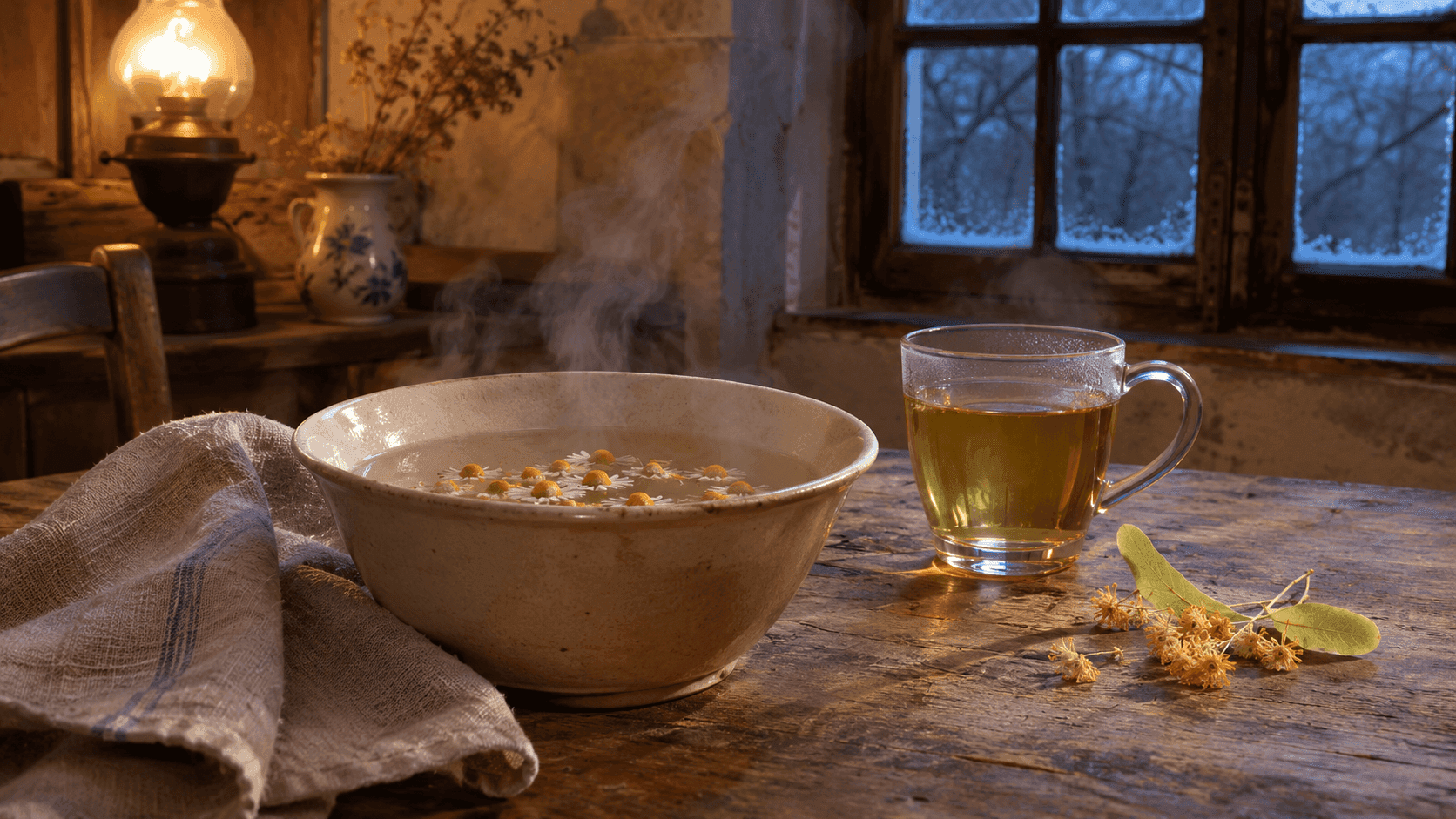
Chamomile, as steam. The books give chamomile steam for when you have a cold. I put 3 to 10 g of dried flowers in a bowl, pour 100 ml of very hot water over them, sit at the table with a towel over my head and my eyes closed, and breathe. I won't promise you it unblocks anything: doctors say there's no real proof that steam clears the nose, and every winter hospitals see people burned by a steam inhalation, children most of all. So the bowl sits firmly on the table, never on your lap, and no little ones nearby. What else I do with chamomile, I tell you there.
Linden, in the cup. The old handbooks give linden when you've caught a chill, from the first signs. I put 1.5 g of flowers, with their bract, in 150 ml of boiling water, cover it and wait 10 minutes. Two to four cups a day at most. It warms you, it gets you drinking, and it marks a pause before bed. My linden and its flowers, this way.
Elderflower, when it's starting. The books also give a tea of dried elderflowers, nice and hot, at the first signs of a cold: 2 to 5 g in 150 ml of boiling water, three times a day, and only from age 12. The black elder from the hedgerows, I talk about it here.
Echinacea, for a few days only. The books also give its root at the first signs of a cold, for a few days, and only from age 12. It isn't for everyone: not if you're allergic to the daisy family, not when pregnant or breastfeeding, and not when your body's defences are in question. I explain when to take echinacea, for how many days, and who it isn't for.
Peppermint, as essential oil, for the big ones. By tradition, its essential oil is breathed in over hot water when your nose is stuffed with a cold: the books count 0.08 to 0.16 ml, three times a day at most, and only from age 12. Never near a little one's nose. Everything I know about peppermint.
Eucalyptus. Its oil is the one in the pharmacy books for a cough with a cold, breathed in as steam. But it has to be handled seriously: never under 2, never for a child who has ever had convulsions, and not during pregnancy or breastfeeding. For essential oil blends to breathe in, the French pharmacopoeia goes further: not for children, and not for pregnant or breastfeeding women. If you want some for yourself, ask the pharmacist and follow the leaflet.
And thyme? Everyone drops a sprig into their bowl of hot water. My books, though, don't give it for the nose: they give it as a tea when a cold makes you cough up phlegm, and not before age 12. So my thyme, I keep it for the cup.
"A blocked nose, you wash it, you let it breathe and you give it time. The rest is for comfort."
Blocked nose at night: sleep with your head up (except babies)
It's often at night that it bothers you most. People advise sleeping with your head raised so the air gets through better: I slip in a second pillow, and I keep tissues on the bedside table.
Before bed, my little ritual: one last nose wash, the cup of linden not too late, the bedroom window open for a moment then shut, and the radiator set so the room stays between 18 and 20 °C.
For a baby, it's the other way round: you always lay it on its back, flat, on a firm mattress, with no pillow, no head wedge, no cushion, even with a cold. Its nose gets washed with single-dose vials of saline: baby lying on its side, head turned, the tip in the upper nostril, then you start again on the other side with another vial if the nose is still blocked. You do it before feeds, so it doesn't bring the milk back up, and just before bed, 4 to 6 times a day, more if its nose is very stuffed. The nasal aspirator, use it sparingly: it unblocks less well and can irritate.
And for children, no steam over a bowl: they're the ones who get burned most. No essential oils either. Saline, water to drink, a cool bedroom, and you keep a good eye on them: the list of what should send you to a doctor is just below.
Which plants?
ElderSambucus nigra
The hedgerow shrub with white flower umbrellas: flower tea and syrup, jam from cooked berries. How to tell it from dwarf elder, and what you never eat.
PeppermintMentha x piperita
Peppermint is the mint with the stinging cold taste, born from water mint and spearmint: a cup of the leaves after a meal that sits heavy, and the essential oil kept apart.
LindenTilia cordata / Tilia platyphyllos
Linden is the big tree on village squares. Its dried flowers, with their bract, make the evening cup and the one for days when you've caught a chill.
ChamomileMatricaria chamomilla L.
Chamomile means two little flowers for your cup: German chamomile, mild, and Roman chamomile, bitter. For a bloated tummy, an irritated throat, skin that's got too hot.
What to know first
Steam and burns: a bowl of very hot water burns, and children are the most at risk. Keep the bowl steady on the table, your eyes closed and out of the steam, and no steam inhalation for children. The books don't give chamomile steam before age 6. And there's no real proof that steam clears the nose.
Chamomile: not if you're allergic to chamomile or to plants of its family, the Asteraceae, the daisy family. Serious allergic reactions have been reported: if you have trouble breathing, or if your face or throat swells, call 15 (the French emergency number) straight away.
Essential oils (eucalyptus, peppermint): never for a child under 2: menthol and eucalyptol can cause a reflex stop in breathing and a spasm of the larynx. Never for a child who has ever had convulsions, with or without fever. Peppermint oil breathed in, not before age 12; eucalyptus oil breathed in, not before age 3, and not during pregnancy or breastfeeding. Essential oil blends for inhalation are not given to children, to pregnant or breastfeeding women, or to adults who have had convulsions or have epilepsy: camphor, eucalyptol or menthol have caused serious effects on the nervous system (convulsions, drowsiness, agitation), especially in children. Don't swallow them, keep them away from the eyes, never on a little one's face, nose or chest, and keep the bottle out of children's reach.
Linden: not before age 4 (1 g per cup from 4 to 12), and not during pregnancy or breastfeeding, for lack of data. If it lasts more than a week, see a doctor.
Elderflower: not before age 12, not during pregnancy or breastfeeding, and not if you're allergic to elder. If it lasts more than a week, gets worse, or if you have trouble breathing, a fever or discoloured phlegm, see your doctor.
Medicines that unblock the nose: with a cold, the advice is not to take oral decongestants (pseudoephedrine): rarely, they can cause a heart attack or a stroke, whatever the dose and duration. Since December 2024 in France, they are only dispensed on prescription. Decongestant nasal sprays are contraindicated for children under 15.
Nose washing: saline or a sea water made for the nose, in single-dose vials for children. No tap water or mineral water: they aren't salty enough and can carry germs. For a baby, before feeds, so it doesn't vomit.
Babies' sleep: always on the back, flat, on a firm mattress, with no pillow, duvet, head wedge or cushion, even with a cold, in a bedroom at 18-20 °C.
When to see your doctor
- With a fever over 38.5 °C, your face or an eye swells, or your eye hurts: call 15 or 112 (French emergency numbers), or go to A&E.
- With a fever over 38.5 °C, your vision blurs or an eye seems to bulge out: call 15 or 112, or go to A&E.
- With a fever over 38.5 °C, an intense, unusual headache, with nausea or light bothering you: call 15 or 112, or go to A&E.
- A child with a fever over 39 °C, very tired, a nose running like pus and swelling around one eye: call 15 or go to A&E.
- A baby under 3 months with a fever: get urgent medical help.
- A child of any age with a fever of 40 °C or more: get urgent medical help.
- A child who has trouble breathing: get urgent medical help.
- A child who is drowsy, responds poorly when you stimulate them, or cries weakly: get urgent medical help.
- A child who is very pale, or has purplish spots on the skin: get urgent medical help.
- A child with violent headaches, vomiting or unexplained crying, even without fever: get urgent medical help.
- A child with heavy diarrhoea or vomiting that could dehydrate them: get urgent medical help.
- You have trouble breathing or swallowing: see a doctor quickly.
- You have intense headaches: see a doctor quickly.
- You are vomiting: see a doctor quickly.
- Your fever goes above 38.5 °C: see a doctor quickly.
- You have a bad pain in one ear: see a doctor quickly.
- You have conjunctivitis (red, sticky eyes): see a doctor quickly.
- Your symptoms suddenly get worse: see a doctor quickly.
- Your symptoms haven't eased after 15 to 20 days: see a doctor quickly.
- Sinus pain that gets stronger despite 48 to 72 hours of treatment to ease it: your GP the same day.
- Pain in a single sinus that spreads down towards the teeth: your GP the same day.
- A runny nose that increases, turns like pus and comes from one nostril only: your GP the same day.
- Throbbing pain on one side, worse when you lean your head forward, at the end of the day or at night: your GP the same day.
- A fever under 38.5 °C with moderate pain under the eyes for more than three days: book an appointment with your GP in the next few days.
- A cold (blocked nose, cough, sneezing) lasting more than a week, with sinus pain appearing: book an appointment with your GP in the next few days.
- A child whose fever has been over 38.5 °C for more than three days: have a doctor see them.
- A child whose fever starts after 3 days of a cold: have a doctor see them.
- A child whose blocked nose, runny nose or cough hasn't improved after ten days: have a doctor see them.
- A child with earache, or whose ear has discharged: have a doctor see them.
- A child with conjunctivitis with pus or swollen eyelids: have a doctor see them.
- A child who has trouble feeding, is vomiting or has diarrhoea: have a doctor see them.
- A child whose behaviour changes in a way that worries you: have a doctor see them.
- You have a long-term condition (diabetes, chronic lung disease, weakened immune defences) and you have a cold: see your GP.
- Your nose blocks up or runs again and again, with sneezing fits, a clear discharge and no fever: talk to your GP, who will look into whether it's an allergy.
Your questions
Blocked nose: what should I do?
First, wash it: saline or a sea-water spray in each nostril, then a disposable tissue. Next, drink water, keep the bedroom around 18 to 20 °C, aired and free of tobacco smoke, and sleep with your head a little raised. Most of the time it's a cold that clears up on its own in 7 to 10 days.
How do I unblock my nose at night?
A nose wash just before bed, an extra pillow to raise your head, and a cool bedroom, around 18 to 20 °C, with no air conditioner. I add a cup of linden in the evening. But for a baby, never a pillow: it sleeps flat on its back.
Is steam inhalation a good idea for a blocked nose?
It's an old habit, and the books give chamomile steam when you have a cold: 3 to 10 g of flowers in 100 ml of very hot water. But there's no real proof that steam clears the nose, and a bowl of hot water burns. So keep the bowl steady on the table, for grown-ups only, never for children.
Can I put eucalyptus in a child's steam?
I don't. Eucalyptus oil, like peppermint oil, can cause a spasm of the throat under age 2, and it isn't given to a child who has ever had convulsions. For essential oil blends to breathe in, the French pharmacopoeia says no for all children. For them, it's saline, water to drink and a cool bedroom.
How do I unblock a baby's nose?
With single-dose vials of saline: baby lying on its side, head turned, the tip in the upper nostril, then the other side with another vial. Before feeds and just before bed, 4 to 6 times a day. No tap water, no essential oils, and if baby is under 3 months and has a fever, get urgent medical help.
How long does a blocked nose last?
With a cold, about ten days: the books say it clears up on its own in 7 to 10 days. For an adult, if it hasn't gone after 15 to 20 days, or if it suddenly gets worse, see your doctor. For a child, if the blocked nose hasn't improved after ten days, show them to the doctor.
References
- Rhinopharyngite ou rhume de l'adulte : que faire et quand consulter ? · ameli.fr, 2026
- Rhinopharyngite de l'enfant : que faire et quand consulter ? · ameli.fr, 2026
- Sinusite aiguë : que faire et quand consulter ? · ameli.fr, 2026
- Comment pratiquer un lavage de nez chez un enfant ? · ameli.fr, 2026
- Comment bien coucher un bébé ? · ameli.fr, 2024
- Rhinite allergique et rhume des foins : symptômes et causes · ameli.fr, 2026
- Rhinite allergique et rhume des foins : diagnostic et traitement · ameli.fr, 2026
- En cas de rhume, évitez les médicaments vasoconstricteurs par voie orale ! · ANSM, 2024
- Formulaire national 2023 : mélanges d'huiles essentielles destinés à l'inhalation · ANSM, Pharmacopée française, 2023
- European Union herbal monograph on Eucalyptus globulus Labill.; Eucalyptus polybractea R.T. Baker; Eucalyptus smithii R.T. Baker, aetheroleum, Revision 1 (EMA/HMPC/320292/2023) · European Medicines Agency, HMPC, 2024
- European Union herbal monograph on Mentha x piperita L., aetheroleum, Revision 1 (EMA/HMPC/522410/2013) · European Medicines Agency, HMPC, 2020
- European Union herbal monograph on Matricaria recutita L., flos (EMA/HMPC/55843/2011) · European Medicines Agency, HMPC, 2015
- Community herbal monograph on Tilia cordata Miller, Tilia platyphyllos Scop., Tilia x vulgaris Heyne or their mixtures, flos (EMA/HMPC/337066/2011) · European Medicines Agency, HMPC, 2012
- European Union herbal monograph on Sambucus nigra L., flos, Revision 1 (EMA/HMPC/611512/2016) · European Medicines Agency, HMPC, 2018
- Community herbal monograph on Thymus vulgaris L. and Thymus zygis L., herba (EMA/HMPC/342332/2013) · European Medicines Agency, HMPC, 2013
- NHS and British Burn Association issue public safety warning: steam inhalation causes burns · Royal Devon University Healthcare NHS Foundation Trust, 2025
Information. This information is provided for general knowledge and doesn’t replace medical advice. Check with a healthcare professional before any use.
Health Disclaimer