Itchy bites
An insect bite that itches or hurts? Ice wrapped in a cloth, no scratching, a wash with soap and water. And I’ll tell you when it’s time to call 15.
Reviewed by Ruosi Wu, PhD in Pharmacy, MD in Traditional Chinese Medicine
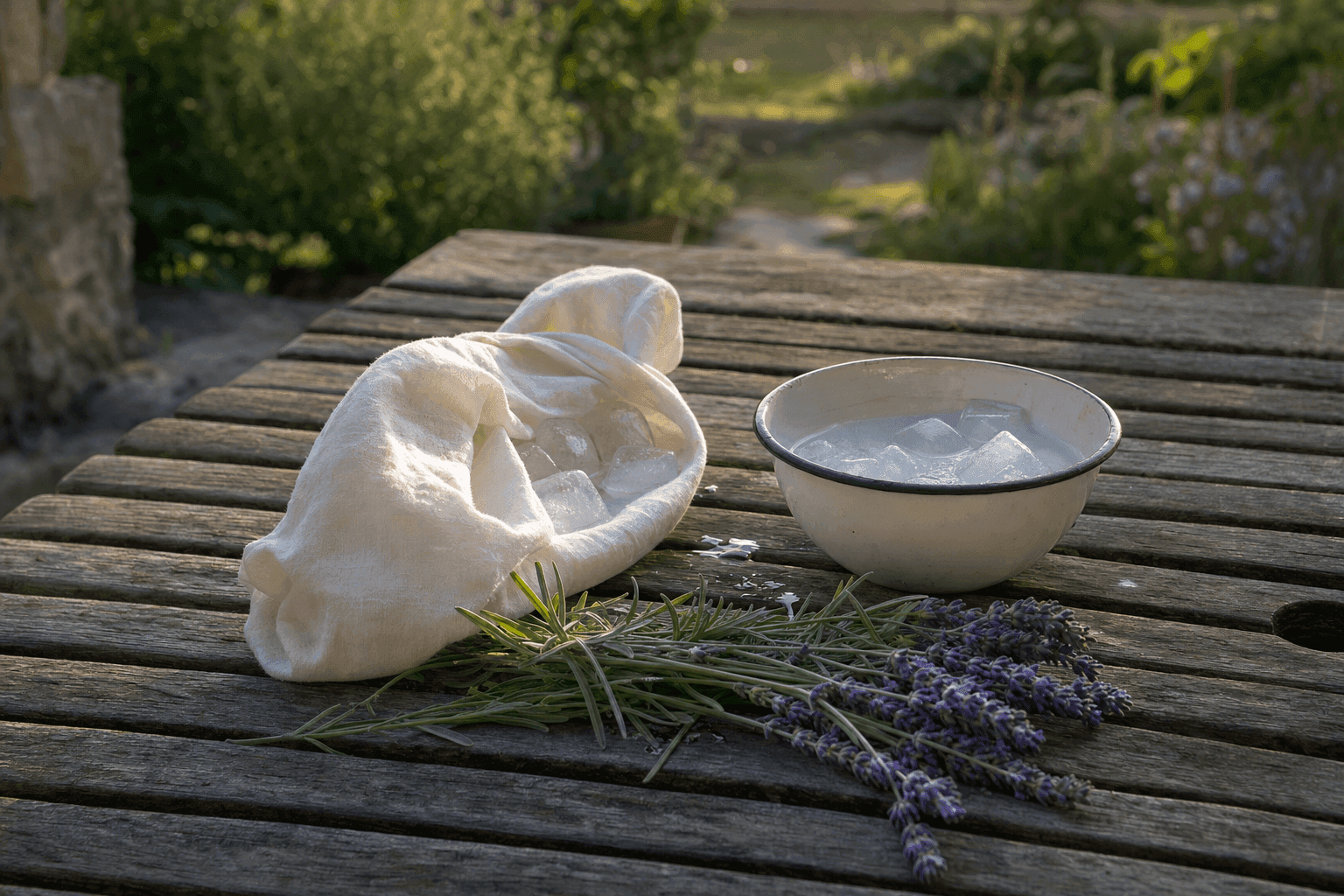
For an insect bite, put ice wrapped in a cloth on it straight away, don’t scratch, and wash with soap and water. After that, a cold chamomile compress on skin that feels hot, or, for the itching, a diluted peppermint preparation for the older ones. If the face or throat swells, or you can’t breathe well, call 15 or 112.
Key takeaways
- For an insect bite, the first thing to do is cold: ice wrapped in a cloth, never straight on the skin, and no more than fifteen to twenty minutes.
- No scratching: wash with soap and water, and when it itches, gently rub the palm of your hand over the bite.
- The lavender sprigs in my ice pack are for the smell: it’s the cold that does the work.
- For the itching, the books give a diluted peppermint essential oil preparation, on skin that isn’t broken, from 4 years old and never under 2.
- Tongue, lips or throat swelling, trouble breathing or swallowing after a sting: call 15 or 112 (the emergency numbers in France) right away.
Granny’s little steps
- Cold, in a cloth
A few ice cubes in a clean tea towel, laid on the bite, never ice straight on the skin. Fifteen to twenty minutes at most.
- No scratching
When it itches, gently rub the palm of your hand over the bite, or dab it with a little cool water.
- Wash the bite
Soap and water, then an antiseptic for a wasp or bee sting.
- Take out the stinger or the tick
A bee stinger is scraped out with your fingernail or the edge of a card, without pinching it. A tick comes off with a tick remover, without putting anything on it first.
- Take off your rings and sit down
Stung on the hand? Take your rings off straight away. After a wasp or a bee, stay quiet for half an hour.
A recipe to try
The ice pack with lavender sprigs
Right after the bite, in the garden or when you get back from a walk
What you’ll need
- 4 or 5 ice cubes
- A clean cotton tea towel
- 2 or 3 sprigs of lavender from the garden, for the smell (if you have some)
How I go about it
- Put the ice cubes in the middle of the tea towel and lay the lavender sprigs next to them.
- Fold the tea towel into a little pack, so there’s always cloth between the ice and the skin.
- Lay the pack on the bite, without pressing hard.
- Leave it for fifteen minutes, never more than twenty, then take it off.
- If it starts itching again later in the day, start over with fresh ice cubes. The sprigs aren’t rubbed on the bite: they’re there for the smell.
For an insect bite, the first thing to do is cold: a few ice cubes in a tea towel, laid on the bite, and above all, no scratching. Then you wash with soap and water, and you keep an eye on it. At my house, the ice pack always has two sprigs of lavender slipped inside, for the smell of summer. Here’s what I do, and the point where it stops being a grandma’s business.
Insect bites: mosquito, wasp, harvest mite or tick, they’re not the same
Not all bites look alike, and it helps to know who got you. Mosquitoes, horseflies and ants are usually nothing serious: they leave a bump that itches like mad.
Wasps, bees, hornets and bumblebees are another story: they sting with a stinger and leave venom. At first it hurts, it swells, it goes red, and usually it’s gone in a few hours. A bee leaves its stinger stuck in the skin, and it dies from it. So the sting that hurts most, around here, is that one: the mosquito makes you itch, the wasp makes you hurt. On the face or the neck, it can swell a lot and fast, and in the mouth or throat, it can get in the way of breathing: then you don’t hang about.
Harvest mites, you can’t see them: they’re tiny mites. From April to September, they leave red, itchy patches where clothes are tight, under the waistband, the elastic of your socks or your bra, and in the folds of the skin. Me, it’s after mowing the lawn in August that I find them. For those, a hot shower is what’s advised. And the tick doesn’t bite in passing: it stays attached, you have to take it off, and you keep an eye on the spot for a month.
What to do after an insect bite: cold first
Cold is my first move, and it’s also what the health books say. I take four or five ice cubes, wrap them in a clean tea towel, and lay the little pack on the bite. Never ice straight on the skin: the cloth is there so it doesn’t burn it. And no more than fifteen to twenty minutes at a time.
In my tea towel, I always slip two or three sprigs of lavender from the garden. They’re not what makes the bite go away, the cold is. The lavender is so my ice pack smells of summer rather than of the freezer.
Then, no scratching. I know, that’s the hardest part. When it itches, gently rub the palm of your hand over the bite, or dab it with a little cool water: it freshens the skin and calms the itching. With my grandchildren, I keep their nails short and keep their hands busy.
Then you wash, with soap and water, and for a wasp or a bee, you put on an antiseptic afterwards. If the bee’s stinger is still there, take it out quickly by scraping it with your fingernail or the edge of a card, without pinching it: if you pinch, you squeeze the venom sac. Stung on the hand? Take your rings off straight away. After a wasp or a bee, stay quiet for half an hour: me, I sit on the garden bench with the ice pack on my arm. If it hurts, some paracetamol, and check that your tetanus jab is up to date. If it’s still itchy the next day, the pharmacist has antihistamine creams.
For a tick, no ice: you take it off as fast as you can with a tick remover from the pharmacy, without putting anything on it first, no ether or any other product. You slide the hook in flat against the skin and turn while pulling gently, without crushing it. You disinfect, you wash your hands, then for a month you measure the redness every day and take a photo of it: if it grows, you have something to show the doctor.
Grandma’s plants for an itchy insect bite
Plants don’t replace the cold: they come after, and I choose them carefully.
Lavender. The old handbooks put true lavender among the plants people put on the skin, and they mention insect bites. But the big plant books don’t give either the method or the amount for the skin. So I won’t tell you to dab it neat on the bump: my lavender goes in sprigs in the ice pack, for the smell. Essential oil is very concentrated: not under 12, not during pregnancy or breastfeeding, and ask your pharmacist before using it.
German chamomile. The books give its cooled compress for small skin irritations, like skin that got hot in the sun. I also lay it on a red bite that feels hot, once the cold has done its job. I put 3 to 10 g of dried flowers in a bowl, pour on 100 ml of boiling water, cover for ten minutes, strain and let it cool completely. I soak a clean cloth, wring it out a little and lay it on the bite, away from the eyes, several times a day. It’s for over-12s, and if you’re allergic to ragweed or chrysanthemums, you go without. It’s the same compress as for skin that has had too much sun, and everything I know about chamomile is over here.
Peppermint. Here, it’s not the leaf that counts, it’s the essential oil. The books give it by tradition when it itches in one particular spot, on skin that isn’t broken. Never neat: a ready-made diluted preparation, which your pharmacist will give you, in a thin layer, three times a day at most, no more than two weeks. Not on a bump scratched until it bleeds, and wash your hands afterwards. Not under 4, and never under 2: in very little ones, menthol can suddenly stop their breathing. Not for a child who has already had convulsions either, nor during pregnancy or breastfeeding. My peppermint, I tell you about it there.
Keeping insect bites away in the garden and on walks
For wasps and bees, I wear light, covering clothes when I garden, I leave the perfume in the bathroom, and I don’t linger near fallen fruit or the afternoon snack. No bare feet in the grass. A nest near the house, you stay at least five metres away, and you don’t destroy it yourself: you report it to the town hall. Against mosquitoes, repellents, a mosquito net and screens on the windows; for little ones, repellents need care, so read the leaflet and ask your pharmacist.
For ticks, on walks: long, light-coloured trousers tucked into your socks, closed shoes, a hat, and you stay on the paths, away from tall grass and ferns. When you get home, and again the next day, you look over your whole body, the armpits, the backs of the knees, the scalp, the neck, the belly button, the ears. The children too. What I take with me in summer, I’ve put in my holiday plant kit.
Grandma helps with the little bites of summer. A sting that makes the throat swell or takes your breath away, that’s 15, right away.
Which plants?
Ribwort plantainPlantago lanceolata
The five-seam herb of the paths: its young leaves in salad, its tea when your throat is scratchy, a crushed leaf on a nettle sting. And what to know first.
PeppermintMentha x piperita
Peppermint is the mint with the stinging cold taste, born from water mint and spearmint: a cup of the leaves after a meal that sits heavy, and the essential oil kept apart.
ChamomileMatricaria chamomilla L.
Chamomile means two little flowers for your cup: German chamomile, mild, and Roman chamomile, bitter. For a bloated tummy, an irritated throat, skin that's got too hot.
What to know first
Cold: never ice straight on the skin: always wrapped in cloth, so it doesn’t burn the skin, and no more than fifteen to twenty minutes at a time.
If you’re allergic to stings: always keep on you the emergency kit your doctor prescribed, with its adrenaline auto-injector pen, and learn to recognise the signs of a reaction, you and your family. At the slightest sign, the pen goes on the outer side of the thigh, then you call 15. Your doctor can also send you to see an allergist.
At the pharmacy: for pain, paracetamol. For the itching of a wasp or bee sting, an antihistamine cream, once the stinger is out and the sting has been disinfected. For a child, if you’re expecting a baby or if you’re already on treatment, ask your pharmacist for advice.
Lavender: the sprigs in the ice pack are for the smell. Lavender essential oil isn’t swallowed, never goes neat into the eyes, nose or mouth, and isn’t given under 12, for lack of data, nor during pregnancy or breastfeeding. The big books don’t give it any use on the skin for bites. Keep the bottle out of children’s reach, never with babies' care products, wash your hands after using it, and ask your pharmacist for advice before any use. If you’re allergic to lavender, you go without.
The German chamomile compress: not under 12. Chamomile is in the same family as ragweed, chrysanthemums, marigolds and daisies: if you’re allergic to one of these plants, you go without, on the skin as in a cup. Serious allergic reactions have been reported: if you have trouble breathing, if your face or throat swells, call 15 right away. No compress on the eyes or close to them: it can irritate them. If you’re breastfeeding and you put some on your skin, clean the breast well before the feed. If it isn’t better after a week, or if it gets worse, go and see your doctor.
Peppermint essential oil: never neat on the skin: only as a ready-made diluted preparation, in a thin layer, three times a day at most, and no more than two weeks in a row. Never under 2, in any form, because in very little ones menthol can cause a reflex stop in breathing and a spasm of the throat; never apply it to the face, nose or chest of a baby or young child. On the skin, not under 4. Never for a child who has already had convulsions, with or without fever. Not during pregnancy or breastfeeding, for lack of data. Not on broken or irritated skin, nor on a scratched bump, and wash your hands afterwards: it irritates the eyes. Don’t use several products containing it at the same time. Not if you’re allergic to peppermint or menthol. On the skin, it can cause redness and irritation: if anything unusual happens, stop, and if it doesn’t pass in two weeks, go and see your doctor.
Repellents: for little children, they need special care: read the leaflet and ask your pharmacist. Against ticks, DEET isn’t recommended during pregnancy or under 2; IR3535 can be used from 6 months. Treating clothes with permethrin is no longer recommended.
Ticks: don’t put anything on a tick before taking it off, no ether or any other product. If you disinfect with chlorhexidine, know that it can, rarely, cause a serious allergic reaction within the hour: hives, swelling, trouble breathing, feeling faint, that’s 15.
When to see your doctor
- After a sting, trouble breathing or swallowing: call 15 or 112 (the emergency numbers in France) right away.
- Tongue, lips, throat, eyes or face swelling after a sting: call 15 or 112 right away.
- Dizziness, feeling faint or passing out after a sting: call 15 or 112 right away, and lay the person on their side.
- Red, itchy patches all over the body (hives) after a sting: call 15 or 112 right away.
- Nausea, vomiting or diarrhoea after a wasp, bee, hornet or bumblebee sting: call 15 or 112 right away.
- Skin that turns bluish or very pale, fever or shivers after a wasp, bee, hornet or bumblebee sting: call 15 or 112 right away.
- Swelling of more than 10 cm around the sting, spreading to one or two nearby joints: call 15 or 112 right away.
- A sting in the mouth or throat: call 15 or 112 and give an ice cube to suck while you wait.
- More than 20 wasp, bee or hornet stings in an adult, or 4 or 5 in a child: call 15 or 112 right away.
- You’re allergic and you have your adrenaline pen: at the slightest sign of a reaction, inject yourself on the outer side of the thigh, then call 15.
- A bite that’s still very red, swollen and painful 24 hours later: go and see your doctor.
- After a spider bite in the south of France or in Corsica, a headache, feeling faint or cramps: go and see your doctor.
- After a tick bite, a red patch that grows around the bite, even an old one (often more than 5 cm, between 3 and 30 days later, without itching): go and see your regular doctor.
- In the weeks after a tick bite, fever, tiredness you can’t explain, pain in the joints, a red patch elsewhere on the body or a black scab where the bite was: go and see your regular doctor.
- A tick on a pregnant woman, a child under 8 or someone whose defences are weakened, a tick that stayed on for more than 36 hours, swollen with blood, or that you can’t get off: see your doctor soon.
- The tick’s head stayed in the skin: don’t keep at it, ask your pharmacist or your doctor for advice.
Your questions
What should I do right after an insect bite?
Put something cold on it: a few ice cubes in a cloth, never straight on the skin, fifteen to twenty minutes at most. Don’t scratch, wash with soap and water, and for a wasp or a bee, put on an antiseptic afterwards. If it’s a bee, scrape the stinger out with your fingernail, without pinching it. If the face or throat swells, or you can’t breathe well, call 15 or 112.
How can I tell what bit me?
A bump that itches a lot is often a mosquito, a horsefly or an ant. A sting that hurts, swells and goes red straight away is more likely a wasp, a bee, a hornet or a bumblebee, and the bee leaves its stinger in the skin. Red patches under the waistband or the elastic of your socks, from April to September, are often harvest mites. And a little creature stuck to the skin after a walk is a tick.
Which insect sting hurts the most?
Around here, it’s wasps, bees, hornets and bumblebees that hurt, because they sting with a stinger and leave venom. The mosquito mostly makes you itch. Usually, the pain of a wasp sting goes away in a few hours. If the swelling spreads a lot, or if you feel unwell, call 15.
What can I put on an itchy bite?
Cold first. After that, the pharmacist has antihistamine creams for the itching, to put on once the bite is clean. The plant books also give a diluted peppermint essential oil preparation, on skin that isn’t broken, from 4 years old and never under 2. Ask your pharmacist for advice, especially for a child or if you’re expecting a baby.
Cold or heat on a bite?
Cold, for mosquitoes, wasps and bees: ice in a cloth, fifteen to twenty minutes at most. For harvest mites, it’s the other way round, a hot shower is advised. And for a tick, neither: you take it off with a tick remover, without putting anything on it first.
When should an insect bite worry you?
Right away if the tongue, lips, throat or eyes swell, if you have trouble breathing or swallowing, if you feel unwell or if itchy patches cover the body: call 15 or 112. The same for a sting in the mouth, or for lots of stings at once. If the bite is still very red, swollen and painful after 24 hours, go and see your doctor. And after a tick, a red patch that grows around the bite needs to be shown to the doctor too.
Also worth reading
References
- Piqûres de guêpes, abeilles, frelons et bourdons · ameli.fr, 2026
- Piqûre d'insectes et d'autres animaux · Santé.fr, 2026
- European Union herbal monograph on Mentha x piperita L., aetheroleum (Rev. 1) · EMA, HMPC, 2020
- European Union herbal monograph on Matricaria recutita L., flos · EMA, HMPC, 2015
- Community herbal monograph on Lavandula angustifolia Miller, aetheroleum · EMA, HMPC, 2012
- Huiles essentielles : risques et précautions · Anses, 2024
- Lavande officinale (fiche) · Université de Liège, 2024
Information. This information is provided for general knowledge and doesn’t replace medical advice. Check with a healthcare professional before any use.
Health Disclaimer