Soothe your heavy head
Grandma’s remedies for a headache: some quiet, a big glass of water and a cool cloth on the back of your neck. Peppermint for adults, and when to call the doctor.
Reviewed by Ruosi Wu, PhD in Pharmacy, MD in Traditional Chinese Medicine
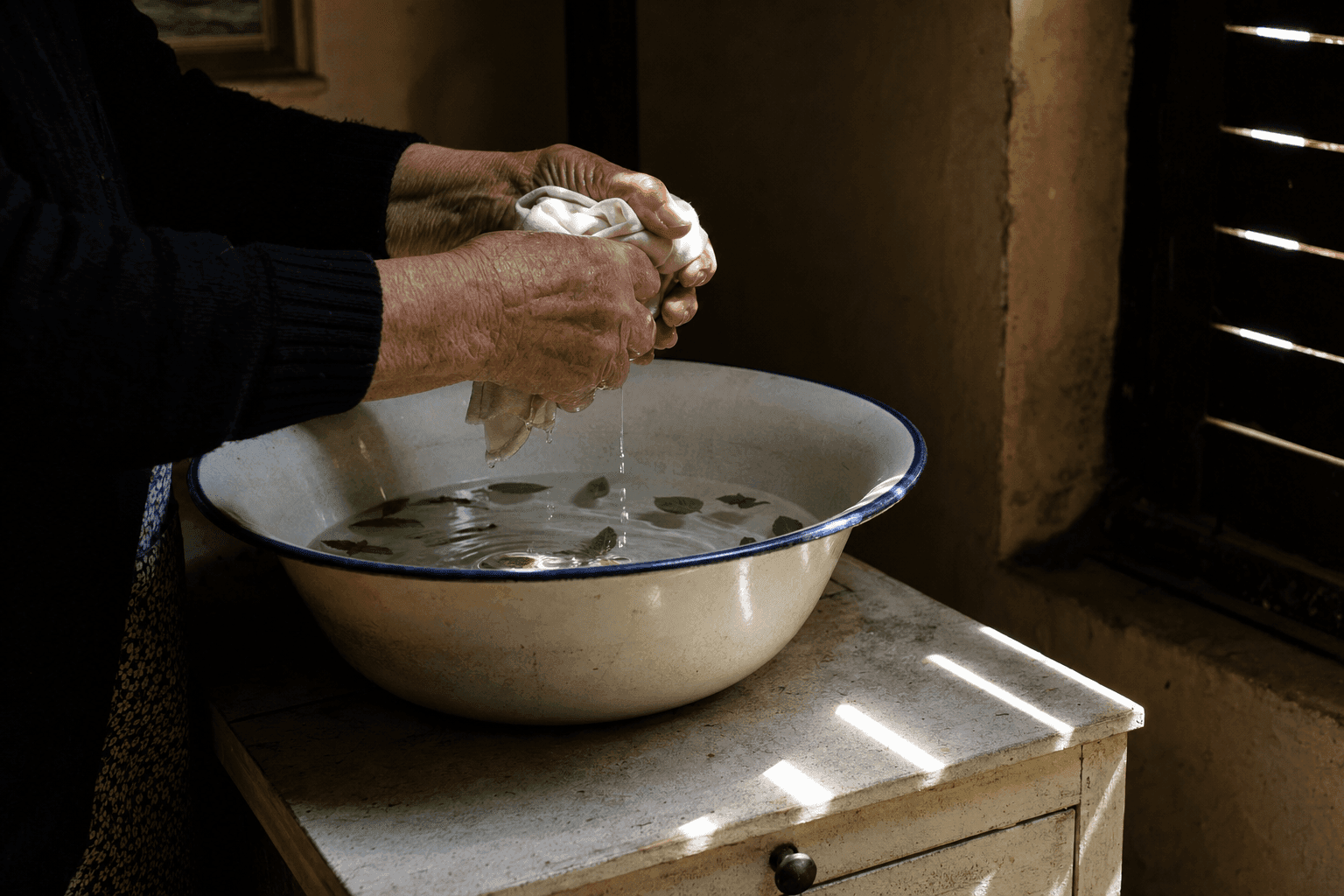
For a headache, my grandma’s remedy starts with the simplest things: rest somewhere quiet and dim, drink a big glass of water and put a cool cloth on the back of your neck. For adults, a 10% peppermint preparation rubbed on the forehead and temples is what my books give for a tight, pressing head. If the pain comes all at once, very strong, or with fever and a stiff neck, call 15.
Key takeaways
- For an ordinary headache, the first thing to do is still to rest somewhere quiet and dim, with a big glass of water.
- Don’t skip meals, put the screen down, and don’t sleep longer than usual: all of that can keep the ache going.
- Peppermint essential oil goes on the forehead and temples, diluted to 10%, and only for adults.
- A headache that bursts out all at once, or comes with fever and a stiff neck, trouble speaking or seeing: that’s 15, right away.
- Headaches that change, get worse or no longer ease with what you usually take: show them to your doctor in the next few days.
Granny’s little steps
- Settle somewhere quiet and dim
A calm room, the shutters half closed, your eyes shut. If you can, lie down and try to sleep a little.
- Drink a big glass of water, and eat anyway
Not drinking enough can give you a headache. And don’t skip your meal, even if it’s a light one.
- A cool cloth on the back of your neck
Soaked in cool water and well wrung out, laid behind your neck. If your neck is stiff, a warm hot-water bottle wrapped in a towel does the job too.
- Put the screen down, without sleeping in
Put down your phone and your computer. And the next morning, get up at your usual time: sleeping more than usual can keep the ache going.
- Gently massage your neck and shoulders
With your fingertips, small circles, without pressing hard. Anything that helps you relax also helps a tight head.
A recipe to try
The big glass of water and the cold on your neck
As soon as your head starts to squeeze, in a quiet room
What you’ll need
- A big glass of cool water
- A cold pack, or a small bag of ice cubes
- A clean cloth, to wrap it in
How I go about it
- Settle in a quiet room, with the shutters half closed, and put your phone down.
- Drink your big glass of water slowly, in small sips.
- Wrap the cold pack in the cloth, so it doesn’t go straight on your skin.
- Lay it behind your neck, lie down if you can, close your eyes and leave it there for about a quarter of an hour.
Most of the time, a headache settles down with next to nothing: some quiet, dim light and a big glass of water. I’ll tell you what I do when my head feels tight, what my books say, and the point where it’s time to hand over to the doctor.
Why we get headaches: tension, tiredness, and where it squeezes
Most often, it’s what doctors call a tension headache: a pressure on both sides of the head, like a headband that’s too tight, that doesn’t throb and doesn’t make you feel sick. Your head feels heavy, or empty instead, and it’s hard to concentrate. It tends to come at the end of the day, it climbs with stress and calms down when you relax. Often your neck is stiff at the same time.
Tiredness, stress, a day in front of a screen, a skipped meal, not drinking enough: those are the usual culprits. Too much coffee, or stopping it all at once, can also give you a headache, just like one glass too many the night before. And glasses that no longer suit your eyesight tire your eyes, and it often ends up in your forehead.
People often ask me what it means, the place where it hurts. I’m not a doctor, but here’s what my books say. A pressure on both sides, on the forehead or all the way around, is most often tension. A pain on one side only, that throbs, with light or noise bothering you and sometimes nausea, looks more like a migraine. A headache at the back of the head often goes with a stiff neck, or a neck with arthritis. And a pain above just one eye, that throbs, with fever and a nose running on one side only, is for the doctor, without dawdling.
Having a headache every day, with tiredness on top, isn’t something to let slide. It can be tension settling in, when it comes back more than fifteen days a month. It can also come from painkillers taken too often: after a while, they’re the ones keeping the ache going. And if several people in the house have a headache at the same time, near a heater or a stove that burns gas, wood or heating oil, think of carbon monoxide straight away: open everything wide, get out, call for help.
Grandma’s plants for headache days
I’ll be honest: for the head, my books don’t give many plants. Only one is filed directly under a tight, pressing head: peppermint.
Peppermint, on the forehead and temples. Not in a cup, this time: its essential oil, rubbed on the skin. The books give it to adults for mild tension headaches, diluted to 10% in alcohol, not neat. Don’t mix your own, ask the pharmacist for a preparation at that dilution. You rub some on your forehead and temples; if that’s not enough, you can do it twice more, a quarter of an hour apart, and that’s all for the day. Wash your hands afterwards and keep it away from your eyes. Never before age 18, and above all never on a little one. I tell you all about my peppermint here.
Lavender, linden, lemon balm, people often ask me about them for the head: for the headache itself, my books don’t recognise any of these teas. If it’s tension knotting you up or nights that don’t rest you, go and see my page for frayed nerves or the one for sleep that won’t come.
How to ease a headache at home
When it squeezes, I start with the simplest thing. A calm room, the shutters half closed, a big glass of water. If I can, I lie down and try to sleep a little. Most headaches are nothing serious, and quiet already does a good part of the work.
Next, the neck: a cloth soaked in cool water, well wrung out, laid behind the neck. If your neck is stiff, some people prefer warmth, a warm hot-water bottle in a towel. For a headache at the back of the head, that’s where to start, with a little shoulder massage, without pressing hard. And at night, a low, firm pillow rather than a mountain of cushions.
Don’t skip your meal, even a light one. Put the screen down, phone included. And don’t sleep in the next morning: sleeping more than usual can keep the ache going. Me, who loves lazing in bed on Sundays so much, I had to learn.
For a pain in the forehead, check your eyes too. For eyes that feel strained at the end of the day, I have other little things to try.
If what you usually take for pain, paracetamol for example, no longer does anything, don’t raise the dose on your own. For an adult, it’s 1 gram per dose at most, at least 4 to 6 hours between two doses, and no more than 3 grams a day, unless your doctor says otherwise. When it won’t pass anymore, talk to your doctor in the next few days.
Headaches: when it’s no longer a small ache
What I do here is for the headache you know, the one that looks like the others. As soon as it changes its face, comes all at once, very strong, or comes with fever, a stiff neck, vomiting, trouble speaking, seeing or moving, it’s no longer my department. The list is just below, sign by sign. Read it once, calmly: it’s not to scare you, it’s so you know.
We always hesitate to call 15, we’re afraid of bothering them. A headache that bursts like a thunderclap, you call, full stop.
Which plants?
PeppermintMentha x piperita
Peppermint is the mint with the stinging cold taste, born from water mint and spearmint: a cup of the leaves after a meal that sits heavy, and the essential oil kept apart.
What to know first
Peppermint essential oil. Only for adults, on the skin, diluted to 10% in alcohol, not neat. Not before age 18, for lack of data. Never for a child under 2, neither on the skin nor to breathe in: menthol can stop their breathing. Not for a child who has ever had seizures either, with or without fever. During pregnancy and breastfeeding, go without, unless your doctor tells you otherwise.
Not on damaged or irritated skin, keep it away from your eyes, and wash your hands afterwards: a finger in the eye burns. One application on the forehead and temples, repeated two times at most a quarter of an hour apart, once a day, and not at the same time as another peppermint product. If you’re allergic to peppermint or menthol, leave it alone. If your skin turns red, itches or the pain gets worse, stop and ask your pharmacist or your doctor for advice.
If you’re already on a treatment. The books report no interactions for peppermint rubbed on the skin. If you take something on a doctor’s orders and you’re unsure, ask your pharmacist.
Pain medications. Taken too often, they can themselves keep a daily headache going. Paracetamol, for adults: 1 g per dose at most, at least 4 to 6 hours between two doses, no more than 3 g a day unless your doctor says otherwise, and no alcohol with it. No aspirin for a child without medical advice.
When to see your doctor
- A headache that bursts out all at once, explosive, unbearable, at its worst right from the start: call 15 or 112 right away.
- A sudden, violent headache with sudden weakness, an arm, a leg or one side of the face that stops responding, seizures, trouble speaking or confusion: call 15 or 112 right away.
- A headache with fever, vomiting, a stiff neck, or a condition that keeps getting worse: call 15 or 112 right away.
- A headache with fever and small red or purple spots on the skin that don’t fade when you press a glass on them: call 15 or 112 right away.
- A violent headache that comes on all at once, with pain in one eye or both and blurred vision: call 15 or 112 right away.
- A headache after a hard blow to the head: call 15 or 112 right away.
- A headache that appears within three months of a fall or a knock to the head, even a light one: go to the emergency room or call 15, and don’t drive.
- Several people in the house who have a headache, feel sick or are vomiting, near a heater, a stove or a water heater that burns gas, wood or heating oil: open doors and windows, turn the appliance off if you can, everyone out, and call 15, 18 (the fire brigade) or 112.
- A new, intense headache with vomiting, aching muscles, heavy tiredness, memory gaps or failing eyesight: see your doctor the same day.
- A pain above just one eye that throbs and gets worse when you press on it, with a fever above 38.5 °C and a nose running on one side only: go and see your doctor without waiting.
- A headache with jaw pain when you eat, or a scalp that hurts to the touch, especially in an older person: call your doctor quickly.
- A child whose headache wakes them at night, or gets worse day after day: call their doctor quickly.
- Headaches that slowly get worse over weeks or months: make an appointment with your doctor in the next few days.
- A headache that isn’t like the ones you usually get: make an appointment with your doctor in the next few days.
- A headache that no longer eases with what you usually take: make an appointment with your doctor in the next few days.
- Headaches that keep coming back when you never used to get them: make an appointment with your doctor in the next few days.
- Headaches several times a week, or painkillers taken almost every day: talk to your doctor about it.
Your questions
What can I do about a headache?
Start with quiet: a calm room, dim light, a big glass of water and a cool cloth on the back of your neck. Don’t skip your meal and put the screen down. For adults, a 10% peppermint preparation rubbed on the forehead and temples is the grandma’s remedy my books give for a tight, pressing head.
When does a headache become worrying?
When it bursts out all at once, very strong, or comes with fever and a stiff neck, vomiting, trouble speaking, seeing or moving: then it’s 15 or 112, right away. A headache that gets worse over the weeks, changes its face or no longer eases with what you usually take, show it to your doctor in the next few days.
A headache every day and tiredness: what could it be?
Very often it’s tension: stress, tiredness, poor sleep, and a heavy head that comes back at the end of the day. Painkillers taken too often can also keep it going. If several people in the house have a headache at the same time near a heater, open the windows, get out and call 15, 18 (the fire brigade) or 112. Either way, a headache every day is something to tell your doctor about.
Where does a headache in the forehead come from, and how do I ease it?
Most often it’s tension, or eyes tired from a screen or from glasses that no longer suit your eyesight. Rest somewhere quiet, put the screen down and, for adults, rub peppermint diluted to 10% on your forehead and temples. A throbbing pain above just one eye, with fever and a nose running on one side, is for the doctor without waiting.
How do I ease a headache at the back of the head?
There, it’s often a stiff neck. Put a cool cloth behind your neck, or a warm hot-water bottle if you prefer heat, gently massage your shoulders, and sleep on a low, firm pillow. If your neck is stiff and you have a fever, that’s a different story: call 15.
And if the headache doesn’t go away with paracetamol?
Don’t raise the dose on your own: for an adult, it’s 1 g per dose at most, at least 4 to 6 hours between two doses, and no more than 3 g in a day, unless your doctor says otherwise. If what you usually take no longer does anything, make an appointment with your doctor in the next few days. And if you take it almost every day, tell them: over time, that can keep the ache going.
References
- Mal de tête (céphalée) : définition et causes · ameli.fr, 2026
- Mal de tête : comment être soulagé(e) et quand consulter ? · ameli.fr, 2026
- Comment réagir en cas de mal de tête ? · Vidal, 2021
- Reconnaître une sinusite aiguë · ameli.fr, 2026
- Comment éviter une intoxication au monoxyde de carbone ? · Santé.fr, ministère de la Santé, 2025
- Headaches · NHS, 2024
- Tension headaches · NHS, 2025
- European Union herbal monograph on Mentha x piperita L., aetheroleum (Rev. 1) · EMA, HMPC, 2020
Information. This information is provided for general knowledge and doesn’t replace medical advice. Check with a healthcare professional before any use.
Health Disclaimer