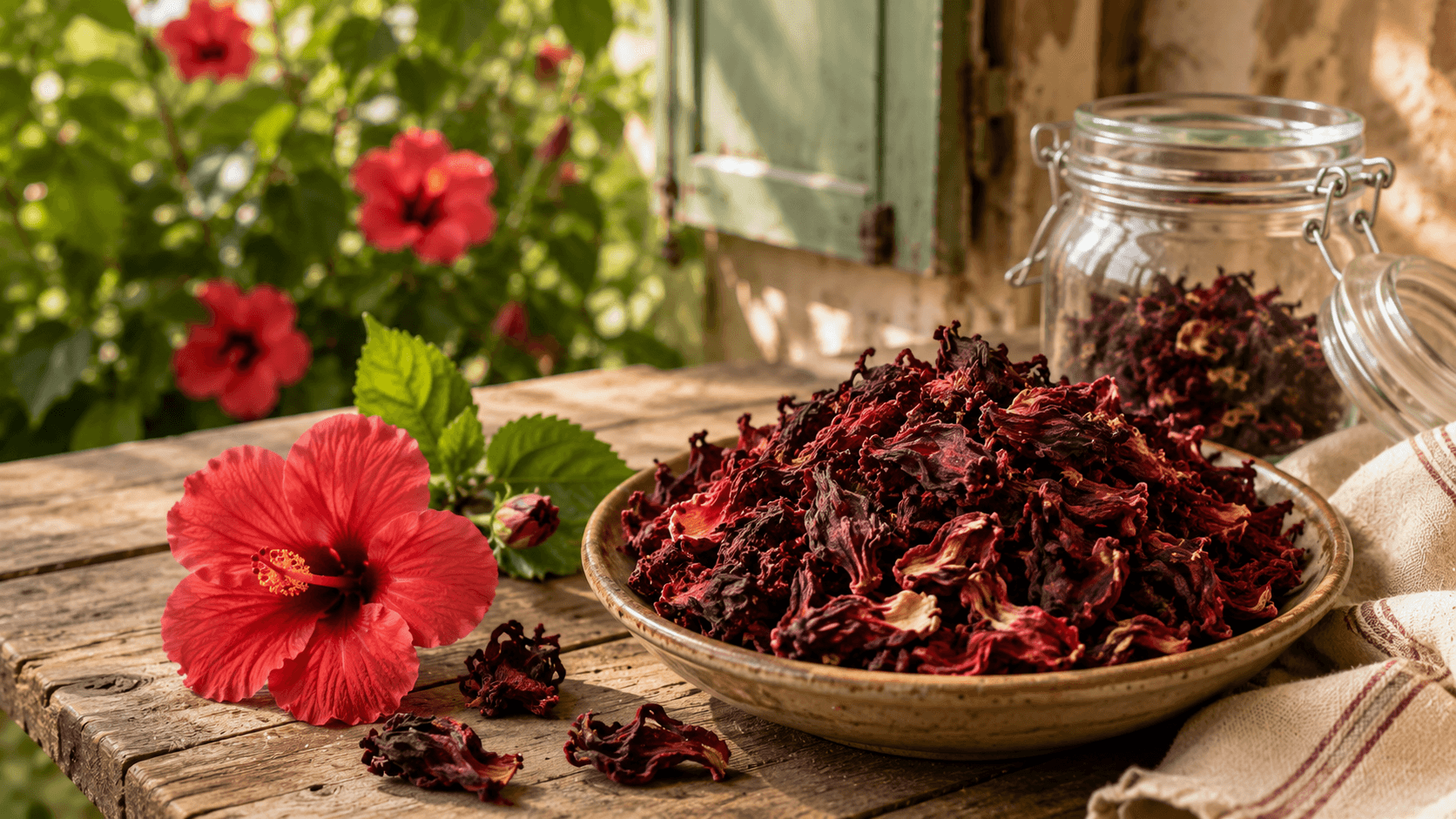
With its beautiful red cups, this sun-loving plant from West Africa makes a delicious, tart infusion. We have always gathered it to prepare a refreshing drink that does you so much good on warm summer days.
Who she really is
Family : Mallow family (Malvaceae). Native to West Africa, Hibiscus sabdariffa is now widely naturalised and cultivated throughout tropical and subtropical regions of the world.
Parts used : Flowers, Leaves, Seed. Calyces harvested by hand in late autumn, from October to December, once the flowers have fallen and the red cups are thick and fleshy.
Hibiscus is a sun-loving plant with bright red cups that we have always brewed into a delicious, tart drink. This traditional infusion, often called Bissap, is wonderful to share with your loved ones. It naturally supports your vitality and simply does you good, whether you drink it hot or iced.
Her story
Hibiscus, with its spectacular flowers in vibrant colours, is much more than a simple ornament for our gardens. Native to tropical regions, this generous plant spans ages and continents, bringing with it a breath of freshness and an incomparable sweetness of life.
A travelling flower rooted in history
The word hibiscus finds its roots in the ancient Greek hibískos, which originally referred to marshmallow. This large Malvaceae family includes several hundred species of herbs, shrubs, and trees. Known since high antiquity, these plants were carefully cultivated in Egypt and Southeast Asia, not only for their captivating beauty, but also for their fruits which people loved to eat.
In the 12th century, the Moors of Spain introduced hibiscus to Europe, paving the way for its spread. A few centuries later, in the 17th century, settlers took it to the New World. Even today, this flower carries a strong symbolic meaning: it is the national flower of South Korea (with Althaea, Hibiscus syriacus) and Malaysia (with the China Rose Hibiscus, Hibiscus rosa-sinensis).
Botany of a primitive and fascinating flower
In our regions or in the tropics, hibiscus often appears as a beautiful, vigorous shrub. It can reach five metres in height and width. Its alternate, simple, and oval leaves are adorned with toothed or wavy edges of a bright green.
But it is its flower that inspires wonder. Usually solitary, it reveals a fascinating and primitive architecture. Its calyx has five free sepals, while its corolla displays five delicate petals, slightly fused at their base. The numerous stamens, for their part, fuse to form a long central tube characteristic of Malvaceae. The pistil passes through this tube to let a stigma with five divisions bloom. The latter only becomes receptive when the stamens wither, a natural trick that promotes cross-pollination. Once the flower has bloomed, it gives way to a capsule that opens at maturity to release small, hairy seeds.
The tangy sweetness of traditional uses
In traditional herbalism, we are particularly interested in the fleshy calyces of Hibiscus sabdariffa, often called roselle. It is from these calyces that we extract a deep ruby-red drink, known as bissap in West Africa, or karkadeh in Egypt.
Rich in natural organic acids (such as citric, malic, and tartaric acids) and precious pigments called anthocyanins, this infusion offers a unique tangy and thirst-quenching flavour. Traditionally, we prepare this drink to cool down during hot summer days or to accompany the end of a hearty meal. In popular tradition, this drink is reputed to do the body good, help you feel lighter, and bring welcome comfort when you feel tired or congested.
"In my kitchen, I like to prepare a large pitcher of bissap by adding a pinch of fresh mint or a drizzle of honey. It is a drink for sharing that comforts both young and old, and makes us feel more resilient to face the changing seasons."
Tips for preparation and tasting
To fully savour the benefits and aromas of hibiscus, simplicity is key. You can enjoy this infusion hot in winter to warm you up, or iced in summer for a maximum thirst-quenching effect.
- As a hot infusion: Use one tablespoon of dried hibiscus flowers per cup. Pour in simmering water and let infuse for 5 to 10 minutes depending on the desired intensity. The drink will take on a beautiful purple colour.
- As an iced drink: Infuse the flowers hot, let cool, then place the preparation in the refrigerator with a few lemon slices or mint leaves.
Although hibiscus is a gentle plant in common use, every body is unique. If you have any doubts, if you are following a specific health program, or if you are pregnant, it is always best to ask your doctor or pharmacist for advice.
What makes it work
Organic acids (including citric, malic, and tartaric acids), anthocyanins (such as delphinidin-3-sambubioside and cyanidin-3-sambubioside), flavonoids, and mucilages. These natural compounds give the calyces their deep red colour, characteristic tart flavour, and traditional soothing qualities.
What I use her for
- · 01Hibiscus sabdariffa is a sun-loving plant originally from West Africa with bright red, fleshy cups.
- · 02The dried calyces of Hibiscus sabdariffa are used to prepare a traditional, tart infusion called Bissap.
- · 03Hibiscus sabdariffa infusion can be enjoyed hot in winter or served cold as a refreshing summer drink.
- · 04Traditional use of Hibiscus sabdariffa infusion helps support vitality and brings comfort when the body feels sluggish.
How I prepare her
Granny’s little recipes
My fresh summer afternoon bissap
In the afternoon, to cool down when the sun is beating down
What you’ll need
- 2 good handfuls of dried hibiscus flowers (karkadeh)
- 1 litre of cold water
- 1 tablespoon of wildflower honey
- A few mint leaves from the garden
How I go about it
- 01Boil the water in your favourite saucepan.
- 02Remove from the heat, throw in the hibiscus flowers and let infuse for about ten minutes to get a beautiful ruby-red colour.
- 03Strain everything using a fine sieve.
- 04Add the honey while it is still warm so it mixes well, then slip in the mint leaves.
- 05Let cool completely and place the pitcher in a cool place before enjoying this delight.
The comforting herbal tea for the end of meals
After a meal, when the tummy needs some gentleness
What you’ll need
- 1 teaspoon of dried hibiscus flowers
- 1 pinch of fennel seeds
- 1 large cup of simmering water
How I go about it
- 01Place the hibiscus and fennel directly into your cup.
- 02Pour the simmering water over them.
- 03Cover well to keep all the good steam in and let rest for 8 to 10 minutes.
- 04Strain and drink slowly, it helps you feel lighter after a good meal.
The steam bath for a fresh complexion
Sunday evening, to enjoy a gentle moment
What you’ll need
- 3 tablespoons of hibiscus flowers
- 1 large bowl of boiling water
How I go about it
- 01Put the hibiscus flowers at the bottom of a large heat-resistant bowl.
- 02Pour the boiling water over them to release the aromas and colourful pigments.
- 03Place your face over the bowl, at a reasonable distance so you do not burn yourself.
- 04Cover your head with a clean towel and breathe calmly for 5 to 10 minutes, it does wonders for the skin.
What to know first
This information doesn’t replace advice from a healthcare professional. Health Disclaimer →
Her identity card
- Latin name
- Hibiscus sabdariffa
- Family
- Mallow family (Malvaceae)
- Parts used
- Flowers, Leaves, Seed
- Harvest
- Calyces harvested by hand in late autumn, from October to December, once the flowers have fallen and the red cups are thick and fleshy.
- Form
- Infusion, herbal tea, powder, and liquid extract.
- Origin
- Native to West Africa, Hibiscus sabdariffa is now widely naturalised and cultivated throughout tropical and subtropical regions of the world.
- Storage
- Store your dried hibiscus calyces in an airtight jar, kept in a cool place away from light and dampness, to preserve all their lovely tart flavour for up to a year.
If you remember just one thing
- 01Hibiscus sabdariffa is a sun-loving plant originally from West Africa with bright red, fleshy cups.
- 02The dried calyces of Hibiscus sabdariffa are used to prepare a traditional, tart infusion called Bissap.
- 03Hibiscus sabdariffa infusion can be enjoyed hot in winter or served cold as a refreshing summer drink.
- 04Traditional use of Hibiscus sabdariffa infusion helps support vitality and brings comfort when the body feels sluggish.
Your questions
We have always brewed hibiscus tea to bring comfort when the body feels a bit sluggish or when you need a gentle, refreshing lift. This lovely red drink naturally supports your vitality and simply does you good from the very first sip, trust me.
To prepare a traditional hibiscus drink, you simply steep a small handful of the dried red flowers in boiling water for about ten minutes. You can drink this tart infusion hot to warm your spirits in winter, or let it cool down with a slice of lemon and some mint when the sun is high.
Yes, you can enjoy a cup of hibiscus tea every day as a comforting, tart treat to help you unwind or refresh. However, if you have any health conditions or are taking medication, it is always best to ask your doctor or pharmacist first just to be safe.
Hibiscus tea has a wonderfully tart, fruity flavour that is very refreshing on the palate. Its deep ruby colour and tangy taste make it a delightful drink to share with your loved ones, whether you prefer it hot or iced.
While hibiscus is a wonderful, time-tested plant, you must always listen to your body when trying something new. If you are pregnant, nursing, or taking regular treatments, please ask your doctor before drinking it regularly.