Adaptogenic plants: I'll tell you plainly what I think of them
People talk to me about adaptogenic plants all autumn: rhodiola, ashwagandha, maca, cordyceps. I'll tell you where the word comes from, why they stay out of my cups, and what I drink instead.
People talk to me about adaptogenic plants all autumn. My neighbour showed me her sachet of powder, you see them in every shop window, and each one has its name: rhodiola, ashwagandha, maca, cordyceps. I'll tell you how things are. It's a scholar's word, not a kitchen word, and in my kitchen I only put what I know how to measure.
Adaptogenic plants: where the big word comes from
It was my grandson, the one who's at university, who explained it to me. We owe the idea to a Russian toxicologist, Nikolai Lazarev, in 1947. He was trying to describe how plants like ginseng worked, and he spoke of substances that would help the body stand up better to stress and to everything that knocks it about. After him, other scholars tried to draw the thing more precisely.
Only here's the thing: sixty years later, the European books took a close look at all that. They wrote that the idea still needed clearing up, and that the word wasn't accepted in doctors' vocabulary over here. That doesn't mean these plants are worthless. It means you can't lump them all together, with a label that promises to keep you going. I'd rather take them one by one.
Adaptogen is a scholar's word, not a kitchen word. And in my kitchen, I only put what I know how to measure.
The adaptogenic plants people tell me about, one by one
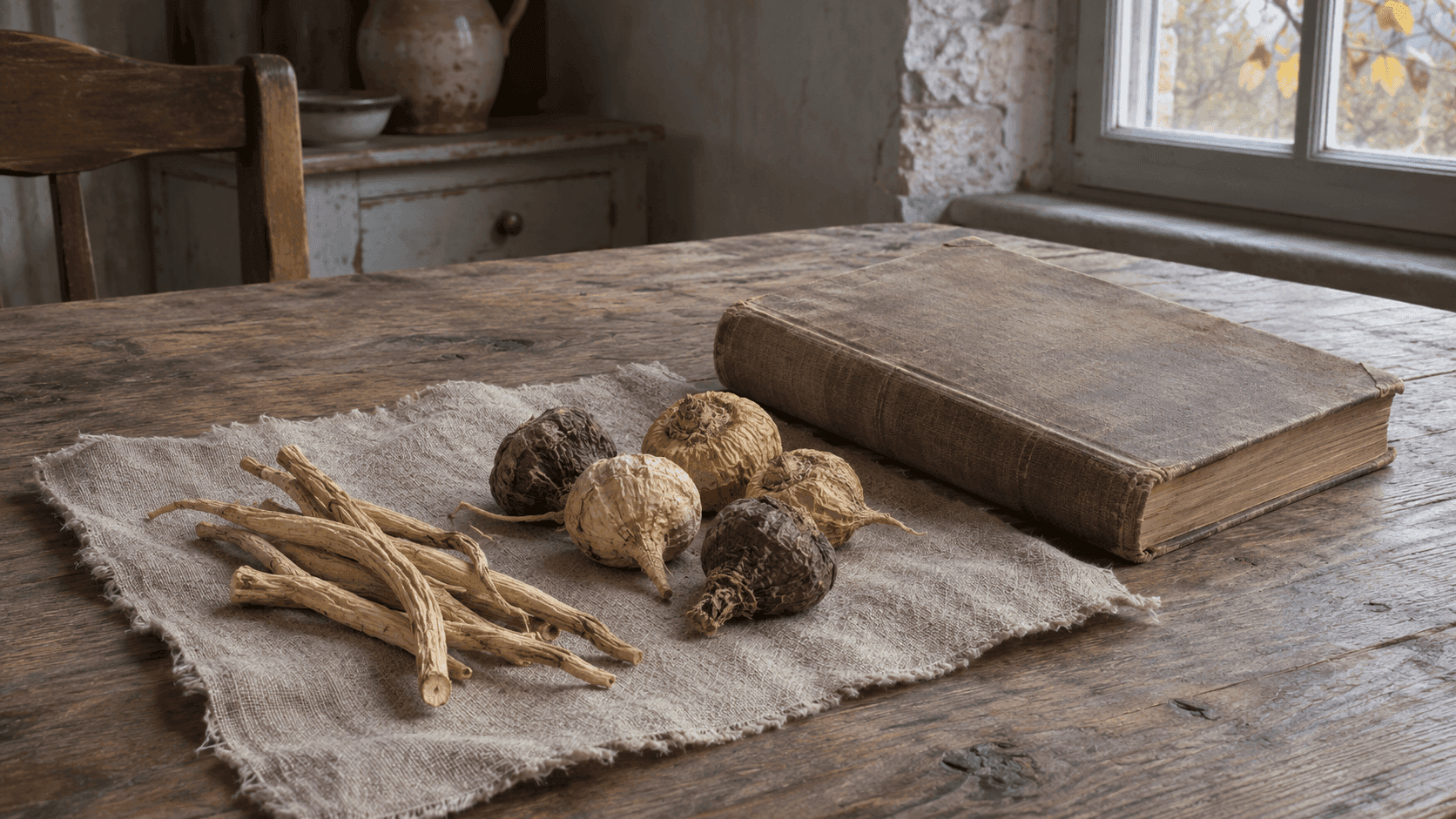
Rhodiola is a little succulent from cold mountains. Cut fresh, its root smells of roses, and in Russia they call it golden root. The books give it to adults for stressful times when you feel tired and worn out, but only as an extract made with alcohol. For the root in a cup, they give neither a measure nor a length of time, so I don't either. What I know about rhodiola, I've written down for you.
Ashwagandha comes from India, and it's in the same family as the tomato and the aubergine. Its name means “smell of horse” in Sanskrit. Over there, people have used it for a very long time, nearly always mixed with other plants. Here, it's mostly sold as supplements, and in 2024, it was concluded in France that nobody could say what amount is safe. Ashwagandha and all its warnings, it's this way.
Maca grows in the Andes of Peru, at around 4,000 metres, where almost nothing else grows. Over there, it's a food: they bake it in the oven, or boil it in water or milk. Here, it's sold as a powder, and for that powder, nobody has been able to say that it's safe. My story of maca is there.
Cordyceps, last of all, isn't even a plant: it's a mushroom that grows on a caterpillar, on the high plateaus of Tibet, and over there they call it “summer grass, winter worm”. My daughter wrote to me from Shanghai that people cook it with duck or chicken. Here, it has no place in the kitchen, and in some cordyceps powders, arsenic and lead have been found. Cordyceps, I've told you all about it. Me, on winter evenings, I stick to chicken broth and ginger.
That leaves ginseng, the root from Korea and north-east China. It's the only one of these names that has a measure in my kitchen: 1 to 2 g of dried root simmered for a quarter of an hour in 150 ml of water, in the morning, for adults, and never for more than three months. I told you about it in my letter on energising plants.
What I do when tiredness and nerves get mixed up in it
When I feel worn out, I start with what costs nothing: going to bed at the same time, three meals at regular times, a walk round the garden even under a grey sky. And in the evening, when my head is still spinning, I have a cup of lemon balm, 1.5 to 4.5 g of dried leaves in 150 ml of boiling water, ten minutes with a lid on, or of linden, 1.5 g of flowers with their bract in the same water. These aren't plants that promise to keep you going. They're cups that settle you. My plants and habits for frayed nerves, I've written them all down for you.
What to know first
If you already take one of these plants, here's what my books say. Rhodiola: not under 18, not when pregnant or breastfeeding, and not without your doctor's say-so if you take something on a doctor's orders for your mood, because your heart could beat very fast. Ashwagandha: it's advised against if you have a thyroid, liver or heart problem, too many male hormones, if you're pregnant or if you take something to help you sleep or calm down, and as a precaution when breastfeeding and under 18; if your skin or the whites of your eyes turn yellow, stop and go and see your doctor without waiting. Maca: if you're pregnant or breastfeeding, have a blood pressure problem, take something to thin the blood, or are being followed for anxiety or depression, not without talking to your doctor. Cordyceps: not when pregnant or breastfeeding, not for children, not if you bleed easily or take something to thin the blood, and not with an autoimmune problem.
Ginseng: not under 18, nor during pregnancy or breastfeeding. Lemon balm and linden: not under 12, nor during pregnancy or breastfeeding; lemon balm can make you drowsy, and if you have a thyroid problem, ask your doctor first. In every case, always tell your doctor what you're taking, and don't stack several supplements at once.
And above all, listen to your tiredness. If it doesn't go away in spite of rest, if you can't get through your days any more, if your spirits are really low, or if it comes with fever, weight loss you weren't trying for or a great thirst, it's not a root you need, it's your doctor. And if you're having dark thoughts, call 3114 (the French suicide crisis line): it's free, day and night.
There. My neighbour's sachet stayed on her table, and I came home with a bunch of leeks under my arm. The kettle is singing, the lemon balm is waiting in its jar. I'll write again soon.