A strange mushroom that grows on insects. The most famous one comes from the meadows of Tibet, the little orange one is farmed. Me, I don't use it, and I'll tell you why.
Who he really is
Family: it's not a plant, it's a mushroom. Cordyceps militaris belongs to the Cordycipitaceae family; its cousin from Tibet, Ophiocordyceps sinensis, to the Ophiocordycipitaceae.
Part used: the whole mushroom. The Tibetan one is sold with the mummified caterpillar it grew in.
Cordyceps is a mushroom that grows on insects. The most famous one pushes up out of the ground in spring in the meadows of Tibet, from a caterpillar it took over during the winter. The other, cordyceps militaris, is a little orange mushroom people know how to grow. There's a lot of talk about it, so I'm going to tell you things as they are.
Her story
Cordyceps is a mushroom that grows on insects. It's not a plant, even if shops put it with them. The most famous one pushes up out of the ground in spring, in the high meadows of Tibet, from a caterpillar it took over during the winter. The other, cordyceps militaris, is a little orange mushroom grown on rice.
I'll be frank with you: I've never had this one in my jars. But everyone asks me about it, so I got the books out again. I'll tell you what I found, the good and the not so good.
Cordyceps, a mushroom that lives on insects

Imagine a mushroom that doesn't grow on wood or in moss, but inside an insect's body. That's cordyceps. The fungus gets into a larva, fills it bit by bit, and when the larva is dead, a little club pushes out of its body to release new spores. It isn't pretty, but that's nature, and it doesn't ask our opinion.
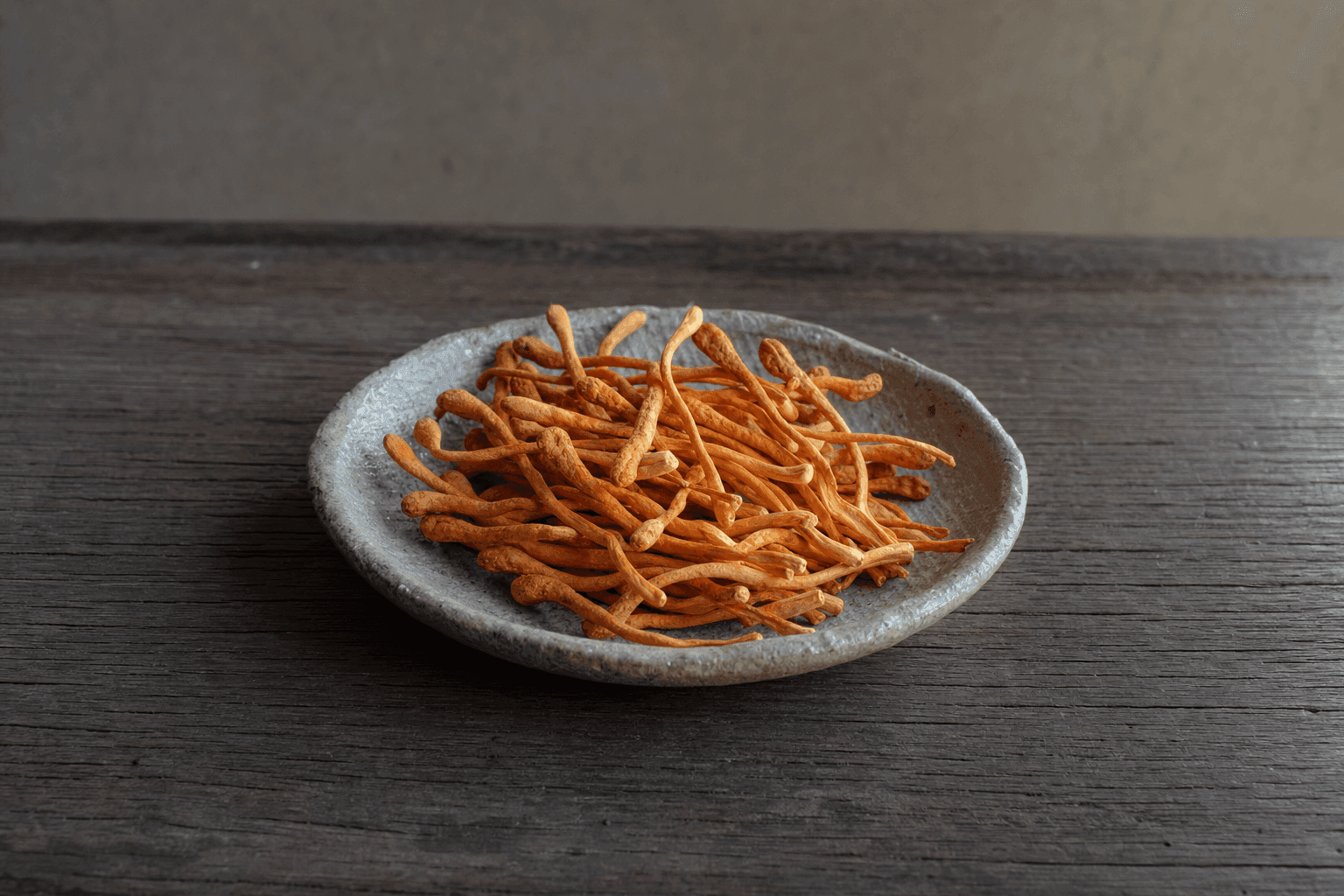
There are all sorts, and each has its own insects. The one called cordyceps militaris is fairly common across the whole Northern Hemisphere. In Europe, you can see it coming up out of the ground from August to November: a little orange club, one to eight centimetres long, stuck on a buried butterfly or moth chrysalis. I've never found one in my woods. Mind you, I've never looked.
Cordyceps sinensis and cordyceps militaris: two very different cousins
The most famous is the Tibetan one. Scientists long called it Cordyceps sinensis. Since 2007, its name has been Ophiocordyceps sinensis: they realised it wasn't in the same family as militaris. It lives on the caterpillars of small moths, in the meadows of the Tibetan plateau and the Himalayas, between 3,000 and 5,000 metres.
The caterpillar spends the winter underground nibbling roots. If the fungus has caught it, it fills it and mummifies it, without damaging its skin. In spring or early summer, a yellow-orange stalk comes out near its head and pokes up out of the ground. The whole thing, caterpillar and stalk, is less than ten centimetres long.
In Tibet it's called yartsa gunbu, “grass in summer, worm in winter”. In Chinese it's dōngchóng xiàcǎo, the same idea the other way round: “winter worm, summer grass”. In winter you see a little creature. In summer you see a grass. You have to admit that's well put.
It's so sought after that in Beijing, weight for weight, it can sell for up to three times the price of gold. Every spring in Nepal, houses and schools empty out: people go up into the mountains to pick it. For some villages on the plateau, it's the main source of money. Only here's the thing: so much of it has been gathered that it's in decline. It's now listed as a “vulnerable” species on the world list of threatened species. In fifteen years, at least three in ten have disappeared.
Cordyceps militaris, on the other hand, is farmed, and on a big scale. It's grown on rice, on silkworm pupae, or in a nourishing broth. China produces thousands of tonnes of it every year. It's mostly this one you'll find in Europe in what's sold as cordyceps, along with other fungi grown in tanks. Same name on the label, not the same mushroom at all.
Winter worm, summer grass, in the old books
The oldest text we know about it was written in the 15th century by a Tibetan physician. In China, it appears in a great collection of remedies published in 1694. And hold on to your hat: it was a Frenchman who made it known here. At the start of the 18th century, Dominique Parrenin, a missionary living in China, brought back specimens as a curiosity. The naturalist Réaumur talked about it in Paris in 1726, under the name “plant worm”.
In 1735, the historian Du Halde took up what Parrenin had told. In Beijing, he said, it was a foreign and very rare thing: you hardly saw it anywhere but at the palace. He compared it to ginseng, whose story I tell you over here, and it was credited with bringing back lost strength. And the way to take it, you'll laugh. A Chinese governor had advised the missionary to stuff a farmyard duck with it, cook it over a low heat, take out the mushroom and eat the meat, morning and evening, for eight or ten days. Now that's grandmother's cooking, the Chinese court way.
Even today, over there, people cook it with duck or chicken, leave it to soak in wine, or drink it as a tea. It's listed in the Chinese pharmacopoeia, which ranks it among the things that do the lungs and kidneys good, for coughs that hang on and for a tired lower back and knees. Those are their words, with their way of seeing the body. I'm passing them on as they are, and I'm not promising you anything with them.
What do I take from it? Over there, it's a rare mushroom that you cook in a dish and share. Here, it mostly arrives as a powder, farmed, under a name that covers several mushrooms. It's not quite the same story any more.
Zombie cordyceps: should humans be afraid?
You may have heard of the mushroom that turns ants into zombies. It exists. It's a cousin, Ophiocordyceps unilateralis, that lives in tropical forests and attacks certain ants. The ant it catches leaves its nest, climbs up, and clamps itself by its jaws to the vein of a leaf. It dies there, and the mushroom grows out of its head.
Can it come after us? No. These fungi are made for their own insects, they can't even jump from one species to another. And our bodies are far too warm for them: at our temperature, they don't survive. So sleep easy. Zombie stories are for television.
The real worry lies elsewhere. It's in what people swallow.
And me, what do I do with cordyceps?
Nothing, as you'd guess. And I have my reasons.
First, here it has no place in the kitchen. In Europe, cordyceps militaris, the orange one, is classed among the novel foods that haven't been authorised yet: as long as that's the case, it shouldn't be sold to be eaten. The Tibetan one is only allowed in food supplements.
Next, there's what's been found in it. In 2016, in China itself, the health authorities gave a warning: in Tibetan cordyceps and its powders, they measured up to almost ten times more arsenic than the limit set there for health products, and taking it for a long time means it builds up. There have also been powders full of lead, and mushrooms weighted with wire or soaked in salts to weigh heavier on the scales. When something is worth more than gold, there are always crafty folk about.
And then there's the picking. A mushroom gathered until it's in decline, I don't want to make it my evening bowl.
So when winter comes and I feel run down, I keep it simpler: a good hot chicken broth, with a piece of ginger, my old kitchen companion. It's a bit the same idea as the Chinese court's duck, without the rarity. I've put the recipe further down, with my ginger and lemon infusion. And if it's tiredness that has you thinking of cordyceps, come and see what I do when I'm worn out. If it goes on, it's not a mushroom you need, it's an appointment with your doctor.
What people do with it, over there and here
- · 01In Tibet and China, the caterpillar one, Ophiocordyceps sinensis, has been used for centuries: the oldest text we know about it dates from the 15th century.
- · 02Over there, people cook it with duck or chicken, leave it to soak in wine, or drink it as a tea.
- · 03The Chinese pharmacopoeia ranks it among the things that do the lungs and kidneys good. That's their way of seeing it, not a promise.
- · 04Cordyceps militaris, the orange one, is farmed on a big scale, and in Asia it goes into chicken soup. In Europe, it isn't authorised as a food yet.
- · 05Me, I don't use it: for winter evenings, I stick to chicken broth and ginger.
How they prepare it over there
My winter bowls, in its place
I'm not giving you a recipe for cordyceps: here, it isn't authorised as a food, and the Tibetan one is gathered until it's in decline. For winter evenings, here are my two old faithful bowls instead.
Ginger chicken broth for winter evenings
In the evening, when it's cold outside
What you’ll need
- 1 litre of chicken broth
- 2 whole garlic cloves, crushed
- 1 piece of fresh ginger, 2 to 3 cm, sliced
- 1 tablespoon of soy sauce
How I go about it
- 01Pour the broth into a pan, with the garlic, ginger and soy sauce.
- 02Bring to the boil.
- 03Turn down the heat and let it simmer for 15 minutes, so the flavours blend.
- 04Strain, and drink it good and hot, in a big bowl.
Afternoon ginger and lemon infusion
In the afternoon, when you come in from the cold
What you’ll need
- 300 to 400 ml of water
- 1 small tablespoon of grated fresh ginger
- The juice of half a lemon
- A little honey
How I go about it
- 01Bring the water to the boil.
- 02Add the grated ginger.
- 03Squeeze the half lemon into it.
- 04Cover and leave to infuse for 10 minutes.
- 05Strain, and sweeten with a little honey.
Elsewhere: how others know him
My daughter, who lives in Shanghai, wrote to me once about cordyceps. Over there, the Tibetan one is called dōngchóng xiàcǎo, “winter worm, summer grass”. She told me they cook it with duck or chicken, or leave it to soak in wine. And the little orange one, militaris, goes into chicken soup, like any other mushroom.
It made me smile: my daughter explaining chicken soup to me, of all people. But I understood what she meant. Over there, this mushroom is cooked in a dish that warms you up, and eaten together.
Me, what I love is my ginger chicken broth, simmering gently on the corner of the stove. No mushroom from the other side of the world in it, and it gives me the same pleasure.
What to know first
This information doesn’t replace advice from a healthcare professional. Health Disclaimer →
Her identity card
- Latin name
- Cordyceps militaris (L.) Fr.
- Its cousin from Tibet
- Ophiocordyceps sinensis (formerly Cordyceps sinensis)
- Other names
- Yartsa gunbu in Tibetan, dōngchóng xiàcǎo in Chinese, caterpillar fungus
- Family
- A mushroom, not a plant: Cordycipitaceae (militaris), Ophiocordycipitaceae (sinensis)
- Parts used
- The whole mushroom, with the mummified caterpillar for the Tibetan one
- Harvest
- Sinensis picked by hand in spring, above 3,500 m; militaris grown on rice or pupae
- Form
- Dried mushroom, whole or powdered
- Origin
- Sinensis: Tibetan plateau and Himalayas; militaris: Northern Hemisphere, grown mainly in China
- Storage
- Cool and dry, away from insects
- In Europe
- Militaris: novel food not yet authorised; sinensis: allowed in food supplements only
- Threat
- Ophiocordyceps sinensis listed as “vulnerable” on the list of threatened species
If you remember just one thing
- 01Cordyceps isn't a plant: it's a mushroom that grows on insects, and there are several kinds.
- 02Tibetan cordyceps lives on caterpillars, above 3,500 metres. So much of it has been picked that it's now a threatened species.
- 03Cordyceps militaris is the little orange one grown on rice. In Europe, it isn't authorised as a food yet.
- 04The “zombie” cordyceps of ants can't attack humans: our bodies are far too warm for it.
- 05Me, I don't use it. For winter evenings, a chicken broth with ginger does me fine. Nothing new.
Your questions
It's a mushroom, not a plant. It grows on insects, taking them over bit by bit. The most famous one, Ophiocordyceps sinensis, lives on caterpillars on the Tibetan plateau; the other, Cordyceps militaris, is a little orange mushroom that's farmed. In the shops, both are called cordyceps, but they're not the same thing.
I'm not going to make you any promises. In Tibet and China people have used it for centuries, and the Chinese pharmacopoeia ranks it among the things that do the lungs and kidneys good. Those are traditional uses, with their own way of seeing the body. Here, it isn't even authorised as a food, and if you've been tired for a long time, it's your doctor you need to see.
No. The “zombie” cordyceps everyone talks about attacks certain ants in tropical forests, and these fungi can't even pass from one insect species to another. Our bodies are far too warm for them. You can sleep easy.
It won't turn you into a zombie, but it's no harmless mushroom. In China, in 2016, people were warned that taking it for a long time means swallowing too much arsenic, and cordyceps powders full of lead have been found before. It might also make you bleed more easily, and it doesn't go with everything people take on a doctor's orders. Read what to know first carefully.
It depends which one. Tibetan cordyceps is only allowed in food supplements. Cordyceps militaris, the orange one, is classed in Europe among the novel foods that haven't been authorised yet: as long as that's the case, it shouldn't be sold to be eaten.
Not during pregnancy or breastfeeding: not enough is known. Not if you take something to thin your blood, or if your body attacks itself, what doctors call autoimmune. If you have an operation coming up, you stop it two weeks before. And if you take something on a doctor's orders, especially for blood sugar, ask your doctor first.
References
- Novel Food Status Catalogue : Cordyceps militaris (POL-NF-09242), Ophiocordyceps sinensis (POL-NF-00277), Samsoniella hepiali (POL-NF-14241) · Commission européenne, 2025
- Cordyceps (Ophiocordyceps sinensis) : Botanical Adulterants Prevention Bulletin · ABC-AHP-NCNPR Botanical Adulterants Prevention Program, 2024
- Ophiocordyceps sinensis (Berk.) G.H.Sung, J.M.Sung, Hywel-Jones & Spatafora · GBIF, 2026
- Cordyceps militaris (L.) Fr. · GBIF, 2026
- Ophiocordyceps sinensis · Wikipédia, 2026
- Ophiocordyceps unilateralis · Wikipédia, 2026
- Cordyceps militaris · Wikipedia, 2026
- Description géographique, historique, chronologique, politique et physique de l'empire de la Chine, tome 3 · Jean-Baptiste Du Halde (P.-G. Le Mercier), via Internet Archive, 1735
- Overharvesting threatens 'Himalayan Viagra' fungus: IUCN · AFP, via Phys.org, 2020
- The zombie fungus from 'The Last Of Us' is real, but not nearly as deadly · NPR, via OPB, 2023
- Cordyceps · Memorial Sloan Kettering Cancer Center, About Herbs, 2022
- Cordyceps : uses, side effects, interactions · RxList (Natural Medicines Comprehensive Database), 2026
- 冬虫夏草含砷提示 (rapport sur l'avis aux consommateurs de l'administration chinoise des aliments et médicaments, 4 février 2016) · Yicai (第一财经), 2016
- La recette de la semaine : poulet caramélisé au soja dans un bouillon ail-gingembre · Paris Match Belgique, 2025
- Le gingembre, le miel et le citron · Île aux épices