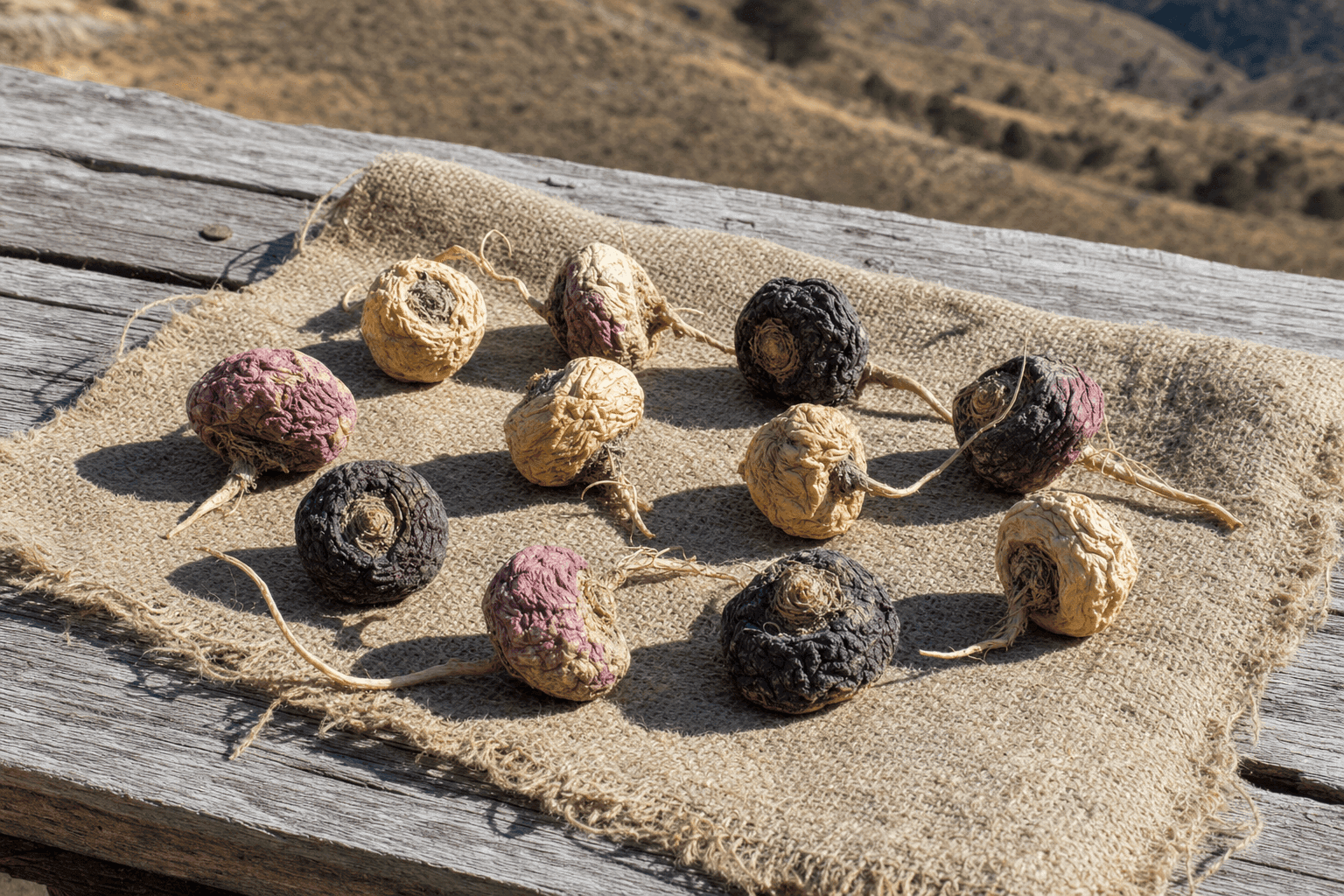
The root of a little plant from the Peruvian Andes, a cousin of the radish, eaten cooked or dried over there. Here it's mostly sold as a powder, and the authorities stay cautious.
Who she really is
Family: Cabbage family (Brassicaceae), the same as radish, cabbage, mustard and cress.
Part used: the swollen root (really the bottom of the stem, the hypocotyl), fresh or dried in the sun.
Maca (Lepidium meyenii) is a little plant from the high plateaus of Peru, grown between 3,950 and 4,450 metres up, and people there have been eating its root for thousands of years. Over there, they cook it, fresh or dried, as a porridge or a drink. Here, you mostly find it as a powder and in food supplements, and the French health authorities couldn't say that this powder was free of risk: read what to know first carefully.
Her story
Maca is a root from the high plateaus of Peru, from the same family as the radish, and people up there have grown it to eat for thousands of years. Its scientific name is Lepidium meyenii, and here it's also called Peruvian ginseng. In France, you mostly see it as a powder, in a pouch.
I'll tell you things the way they are. I've never had maca in my garden, and it probably wouldn't grow there anyway. The other day, one of my neighbours showed me her pouch of powder and asked me what I thought. So I got the books out again. Here's what I found, the good and the not so good.
Maca, a root that grows where nothing grows
Picture a big plateau way up in the Andes, in the middle of Peru, over by Lake Junín. You're between 3,950 and 4,450 metres up. The sun beats down, the wind never stops, and it freezes almost every night. In the afternoon it can be 18 degrees, and at sunset it drops to 10 below zero. It's sheep and llama country. Up there, even the bitter potato can't hold on. Maca can.
It's not much to look at. A small, completely flat rosette of leaves, pressed against the ground, and that's what keeps the frost off it. It's so discreet that visiting agronomists didn't even realise they were walking through a field. What you're after is underneath: a swollen root shaped like an upside-down pear, up to eight centimetres across. Botanists will tell you it's not quite a root, but the bottom of the stem, just above it: they call that the hypocotyl. Me, I'll keep calling it a root.
It doesn't come in just one colour. There are yellow ones, cream ones, purple, red, black and even charcoal grey. Over there, the yellow ones are the favourites. An old Spanish chronicler, Father Cobo, already wrote it down: it is born in the roughest, coldest part of the mountains, where no other plant grown for food will grow.
Lepidium meyenii, a cousin of the radish and of cress
Its scientific name, Lepidium meyenii, was given in 1843 by a botanist called Walpers. Lepidium is the same genus as garden cress, that peppery little cress I sow along the edge of the vegetable patch in spring. And the family is the Brassicaceae: radish, turnip, cabbage, mustard. In fact its root looks like a radish, and it has a strong smell all its own. I always keep black radish in my pantry, so that made me smile: a cousin of my radish, perched more than four thousand metres up.
The experts don't quite agree with each other: some call cultivated maca Lepidium peruvianum. But the name you'll see most often is still Lepidium meyenii.
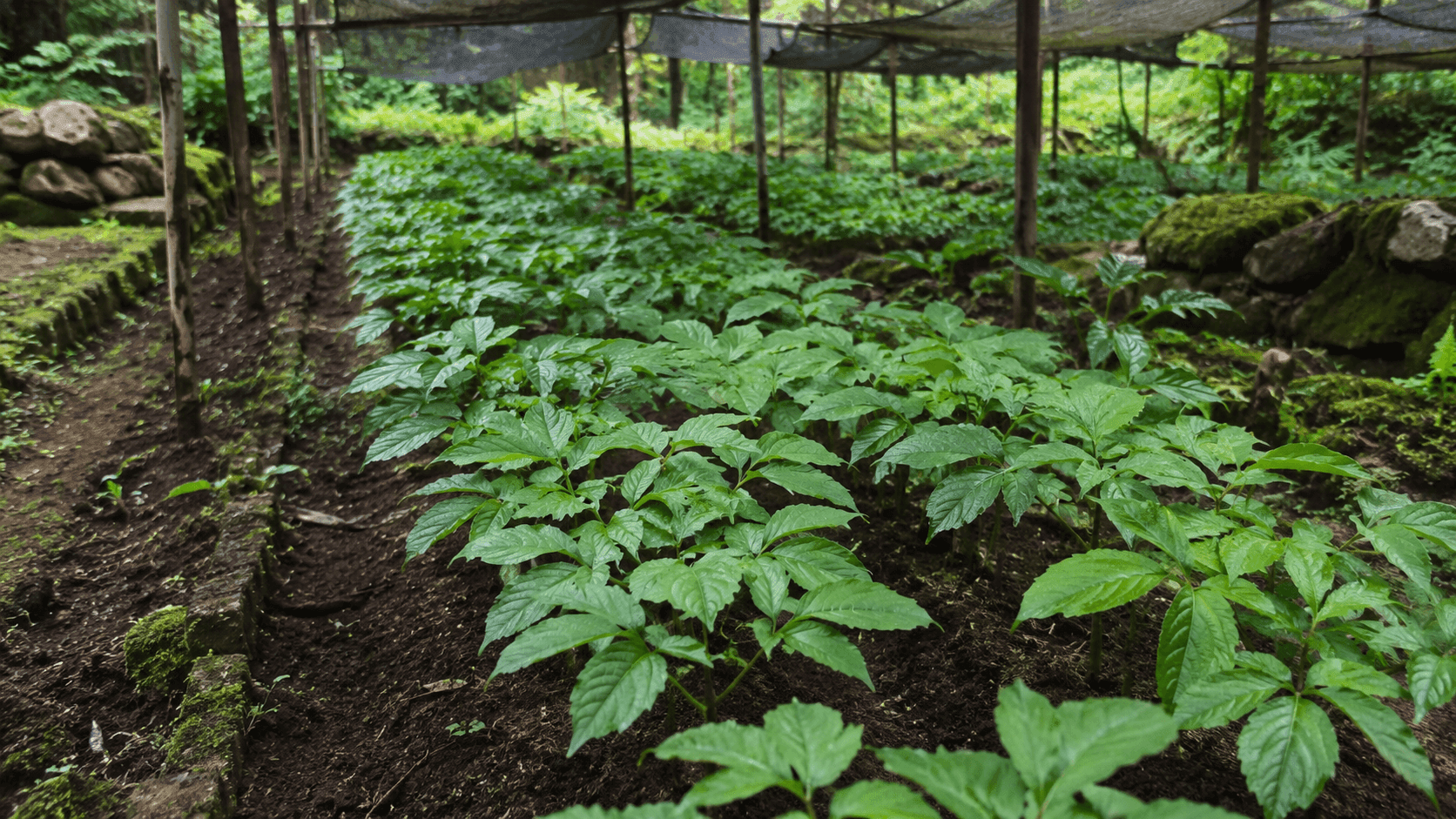
And that nickname, Peruvian ginseng? Don't be fooled: it's not the same plant, and it doesn't have the same story. If it's ginseng you're curious about, I tell you about it over here.
How maca is eaten over there
Over there, maca is food first and foremost. Fresh, it's a delicacy: they bake it in the oven or in the hot ashes. The books say it has a tangy taste and a smell a bit like butterscotch.
But mostly they eat it dried. After the harvest, the roots are spread out in the sun for about two months. On the Junín and Pasco plateau, they don't even wash them first. They turn brown, soft and sweet, with a slightly musky taste. Then they go into sacks, in the attic or on a wooden rack, somewhere cool and dry, and they keep for years, four years and sometimes more. That's something I understand, since I hang my bunches of plants upside down to dry.
Dried, it's as hard as a stone. So they boil it, in water or in milk, and that makes a fragrant porridge. The books even say maca boiled in water is sweeter than cocoa. And the people of the high plateaus advise always boiling it before you eat it. They also make a fermented drink from it, maca chicha, and in Huancayo people love maca puddings and maca jam. Today in Peru they also put it in biscuits, cakes, crisps and drinks.
Nothing goes to waste: they say even the leaves get eaten, the way we eat cress here. And maca is also used to fatten guinea pigs, which people raise over there for the table. Dried, it travels well: it's traded with the valley villages for rice, and you'll find it as far away as the markets of Lima.
From a nearly forgotten root to maca powder
Maca isn't new. Old forms of it have been found at archaeological sites going back to 1600 BC. It mattered so much that in colonial times the Junín area had to pay a tribute of about nine tonnes of maca.
And yet it very nearly disappeared. Around 1980, only about ten hectares were still being grown. In 1982 it was even declared in danger of extinction as a crop. It was in the 1990s that the world started taking an interest, with big orders coming from Japan.
Since 2011, Peru has protected its name: “Maca Junín-Pasco”, fresh or dried, is an appellation of origin, like our cheeses. It comes from the Bombón plateau, between the Junín and Pasco regions. Up there, it's sown when the frosts stop and the first rains come, and the root takes eight to nine months to form. It's pulled up by hand between May and July.
So what about maca powder? It's simply the dried root, ground up. To sell it, they prepare it in several ways: dried with hot air, roasted in the oven, or cooked before it's ground. What you find in pouches here is that, or sometimes an extract. In Europe people were already eating it before 1997, so it counts as an ordinary food, not a novel one.
Maca powder, maca for men or for women: what I think
On the pouches and on the internet, you'll read all sorts. Promises for men, other promises for women. Me, I won't make any. What the books tell is the story of a mountain root that fed people where nothing else would grow, and that gets eaten cooked.
Here, it's another story. In France, maca is allowed in food supplements, as long as lab tests prove the powder doesn't contain certain substances that are being watched. But the French health authorities looked at maca root powder three times, in 2004, 2007 and 2008. Their conclusion: with what we know today, nobody can say it's free of risk. In Denmark they even took supplements containing it off the market. The list of what to know is just below.
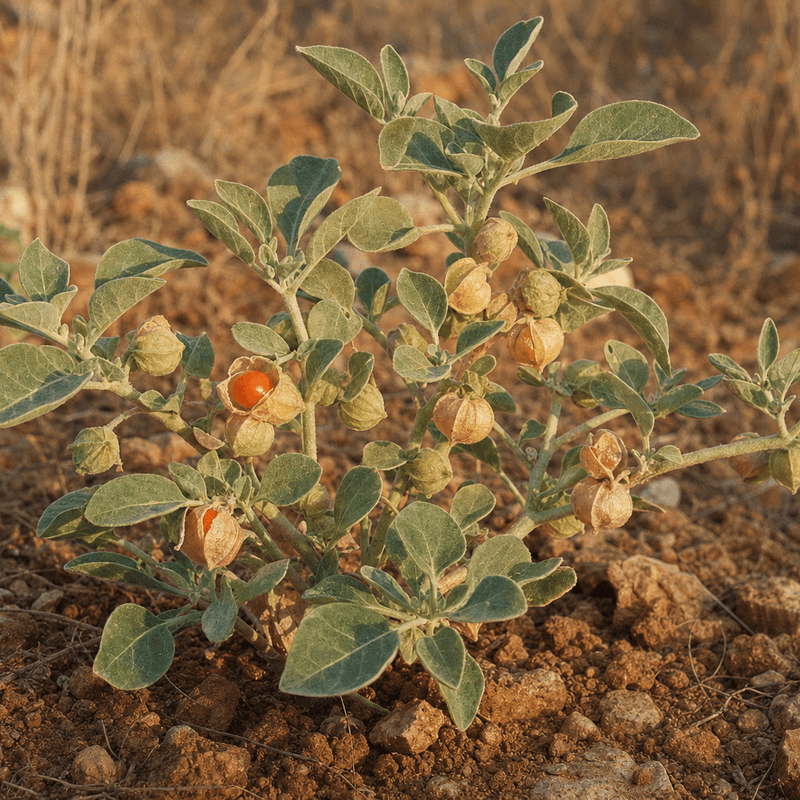
It's a bit like ashwagandha, which I told you about: a plant that truly belongs in its own kitchen or its own tradition back home, and that arrives here as a powder, far from where it comes from. So I look at maca with curiosity and with respect. But I don't put it in my cups.
If it's tiredness that has you eyeing that pouch, I've written down what I do for a passing slump. And if you feel worn out for no reason, or if it drags on, it's not a powder you need, it's an appointment with your doctor. Agreed?
What people do with it, over there and here
- · 01Over there, maca is food first and foremost: fresh, they bake it in the oven or in the hot ashes, as a delicacy.
- · 02Dried in the sun, it keeps for years. They boil it in water or in milk to make a fragrant porridge.
- · 03They also make a fermented drink from it, maca chicha, and in Huancayo, puddings and jam.
- · 04Dried, it's traded for rice with the valley villages, and it's also used to fatten guinea pigs.
- · 05Here, you mostly find it as a powder and in food supplements. Me, I don't use it, and I've told you why.
How they prepare it over there
Why I'm not giving you a recipe
For maca, I'm not giving you a recipe with measurements. Over there, they boil it in water or in milk, as a porridge or a drink, but I didn't find any amounts in serious books. And here, nobody has been able to say that maca powder is free of risk. I'd rather tell you that than spin you a story.
What to know first
This information doesn’t replace advice from a healthcare professional. Health Disclaimer →
Her identity card
- Latin name
- Lepidium meyenii Walp.
- Other names
- Maca, Peruvian ginseng; Lepidium peruvianum for some botanists
- Family
- Cabbage family (Brassicaceae)
- Parts used
- Swollen root (hypocotyl)
- Harvest
- Pulled up by hand from May to July, eight to nine months after sowing
- Form
- Fresh or dried root, whole or ground into powder
- Origin
- High plateaus of the Peruvian Andes (Junín and Pasco), between 3,950 and 4,450 m
- Storage
- Sun-dried root, kept in a sack somewhere cool and dry, for several years
- In France
- Allowed in food supplements, provided lab tests are done; safety of the powder judged not shown
If you remember just one thing
- 01Maca is the root of a little plant from the Peruvian Andes, a cousin of the radish and of cress, grown between 3,950 and 4,450 metres up.
- 02Over there, maca is food first: they cook it fresh, or dry it in the sun and then boil it in water or milk.
- 03People call it Peruvian ginseng, but it isn't ginseng.
- 04Maca powder is allowed in France, but the health authorities couldn't say it was free of risk: if you're pregnant, breastfeeding or take something on a doctor's orders, talk to your doctor first.
- 05Me, I look at maca with curiosity, but I don't put it in my cups. Nothing new.
Your questions
It's the root of a little plant from the high plateaus of Peru, Lepidium meyenii, from the same family as the radish and cress. It's been grown up there, between 3,950 and 4,450 metres, for thousands of years, to be eaten. Here it's also called Peruvian ginseng, and you mostly find it as a powder.
Over there, they cook it fresh, in the oven or in the hot ashes. But mostly they dry it in the sun, then boil it in water or milk to make a porridge or a drink. The books say it has a tangy taste and a butterscotch smell, and that once dried it turns sweet and a little musky.
It's not banned in France: it can go into food supplements, as long as lab tests prove it doesn't contain certain substances that are being watched. But the French health authorities, after looking at it three times, concluded that nobody could say it was free of risk. In Denmark they even took maca supplements off the market.
I won't give you an amount: nobody here has been able to say how much powder is free of risk. If you're still thinking about it, talk to your doctor first, especially if you have blood pressure trouble or already take something on a doctor's orders. And beyond three months, ask your doctor again.
You'll read plenty of promises, for both. Me, I make none: over there, it's first of all a root that gets eaten cooked. If you're pregnant or breastfeeding, don't take it without talking to your doctor first.
References
- Lost Crops of the Incas: Little-Known Plants of the Andes with Promise for Worldwide Cultivation, chapitre « Maca » · National Research Council, National Academies Press, 1989
- Avis relatif à l'évaluation des compléments d'information concernant l'emploi de la poudre de racine de maca (saisine 2008-SA-0011) · Afssa (aujourd'hui ANSES), 2008
- Avis relatif à l'évaluation des compléments d'information concernant l'emploi de la poudre de racine de maca (saisine 2007-SA-0033) · Afssa (aujourd'hui ANSES), 2007
- Arrêté du 24 juin 2014 établissant la liste des plantes, autres que les champignons, autorisées dans les compléments alimentaires et les conditions de leur emploi · République française (copie FAOLEX), 2014
- Natural Health Product Monograph: Maca, Lepidium meyenii · Health Canada, 2024
- Appellation of origin AO-903 : Maca Junín-Pasco · OMPI, système de Lisbonne, 2012
- Product specification for Maca Junín-Pasco (PDO) · UK Government (Defra)
- Ethnobiology and Ethnopharmacology of Lepidium meyenii (Maca), a Plant from the Peruvian Highlands · Evidence-Based Complementary and Alternative Medicine (PMC), 2012
- Novel food catalogue of European Commission · Ruokavirasto (Autorité finlandaise de sécurité des aliments), 2026
- Maca (Lepidium meyenii) · VIDAL, 2014
- Maca · Wikipédia, 2026