The man-root from the shady woods of Korea and northeast China. I simmer it in the morning, for a few weeks at a time, when I'm feeling flat.
Who she really is
Family: Araliaceae.
Part used: the root, simply dried (white ginseng) or steamed and then dried (red ginseng).
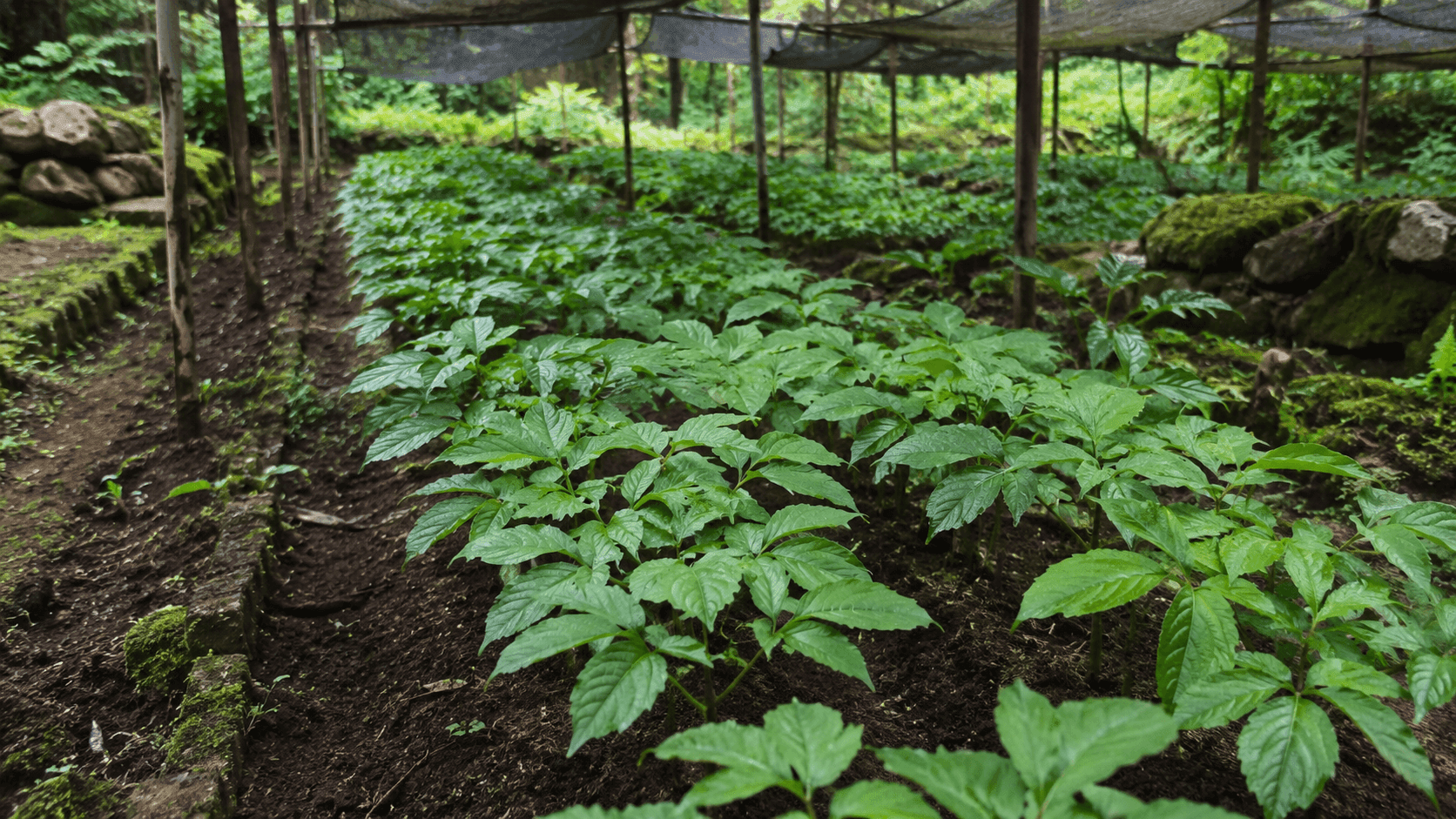
Ginseng (Panax ginseng) is a small perennial plant of the shady mountain woods of Korea, northeast China and the Russian Far East. It's grown in the shade for years for its fleshy root, which sometimes takes on the funny shape of a little man. The books list it among the plants traditionally used by adults when they feel tired and weak.
Her story
Ginseng is the root of Panax ginseng, a small plant from the shady woods of Korea and northeast China, and you simmer it in a decoction. It's not a plant from my garden, this one. But it has such a lovely story, and it came such a long way to reach us, that I made room for it next to my jars.
Panax ginseng, the man-root of the shady woods

Picture a little plant thirty to sixty centimetres tall, in the shade of big trees, in the mountains of Korea, northeast China and the Russian Far East. Its leaves are cut like an open hand, into three to five toothed leaflets. At the top, an umbel of flowers, then little round fruits that turn red when they're ripe. In autumn it loses its leaves and stem, and it waits for spring without minding the frost.
But what we're after is underneath. A fleshy root that grows slowly, very slowly. It's usually only dug up after five or six years. In the wild it has become rare, and that's why the Koreans and the Chinese learned to grow it. Today it's protected in Russia and China, and nearly all the ginseng you can find comes from farms.
One Sunday, my grandson, the one who's at university, turned up with a Chinese book under his arm. He showed me the two characters of its name: rénshēn. Rén means man. Shēn means root. The man-root, then, because as it gets older it sometimes looks like a little man, a body with two arms and two legs. My friend in Tokyo, Keiko, made me laugh when I told her: where she lives, those same characters are read ninjin, and these days ninjin means carrot.
And the Latin name, Panax, comes from Greek, like our word panacea, the remedy for every ill. No less. A plant with a name like that doesn't need anyone piling it on, so I'm going to be careful.
How ginseng made its way to France
In France we've known it since 1711, thanks to a Jesuit, Father Pierre Jartoux, who lived in China. On 12 April 1711 he wrote a long letter describing the ginseng of Tartary, and he explained that its name meant “shape of a man”. His letter went all around Europe. And he had slipped an idea into it: a plant like that might well grow in Canada too, which was a French colony back then.
Over there, another Jesuit, Father Joseph-François Lafitau, came across the letter while passing through Quebec, in October 1715. He lived at the Sault-Saint-Louis mission, across from Montreal. He searched for months, and he had nearly given up. Then one day he saw the plant growing near a house. A Mohawk woman he had hired to help him recognised it straight away: among the Iroquois, it was a remedy everyone knew.
It was the American cousin, the one we now call American ginseng, or five-leaf ginseng, Panax quinquefolius. Lafitau presented his paper to the Regent in 1718, and the learned men in Paris were very sceptical at first. But soon people were sending dried roots from Canada all the way to China, and that trade became the colony's second biggest, right after furs. So much of it was dug up that the plant nearly vanished from the St Lawrence valley. In Quebec today, it's protected by law. That breaks my heart a little: love a plant too much, and you make it disappear.
And would you believe it, people also tried to grow ginseng in France. It can be done, as long as you give it shade, light and slightly acid soil, and at least six years of patience. I've never tried: my shady corner is already taken by my ferns.
Red ginseng, white ginseng: the same root
People often ask me what red ginseng is. It's very simple: it's the same Panax ginseng root. White ginseng has just been dried. Red ginseng has been steamed first, then dried. To make it, you take farmed roots, dug up in autumn, and wash them before steaming them. That gives them their dark reddish brown colour and a stronger taste, bitter and sweet at once, a little caramelised.
Korean red ginseng is just that: Panax ginseng grown in Korea and prepared this way. Over there ginseng is called insam, and the most famous kind grows there.
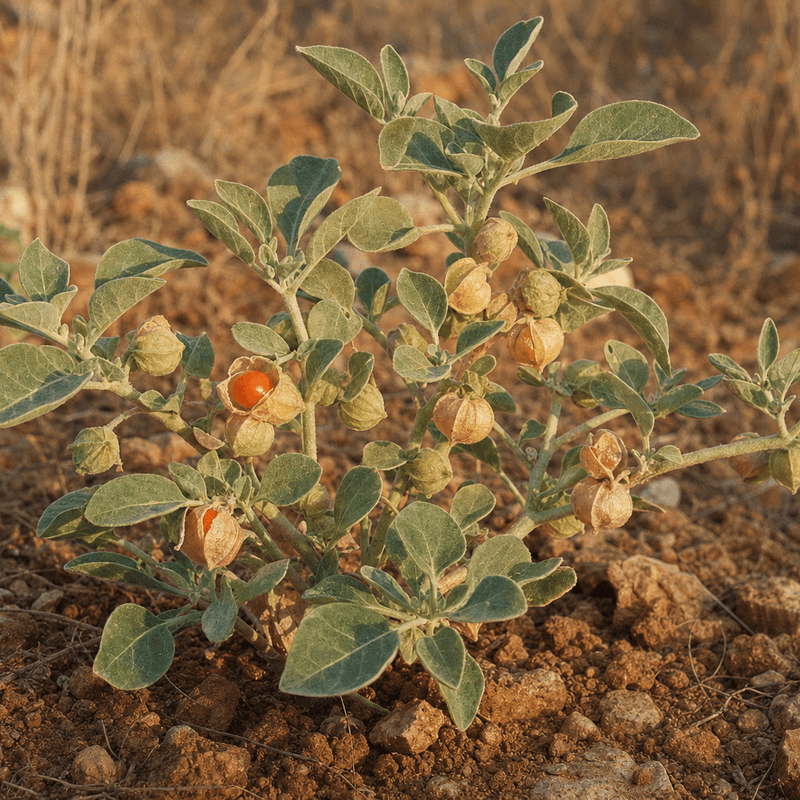
Watch out for names, though. In my shop you'll find two roots. My ginseng root is real Panax ginseng. Imperial ginseng is dang shen, Codonopsis pilosula: a climbing plant of the bellflower family, whose root is also used in China. It has the word ginseng in its name, but it isn't a real ginseng, and it has uses of its own. Same thing for ashwagandha, which is sometimes called Indian ginseng: I tell you about that one separately, and it's a whole different story.
What ginseng is good for, according to the old handbooks
In Korea, China and Japan, people have been using ginseng root for thousands of years. It's one of the most important plants in their old traditions, taken as a tonic when the body had lost its spring.
Here, today's books are more careful, and I think they're wise. They list ginseng, white and red alike, among the plants traditionally used by adults when they feel tired and weak. That's all. And they make it clear that it's long use talking, nothing else.
So I'll tell you how it is: I'm not promising you wonders or instant results. It's a root you take for a while, in the weeks when you feel flat, and never for more than three months in a row. If after two weeks you still feel just as tired, or it gets worse, it's not a decoction you need, it's an appointment with your doctor. And if it's a passing tired spell that brought you here, I've written down my little habits for those days.
And what about women, people ask me? The same rules as for everyone, plus one: not during pregnancy, and not while breastfeeding. Not for children and teenagers either: ginseng is for grown-ups, from eighteen on.
How I make ginseng, and my ginseng and ginger cup

A root is hard and dense. A plain infusion doesn't draw much out of it: for roots, the books say to make a decoction. I weigh out 1 to 2 g of root in thin slices, put them in 150 ml of cold water, bring it to the boil, and let it simmer gently, with a lid on, for a good quarter of an hour. The books say you can drink two or three cups a day. I drink it in the morning and at lunchtime, never in the evening: it can keep you awake, and I'm fond of my nights.
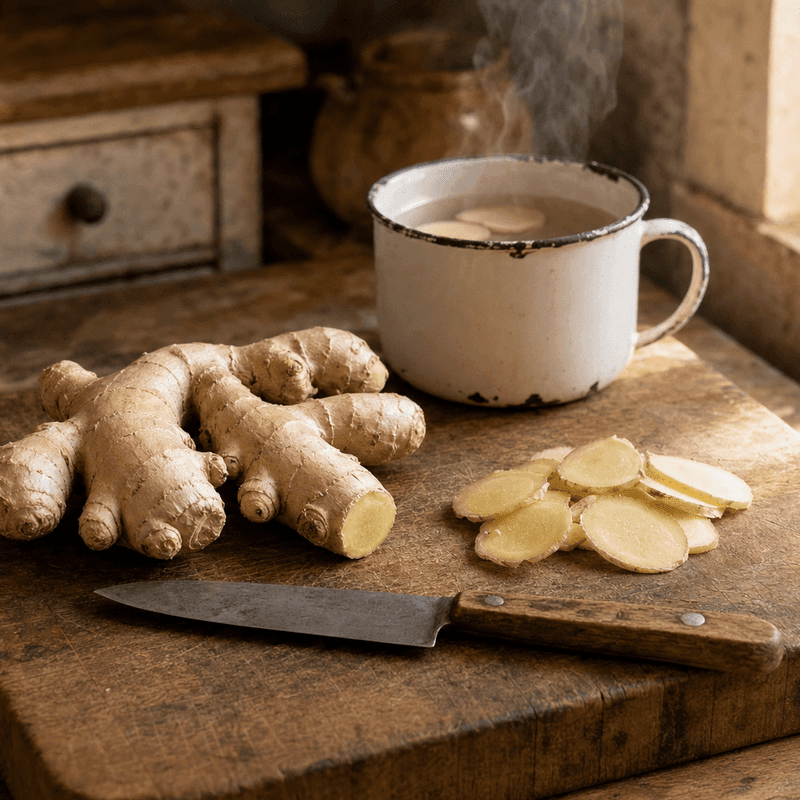
And ginger, you ask? Nothing to do with it, apart from the start of the name. Ginger is a rhizome of the Zingiberaceae family, from India and southern China; ginseng is a root of the Araliaceae family. But the two get along well: on winter mornings I add two slices of fresh ginger to my ginseng slices. What else I do with ginger, I've told you on its own page.
And then there's a recipe I love, Korean ginseng chicken soup, samgyetang. A small spring chicken stuffed with sticky rice and garlic, simmered with a piece of ginseng root and some jujubes. In Korea the custom is to eat it on the hottest days of summer. I'd rather make it in November, when it's raining on the garden. I've put my version in the recipes, with just the right amount of ginseng.
What I love about ginseng is its earthy taste, a bit bitter and a bit sweet. Five or six years under the trees deserves to be drunk sitting down, without looking at the clock.
What I use her for
- · 01A cup of decoction in the morning, in the weeks when I feel flat and worn out: that's its traditional use, for adults.
- · 02Only for a while at a time: no more than three months in a row, and if I'm not feeling better after two weeks, I go and see my doctor.
- · 03With two slices of fresh ginger, for a cup that warms your hands on winter mornings.
- · 04A little piece in the pot, for Korean ginseng chicken soup.
- · 05I keep it for the morning and lunchtime: it can keep you awake.
How I prepare her
Granny’s little recipes
My morning ginseng decoction
In the morning, in the weeks when you feel flat
What you’ll need
- 1 to 2 g dried ginseng root, in thin slices
- 150 ml cold water
- A little honey, if you like
How I go about it
- 01Put the slices in the cold water, in a small pan.
- 02Bring to the boil, then turn the heat down and let it simmer for 15 minutes, with a lid on.
- 03Strain, add the honey if you like, and drink it hot.
- 04Up to 2 or 3 cups a day, best in the morning and at lunchtime. For adults only, and no more than 3 months in a row.
Ginseng and ginger for winter mornings
In the morning, when it's cold outside
What you’ll need
- 1 g dried ginseng root, in thin slices
- 2 thin slices of fresh ginger
- 150 ml cold water
- 1 teaspoon honey, if you like
How I go about it
- 01Put the ginseng and ginger in the cold water, in a small pan.
- 02Bring to the boil, then let it simmer for 15 minutes, with a lid on.
- 03Strain, add the honey if you like, and sip it slowly.
- 04Count this cup as one of your 2 or 3 cups of ginseng for the day.
Korean-style ginseng chicken soup
A Sunday lunch in November, for two
What you’ll need
- 1 spring chicken (poussin) of about 500 g, cleaned and rinsed
- 70 g sticky rice, soaked for 1 hour in cold water, then drained
- 6 to 8 cloves of garlic
- 2 g dried ginseng root, in slices
- 2 dried jujubes
- 2 spring onions, finely sliced
- Salt and pepper
How I go about it
- 01Stuff the chicken with the rice and garlic, tuck in the wings and tie the legs so the stuffing stays inside.
- 02Put it in a pan just big enough for it, cover with water, bring to the boil, then turn the heat down and skim for 1 to 2 minutes.
- 03Add the ginseng and a good pinch of salt, and let it simmer for 20 minutes, skimming now and then.
- 04Let it simmer another 20 to 25 minutes, until the chicken is tender. Add the jujubes 5 minutes before the end.
- 05Serve in two big bowls with the broth, scatter the spring onion on top, and put the salt and pepper on the side. One bowl each comes to 1 g of ginseng per person.
What to know first
This information doesn’t replace advice from a healthcare professional. Health Disclaimer →
Her identity card
- Name
- Ginseng, Korean ginseng, insam in Korean, rénshēn in Chinese
- Latin name
- Panax ginseng C.A.Mey.
- Family
- Araliaceae
- Part used
- Root
- Harvest
- Root dug up in autumn, usually when the plant is five or six years old
- Form
- Dried root (white ginseng) or steamed and then dried (red ginseng), in thin slices, for a decoction
- Origin
- Shady mountain woods of Korea, northeast China and the Russian Far East; grown mostly in Korea and China
- Storage
- A tightly closed jar, somewhere dry and out of the light
- Not to be confused with
- American ginseng (Panax quinquefolius), dang shen or “imperial ginseng” (Codonopsis pilosula), ashwagandha or “Indian ginseng”
If you remember just one thing
- 01Ginseng is the root of Panax ginseng, a plant from the shady woods of Korea and China: its Chinese name, rénshēn, means man and root.
- 02Red ginseng and white ginseng are the same root: red is steamed before it's dried, white is simply dried.
- 03Imperial ginseng is dang shen, a different plant: real ginseng is Panax.
- 04Traditionally, adults drink ginseng as a decoction when they feel tired and weak, and never for more than three months in a row.
- 05Not before 18, not during pregnancy or breastfeeding, and if you take something on a doctor's orders, ask your doctor first.
Your questions
Ginseng is the root of Panax ginseng, a perennial plant of the shady woods of Korea, northeast China and the Russian Far East. Its name comes from the Chinese rénshēn: rén means man, and shēn means root. As it gets older, the root sometimes looks like a little man, hence the name man-root.
It's the same Panax ginseng root as white ginseng, but farmed, steamed and then dried. That gives it its reddish brown colour and a bitter, sweet, slightly caramelised taste. Korean red ginseng is red ginseng grown in Korea, where ginseng is called insam.
White or red, the books list it among the plants traditionally used by adults when they feel tired and weak. It's a long-standing use, nothing more, and I'm not promising you instant results. If you're still tired after two weeks, go and see your doctor.
Yes, but for a while at a time: up to 2 or 3 cups of decoction a day, with 1 to 2 g of root per cup, and no more than 3 months in a row. It's for adults only. And keep it for the morning and lunchtime, because it can keep you awake.
Not before 18, not during pregnancy or breastfeeding, and not if you're allergic to ginseng. If you take something on a doctor's orders, especially to thin your blood or for your blood sugar, ask your doctor first: some handbooks say ginseng could interfere with clotting and lower blood sugar. It can also upset your stomach and keep you awake.
They're two plants that only share the start of their names. Ginger is a rhizome of the Zingiberaceae family, from India and southern China. Ginseng is a root of the Araliaceae family, from the mountains of Korea and northeast China. The two go nicely together in a cup, in the morning.
References
- European Union herbal monograph on Panax ginseng C.A.Mey., radix, Final, Revision 1 (EMA/HMPC/27744/2023) · European Medicines Agency (HMPC), 2024
- Assessment report on Panax ginseng C.A.Mey., radix, Revision 1 (EMA/HMPC/27745/2023) · European Medicines Agency (HMPC), 2024
- Glossary on herbal teas (EMA/HMPC/5829/2010 Rev.1) · European Medicines Agency (HMPC)
- Asian Ginseng · National Center for Complementary and Integrative Health (NIH), 2025
- LAFITAU, JOSEPH-FRANÇOIS · Dictionary of Canadian Biography
- Ginseng in Canada? · John Carter Brown Library
- 红参 Hongshen (Ginseng Radix et Rhizoma Rubra), Pharmacopée chinoise 2020 · ShennongAlpha, Westlake University
- Ginseng · Wikipédia, 2026
- Panax quinquefolius (ginseng américain) · Wikipédia, 2026
- Panax ginseng · Wikipedia (en), 2026
- Codonopsis pilosula · Wikipedia (en), 2026
- Gingembre · Wikipédia, 2026
- Samgye-tang · Wikipedia (en), 2026
- Korean ginseng chicken soup (samgyetang) · SBS Food
- Fiche technique Ginseng rouge, racine séchée · L'île aux épices