Lavender and sleep: my bedtime sachet and the oil I handle with care
In July, I cut my lavender and hang it upside down to dry. Then it ends up in a sachet under the pillow or in the evening cup. And its essential oil? I'll tell you how I keep it.
Lavender for sleep, in my house, is a story that starts in July. That's the month when my mother cut the stems in full flower, and I still do the same. My row of fine lavender grows in full sun, along the low wall of the vegetable garden, and as long as it's in flower, the bees never leave it.
My fine lavender, picked in July
I cut the flower spikes one morning, once the dew has gone and before the worst of the heat, when about half the flowers are open. I make little bundles of twenty to thirty stems, tied tight at the base with string, and hang them upside down in the barn, somewhere dry and dim, for ten to fifteen days. Then I strip the flowers into a jar that closes well, kept out of the light: they keep their scent for up to two years. I've shown you how I dry my July herbs, if you'd like to give it a go.
Its name is said to come from the Latin lavare, to wash, because it went into bathwater: the Romans were already scenting their baths and their linen with it. In our house, it mostly ended up in the wardrobes, between the sheets.
Be careful what you pick. The lavender in my cup is true lavender, also called fine lavender or officinal lavender, Lavandula angustifolia: a single spike at the end of a long stem with no branches. Spike lavender and lavandin, the one in the big fields, smell more of camphor. They're other plants: don't put them in your cup thinking it's the same thing.
A lavender sachet under the pillow: I crumple it between my fingers before I turn out the light. My mother taught me that, and I've never changed.
Lavender and sleep: the sachet under the pillow, the evening cup
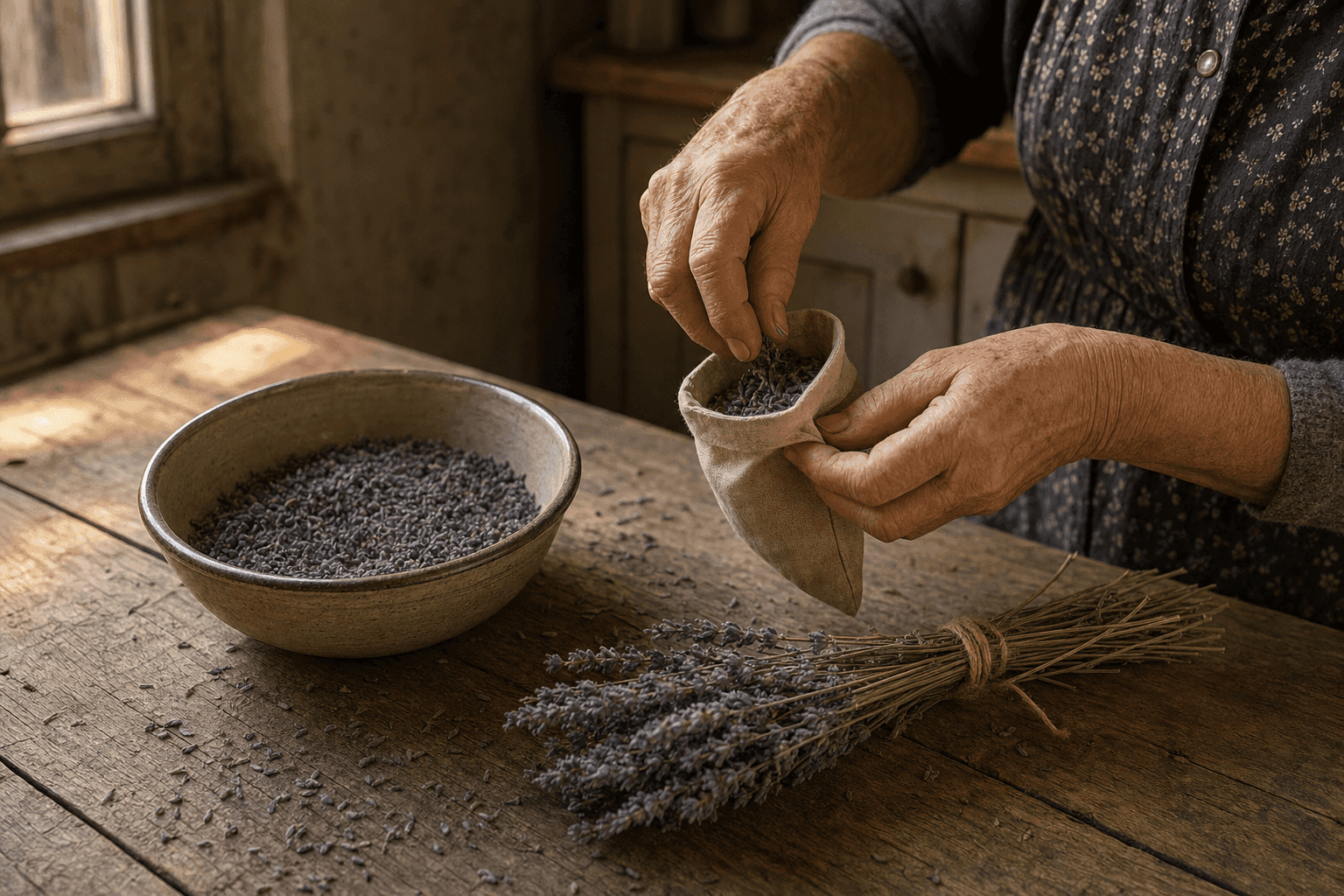
The sachet is my mother's habit, and it's stayed mine. I put two to three good tablespoons of well-dried flowers (15 to 20 g) in the middle of a square of linen about twelve centimeters across. I gather the four corners into a little pouch, a bit of ribbon, and off the sachet goes under the pillow. Once a month, I crumple it between my fingers to wake up the scent, and after two or three months, I change the flowers.
I'm not promising it'll put you to sleep. All I know is that I like the scent when I turn out the light, and that it reminds me of my mother's linen.
On evenings when my head is still spinning, I drink a cup. For lavender flower, the books keep only one traditional use: tense nerves, a tired head, and sleep that's slow to come. That's all, and that's already not bad. For difficult nights as for days when your nerves are all in a knot, it's one of the tins I open.
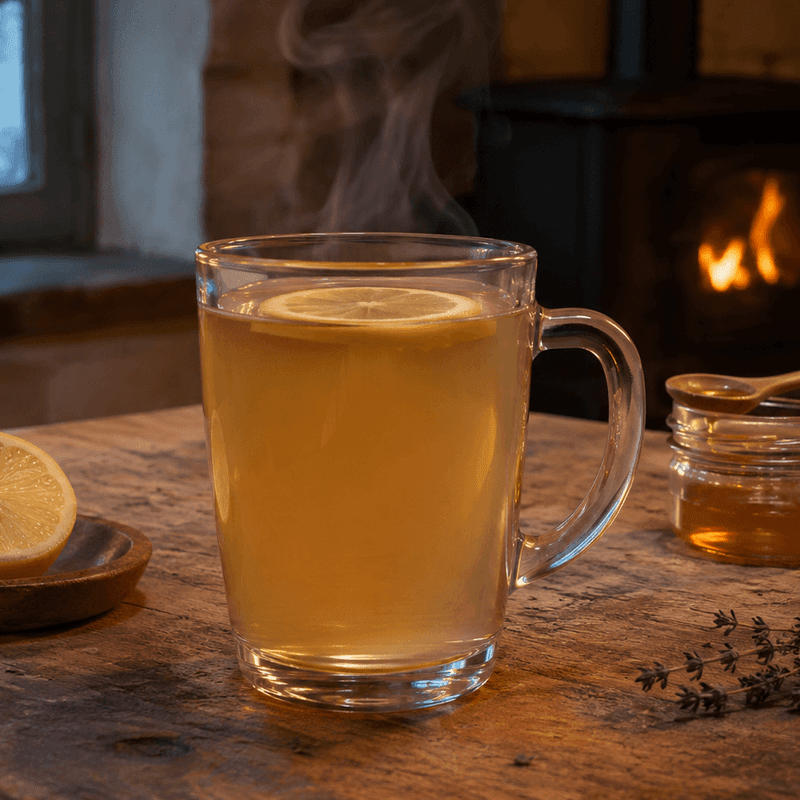
I put 1 to 2 g of dried flowers in the bottom of the cup, pour in 150 ml of boiling water, cover it and let it steep for ten minutes before straining. The taste is very perfumed, so I keep a light hand. My mother added a spoonful of honey, and I do as she did. Three cups a day at most, and it's for the bigger ones, from age 12. Everything I know about my lavender, I've put on its page, and for my other evening plants, verbena and lemon balm, I wrote you another letter.
Lavender doesn't make you sleep. It smells of clean laundry, and that's enough to set the day down.
Lavender essential oil: how to use it, and its dangers
Where do you put lavender essential oil for sleep? People ask me that a lot. I don't put any near my bed: for the night, I have my sachet. In my house, the little bottle is only for scenting the rooms.
The essential oil is drawn from the flowering tops with steam, and it takes up to 200 kg of fresh flowers to make one liter. That tells you how concentrated it is. If you buy some, look at the Latin name: for true lavender, it's Lavandula angustifolia. The one from upper Provence has even had its own appellation of origin since 1981. But concentrated means you respect it, and my rules are simple:
- I don't swallow it: not neat, not in the cup, not on a sugar cube. Swallowed in large amounts, it can be toxic to the nervous system.
- Never neat in the eyes, nose or mouth, and I wash my hands after using it.
- No essential oil for children (the books don't give it before age 12), or for a woman who's pregnant or breastfeeding.
- The bottle is kept right up high, out of reach of little ones, and never next to the babies' things: parents have been known to give it by mistake instead of vitamin D drops.
- With a diffuser, I air the room well, and if anyone in the house has asthma, we go without.
- Before you use it, ask your pharmacist for advice.
If a little one has swallowed some by accident, call a poison control center or emergency services right away, and say which oil, how much, the child's age and what's happening.
There are rules for the cup too. No lavender to drink during pregnancy or breastfeeding, and not before age 12. It can make you drowsy: if that happens to you, no driving and no machines. If you're allergic to lavender, go without it, and if anything unusual happens, stop and ask for advice. If you take something on a doctor's orders to thin your blood, for sleep or for your nerves, talk to your doctor or pharmacist before having it regularly. And if sleep doesn't come back, or if it gets worse, it's no longer a matter for lavender: go and see your doctor.
Before I let you go
This afternoon, I filled three sachets on the kitchen table, with the bowl of summer flowers and a spool of ribbon. One for my pillow, two for the linen cupboard. I can still smell it on my fingertips, and a few flowers rolled under the table: I'll find them tomorrow when I sweep. Until the next letter.