Comfort for your tummy
When your tummy pulls or knots up, you sit down, put on a warm hot-water bottle and drink a cup of German chamomile. And you know which signs mean calling the doctor, or 15 (the emergency number in France).
Reviewed by Ruosi Wu, PhD in Pharmacy, MD in Traditional Chinese Medicine
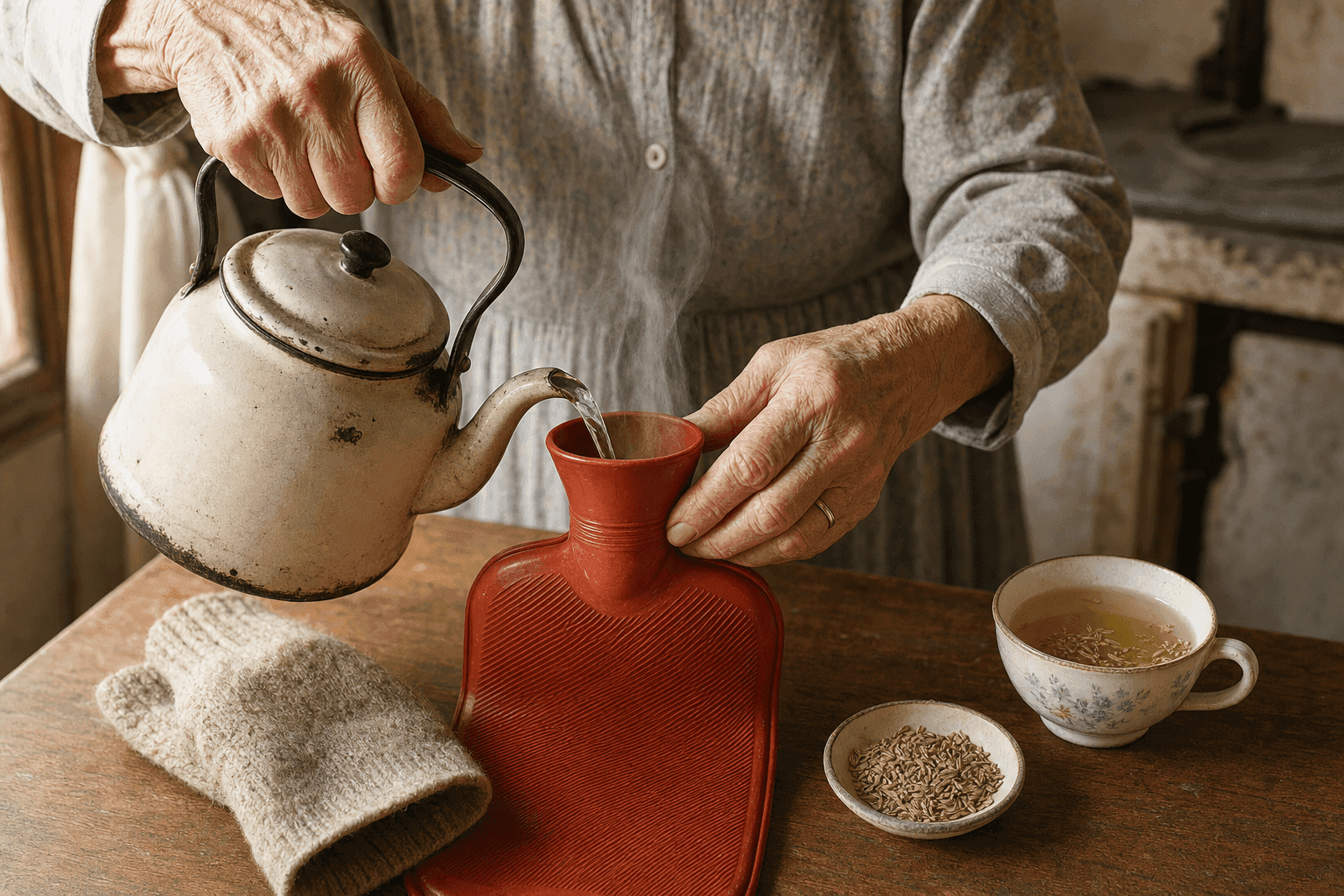
When your tummy hurts, sit down, breathe calmly and put a warm hot-water bottle on your tummy. A cup of German chamomile after a meal is what my books give for a tummy that knots up. If the pain is sudden, or if there’s fever, vomiting or blood, go and see your doctor.
Key takeaways
- Most often, a tummy ache comes from difficult digestion, a sensitive bowel or constipation, and sometimes from nerves.
- To ease a tummy ache, you sit down, breathe calmly, eat lightly and drink water.
- A hot-water bottle, hot but not scalding, laid on your tummy: it’s the age-old habit, and some people find it brings relief.
- German chamomile, fennel seeds, lemon balm, rosemary and sage are traditionally given, in a cup, for a tummy that pulls or knots up after eating.
- Sudden pain, a very hard tummy, fever, vomiting, blood, pain during pregnancy or in a child: that needs a doctor, sometimes right away.
Granny’s little steps
- Sit down and breathe calmly
Sit or lie down, loosen your belt and breathe slowly. Relaxing and resting is the first thing to do when your tummy pulls.
- The hot-water bottle on your tummy
Hot but not scalding, wrapped in a tea towel. Some people find a little warmth on the tummy brings relief; for a child, keep it lukewarm.
- Eat lightly and drink water
Small amounts, simple food. If it really hurts a lot, don’t eat anything for a few hours, and drink water.
- A cup of German chamomile
1.5 to 4 g of dried flowers in 150 ml of boiling water, ten minutes covered, three or four cups a day at most. The recipe is just below.
- For a stitch, lean forward
Stop, breathe deeply, press on the side that hurts, stretch your tummy, and lean forward with your hands on your thighs.
A recipe to try
The after-meal cup of German chamomile
After lunch or dinner, when your tummy bloats or knots up
What you’ll need
- 1.5 to 4 g of dried German chamomile flowers
- 150 ml of water
- A spoonful of honey, if you like
How I go about it
- Bring the water to the boil.
- Pour it over the flowers in the bottom of your cup.
- Cover and let it steep for 10 minutes.
- Strain, add the honey if you like, and drink it slowly. Three or four cups a day at most.
When your tummy hurts, start by sitting down, breathing calmly and putting a hot-water bottle on your tummy; a cup of German chamomile after the meal does the rest. I’ll tell you where it most often comes from, what I do at home, my plants with their amounts, and the signs that are no longer a matter for herbal tea.
Why your tummy hurts, most of the time
Everyone, or nearly everyone, has had a tummy ache. It can pull, squeeze, burn, twist, come on slowly or all at once. That’s because there’s a lot going on in there: the stomach, the bowel, the liver, the pancreas, the kidneys, and lower down the bladder and, for women, the womb and the ovaries.
But the books say something reassuring: most often, it comes from three very ordinary things. Difficult digestion, which hurts high in the tummy, just under the ribs. A sensitive bowel, which tightens up on its own and hurts a bit all over. Or constipation, even a passing one, which gives cramps and a bloated tummy.
And then there are nerves. The books say tummy aches that come back often, with no cause found, can go with anxiety, and that in children, some come on just as it’s time to leave for school. Me, the day before big family meals, my tummy was in knots before I’d even set the table.
How to ease a tummy ache at home
If the pain is moderate and none of the signs on the list further down worry you, here’s what I do. First, I stop. I sit or lie down, I loosen anything tight, and I breathe calmly. Relaxing and resting is my doctor’s first piece of advice.
Next, the hot-water bottle: hot water, not boiling, in a tea towel, laid on the tummy. The books say some people feel relief with something moderately warm on their tummy. My mother used to put it on me when I was little.
For food, go gently, in small amounts. If it really hurts a lot, don’t eat anything for a few hours. And drink water.
Then a warm cup. For a child too, the books say a warm herbal tea and a lukewarm hot-water bottle can help, unless it looks like appendicitis. But not just any plant for little ones: I’ve written further down which ones, and from what age.
And keep an eye on it. If it doesn’t pass, if it gets worse, or if fever or vomiting turn up along the way, it’s no longer a small trouble. At the pharmacy, there are also things to calm a tummy that’s cramping: ask your pharmacist, and read further down what you need to know first.
Which herbal tea to drink for a tummy ache
My books give several plants for a tummy that pulls, knots up or bloats after eating. One at a time, in a cup, and measured.
German chamomile. It’s my first cup when my tummy knots up in little cramps after a meal. The mild one, not Roman chamomile, which is bitter. You put 1.5 to 4 grams of dried flowers in 150 ml of boiling water, ten minutes covered, three or four cups a day at most. If it’s no better after a week, you go and see your doctor. It’s also the only one of these plants the books allow during pregnancy, and for children from 6 months, in smaller amounts. What else I do with chamomile, I tell you here.
Fennel. The seeds, not the bulb you bake au gratin. The books give them for a tummy that pulls and bloats, with gas: 1.5 grams of seeds for a big bowl of boiling water (250 ml), fifteen minutes covered, up to three bowls a day, no more than two weeks in a row, and from age 12. I tell you all about my fennel there.
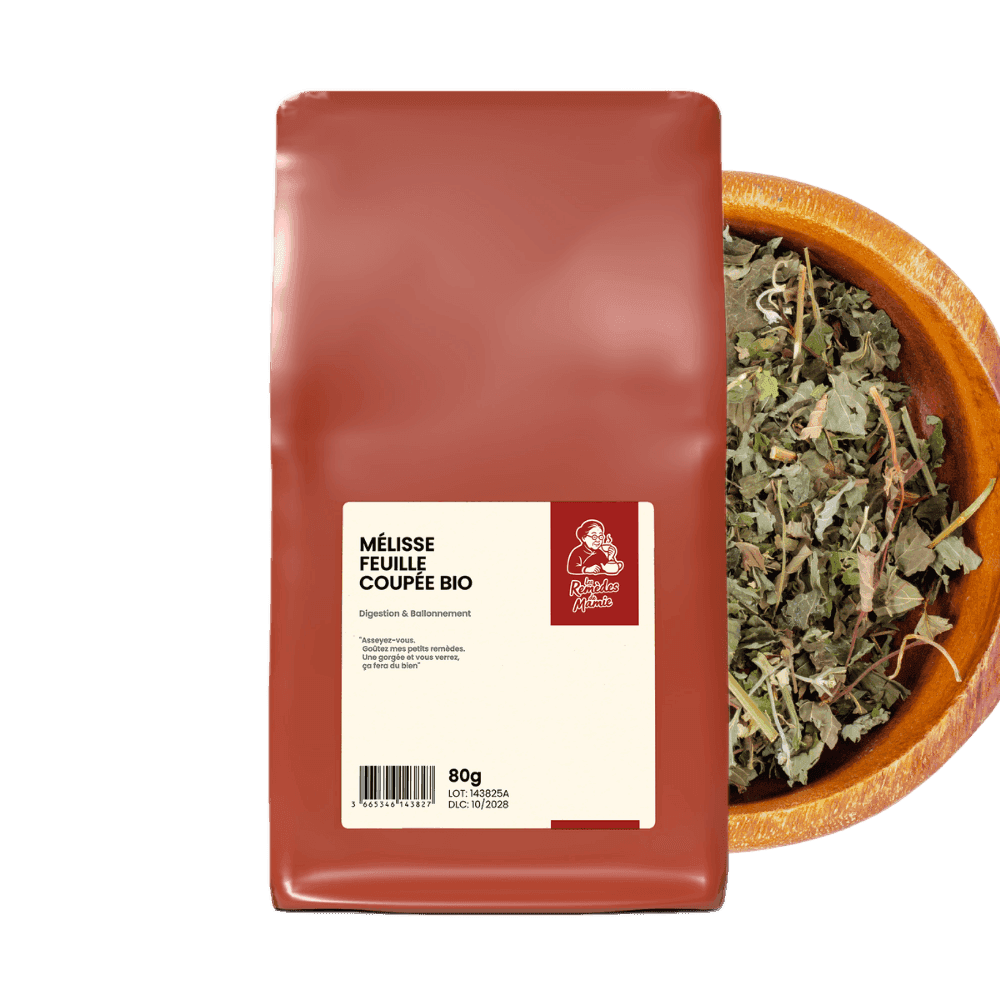
Lemon balm. For a tummy that bloats and makes gas after eating, and also when your nerves are a little on edge: very handy when it’s stress that’s tightening your tummy. 1.5 to 4.5 grams of dried leaves in 150 ml of boiling water, ten minutes covered, one to three cups a day, from age 12. It can make you a bit sleepy. I tell you about my lemon balm here.
Rosemary. After a meal that was too heavy, when digestion drags or your tummy tightens up a little: 1 to 2 grams of dried leaves in 150 to 250 ml of boiling water, ten minutes covered, two or three cups a day, no more than 6 grams in a day, from age 12. Not if you have a liver or gallbladder problem. Let me introduce you to my rosemary there.
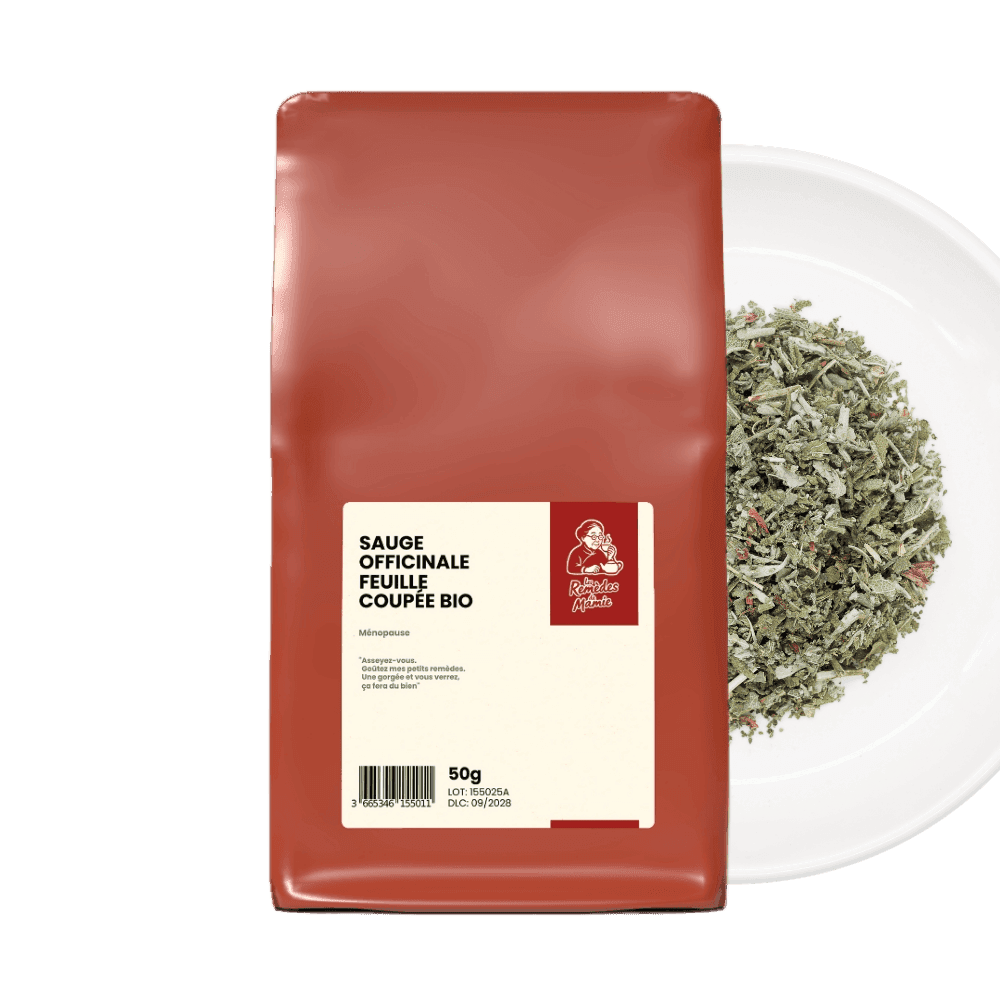
Common sage. The books give it after a meal that was too heavy, when there’s a bit of burning or bloating. 1 to 2 grams of dried leaves in 150 ml of boiling water, ten minutes covered, up to three cups a day, for a short stretch, and only for adults. I tell you more about my sage here.
These plants aren’t for everyone: pregnancy, children, allergies, I’ve put it all further down, plant by plant.
“A hot-water bottle, a cup, and you sit down. Your tummy doesn’t like to be rushed.”
Pain low in the tummy, pain up high: knowing when it’s no longer a small trouble
Where it hurts doesn’t tell you everything, but it gives you some landmarks. Up high, in the middle, just under the ribs, it’s often the stomach or the gallbladder. But pain in that spot that climbs toward the chest, neck or shoulders can come from the heart: then you call 15 or 112 (the emergency numbers in France) right away.
Low on the right, pain that gets stronger and stronger and stays in the same place, with nausea and a bit of fever, makes you think of appendicitis. You see the doctor as quickly as possible, and for a child, you don’t give them anything to eat or drink while you wait.
Pain low in the tummy for a woman can be her period, of course. For a tummy that pulls during your period, I have other little habits. But pain low in the tummy without your period, with a late period or burning when you pee, can come from the bladder, the ovaries, or a pregnancy that hasn’t settled in the right place. Only your doctor can sort that out. And a pregnant woman with tummy pain she’s never felt before calls 15 or 112 without waiting.
With children, I’m even more careful: fever, vomiting, turning very pale or cold sweats along with the tummy ache, you call their doctor right away or go to the emergency room. And if it lasts more than 24 hours, you have the doctor see them.
My herbal teas and my hot-water bottle are for a tummy that pulls after a meal or a bout of stress. The rest is your doctor’s job: the list is just below, sign by sign.
Which plants?
AnisePimpinella anisum
Green anise means the little grey-green seeds of a Mediterranean umbellifer: I steep them when my tummy bloats or when I cough with a cold, and I put some in my biscuits.
Ceylon cinnamonCinnamomum verum
Ceylon cinnamon is true cinnamon: the thin bark of a tree from Sri Lanka, in sticks of many layers, with far less coumarin than cassia. I put it in rice pudding, and in a cup when my tummy bloats.
RosemarySalvia rosmarinus
Rosemary is the evergreen Mediterranean shrub you keep close to the kitchen: for the potatoes, for a cup after a meal, for the bath.
FennelFoeniculum vulgare Mill.
Fennel is the tall plant that smells of anise: its seeds go into a tea when your tummy bloats, the Florence bulb goes into the kitchen, and wild fennel grows along the roadsides.
SageSalvia officinalis
Common sage is the little shrub with soft grey leaves that we keep near the kitchen: for the roast, for the cup after a meal, for a tickly throat.
ChamomileMatricaria chamomilla L.
Chamomile means two little flowers for your cup: German chamomile, mild, and Roman chamomile, bitter. For a bloated tummy, an irritated throat, skin that's got too hot.
Lemon balmMelissa officinalis
Lemon balm is the perennial garden herb that smells of lemon when you crush it: a cup in the evening, a cup when your tummy bloats, and a few leaves over summer fruit.
What to know first
German chamomile: it belongs to the daisy family (Asteraceae), like ragweed, chrysanthemums and marigolds. If you’re allergic to any of these plants, go without. Serious allergic reactions have been reported: if you have trouble breathing, or if your face or throat swells, call emergency services right away. During pregnancy and breastfeeding, the books allow simple German chamomile tea, in the usual amounts. For children, not before 6 months, and smaller amounts depending on age: 0.5 to 1 g of flowers from 6 months to 2 years, 1 to 1.5 g from 2 to 6 years, 1.5 to 3 g from 6 to 12 years, two to four times a day. Interactions have been reported with warfarin (a blood thinner), with certain medications processed by the liver, and in kidney transplant patients who drank a lot of it for a long time: if you’re on long-term treatment, ask your doctor or your pharmacist before drinking it regularly.
Fennel: not during pregnancy or breastfeeding. No fennel tea before age 4, not even for babies’ colic. Between 4 and 12, the books give a smaller cup (1 g of seeds in 100 ml of boiling water, 15 minutes, up to three times a day, for less than a week), but only with seeds known to be suitable for children: ask your pharmacist first. No fennel if you’re allergic to fennel, anethole, anise, caraway, celery, coriander, dill or mugwort pollen. No more than two weeks in a row.
Lemon balm: not during pregnancy or breastfeeding, and not before age 12. It can make you drowsy: if it does, don’t drive or use machines. If you have a thyroid problem or are on treatment for one, ask your doctor before drinking it regularly. The books have no data on combining it with other products: if you take something on a doctor’s orders, especially for sleep or for your nerves, talk to your doctor or your pharmacist.
Rosemary: not during pregnancy or breastfeeding, and not before age 12. If you have liver disease, gallstones, an inflamed gallbladder or blocked bile ducts, don’t drink rosemary tea without your doctor’s advice. In a cup, no more than 6 g of leaves in a day. Not if you’re allergic to rosemary. The books don’t report any interaction; if you’re on long-term treatment, talk to your doctor or your pharmacist all the same.
Common sage: not during pregnancy or breastfeeding, and not before age 18. Don’t push the dose: sage contains thujone, which the books say is toxic to the nerves, and that’s why you only take it for a short stretch, up to three cups a day. Sage essential oil is never swallowed. Not if you’re allergic to sage. The books don’t report any interaction; if you’re on long-term treatment, talk to your doctor or your pharmacist all the same. Clary sage, white sage and ornamental sages are different plants.
Children: of these five plants, only German chamomile is given in a cup from 6 months, in the small amounts written above. Fennel, not before age 4, and with your pharmacist’s go-ahead up to 12. Lemon balm and rosemary, not before age 12. Sage, not before age 18. If a child has pain low on the right side of the tummy, getting stronger and stronger, with nausea, vomiting, fever or paleness, don’t give them any herbal tea or anything to eat, and get them seen as quickly as possible.
How long: if your tummy is no better after a week of chamomile, or two weeks with the other plants, or if it gets worse along the way, stop and go and see your doctor.
What you get at the pharmacy: if you don’t know where your tummy ache comes from, avoid aspirin and anti-inflammatories: they’re contraindicated in many cases (a stomach ulcer, gastritis) and they can mask an infection. My doctor recommends paracetamol instead. For an adult, start with 500 mg, no more than 1 g per dose, at least 4 to 6 hours between two doses, no more than 3 g a day unless your doctor says otherwise, and no alcohol in the meantime. Under 50 kg, read the leaflet for the dose. It can be taken during pregnancy and breastfeeding, but not if you’re allergic to it, if you have phenylketonuria or if your liver is diseased; too much paracetamol can seriously damage the liver. Antispasmodics calm bowel contractions better than painkillers; some are sold without a prescription, ask your pharmacist for advice. Don’t mix or alternate different painkillers without your doctor’s advice, and if it doesn’t bring relief quickly, go and see them. Finally, if the pain is violent and sudden and you don’t know where it comes from, don’t take anything for the pain before seeing the doctor: it would make it harder for them to find the cause.
When to see your doctor
- Sudden, intense tummy pain, like a stab: call 15 or 112 (the emergency numbers in France) right away.
- Pain high in the tummy that spreads to the chest, neck or shoulders: call 15 or 112 right away.
- Tummy pain just after a road accident, a bad fall or a blow: call 15 or 112 right away.
- Tummy pain and you’re vomiting blood or a brownish liquid: call 15 or 112 right away.
- Tummy pain with feeling faint and a fever: call 15 or 112 right away.
- Tummy pain with nausea and vomiting when you have diabetes: call 15 or 112 right away.
- Shortness of breath without exertion, or trouble breathing that lasts or gets worse: call 15 or 112 right away.
- A very hard, painful, tense tummy: call 15 or 112 right away.
- You’re pregnant and have tummy pain you’ve never felt before: call 15 or 112 right away.
- A child with sudden tummy pain, like a stab, or pain that gets worse fast: call their regular doctor right away, or go to the nearest emergency room.
- A child with tummy pain after a fall, a blow or an accident: call their regular doctor right away, or go to the nearest emergency room.
- A child with tummy pain who can no longer have a bowel movement, pass gas or pee: call their regular doctor right away, or go to the nearest emergency room.
- A child with tummy pain and a fever, especially if it stays moderate, between 38 and 38.5 °C: call their regular doctor right away, or go to the nearest emergency room.
- A child with tummy pain and trouble breathing: call their regular doctor right away, or go to the nearest emergency room.
- A child with tummy pain who is vomiting, or has bad diarrhea: call their regular doctor right away, or go to the nearest emergency room.
- A child with tummy pain and blood in their urine or stools: call their regular doctor right away, or go to the nearest emergency room.
- A child with tummy pain who turns very pale, or breaks out in cold sweats: call their regular doctor right away, or go to the nearest emergency room.
- A child with pain low on the right side of the tummy, getting stronger and stronger, with nausea, vomiting, fever or paleness: get them seen as quickly as possible, and don’t give them anything to drink or eat while you wait.
- Tummy pain with nausea, vomiting or fever: see your regular doctor the same day.
- Tummy pain with a high fever: see your regular doctor the same day.
- Tummy pain and trouble peeing: see your regular doctor the same day.
- You’re no longer having bowel movements and no longer passing gas: see your regular doctor the same day.
- Your skin or the whites of your eyes turning yellow: see your regular doctor the same day.
- New tummy pain that won’t let up and stops you doing what you usually do: see your regular doctor the same day.
- Tummy pain with an unusually late period: see your regular doctor the same day.
- Red blood in your stools, or black stools: see your regular doctor the same day.
- A tummy ache that doesn’t calm down, or gets worse, after two days of painkillers: see your regular doctor in the next few days.
- Tummy pains that keep coming back, and you’ve never had a checkup for them: see your regular doctor in the next few days.
- Tummy pain and you’re constipated when you weren’t before: see your regular doctor in the next few days.
- You’re losing weight without trying: see your regular doctor in the next few days.
- Tummy pain that comes on when you’ve been taking anti-inflammatories or cortisone for a long time: see your regular doctor in the next few days.
- A child who still has tummy pain after 24 hours: have their doctor see them in the next few days.
- A child whose tummy ache doesn’t pass with what their doctor advised: have their doctor see them again in the next few days.
Your questions
How can I ease a tummy ache quickly?
Sit down, loosen anything tight and breathe calmly. Put a hot-water bottle, hot but not scalding, wrapped in a tea towel on your tummy, eat lightly and drink water. A cup of German chamomile, 1.5 to 4 g of flowers in 150 ml of boiling water, is what my books give for a tummy that knots up after eating. If the pain is sudden or very strong, or if there’s fever, vomiting or blood, it’s no longer one for home: go and see your doctor.
Which herbal tea should I drink for a tummy ache?
German chamomile: 1.5 to 4 g of flowers in 150 ml of boiling water, ten minutes covered, three or four cups a day at most. Fennel seeds: 1.5 g in 250 ml of boiling water, fifteen minutes, up to three bowls a day, no more than two weeks, from age 12. Lemon balm: 1.5 to 4.5 g of leaves in 150 ml, up to three cups a day, from age 12. One plant at a time; rosemary and sage are also given after a meal that was too heavy, but not to children.
Can stress give you a tummy ache?
Yes, you know that knotted-up tummy. The books say tummy aches that come back often, with no cause found, can go with anxiety, and that in children, some come on just as it’s time to leave for school. On those days, I drink a cup of lemon balm, 1.5 to 4.5 g of leaves in 150 ml of boiling water, and I breathe slowly. If it keeps coming back, talk to your doctor so you know for sure.
Why do I have pain low in my tummy when I don’t have my period?
Low in the tummy, for a woman, it can be your period, but also the bladder, the ovaries, the womb, or a pregnancy that hasn’t settled in the right place. Only your doctor can tell the difference. If you have pain with an unusually late period, trouble peeing or a fever, see your doctor the same day. And if you’re pregnant and have never had this kind of pain, call 15 or 112 (the emergency numbers in France).
What should I do about a tummy ache when I’m pregnant?
A tummy pain you’ve never felt before, when you’re pregnant, means 15 or 112 (the emergency numbers in France) right away: you don’t stay alone with that. For the rest, ask your doctor before taking anything at all. Of my plants, only a simple German chamomile tea is allowed by the books during pregnancy; fennel, lemon balm, rosemary and sage, no.
When should a tummy ache worry me?
Sudden pain like a stab, a very hard tummy, pain that climbs toward the chest or shoulders, vomiting blood, feeling faint with a fever: call 15 or 112 (the emergency numbers in France) right away. Fever, vomiting, blood in your stools, no more stools or gas, skin turning yellow: see your doctor the same day. For a child, sudden pain, fever or turning very pale means their doctor right away or the emergency room.
Also worth reading
- The LetterMy cherry stone heat bag, made with the stones of summerThe stones from June's cherries, washed, dried in the sun and sewn into a cotton bag: that's my dry winter heat bag. I'll tell you how to make it, and how to heat it without burning yourself.
- The LetterMy sage, a honey plant, and its bees: come listen to summer with meMy sage is in flower and it hums from morning to night. Let me tell you about its bees, the cup and the gargle I make from it, and what I think of burning sage.
- The LetterMy sage and lemon lemonade: here's my summer jug for youWhen summer heats up the yard, out comes my jug: sage from the jar, a lemon, water. Here's my sage lemonade for you, with the right measurements, and who should go without it.
What I’ve made with
References
- Le mal de ventre : définition et causes · ameli.fr, 2026
- Mal de ventre : que faire et quand consulter ? · ameli.fr, 2026
- Mal au ventre chez l'adulte · Santé.fr, Service public d'information en santé, 2026
- Mal de ventre chez l'enfant · Santé.fr, Service public d'information en santé, 2025
- European Union herbal monograph on Matricaria recutita L., flos · EMA, HMPC, 2015
- European Union herbal monograph on Foeniculum vulgare Miller subsp. vulgare var. vulgare, fructus (Rev. 1) · EMA, HMPC, 2024
- Community herbal monograph on Melissa officinalis L., folium · EMA, HMPC, 2013
- European Union herbal monograph on Rosmarinus officinalis L., folium (Rev. 1) · EMA, HMPC, 2024
- European Union herbal monograph on Salvia officinalis L., folium (Rev. 1) · EMA, HMPC, 2016
- Public statement on Salvia officinalis L., aetheroleum · EMA, HMPC, 2016
- Glossary on herbal teas · EMA, HMPC
- Chamomile · NCCIH, National Institutes of Health
Information. This information is provided for general knowledge and doesn’t replace medical advice. Check with a healthcare professional before any use.
Health Disclaimer