Comfort during your monthly cycle
When your period pulls, you start with a hot-water bottle, some rest and a cup of fennel or yarrow tea. And you know when it’s time to go and see your doctor.
Reviewed by Ruosi Wu, PhD in Pharmacy, MD in Traditional Chinese Medicine
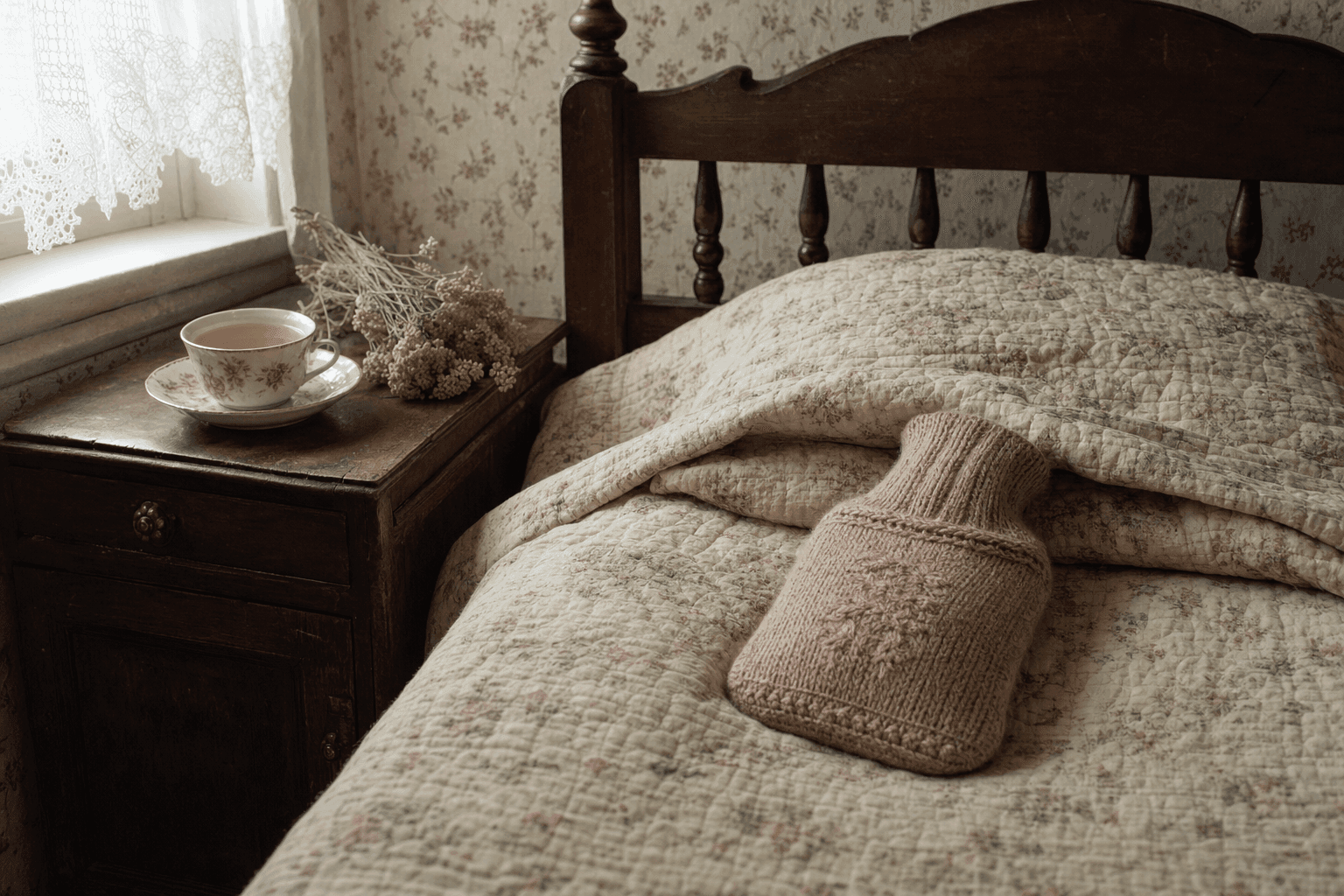
For painful periods, start with heat: a hot-water bottle on your lower belly, lying down, and some rest. A tea of fennel seeds or yarrow is what my books give for the little cramps that come with periods. If the pain makes you miss days or nothing calms it, go and see your doctor.
Key takeaways
- For painful periods, the first thing to reach for is still a hot-water bottle on your lower belly, or a hot bath, with some rest.
- Moving gently, sleeping well and leaving coffee, alcohol and cigarettes aside on those days often helps.
- Fennel seeds and yarrow are traditionally given as a tea for the little cramps that come with periods.
- Hurting so much that you miss school or work isn’t normal: you talk to your doctor about it.
- Pain that nothing calms, or that comes outside your period or during sex, is something to show a doctor.
Granny’s little steps
- A hot-water bottle on your lower belly
Fill it with very hot water, not boiling, wrap it in a tea towel and keep it on your lower belly, lying down. A hot bath does the same job: the warmth helps the tight belly relax.
- Rest and get your full sleep
Before and during your period, go to bed earlier and put off whatever can wait. Sleep, on those days, isn’t a luxury.
- Move a little, very gently
A walk, some easy cycling, some stretching. Even if you want to stay curled up in a ball, a gentle sport often helps.
- Massage your belly with the flat of your hand
With a nice warm hand, make little circles on your lower belly, without pressing hard. With the hot-water bottle, it’s even better.
- Leave coffee, alcohol and cigarettes aside
Before and during your period, you go without. A hot cup of tea takes the place of the afternoon coffee very nicely.
A recipe to try
Fennel tea for the evenings when it pulls
In the evening, when your period starts to pull
What you’ll need
- 1.5 g of dried fennel seeds (weigh them the first time, after that you’ll know by eye)
- 250 ml of water, a big mug
- 1 teaspoon of honey, if you like
How I go about it
- Bring 250 ml of water to the boil.
- Put 1.5 g of fennel seeds in the mug and pour the boiling water over them.
- Cover with a saucer and let it steep for 15 minutes.
- Strain, add the honey if you want, and drink it hot, slowly, with the hot-water bottle on your belly.
- You can have up to three mugs a day, but no more than two weeks in a row.
Painful periods calm down first with heat: a hot-water bottle on your lower belly, some rest, and a hot cup within reach. I’ll tell you what I do, what my books say, and when it’s time to stop gritting your teeth and go and see your doctor.
Why painful periods pull like that
During your period, the womb contracts. It’s often these contractions that pull, that squeeze, that fold you in two some mornings. The pain comes with the period, right from the start, and it can spread down into your lower back and thighs. On the worse days, some women also get a headache, or feel queasy.
You’re not alone, far from it. The books say that between half and two thirds of young women have pain during their periods. And for about 15 in 100, it’s bad enough to miss school or work.
My mother used to say: “That’s how it is, my girl, grit your teeth.” I believed her for a long time. Today, doctors say something else: hurting that much is neither normal nor something you just have to put up with. Discomfort that goes away with a hot-water bottle and a quiet day, that I know how to handle. Pain that pins you to your bed every month is another story, and I’ll talk to you about it further down.
What to do when you have painful periods: heat, rest, and moving a little
The first thing is the hot-water bottle. Fill it with very hot water (not boiling), wrap it in a tea towel and lay it on your lower belly, lying down. A hot bath does the same job: the warmth helps the tight belly relax. Me, I prefer the hot-water bottle in bed, with a big sweater. It’s less cleaning up than the bathtub.
You can also massage your belly, very gently, with the flat of your hand, a nice warm hand. Nothing clever: little circles, without pressing hard, until it eases off a bit.
Next, rest. Get your full night’s sleep, before and during your period. It isn’t laziness, it’s upkeep. If you can push a big chore back two days, push it back. The laundry will wait, it’s used to it.
And then, it seems odd when you want to stay curled up in a ball, but moving often helps. A walk, a bit of easy cycling, some stretching, a gentle sport. Nothing that makes you sweat like a marathon, just getting your body going again. The rest of the month counts too: regular activity, good sleep and varied meals.
On those days, I’d tell you to leave aside coffee, wine and cigarettes, before and during your period. And if you need something from the pharmacy for the pain, ask the pharmacist for advice, and no aspirin for period pain: it says so everywhere, and they’re right.
Grandma’s plants for painful periods
For the little cramps that come with periods, my books mostly give two. I’ll introduce them the way I know them, with the amounts, because a tea is something you measure.
Yarrow. I always keep a jar of it, dried flowering tops from the herbalist. The pharmacopoeia gives it, by tradition, for the little cramps that come with periods. You put 1 to 2 grams in 250 ml of boiling water, two to three times a day. It’s a bit bitter, I won’t lie to you. If things aren’t better after a week, stop and ask your doctor.
Fennel. Not the bulb you make into a gratin, the seeds. The books give them for the little cramps that come with periods, and also for a bloated belly. Count 1.5 grams for a big mug of boiling water (250 ml), fifteen minutes covered, three mugs a day at most, and no more than two weeks in a row. It’s my tea for tonight, I’ll give it to you further down. If you want to know more about it, I told you all about fennel over here.
And chamomile, lemon balm? For period cramps, my books don’t give them. If your belly swells on those days, I talk about the bloated belly here, and if you sleep badly, this way for nights when sleep won’t come.
“A tea doesn’t do magic. It keeps the hot-water bottle and the rest company, that’s all, and that’s already a lot.”
Painful periods: knowing when it’s no longer a small ache
My teas are for the monthly discomfort, the one you know by heart. If the pain changes its face, if it makes you miss days, if nothing you take calms it, or if it comes outside your period, it’s no longer my department. It’s your doctor’s, your midwife’s or your gynecologist’s.
I’ve put the list just below, sign by sign. Read it once, calmly, and keep it in the back of your mind. It’s not to scare you: it’s so you don’t lose years telling yourself that’s just how it is.
And if you have a daughter who’s starting her periods and hurts a lot right from the start, don’t let her grit her teeth the way I was taught to. Talk to her doctor about it, together with her. The check-up visit around 15 or 16 is there for that too.
Which plants?
FennelFoeniculum vulgare Mill.
Fennel is the tall plant that smells of anise: its seeds go into a tea when your tummy bloats, the Florence bulb goes into the kitchen, and wild fennel grows along the roadsides.
What to know first
Fennel and yarrow aren’t taken during pregnancy or while breastfeeding: the books advise against them, for lack of enough data. If your period is late and your belly hurts, don’t count on a tea, go and see your doctor.
Yarrow belongs to the daisy family (Asteraceae): if you’re allergic to any of these plants, don’t take it. Fennel is in the same family as anise, caraway, celery, coriander and dill: no fennel if you’re allergic to any of them, or if you’re allergic to mugwort pollen.
No fennel or yarrow for periods before age 12. Fennel, no more than two weeks in a row. If the cramps don’t ease after a week of tea, or if they get worse, stop and talk to your doctor.
The books don’t report any interaction with a treatment for fennel and yarrow. If you already take something on a doctor’s orders, ask your pharmacist anyway. And for period pain, avoid aspirin.
When to see your doctor
- Pain so bad it makes you miss school or work: make an appointment with your doctor, your midwife or your gynecologist, it can be a sign of endometriosis.
- Pain that paracetamol (acetaminophen) or ibuprofen, taken as directed, doesn’t calm: don’t wait for next month, see your doctor.
- Pain that comes back every month, stronger and stronger: talk to your doctor about it.
- Periods that become painful after years of no trouble, or pain that isn’t like usual: see your doctor.
- Pain in your lower belly outside your period, in the middle of your cycle or all the time: see your doctor.
- Deep pain during or after sex: talk to your doctor or your gynecologist about it.
- Pain when you go to the toilet or pee, or blood in your urine, in step with your periods: see your doctor.
- Fever with lower belly pain, chills or unusual discharge (yellowish, heavy): call your doctor the same day, an infection of the fallopian tubes (salpingitis) needs urgent treatment.
- Bleeding between periods: make an appointment with your doctor quickly.
- New, very strong pain that comes on suddenly, won’t let up, or gets worse when you press gently on your belly: get examined the same day.
- A late period, or a possible pregnancy, with lower belly pain or bleeding: get examined without waiting, to rule out an ectopic pregnancy.
- Very heavy bleeding, several pads or tampons an hour for more than two hours: see a doctor right away.
- Feeling faint, dizziness, cold sweats or trouble breathing along with bleeding: go to the emergency room right away.
- A young girl who has a lot of pain from her very first periods: talk to her doctor about it, together with her, the check-up visit at 15 to 16 is there for that.
Your questions
What can I do about painful periods?
Start with heat: a hot-water bottle on your lower belly or a hot bath, and some rest. Moving gently often helps too, even if you want to stay curled up in a ball. A tea of fennel seeds or yarrow is what my books give for the little cramps that come with periods.
Which tea should I drink for painful periods?
Fennel seeds: 1.5 g in 250 ml of boiling water, 15 minutes covered, up to three times a day and no more than two weeks. Or yarrow: 1 to 2 g in 250 ml of boiling water, two to three times a day. Neither one during pregnancy, breastfeeding, or before age 12.
Is unbearable period pain normal?
No. Hurting so much that you can’t go to school or work is neither normal nor something you just have to put up with, even if we were taught to grit our teeth. Make an appointment with your doctor, your midwife or your gynecologist, especially if what you take for the pain isn’t enough.
Does period pain come from contractions?
Yes, very often: during your period, the womb contracts, and that’s what pulls. The pain can spread down into your lower back and thighs, and sometimes give you a headache. If it changes its face or shows up after years of no trouble, talk to your doctor about it.
Does clove help with painful periods?
In my books, clove is filed under the mouth and throat, not periods. I found nothing serious that gives it for that, so I don’t recommend it to you. For those days, I stick with the hot-water bottle, fennel and yarrow.
And for a teenage girl with painful periods?
The hot-water bottle, rest and moving a little work for her too. Fennel and yarrow, the books keep for age 12 and up. And if she has a lot of pain from her very first periods, don’t wait: talk to her doctor about it, together with her.
Also worth reading
References
- Règles douloureuses (Dysménorrhées) · Santé.fr, ministère de la Santé, 2026
- Endométriose : symptômes, diagnostic et évolution · Ameli, Assurance Maladie, 2026
- Symptômes de l'endométriose · Santé.fr, ministère de la Santé
- Salpingite : symptômes, diagnostic et évolution · Ameli, Assurance Maladie, 2025
- Douleurs menstruelles (dysménorrhées) · ANSM, 2024
- C'est normal d'avoir mal pendant les règles, vraiment ? · Inserm, Canal Détox, 2023
- Crampes menstruelles · Manuel MSD, version pour le grand public
- Grossesse extra-utérine · Manuel MSD, version pour le grand public
- Saignements vaginaux · Manuel MSD, version pour le grand public
- European Union herbal monograph on Foeniculum vulgare Miller subsp. vulgare var. vulgare, fructus (Rev. 1) · EMA, HMPC, 2024
- European Union herbal monograph on Foeniculum vulgare Miller subsp. vulgare var. dulce, fructus (Rev. 1) · EMA, HMPC, 2024
- European Union herbal monograph on Achillea millefolium L., herba (Rev. 1) · EMA, HMPC, 2020
Information. This information is provided for general knowledge and doesn’t replace medical advice. Check with a healthcare professional before any use.
Health Disclaimer