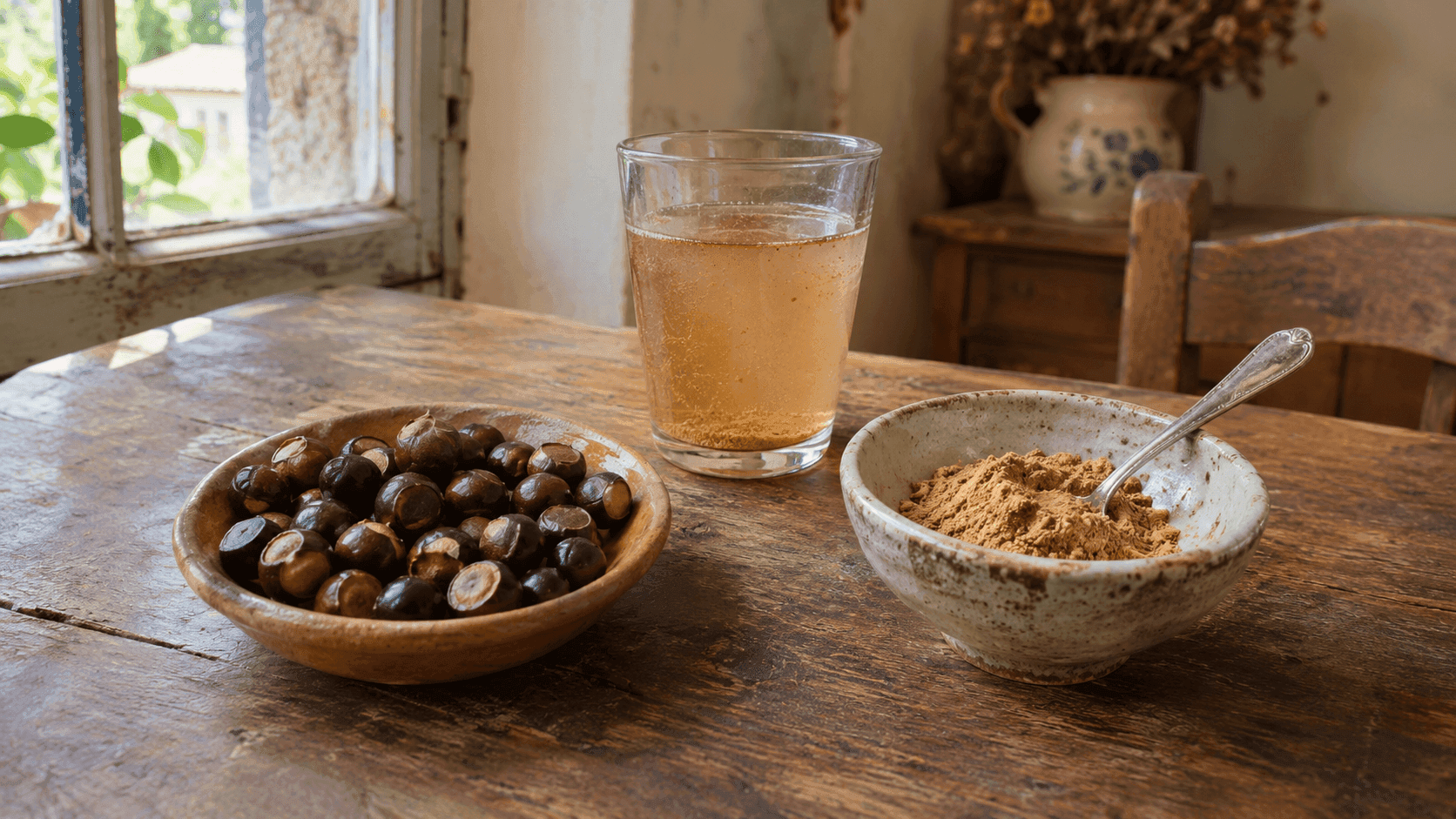
Guarana is the seed of an Amazon vine, full of caffeine. I grind it and stir one small 450 mg dose into water in the morning, counting it along with my coffee.
Who he really is
Family: Soapberry family (Sapindaceae). Guarana comes from the Amazon forest. It's grown mostly in Brazil, in the state of Amazonas, and also in Bahia.
Part used: the seeds, dried and roasted, whole or ground.
Guarana is the seed of an Amazon vine, Paullinia cupana. These seeds are full of caffeine, often more than coffee beans. I grind them at home, one small dose at a time, in the morning, and never in the evening.
His story
Guarana is the seed of an Amazon vine, Paullinia cupana, and it is full of caffeine. Over there, people roast the seeds, grind them and drink them in water, and they did it long before we did. I keep a few in a jar for the mornings when everything feels heavy, and I take them seriously: it's a bit like the coffee of the Amazon, not an evening herbal tea.
What is guarana? An Amazon vine and its little black eyes
Guarana is a vine from the soapberry family. In the Amazon forest it climbs up the trees, keeps its leaves all year round and can grow up to 10 metres long. Its leaves are large, thick as leather, deeply veined and toothed along the edge. Its flowers are small, yellowish or whitish, and they smell lovely.
Then come the fruits, in bunches. Each one is the size of a hazelnut, deep yellow to orange red. When it's ripe, it splits open and shows a purplish brown seed, almost black, half wrapped in white flesh. It looks like an eye watching you from the branch. In fact, people sometimes call it "the eye of the forest".
It's grown mostly in Brazil: in the state of Amazonas, around the town of Maués, and also in Mato Grosso and Bahia. The bunches are picked by hand, from October to December.
Where guarana comes from: the Sateré-Mawé and the story of the two eyes
Before it ever reached our cupboards, guarana is the story of a people. The Sateré-Mawé live in Amazonas, near Maués, and they are the ones who grow it and sell it. They call it waraná, a word that is said to mean, in their language, "the essence of reason". That's where our word guarana comes from. They even call themselves "the children of guarana".
They still tell their story. A god killed a child the whole village loved. Another god, a kinder one, took the child's eyes. He planted the left eye in the forest, and out of it grew wild guarana. He planted the right eye in the village, and out of it grew the guarana people grow. When you look at an open fruit, with its black seed in its white, you understand the story.
For them, preparing guarana takes time. They take the seeds out of the fruits, soak them in water, remove the white flesh and dry them in the sun. Then they roast them for two to three hours in clay ovens. Once they've cooled, they take off the thin skin, crush the seeds with a little water and shape the paste into sticks. Those sticks are left above the fire for several months.
To drink it, they grate a little of the stick into water. The Sateré-Mawé call this drink waraná hy. Elsewhere in the region, people grate it with the dried tongue of a pirarucu, an Amazon fish, and call it çapó. The Guaraní used to grate this "guarana bread" into hot water, with sugar.
Guarana reached us in the 19th century, and it became fashionable in France as a drink to perk yourself up. The French pharmacopoeia has kept two descriptions of it: the seed, and the paste, in cylindrical sticks that can weigh up to 300 g.
Guarana drinks: from the grated stick to sodas and cans
Today, when people say guarana, many think of a drink first. In Brazil, Peru and Paraguay, the word on its own means a guarana soda. Over there, these fizzy drinks are made with extracts taken from the seeds, and their caffeine is adjusted by adding more or less extract. My friend in Brazil told me about it, I'll tell you more further down.
Here in France, guarana mostly turns up in so-called energy drinks, with caffeine and other plant extracts. I don't like those cans. And for them, the advice is clear: not before or during sport, never with alcohol, and not at all for children, teenagers, pregnant or breastfeeding women, or fragile hearts. The caffeine in guarana counts just like the caffeine in coffee: it all adds up over the day.
My own guarana drink, I make at home, one dose at a time: in a glass of water, in a hot sweet cup the way the Guaraní did, or as a lemonade. The recipes are further down. And in summer, when I just want something cool, I'd rather have my iced hibiscus tea.
Guarana benefits: what the books say, without exaggerating
People often ask me what the benefits of guarana are. I'll tell you how it is. The books recognise a traditional use for it, in adults, when you feel tired and weak. As a powder, in small doses. And if the tiredness is still there after a week, it's your doctor you need to see, not one more dose. For the days when everything feels heavy, I have other little habits for a passing slump, and I always start with those.
You need to know what's in it, too: caffeine, and not just a little. The seeds often hold more than coffee beans do. So I take it the way I take coffee: in the morning, not too much, and never late.
"Guarana isn't a jolt to keep repeating: it's one small dose in the morning, and you count it along with your coffee."
I'll tell you what it doesn't do, too. It doesn't replace a night's sleep, and in the evening it can keep you awake. For the nights when sleep won't come, I have other plants, much gentler ones.
Guarana powder: how much, when, and what it tastes like
I make my guarana powder myself. I buy whole seeds, and I only grind a few at a time, in the coffee grinder. One dose is 450 mg of powder: less than half a gram, a small pinch. I weigh it on a precision scale, because you can easily get it wrong by eye. Then I stir it into a glass of water.
The books say: one dose of 450 mg, up to five times a day at most, for adults. I stop well before that. And never late in the day.
How much caffeine is that? Depending on the seeds, one dose gives you up to about 25 mg. A cup of filter coffee is roughly 90 mg, an espresso 80 mg, a cup of black tea 50 mg, a can of cola 40 mg. So one dose of guarana is less than a third of a cup of filter coffee. But it all adds up: for an adult, the advice is not to go over 400 mg of caffeine a day, or 200 mg in one go. So my morning guarana takes the place of a coffee, it doesn't come on top of all the others.
And the taste? People often ask me. Guarana powder is rough, a little bitter, with an earthy taste, and it vaguely reminds you of coffee. The seed itself doesn't taste of much, apart from that bitterness. That's why the Brazilian fizzy drinks got rid of it: at the start of the 20th century, people there learned how to take the roughness and bitterness out of the seeds. I don't hide it completely: a little sugar or lemon, and it goes down very well.
I keep the whole seeds in a tightly closed jar, away from heat, light and damp. The powder, I only make enough for a few days.
What I use him for
- · 01In the morning, when I feel tired and weak: one 450 mg dose of ground seed, stirred into a glass of water.
- · 02Instead of my early afternoon coffee, not on top of it: one dose, and I count my caffeine for the day.
- · 03In a hot cup, the Guaraní way: the powder in hot water, with a little sugar.
- · 04As a homemade lemon lemonade, in summer, when I fancy something fizzy: one dose per glass.
How I prepare him
Granny’s little recipes
The morning glass of water with guarana
In the morning, when you feel tired and weak (2 minutes)
What you’ll need
- 450 mg of ground guarana seeds (one dose, weighed)
- A glass of cool water, about 150 ml
How I go about it
- 01Finely grind a few seeds in the coffee grinder.
- 02Weigh 450 mg of powder on a precision scale.
- 03Tip the powder into the glass of water and stir well for a good minute.
- 04Drink it straight away, stirring again before the last sip. That's one dose: count it along with your coffee for the day.
The hot cup of guarana, the Guaraní way
Mid-morning, when it's chilly (5 minutes)
What you’ll need
- 450 mg of ground guarana seeds (one dose, weighed)
- 150 ml of water
- 1 teaspoon of sugar or honey
How I go about it
- 01Heat the water until it starts to simmer.
- 02Put the powder and sugar in your cup, pour the hot water over and stir.
- 03Let it cool for two or three minutes.
- 04Drink it, stirring now and then. That's one dose: no other coffee straight after.
The early afternoon guarana lemonade
In summer, in the early afternoon, for one tall glass (5 minutes)
What you’ll need
- 450 mg of ground guarana seeds (one dose, weighed)
- 20 ml of lemon juice
- 18 g of sugar
- 200 ml of well-chilled sparkling water
- A strip of zest or a slice of lemon
How I go about it
- 01In a tall glass, mix the sugar and lemon juice until the sugar melts.
- 02Add the guarana powder and whisk with a fork so it mixes in well.
- 03Pour in the well-chilled sparkling water and add the zest or slice.
- 04Drink it straight away. That's one dose of guarana: count it in your day, and no lemonade like this late in the day.
Elsewhere: how others know him
My friend in Brazil writes that where she lives, when you say "guaraná", everybody thinks of a soda. It's the everyday fizzy drink, and they drink it nice and cold. The best known one was invented in 1921, and it's the second best-selling drink in the country, just behind cola.
Keiko, my friend in Tokyo, calls it garana. She wrote to me that in Japan, too, it's first of all a fizzy drink. Small Japanese drink makers launched it in 1958, to stand up to American cola. In Hokkaido, up north, cola arrived later than elsewhere, so the guarana soda settled in first, and people there have stayed loyal to it: you can still find bottles that are only sold on the island.
What I like is simpler: a glass of my lemon lemonade in the early afternoon, with my little weighed pinch. One glass, not two.
What to know first
This information doesn’t replace advice from a healthcare professional. Health Disclaimer →
His identity card
- Name
- Guarana
- Other names
- Waraná, guaraná, eye of the forest
- Latin name
- Paullinia cupana Kunth
- Family
- Soapberry family (Sapindaceae)
- Part used
- The seeds
- Harvest
- By hand, from October to December
- Form
- Whole seeds, powder stirred into water
- Origin
- Amazon; grown mostly in Brazil (Amazonas, Bahia)
- Storage
- In a closed jar, away from heat, light and damp
If you remember just one thing
- 01Guarana is the seed of an Amazon vine, Paullinia cupana, and it is full of caffeine.
- 02The books recognise a traditional use for it in adults when you feel tired and weak: 450 mg of ground seed per dose, five doses a day at most, never in the evening.
- 03A dose of guarana is extra caffeine: count it along with your coffee, tea and sodas, 400 mg a day at most for an adult.
- 04No guarana if you're pregnant or breastfeeding, before 18, or if you have high blood pressure or a heart that beats irregularly.
- 05Guarana isn't a jolt to keep repeating: if after a week you still feel flat, it's your doctor you need to see.
Your questions
I won't promise you any more than the books say: a traditional use in adults, when you feel tired and weak, as a powder and in small doses. It's caffeine, like coffee: it can keep you awake and make your heart pound. If the tiredness lasts more than a week, it's your doctor you need to see.
The powder is rough, a little bitter, with an earthy taste that vaguely reminds you of coffee. The seed on its own doesn't taste of much apart from that bitterness. A little sugar or lemon softens it nicely.
No guarana if you have high blood pressure, a heart that beats too fast or irregularly, a stomach or duodenal ulcer, an overactive thyroid, or if you're prone to anxiety. Not before 18, and not if you're pregnant or breastfeeding. If you already take something on a doctor's orders, ask your doctor or pharmacist first.
No, don't take it during pregnancy or while breastfeeding: we don't know whether it's safe, and caffeine reaches the baby through the placenta and in breast milk. During those months, the advice is not to go over 200 mg of caffeine a day, from all sources, which is roughly two cups of filter coffee.
If your liver is badly damaged, for example with cirrhosis, don't take it: caffeine is cleared poorly and builds up. Caffeinated so-called energy drinks should also be avoided when the liver is seriously affected. For any other liver problem, ask your doctor first.
From the Amazon: it's a forest vine, grown mostly in Brazil, in the state of Amazonas, around Maués, and also in Bahia. Its name comes from waraná, the name the Sateré-Mawé, a people from there, give it. Its seeds are roasted and ground, and used for drinks.
References
- Community herbal monograph on Paullinia cupana Kunth ex H.B.K. var. sorbilis (Mart.) Ducke, semen (EMA/HMPC/897344/2011) · European Medicines Agency, HMPC, 2013
- Assessment report on Paullinia cupana Kunth ex H.B.K. var. sorbilis (Mart.) Ducke, semen (EMA/HMPC/897384/2011) · European Medicines Agency, HMPC, 2013
- La caféine · EFSA, Autorité européenne de sécurité des aliments, 2015
- Boissons énergisantes : quels effets sur la santé ? · Anses, 2022
- Guarana · Wikipédia, 2026
- Guarana · Wikipedia, 2026
- Guaraná Antarctica · Wikipédia, 2026
- ガラナ飲料 · Wikipedia(日本語版), 2026
- Comment faire sa limonade maison ? · Boulanger, 2026