Aloe vera is a succulent from dry countries. The clear gel inside its leaves goes on skin and hair; the yellow sap hiding under the green skin gets thrown away.
Who he really is
Family: Asphodelaceae. Aloe vera comes from the mountains of northern Oman, on the Arabian Peninsula. It has been grown for a very long time around the Mediterranean and in warm countries.
Part used: the clear gel from the heart of the leaf. Not the yellow sap that runs just under the green skin: that one gets thrown away.
Aloe vera gel is the clear jelly you find at the heart of the big fleshy leaves of the aloe, a succulent from dry countries. People have been putting it on their skin since ancient times. I keep it for skin and hair, and I don't drink it.
His story
Aloe vera gel is the clear, slightly sticky jelly you find when you open an aloe leaf. People put it on skin that's had too much sun, on a little kitchen burn, or on their hair. Me, I don't have any aloe in the garden: it wouldn't make it through the winter. But my neighbour has a big pot of it, and every now and then she cuts me a leaf over the hedge.
Aloe vera gel: what exactly is it?
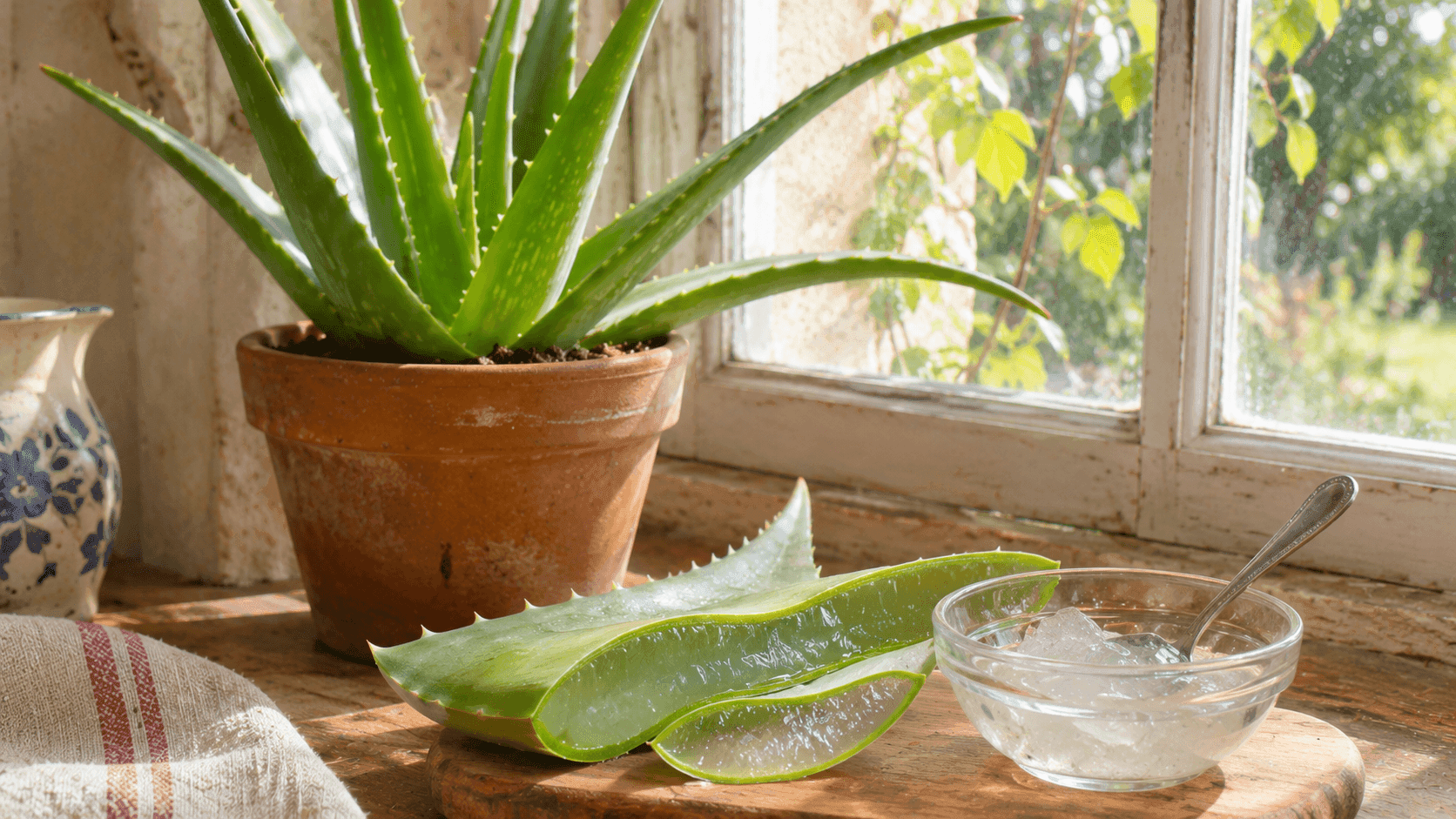
Aloe vera is a succulent from dry countries. Its leaves grow in a rosette, thick and fleshy, a slightly greyish green, with little prickly teeth along the edges. It grows 50 cm to 1 m tall, and when it's happy, it sends up a long stalk of yellow flowers shaped like little tubes.
Inside a leaf there are two things, and that's what I want you to remember from this whole page. In the middle, the gel: clear, colourless, it comes from the cells at the heart of the leaf. And just under the green skin, a bitter yellow sap that runs out on its own as soon as you cut the leaf. The books call it the latex, or aloe sap.
That yellow sap is what gets your bowels moving, and not just a little. It's because of the sap that people are wary of drinking aloe, and I'll come back to that further down. The gel, we keep for the skin.
The name comes from the Greek aloê, and vera means "true" in Latin: it's the true aloe. It's also called Barbados aloe or Curaçao aloe. On Réunion Island they say bitter aloe, or mazambron. (Mazambron, I had to say it three times before I got it right.)
Where aloe vera comes from: from the mountains of Oman to our windowsills
Its cradle is the mountains of northern Oman, at the tip of the Arabian Peninsula. But it's been grown for so long that today it grows wild in North Africa, the Canary Islands, Madeira, and all the way into southern Spain and Portugal.
Aloe has been known since ancient times, in Mesopotamia, Egypt and Greece. An old Egyptian papyrus, the Ebers papyrus, counts it among its plants, and Dioscorides, a Greek physician, left a precise description of it. It turns up again in a great Byzantine book of plants from the year 512. Later, in the 16th and 17th centuries, the Spanish and the Dutch took it to the Caribbean and the Americas. Barbados and Curaçao, which gave it two of its names, are islands in the Caribbean.
One thing that muddles everyone: in the old manuals, plain "aloes" is often the dried yellow sap, the one sold in pharmacies to get the bowels moving. That's not the same thing as the gel at all.
Here, aloe vera can't stand frost, snow or too much water. In the south of France it can go in the ground; anywhere else, it lives in a pot and spends the winter in the house or in a greenhouse. My neighbour puts hers outside in summer, in the sun and out of the wind, in a cactus compost that drains well. In winter she hardly waters it at all. And she keeps it out of her cat's reach: I'll tell you why further down.
How to take the gel from an aloe vera leaf, without the yellow sap
The first time my neighbour showed me, I thought it took forever. Now I know why you take your time. You don't cut from a young plant: it needs to be at least two or three years old. You take an outer leaf, nice and thick and nice and green, never one from the centre, and no more than three or four leaves at a time.
First, cleanliness: washed hands, a clean knife, a clean glass jar. You cut the leaf cleanly, near the base, and stand it upright in a glass, cut end down. The yellow sap runs out. You wait a quarter of an hour, half an hour, until it stops running, and you throw it away.
Next, you rinse the leaf, cut off the prickly edges, cut it into pieces and take off the green skin, cutting generously so you don't keep the yellow layer just underneath. What's left is the gel, which you scoop out with a spoon and rinse again in cold water until there's no trace of yellow left. The amounts and times are further down, in my recipes.
That gel doesn't keep for long. I put it in the fridge, in a small closed jar, and use it up within a few days, a week at most. If it changes colour, smell or texture, into the bin it goes. For summer, I make ice cubes out of it. And I'll say it again: this homemade gel is for skin and hair. I don't eat it and I don't drink it, even well rinsed, because it can keep traces of the yellow sap.
Aloe vera gel on the skin and in the hair
On the skin, the books have long given it for minor burns that aren't serious, light sunburn, little scrapes and little irritations. You spread a thin layer, once or twice a day, or whenever you feel the need. Me, in summer, after a morning weeding in the sun, I put some on my forearms. It's cool, it soothes, and that's all. But I'll be straight with you: it's a traditional use, nothing more. The pharmacy books over here never made it a remedy, so I don't expect anything more from it than that coolness.
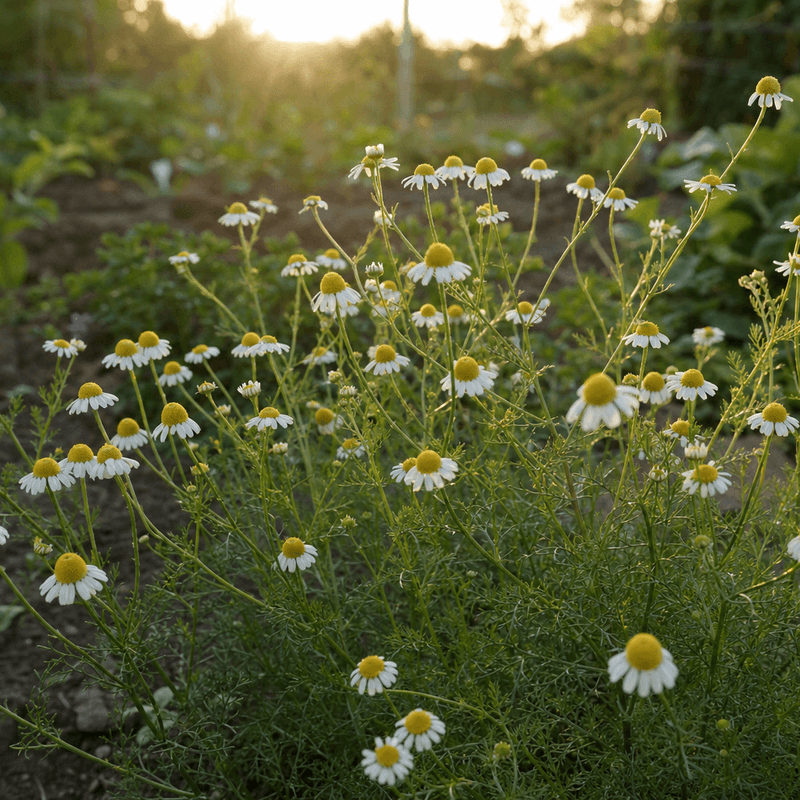
But before the gel, there's water, always. A burn goes under lukewarm water, around 20 °C, for 20 minutes, and you put nothing on it during that time. The gel comes afterwards, and only on a small burn without blisters. A burn that blisters isn't a job for the gel any more: all the signs that should send you to the doctor are further down, in what to know first. For skin that's had too much sun, I've told you all my little habits here. And I also have my chamomile, as a compress, when the skin has got hot.
In the hair, you'll find aloe vera in shampoos, and plenty of people put a little gel on the lengths before rinsing. The old folks even said aloe held off grey hair. I haven't found anything serious to back that up, so I'm not promising you anything. If you like making your own little preparations for the skin, my herbal oils are made with flowers from around here.
And the danger, for hair as for skin? In some people, the gel stings, itches or brings up red patches. So the first time, I put a little on a small patch of skin, on the inside of my arm, and wait and see. If it itches, I rinse it off and don't put any more on.
Aloe vera gel to drink: why I don't risk it
They sell a lot of aloe vera gel to drink, and people often ask me whether it's good for the stomach, or whether you can drink it every day. I'll tell you how things are.
The yellow sap contains substances that get the bowels moving. The books say they can damage cells, and nobody has been able to say what daily amount would be risk-free. Leaf extracts taken by mouth have also been linked to liver trouble. Shop-bought drinking gel is made to contain very little of that sap. Homemade gel, though, can keep traces of it, even well rinsed. So in my house, it's simple: gel from the leaf is for the skin.
The aloe sap that gets the bowels moving is a pharmacy matter: a week at most, never for children, not while pregnant, not while breastfeeding. It's all written further down. If your bowels are lazy, I have much gentler ways. And if your stomach often burns or hurts, it's not a glass of gel you need, it's an appointment with your doctor.
"Aloe gel is for the skin. The yellow sap, you let it run out, and you throw it away."
What I use him for
- · 01On skin that's had a bit too much sun, once it's been cooled under water: a thin layer of fresh gel.
- · 02On a small kitchen burn without blisters, after 20 minutes under lukewarm water, and not before.
- · 03On a little scrape or a little skin irritation, once or twice a day, or whenever I feel the need.
- · 04On the lengths of my hair, a little fresh gel, then I rinse.
- · 05As ice cubes, made ahead for summer, which I let melt before using.
How I prepare him
Granny’s little recipes
Fresh gel from an aloe leaf
When my neighbour cuts me a leaf (half an hour to three quarters of an hour, draining included)
What you’ll need
- 1 mature aloe vera leaf, nice and thick, taken from the outside of a plant at least 2 or 3 years old
- 1 large clean glass
- 1 small, very clean knife and 1 spoon
- 1 small clean glass jar, with its lid
How I go about it
- 01Wash your hands, and wash the knife, the spoon and the jar in hot water.
- 02Cut the leaf cleanly, near the base. Stand it upright in the glass, cut end down, for 15 to 30 minutes, until the yellow sap stops running. Throw that sap away.
- 03Rinse the leaf under cold water. Cut off the prickly edges, then cut it into pieces.
- 04Take off the green skin, cutting generously, and scoop out the clear gel with the spoon.
- 05Rinse the gel under cold water until there's no trace of yellow left, then put it in the jar and close it.
- 06Keep it in the fridge and use it within a few days, a week at most, in a thin layer on the skin. If it changes colour, smell or texture, throw it away. This gel is not for eating or drinking.
Aloe ice cubes for hot days
Made ahead for summer (10 minutes, then a night in the freezer)
What you’ll need
- The fresh gel from one leaf, prepared as in the recipe above
- 1 clean ice cube tray
- 1 freezer bag and something to write the date with
How I go about it
- 01Spread the gel into the ice cube tray, without filling it to the brim.
- 02Leave it in the freezer overnight, then tip the cubes into the closed bag, with the date written on it.
- 03Keep them 4 to 6 months at most.
- 04To use one, let a cube melt in a clean saucer. Never put the cube straight onto burnt skin: on a burn, no ice.
- 05Spread a thin layer of the melted gel on skin that's got hot, once it's been cooled under water. Anything thawed doesn't go back in the freezer.
Elsewhere: how others know him
My friend in Brazil wrote to tell me that over there, aloe is called babosa. She told me you find it in ointments for little burns and sunburn, but that for aloe juices and foods, the health authorities where she lives warn people off. I was glad to read that: we think the same, on both sides of the ocean.
Keiko, my friend in Tokyo, taught me that where she lives, the aloe people most often keep in a pot isn't aloe vera: it's a cousin, candelabra aloe, which she calls kidachi aloe. It even has a nickname, isha-irazu, "no need for a doctor". She laughs about it, and so do I: a nickname like that, I wouldn't take on as my own. Aloe vera, over there, is grown mostly for eating, and its flesh ends up in yogurts.
Me, what I like is simpler: the leaf my neighbour passes me over the hedge in August, and a little fresh gel on my arms after the garden.
What to know first
This information doesn’t replace advice from a healthcare professional. Health Disclaimer →
His identity card
- Name
- Aloe vera
- Other names
- True aloe, Barbados aloe, Curaçao aloe, bitter aloe
- Latin name
- Aloe vera (L.) Burm.f. (syn. Aloe barbadensis Mill.)
- Family
- Asphodelaceae
- Part used
- The clear gel from the heart of the leaf
- Harvest
- One mature leaf at a time, from a plant at least 2 or 3 years old
- Form
- Fresh gel, on skin and hair
- Origin
- Northern Oman; grown around the Mediterranean and in warm countries
- Storage
- In the fridge, a week at most; as ice cubes, 4 to 6 months
If you remember just one thing
- 01Inside an aloe vera leaf there are two things: the clear gel at the heart, for the skin, and the yellow sap under the green skin, which you let run out and throw away.
- 02To take the gel, stand the leaf upright for 15 to 30 minutes so the yellow sap drains out, rinse, and keep the gel in the fridge for a week at most.
- 03A burn gets 20 minutes under lukewarm water first; the gel comes afterwards, and only on a small burn without blisters.
- 04Homemade gel is for skin and hair: I don't drink it, even well rinsed, because it can keep traces of the yellow sap.
- 05The aloe sap that gets the bowels moving is a week at most, never under 12, not while pregnant, not while breastfeeding.
Your questions
On the skin, in a thin layer, once or twice a day, or whenever you feel the need: on a small burn without blisters once it's been cooled under water, a light sunburn, a little irritation. Plenty of people also put some on the lengths of their hair, then rinse. The first time, try it on a small patch of skin. Fresh homemade gel keeps in the fridge for a week at most.
The part to remove is the bitter yellow sap just under the green skin. Stand the cut leaf upright in a glass, cut end down, for 15 to 30 minutes, until it stops running. Then rinse, take off the green skin cutting generously, and rinse the gel until there's no trace of yellow. Even then, homemade gel stays for the skin: it can keep traces of sap, so I don't drink it.
I wouldn't advise it, and certainly not homemade gel, which can keep traces of the yellow sap. That sap contains substances for which nobody has been able to set a risk-free amount. Shop-bought drinking gel is for adults only: if you're pregnant, breastfeeding, being followed for your blood sugar, or already taking something on a doctor's orders, ask your doctor or pharmacist first.
The gel is generally well tolerated, but in some people it stings, itches or brings up red patches, on the scalp as anywhere else. Try a little gel on a small patch of skin first, on the inside of your arm. If it itches, rinse it off and don't put any more on. And don't keep fresh homemade gel in the fridge for more than a week.
On the skin, the gel can sometimes sting, itch or bring up itchy red patches: if so, you rinse it off and stop. Swallowed, the yellow sap causes cramps and loose stools, and taken for a long time, it makes the body lose water and salts. Leaf extracts swallowed have also been linked to liver trouble. That's why drinking aloe isn't something to take lightly.
No, and don't bite into your plant: aloe vera is harmful if swallowed, for us as for dogs, cats and rabbits. What you find in shop-bought yogurts and drinks is specially prepared. And there are plenty of other aloes besides aloe vera: never trust a plant whose name you don't know.
References
- European Union herbal monograph on Aloe barbadensis Mill. and on Aloe (various species, mainly Aloe ferox Mill. and its hybrids), folii succus siccatus (EMA/HMPC/625788/2015) · European Medicines Agency (HMPC), 2016
- Assessment report on Aloe barbadensis Mill. and on Aloe (various species, mainly Aloe ferox Mill. and its hybrids), folii succus siccatus (EMA/HMPC/759585/2015) · European Medicines Agency (HMPC), 2016
- Safety of hydroxyanthracene derivatives for use in food · EFSA Journal (EFSA ANS Panel), 2018
- Commission Regulation (EU) 2021/468 as regards botanical species containing hydroxyanthracene derivatives · EUR-Lex, Union européenne, 2021
- Legislación aloe vera (sentencia del Tribunal General, asunto T-189/21) · AESAN, 2024
- Case C-38/25 P: Appeal brought on 22 January 2025 by the European Commission against the judgment in Case T-189/21 · Official Journal of the European Union (EUR-Lex), 2025
- Aloe - Aloe vera, Topical (monograph) · Health Canada, Natural and Non-prescription Health Products Directorate, 2025
- Aloe vera leaf gel, Oral (monograph) · Health Canada, Natural and Non-prescription Health Products Directorate, 2025
- Egyptian Herbal Monograph, vol. 2: Aloe vera and Aloe (various species, mainly Aloe ferox) · Egyptian Drug Authority, 2026
- Aloe Vera · National Center for Complementary and Integrative Health (NIH), 2025
- Brûlures de la peau : que faire ? · Ameli (Assurance Maladie), 2026
- Brûlures de la peau · Ameli (Assurance Maladie), 2026
- Coup de soleil : que faire et quand consulter ? · Ameli (Assurance Maladie), 2026
- Aloe vera (L.) Burm.f. · Plants of the World Online, Royal Botanic Gardens, Kew, 2026
- Aloe vera · Royal Horticultural Society, 2026
- Aloe vera · Wikipédia, 2026
- Aloe vera · Wikipedia, 2026
- Bois d’agar · Wikipédia, 2026
- Aloe vera · Wikipédia (portugais), 2026
- アロエ · Wikipedia(日本語版), 2026
- Comment prélever le gel sur une aloe vera · Jardiner malin, 2026
- How to Harvest Aloe Vera for Its Gel, Without Harming the Plant · Martha Stewart (repris sur AOL), 2025