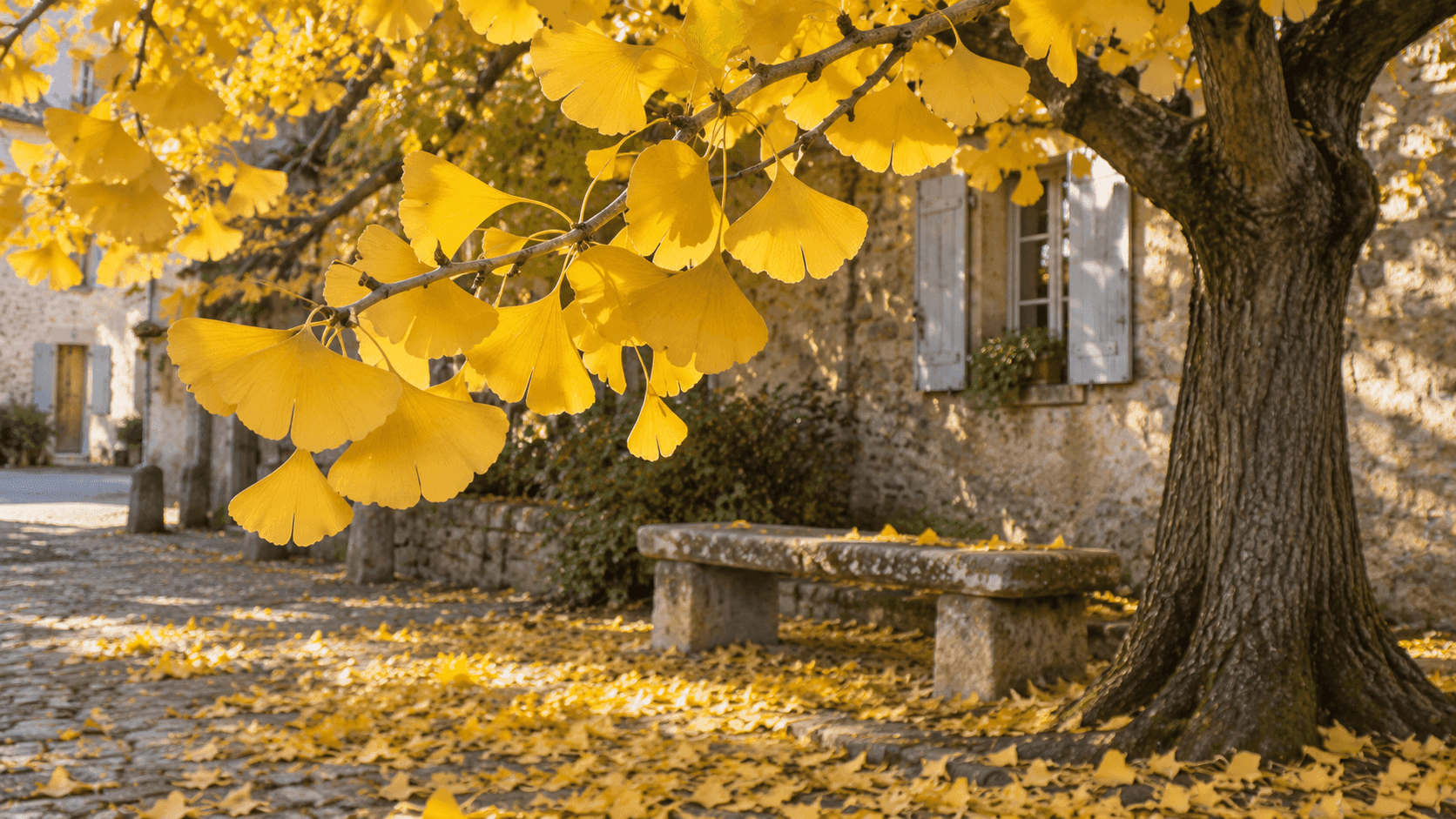
The ginkgo is the forty-crown tree from China, with fan-shaped leaves that turn gold in November. I love it in the garden; its seeds are eaten only cooked, and only a few.
Who he really is
Family: Ginkgo family (Ginkgoaceae). The ginkgo comes from China. It's the only species in its family, and today it's planted in towns and parks all over the world.
Part used: the tree itself, in the garden; its leaves, which I press for my herbarium; and its seeds, only cooked and in small amounts.
The ginkgo is a tall tree with leaves like little fans, split down the middle, that turn golden yellow at the end of autumn. In French it's also called the forty-crown tree. Me, I love it in the garden and in my herbarium. Its leaves I don't put in my cup, and its seeds I only eat roasted, a few at a time.
His story
The ginkgo is a tall tree from China, with leaves like little fans split down the middle, which all turn to gold at the end of autumn. In France we also call it the forty-crown tree. There's one in the public garden next to the town hall, and every year I wait for the morning when it's all yellow. Its leaves are used at the pharmacy, its seeds are eaten cooked in Asia, but not just any old way. Let me tell you.
Ginkgo biloba, a tree like no other
Its scholarly name is Ginkgo biloba. "Biloba" is for its leaf, split into two lobes. And it's a tree all alone in the world: no brother, no cousin, just one species in its whole family. The books say it has held on like that, almost alone in its line, for nearly 200 million years. When I walk under it with my basket, it puts me in my place.
The grown ginkgo biloba tree usually reaches 20 to 30 metres, sometimes up to 40. It lives a very long time: some have been measured at over 1,600 years old. It loses its leaves in winter, and its leaves look like no others, little green fans at the end of a long stalk.
One thing always surprises the grandchildren: the ginkgo has no real flowers. It's a very old tree, from before flowering plants. And each tree is either male or female. The male makes little catkins. The female carries seeds wrapped in yellow flesh, which drop in autumn and smell strongly of rancid butter when you step on them. That's why in towns they mostly plant males. The females, you smell them before you see them. The funniest part is that a ginkgo grown from seed often won't tell you what it is before 25 or 30 years.
From China to Montpellier: why the French call it the forty-crown tree
The ginkgo comes from China, from around Zhejiang, and from there it reached Japan and Korea around the 12th century. The Chinese call it yínxìng, "silver apricot". Our word "ginkgo" comes from the way that name was read in Japan, copied down wrong by a European traveller. I find that lovely, a name that went round the world with a mistake in it.
It reached France in the 18th century. The story goes that in 1788, a garden lover, Monsieur de Pétigny, paid a small fortune to an Englishman for five young plants, 25 guineas. It's from that price, they say, that it got its French name, the forty-crown tree. That same year, one was planted in the botanic garden in Montpellier, and in 1795 a cutting from that ginkgo was planted in the Jardin des Plantes in Paris.
A little later, in 1815, the German poet Goethe sent a friend, Marianne von Willemer, a poem about the ginkgo, with two leaves pasted on the page. He wondered whether this split leaf was one being cut in two, or two beings joined as one. The letter is kept in a museum in Düsseldorf. I've sent leaves by post too, but I'm no Goethe.
The ginkgo leaf, symbol of a tree that holds on
In autumn, ginkgo leaves turn golden yellow, then they fall at the end of the season, sometimes nearly all of them in a few days. One morning the tree is still all yellow, and the next day it's the grass underneath that's gold. I go through the public garden on purpose to see it.
There's a reason it became a symbol. In 1945, in Hiroshima, six ginkgos were growing one or two kilometres from the bomb. They were burnt, and yet they survived, and soon turned green again. A tree that goes through the centuries and starts again after fire, you can see why people keep it in mind.
What can you do with ginkgo leaves? At my house, we pick them up when they're all golden and press them under big books for two to three weeks. Then they go into the herbarium notebook, or they become bookmarks in the old dictionary. For the herbarium, I wrote down how I do it with my grandchildren. And those leaves never go in the cup.
The benefits of ginkgo biloba: what the books say, and what I don't do
People often ask me what the benefits of ginkgo are. I'll tell you how things are. What's made from its leaves is pharmacy business. The books say the leaf, dried and ground to a powder, is traditionally taken when legs feel heavy and hands and feet feel cold, because of sluggish little circulation troubles. But only for adults, and only after the doctor has checked it's nothing serious. For heavy legs, I do things differently, I tell you about it here.
And memory? What you've read about that is about very particular pharmacy preparations, taken on a doctor's advice, not about a leaf picked up in the park. If your mind is slipping, if you have dizzy spells or ringing in your ears that won't go away, it's not a tree you need, it's an appointment. For days when your head is simply elsewhere, I have my little habits.
And leaf tea? I don't make it. The books give no way to prepare it at home, and no amount. They also say the leaf contains a substance that could be bad for you in large amounts and cause allergies, and that nobody has been able to say ginkgo leaf teas are risk-free. So I won't give you a dose. I'd rather tell you that than make up a recipe.
"The ginkgo, I love it before my eyes, not in my cup."
The seeds are another matter. In Asia people eat them in autumn, roasted or in dishes. But raw, they're toxic, and even cooked, they keep what can make you ill: cooking doesn't get rid of it. About ten cooked seeds eaten at once can already be enough to poison someone, and children are even more sensitive. So I roast a few for the grown-ups, five each at most, and never for the little ones. It's all explained further down, in what to know first.
Planting a ginkgo biloba in the garden: where, when, and which one to choose
The ginkgo isn't fussy. It likes sun, and as for soil, as long as it drains well, chalky, clay, loamy or sandy, it's happy. It can take winters down to -25 °C, city pollution, and insects hardly bother it.
Where to plant a ginkgo? Where it'll have room, because it will end up tall: allow at least 4 to 6 metres between the tree and the house or the pipes. You plant it in spring or autumn, avoiding frosty days and heatwaves, and you water it well the first few years, while it roots. If you need a small tree, there are dwarf forms that live happily in a big pot.
Does the ginkgo grow fast? No, and that's its charm. It grows slowly and unevenly, mostly in spring: 20 to 30 cm a year in the first years, then less. It takes 20 to 50 years to be fully grown. Planting a ginkgo is planting for your grandchildren. It doesn't need pruning; at most, you take out the dead wood at the end of winter.
My advice is to choose a male tree. Since you can't tell before 25 or 30 years whether a ginkgo grown from seed is male or female, you buy a male variety, grafted, like 'Autumn Gold'. That way you get the gold of autumn without the smell of rancid butter.
What I use him for
- · 01In the garden: a tall tree for summer shade and gold at the end of autumn, to plant in the sun, with plenty of room around it.
- · 02For the herbarium: its golden leaves, pressed for two to three weeks under big books, then stuck in a notebook or slipped into the dictionary.
- · 03With drinks, in autumn: a few seeds roasted in the pan, for grown-ups only, five per person at most.
- · 04In the cup: no. What's made from the leaves is the business of the pharmacist and the doctor, not of my kitchen.
How I prepare him
Granny’s little recipes
Pressed golden leaves for the herbarium
In November, when the leaves fall (two to three weeks under books)
What you’ll need
- About ten well-golden ginkgo leaves, picked up in dry weather
- Ink-free absorbent paper: blotting paper or kitchen paper
- The biggest books in the house
- A notebook and thin strips of gummed paper
How I go about it
- 01Lay each leaf quite flat between two sheets of absorbent paper, without them overlapping. No newspaper: its ink can stain.
- 02Cover with the biggest books in the house, so all the leaves are well covered.
- 03For two weeks, change the paper roughly every day. Count two to three weeks in all: it's ready when the leaf feels dry to the touch and stays stiff when you lift it.
- 04Stick the leaves in the notebook with the strips of gummed paper, write down the date and the place, and keep the notebook somewhere dry, away from light. Those leaves never go in the cup.
Roasted ginkgo seeds, the way Keiko makes them
An autumn evening, with drinks, for 2 adults (10 minutes)
What you’ll need
- 10 ginkgo seeds in their shells, clean and with the flesh removed (5 per person, no more)
- A pinch of salt
How I go about it
- 01Stand each seed on its edge and gently crack the shell with a nutcracker, without crushing it.
- 02Put the seeds in a dry pan over low heat, and set a rack or a lid on top.
- 03Roast for about ten minutes, shaking the pan now and then, until it smells good.
- 04Remove the shell and the thin skin, which comes off better while hot, salt lightly and eat straight away. Five seeds each, no others that day, and never for children.
Elsewhere: how others know him
My daughter, who lives in Shanghai, taught me that there the ginkgo is called yínxìng, the silver apricot. It has another name too, which I find just right: the grandfather-and-grandson tree, because the one who plants it is too old to gather its seeds, and it's his grandson who harvests them. She told me they put the cooked seeds in rice porridge, which is often served on big occasions, weddings for example. And she made a point of telling me: never raw.
Keiko, my friend in Tokyo, calls it ichō. In Tokyo it's the city's tree, chosen in 1966. She wrote to me that in autumn, at her house, they roast the seeds, the ginnan, in a pan with a little salt, and slip one or two into chawanmushi, a savoury custard cooked in steam. She always adds the same thing: young children don't get any, and grown-ups only eat a few.
Me, what I love is simpler: the November morning when the grass in the public garden is all yellow under the tree, and a ginkgo leaf poking out of my old dictionary. The seeds are for the evenings when I miss Keiko.
What to know first
This information doesn’t replace advice from a healthcare professional. Health Disclaimer →
His identity card
- Name
- Ginkgo
- Other names
- Forty-crown tree, thousand-crown tree (arbre aux quarante écus, arbre aux mille écus in French); yínxìng; ichō
- Latin name
- Ginkgo biloba L.
- Family
- Ginkgo family (Ginkgoaceae)
- Part used
- The leaves and the seeds
- Harvest
- Golden leaves at the end of autumn; seeds in autumn, on female trees
- Form
- Ornamental tree; pressed leaves; seeds only cooked
- Origin
- China (Zhejiang); planted all over the world
- Storage
- Pressed leaves kept dry; seeds in their shells, in the fridge
If you remember just one thing
- 01The ginkgo is a tall tree from China, alone in its family, with fan-shaped leaves that turn golden yellow at the end of autumn.
- 02Its seeds are never eaten raw; cooked, it's only a few for an adult, and never for young children.
- 03Ginkgo leaves, I don't put in my cup: the books give no homemade tea, and what's made from them is the pharmacist's business.
- 04If you take ginkgo and something to thin your blood, talk to your doctor, and you stop it 3 to 4 days before an operation. Pregnant or breastfeeding, you do without.
- 05In the garden, choose a male, grafted ginkgo: you'll have the gold of autumn without the rancid-butter smell of the seeds.
Your questions
I don't promise you anything. What's made from its leaves is pharmacy business: the books say the powdered leaf is traditionally taken when legs feel heavy and hands and feet feel cold, by adults, and only after seeing the doctor. For memory, dizzy spells or ringing ears, it's your doctor you need to see. Me, I love the ginkgo most of all in the garden.
No ginkgo during pregnancy or breastfeeding, and not under 18. If you bleed easily or take something to thin your blood, aspirin for example, not without your doctor's advice, and you stop it 3 to 4 days before an operation. If you have epileptic seizures, or you already take something on a doctor's orders, ask your doctor or pharmacist first.
I pick them up at the end of autumn, when they're all golden and falling, and I press them for the herbarium, two to three weeks under big books. As tea, no: the books give no way to make it at home, and the safety of leaf teas hasn't been established. What's made from the leaves is the pharmacist's business.
Yes, in Asia, but never raw, and in small amounts: even cooked, they keep what can make you ill. About ten cooked seeds eaten at once can already be enough to poison someone. For an adult, I roast five at most, and never for young children. Nausea, vomiting, confusion or convulsions after eating them: call the emergency services straight away (15 in France).
In the sun, in soil that drains well, at least 4 to 6 metres from the house and the pipes, because it grows tall. You plant it in spring or autumn, outside frosty spells. It grows slowly: 20 to 30 cm a year in the first years, and it takes 20 to 50 years to be fully grown.
No real flowers: it's a very old tree, from before flowering plants. Each tree is male or female: the male makes little catkins, the female seeds that drop in autumn and smell of rancid butter when crushed. And a ginkgo grown from seed often won't tell you before 25 or 30 years whether it's male or female.
References
- European Union herbal monograph on Ginkgo biloba L., folium (EMA/HMPC/321097/2012) · European Medicines Agency (HMPC), 2015
- The safety of herbal teas containing ginkgo leaves cannot be evaluated due to insufficient data (Health Assessment 021/2010) · Bundesinstitut für Risikobewertung (BfR), 2009
- ギンナンの食べ過ぎに注意しましょう · 日本中毒情報センター, 2023
- Ginkgo Seed Poisoning · Centre for Food Safety, Hong Kong
- Bai-guo, graine de Ginkgo biloba (白果), Pharmacopée chinoise 2020 · ShennongAlpha, Westlake University, 2020
- Ginkgo biloba L. · Plants of the World Online, Royal Botanic Gardens, Kew, 2026
- Ginkgo · Société nationale d'horticulture de France, 2026
- Ginkgo biloba · Royal Horticultural Society, 2026
- Ginkgo biloba 'Autumn Gold' (m) · Royal Horticultural Society, 2026
- Ginkgo biloba · Wikipédia, 2026
- Ginkgo biloba · Wikipedia, 2026
- Gingo biloba (poem) · Wikipedia, 2026
- 東京都年表 · 東京都, 2026
- Comment réussir à faire un herbier ? · Muséum national d'Histoire naturelle
- Cet été, à quelles plantes faire attention pour éviter les intoxications ? · Anses, 2022
- Ginkgo biloba : culture, variétés et entretien de l'arbre aux 40 écus · Jardiner Malin, 2026
- 簡単! 銀杏の炒り方(焼き方) · DELISH KITCHEN, 2026
- ぎんなんにはどんな栄養がある?おすすめレシピもご紹介 · DELISH KITCHEN, 2026
- ぎんなんの食べ方、下処理、保存方法を詳しく解説 · ふるなび, 2026