Lightness for tired legs
When your legs feel heavy in the evening, especially in summer, you walk, finish your shower with cool water and raise the foot of the bed. And you know when to see the doctor.
Reviewed by Ruosi Wu, PhD in Pharmacy, MD in Traditional Chinese Medicine
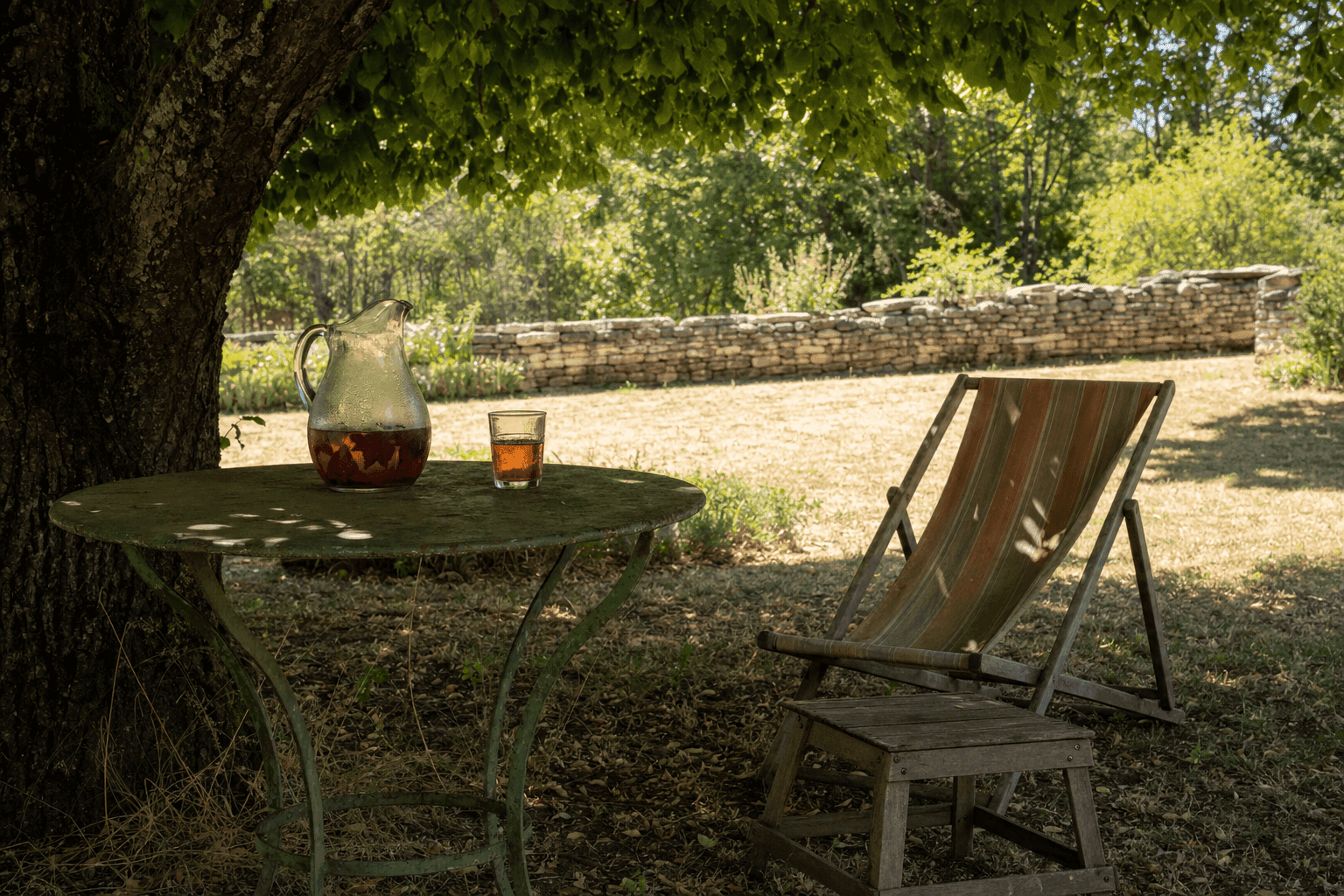
For heavy legs, start by moving: a twenty-minute walk every day, a stream of cool water over your legs in the evening and the foot of the bed raised. In my books, the plant for heavy legs is red vine leaf, as a tea. And only one leg that swells, red and warm, should be shown to the doctor the same day.
Key takeaways
- Heavy legs come from blood having trouble getting back up through the veins: it’s worse in the evening, when it’s hot and when you stand still for a long time.
- The best thing to do is walk: with every step, your calf pushes the blood back toward your heart, like a little pump.
- A stream of cool water over your legs, the foot of the bed raised by 10 to 15 cm, and no very hot baths or saunas: those are the basics.
- In my books, the plant for heavy legs is red vine leaf: 5 to 10 g for 250 ml of boiling water, twice a day, not before age 18.
- Only one leg that swells, warm and painful, means the doctor the same day; with trouble breathing or chest pain, it’s 15.
Granny’s little steps
- Walk twenty minutes a day
With every step, your calf pushes the blood back toward your heart. Take the stairs rather than the elevator, and if you stand or sit for a long time, take breaks to walk a little.
- A stream of cool water over your legs
In the evening, after a day on your feet, finish your shower with cool water, from the ankles up to the knees. In summer, choose cool showers over hot baths.
- Raise the foot of the bed
Slide 10 to 15 cm blocks under the legs of the bed, at the foot end, to make a gentle slope. A pillow under your calves does nothing.
- Lift your toes
When you sit or stand for a long time, pull your toes up toward your shins, several times in a row, and keep your legs stretched out rather than bent. On a plane, move your ankles and drink plenty of water.
- Pedal and massage before bed
Lying on your back, do a few pedaling movements, then massage your legs for a few minutes, working up from the ankles to the knees. A leg that’s swollen, red or warm, you don’t massage: you show it to the doctor.
A recipe to try
The evening cup of red vine
In the evening, when your legs feel heavy after the day
What you’ll need
- 5 g of dried red vine leaves (weigh them the first time, after that you’ll know by eye)
- 250 ml of water, a big bowl
How I go about it
- Boil 250 ml of water.
- Put 5 g of red vine leaves in the bowl and pour the boiling water over them.
- Cover with a saucer and let it steep for 10 minutes.
- Strain and drink it hot, slowly, with your legs stretched out on the sofa.
- You can drink two bowls a day, one in the morning and one in the evening, no more than four weeks in a row. If your legs aren’t better after two weeks, go and see your doctor.
- It’s for adults: not before age 18, and not during pregnancy or breastfeeding.
Heavy legs get relief first through your feet: walking, cooling down, raising them. In the evening, after a day on your feet or an afternoon of heavy heat, your calves feel heavy, they pull, and it feels like your legs won’t carry you anymore. I’ll tell you what I do, what my books say about red vine, and the point where it’s no longer my department.
Heavy legs: the causes, what goes on in your calves
Blood flows down into your legs all by itself. Getting back up to the heart is harder: it goes through the veins, and when they don’t send it back up well, it lingers down below. That’s what the heaviness is. Your legs feel weighed down, tight, quick to tire, and it’s mostly in the calves that you feel it.
The signs of heavy legs, you may know them by heart. It builds up over the day. It’s worse when it’s hot, when you stand shuffling about without really walking, and for women in the days before their period. Sometimes there are cramps, an urge to scratch your lower calves, tingling that makes you get up and walk, and ankles that swell in the evening and go down overnight. The other way round, it’s better when you walk, when you lie down and when it’s cool.
Why is it worse in summer? Because heat widens the veins. Sun on your legs, a very hot bath, the sauna, underfloor heating: all of that makes the heaviness worse. And why you and not your neighbor? The books say it runs in families, that it’s more common in women, with age and with each pregnancy, and that extra weight and jobs where you stay on your feet (hairdressing, shop work, restaurants) don’t help. Nor does sitting all day without moving.
What has always struck me is that the simplest thing is right under your feet. When you walk, the sole of your foot presses on the veins and your calf tightens: that pushes the blood upward, like a pump. That’s why your legs feel better after a stroll than after an hour planted in front of the stove.
My grandma’s remedies for heavy legs: the plants
Red vine leaf. In my books, it’s the plant for heavy legs. Not just any vine: these are the leaves of red grape varieties, picked by hand in autumn, after the grape harvest, then dried. In the old days, winegrowers picked them at harvest time, made infusions they bottled and drank in small amounts. They also made a paste for swollen legs, but the books today don’t say how to make that one, so I won’t give it to you.
The pharmacopoeia gives it, by tradition, for discomfort and heaviness in the legs when blood flows a bit poorly in the veins. You use 5 to 10 grams of dried leaves for 250 ml of boiling water, twice a day. The books say four weeks in a row at most, and if things aren’t better after two weeks, you go and see your doctor, because legs that swell can have other reasons. Not before age 18, and not during pregnancy or breastfeeding. I give you my evening cup further down. I drink it with my legs stretched out on the sofa, and that’s already half the work.
Rosemary, in the bath. Rosemary, I mostly have in the kitchen, but the old handbooks also give it in the bath for heavy legs in the evening, when blood doesn’t flow well in the legs. You put 50 g of leaves in the bathtub, two or three times a week, for 10 to 20 minutes. Watch the temperature: between 35 and 38 °C, no more. Your veins don’t like heat, so I take it barely warm and I always finish with a stream of cool water over my legs. What else I do with my rosemary, I tell you there.
And iced hibiscus? You often see it recommended for heavy legs. At my house, hibiscus is a summer drink: red, tangy, it quenches your thirst when the air is heavy. My books don’t give it for legs, so I’m not going to sell it to you for that. If you like it, my iced bissap is for drinking for pleasure, that’s all. Same goes for peppermint essential oil as a massage: I found nothing serious that gives it for heavy legs, so I don’t recommend it to you.
“An herbal tea won’t walk for you. Red vine goes along, but it’s your feet that do the work.”
Heavy legs at night, in summer, at work: what I do at home
First, I walk. Twenty minutes a day at least, and I take the stairs rather than the elevator. Cycling, swimming or dancing are good too; tennis or basketball, with their sudden stops and starts, much less so.
When you stand or sit for a long time, take breaks to walk, and pull your toes up toward your shins, several times: it wakes up the calf pump. On a plane, move your ankles, don’t cross your legs and drink plenty of water.
In the evening, I run a stream of cool water over my legs, from the ankles up to the knees. Then, lying on my back, a bit of pedaling, and I massage my legs working up toward the knees. For heavy legs at night, I put 10 to 15 cm blocks under the legs of the bed, at the foot end. No pillow under the calves: the books say it does nothing.
In summer, I keep my legs in the shade (and for skin that has already caught the sun, I have other little tricks): no scalding bath, no sauna, no hot wax. Nothing tight, no shapewear, no tall boots, and heels of 3 cm at most. At the table, go easy on alcohol, spices, coffee and tea. Tobacco wears out the veins: if you smoke, your doctor can help you stop.
When heavy legs are no longer a small worry
Heavy legs that weigh the same on both sides and feel better after a walk, I know how to handle. Only one leg that swells all at once, hard, warm, painful, sometimes bluish, is something else: it could be a clot in a vein, phlebitis. That one, you don’t massage it and you don’t count on an herbal tea: you show it to a doctor the same day.
And if you start running short of breath, have a sudden pain in your chest or feel faint, even without a swollen leg, you call 15 or 112 right away. I’ve put the full list just below, sign by sign. It’s not there to scare you, it’s there so you know.
Which plants?
RosemarySalvia rosmarinus
Rosemary is the evergreen Mediterranean shrub you keep close to the kitchen: for the potatoes, for a cup after a meal, for the bath.
What to know first
The plants on this page aren’t for everyone. I’ll tell you everything, plant by plant.
Pregnancy and breastfeeding: no red vine, no rosemary bath, no hibiscus. We don’t know enough about whether it’s safe, so the books say to go without. During pregnancy, heavy legs are common, but a leg that swells and hurts, you show it to your midwife or your doctor the same day.
Children and teenagers: no red vine before age 18, the books lack data. No rosemary bath before age 12.
Red vine: 5 to 10 g of dried leaves for 250 ml of boiling water, twice a day, four weeks at most. If the heaviness doesn’t pass after two weeks, or if it gets worse, stop and go and see your doctor: legs that swell can have other reasons. It can cause a skin allergy (itching, redness, hives), and sometimes nausea, a stomachache or a headache: if that happens, stop. And no red vine if you’re allergic to it.
When not to count on red vine or the bath: inflamed skin, a hard, painful vein, skin that has hardened around the ankles, a wound that won’t close, strong pain, one leg or both swelling all at once. All of that is for the doctor. If you have a weak heart or weak kidneys, ask them first too.
The rosemary bath: 50 g of leaves, water between 35 and 38 °C, 10 to 20 minutes, two or three times a week. Not on damaged or irritated skin. Rosemary can cause contact eczema: if that happens, stop. If you have high blood pressure, be careful with a big hot bath. If the pain lasts more than four weeks despite the baths, or if it gets worse, go and see your doctor. No rosemary if you’re allergic to it.
Hibiscus: if you take something on a doctor’s orders for blood pressure, blood sugar or cholesterol, talk to your doctor before drinking it regularly.
If you’re on a treatment: for red vine, the books know of no interactions, and for rosemary, they report none. If you take an anticoagulant, for example after phlebitis, the rule is to take no medication without talking to your doctor about it: me, I count everyday herbal teas in that too. For everything else, ask your pharmacist.
Compression stockings: you wear them on a doctor’s orders, made to your measurements, because they don’t suit everyone (for example when it’s the arteries in the legs that are damaged). Don’t buy them at random.
When to see your doctor
- If only one leg swells all at once, clearly bigger than the other, hard, warm or painful, sometimes bluish: it could be phlebitis (a clot in a vein), see a doctor the same day and don’t massage it.
- If a vein forms a red, warm, hard, painful cord under the skin, often on a varicose vein: see your doctor quickly, they’ll check there isn’t a deeper clot.
- If you have trouble breathing or get out of breath for no reason: call 15 or 112 right away, especially if a leg has swollen in the last few days.
- If you have a sudden pain in your chest: call 15 or 112 right away.
- If your heart speeds up for no reason: call 15 or 112 right away.
- If you feel faint or pass out: call 15 or 112 right away.
- If you cough up blood: call 15 or 112 right away.
- If a leg suddenly goes weak or numb: call 15 or 112 right away, without waiting for it to pass.
- If you suddenly lose your balance and walk as if you’d been drinking: call 15 or 112 right away.
- If you’re deaf or hard of hearing and can’t make a phone call: 114 (the French emergency number for people who can’t call) answers by text message, chat or video.
- If a leg swells or hurts during pregnancy or in the weeks after giving birth: call your midwife or your doctor the same day.
- If a leg swells or hurts in the weeks after an operation, a cast or whole days in bed: see a doctor the same day.
- If you have a sharp, sudden pain in your leg while resting: see a doctor without delay.
- If both legs swell all at once, especially if you have a weak heart or weak kidneys: see your doctor quickly.
- If a wound on your leg won’t close: show it to your doctor.
- If the skin on your lower legs turns brown, hardens, reddens or starts itching like eczema: talk to your doctor about it.
- If your ankles stay swollen even after a night with your legs raised: make an appointment with your regular doctor.
- If your calf hurts when you walk, so much that you have to stop, and it passes after a few minutes’ rest: talk to your regular doctor about it, it can come from the arteries and not the veins.
- If a burning pain in your foot wakes you at night and makes you let your leg hang out of the bed: make an appointment with your doctor quickly.
- If varicose veins appear, swollen veins at least 3 millimeters wide: make an appointment with your regular doctor.
- If your legs stay heavy despite good habits: make an appointment with your regular doctor.
- If red vine tea changes nothing after two weeks, or if things get worse: stop it and go and see your doctor.
- If you’ve already had phlebitis, or if you have varicose veins, and you’re planning a long plane journey: talk to your doctor before you leave.
Your questions
What causes heavy legs?
Blood has trouble getting back up through the veins and lingers in your legs, especially in the calves. Heat, standing without walking, the days before your period and pregnancy make the heaviness worse. It also runs in families, and extra weight, smoking and a sitting-down life don’t help.
Which herbal tea should I drink for heavy legs?
In my books, it’s red vine leaf: 5 to 10 g of dried leaves for 250 ml of boiling water, twice a day, four weeks at most. If things aren’t better after two weeks, go and see your doctor. Not before age 18, and not during pregnancy or breastfeeding.
What’s the best grandma’s remedy for heavy legs?
Walking, plain and simple: with every step, your calf pushes the blood back toward your heart. Add a stream of cool water over your legs in the evening, blocks under the feet of the bed, and keep your legs away from heat. Red vine tea comes on top of that, not instead of it.
Can alcohol give you heavy legs?
The books put alcohol, along with coffee, tea and spices, among the things that weigh on the veins: better to go easy. That doesn’t mean one glass with a meal will make your ankles swell. But on evenings when my legs feel heavy, me, I have a big glass of water.
And what about over-the-counter products for heavy legs?
There are products for the veins, made from plants like butcher’s broom or horse chestnut, or from molecules made in a lab. They can bring relief for a short while, but nothing has shown that they stop the discomfort from getting worse over the years, and they don’t replace good habits, or compression stockings when your doctor gives you some. Ask your pharmacist which one suits you.
When should I worry about heavy legs?
When only one leg swells all at once, turns hard, warm or painful: that’s the doctor the same day, it could be phlebitis. If you’re short of breath, have a sudden pain in your chest or feel faint, call 15 or 112 right away. And legs that stay heavy despite good habits, or varicose veins that appear, should be shown to the doctor too.
What I’ve made with
References
- Jambes lourdes : symptômes, causes et facteurs favorisants · Ameli, Assurance Maladie, 2026
- Jambes lourdes et chevilles qui enflent : que faire au quotidien ? · Ameli, Assurance Maladie, 2025
- Jambes lourdes : la consultation et le traitement · Ameli, Assurance Maladie, 2026
- Phlébite et paraphlébite : symptômes et diagnostic · Ameli, Assurance Maladie, 2026
- Phlébite : définition et facteurs favorisants · Ameli, Assurance Maladie, 2026
- Phlébite : traitement · Ameli, Assurance Maladie, 2026
- Phlébite : prévention · Ameli, Assurance Maladie, 2026
- AVC et AIT : symptômes, diagnostic et évolution · Ameli, Assurance Maladie
- Artériopathie oblitérante (artérite) des jambes : symptômes, diagnostic, évolution · Ameli, Assurance Maladie, 2024
- European Union herbal monograph on Vitis vinifera L., folium (EMA/HMPC/464684/2016) · EMA, HMPC, 2017
- Assessment report on Vitis vinifera L., folium (Rev. 1) · EMA, HMPC, 2017
- Glossary on herbal teas (EMA/HMPC/5829/2010 Rev.1) · EMA, HMPC, 2010
- European Union herbal monograph on Rosmarinus officinalis L., folium, Revision 1 · EMA, HMPC, 2024
- Egyptian Herbal Monograph, vol. 1 : Hibiscus sabdariffa L. · Egyptian Drug Authority, 2023
Information. This information is provided for general knowledge and doesn’t replace medical advice. Check with a healthcare professional before any use.
Health Disclaimer