With its fiery, lemony root, this ancient spice is a true friend to your stomach. For generations, we have brewed it to warm the body and gently soothe a knotted tummy after a heavy meal.
Who she really is
Family : Ginger family (Zingiberaceae). Native to the warm, tropical forests of Southeast Asia, ginger is now widely cultivated across the humid regions of India, China, and West Africa.
Parts used : Root, Rhizome. Rhizomes harvested from late autumn to winter, once the leaves have withered and dried, by gently lifting the roots from the soil with a fork.
Ginger is that famous, slightly spicy rhizome we have always used to give ourselves a little boost. In my kitchen, we often prepare it as a hot infusion with a touch of honey to soothe the throat and warm the body when it is cold outside.
Her story
Ginger (Zingiber officinale) is a tropical perennial plant whose spicy and warm aromas have been scenting our cups and pots for millennia. Native to India and Southern China, this famous fleshy rhizome is much more than a simple kitchen spice: it embodies a whole section of Asian and Western herbalist traditions.
A botanical treasure from Asia
In its natural environment, ginger appears as a beautiful perennial herb that rises to nearly one meter in height. Its long, lanceolate, evergreen leaves release a pleasant scent as soon as you brush against them. Its flowers, a delicate blend of white and yellow dotted with red, rest on green and yellow bracts. After flowering, the plant produces small capsules containing black seeds.
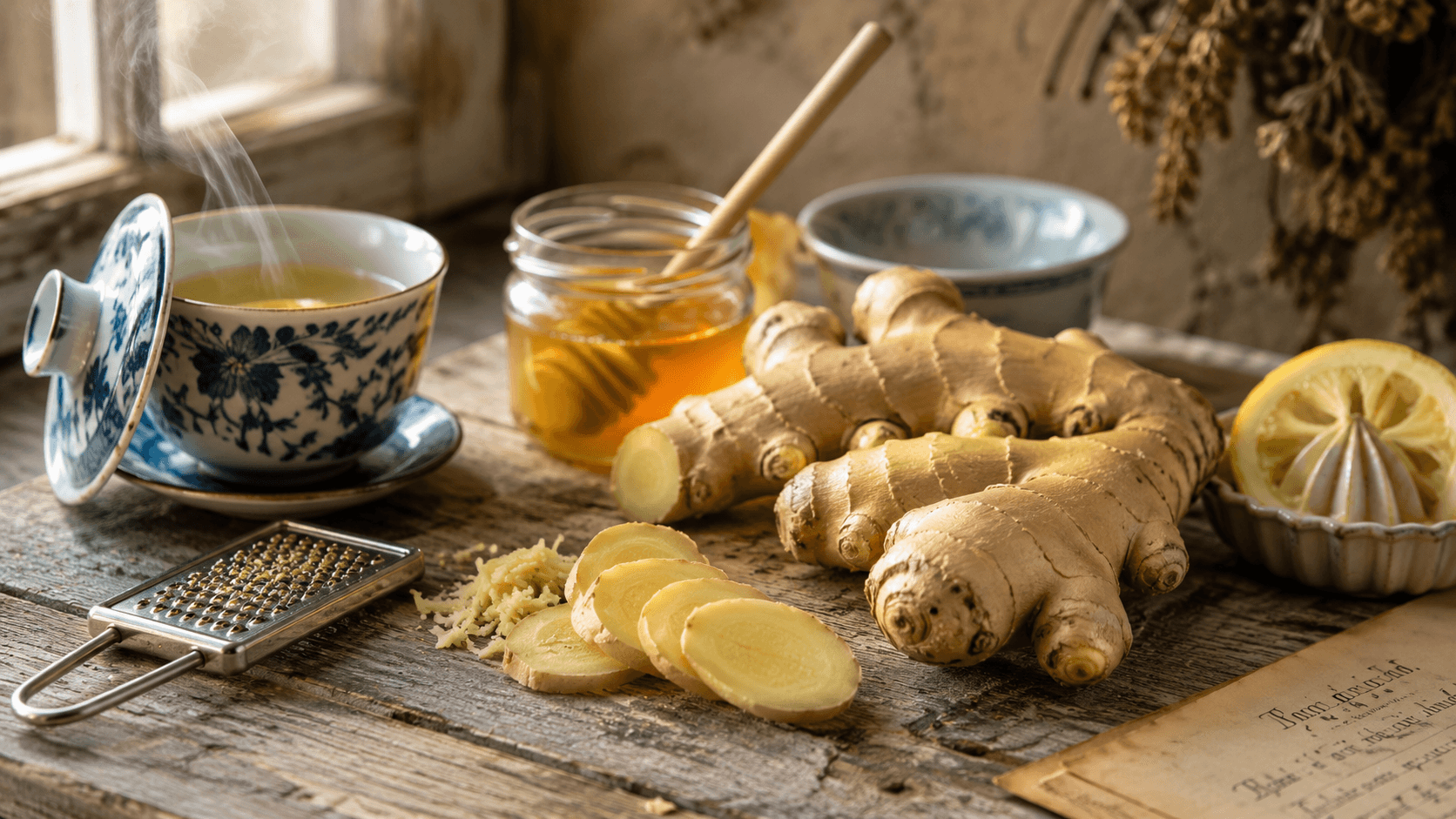
But the real treasure is hidden underground: a horizontal, branched, and bumpy rhizome. This rhizome should not be confused with that of its cousin, Japanese ginger, of which we consume the young flower buds barely emerging from the ground. For our ginger, it is indeed the root that we harvest after long months of cultivation under the tropical sun.
The warmth of family traditions
Since ancient times, herbalists and cooks have passed down the secrets of this vigorous root. In Indian and Asian cuisine, it brings an incomparable spicy freshness. In the West, it has won hearts through comforting sweets like gingerbread or sparkling ginger drinks.
Beyond its culinary use, our grandmothers often prepared a cup of hot ginger to warm the body on winter evenings. It is traditionally said that this infusion helps you feel better when your stomach is tight or after a meal that was a bit too heavy. This is an ancient practice, passed down from generation to generation, to regain a feeling of lightness and digestive comfort.
"A cup of fresh ginger infusion, with a squeeze of lemon and a spoonful of honey, is the secret of our elders to regain vigor and do good to the whole body when the cold sets in."
Natural composition and preparation tips
Modern science has looked into what our ancestors already knew from experience. The ginger rhizome contains unique phenolic compounds, notably gingerols and shogaols, as well as essential oils like zingiberene. These natural elements give it its characteristic flavor and its stimulating action on our senses.
To make the most of its benefits at home, here are a few simple tips:
- As a comforting infusion: Cut three or four thin slices of fresh rhizome. Let them infuse for ten minutes in simmering water, covered to keep the precious oils.
- In tonic cooking: Grate a touch of fresh ginger at the end of cooking over your vegetables or in your broths to wake up the flavors and support digestion.
- As a gentle decoction: For a stronger drink, simmer the root pieces for fifteen minutes before straining.
As with any active plant, moderation is key. If you are expecting a happy event or if you are following a specific health journey, always ask your doctor or pharmacist for advice before consuming ginger in large quantities.
What makes it work
The fiery rhizome of ginger owes its character to active volatile oils containing sesquiterpenes such as zingiberene and ar-curcumene, alongside pungent non-volatile compounds, notably gingerols and shogaols. These natural constituents are well-documented in European pharmacopoeia monographs for their beneficial influence on digestion.
What I use her for
- · 01Ginger is an ancient spice originally from India and Southern China.
- · 02The rhizome of ginger is traditionally used to soothe a knotted stomach after heavy meals.
- · 03Ginger tea has been used for generations to warm the body during cold winter months.
- · 04Pregnant women should consult a doctor before using ginger for their stomach.
How I prepare her
Granny’s little recipes
The comforting herbal tea for very cold days
When returning from a long winter walk, to warm up the body
What you’ll need
- A piece of fresh ginger rhizome about 2 centimeters long
- A cup of hot water
- A spoonful of good honey from our hives
- A squeeze of fresh lemon juice
How I go about it
- 01Wash your piece of ginger carefully and cut it into thin slices.
- 02Place the slices in your favorite cup.
- 03Pour the simmering water over them and cover to keep the heat in.
- 04Let it infuse quietly for about ten minutes.
- 05Add the honey and lemon, mix well, and drink in small sips.
The gentle decoction for the day after a feast
In the morning, when the stomach feels a bit heavy or tight after an overly generous meal
What you’ll need
- A nice piece of fresh ginger (about 3 centimeters)
- Half a liter of spring water
- A few mint leaves from my garden
How I go about it
- 01Gently peel the ginger and cut it into small cubes.
- 02In a saucepan, pour the water and add the ginger cubes.
- 03Bring to a boil, then lower the heat and let it simmer gently for 15 minutes.
- 04Remove from the heat, add the mint leaves, and put a lid on.
- 05Let it rest for another 5 minutes, strain everything, and drink this warm preparation throughout the morning.
The tonic foot bath for the end of the day
In the late afternoon, when you come home with tired legs
What you’ll need
- A generous handful of grated fresh ginger
- A basin of hot water
- Two tablespoons of coarse sea salt
How I go about it
- 01Heat a large pot of water and throw in the grated ginger.
- 02Let it boil for 10 minutes so the water absorbs the benefits of the plant.
- 03Pour this decoction into your basin through a strainer so you do not hurt your feet.
- 04Add the coarse salt and warm water to reach a pleasant temperature.
- 05Plunge your feet in for fifteen minutes, it is a traditional secret to regain vigor.
Elsewhere: how others know her
You know, this little spicy root made a very long journey before arriving in our countryside kitchens. My friend Li, who grew up in the Hunan province of China, told me that over there, ginger has been part of every family's daily life for thousands of years. She calls it "Sheng Jiang" and she explained to me that at home, they always slip a few slices into hot water with a little brown sugar as soon as the cool autumn wind starts to make them shiver. It is their traditional secret to warm the body and feel stronger to face the winter.
One day, a young Indian traveler staying in the village also explained to me that in India, they call it "Adrak". She showed me how they crush it with cardamom pods to prepare real Masala tea. In her home, it is an institution, they drink it throughout the day to maintain good comfort after meals and get a little boost when fatigue sets in.
All these travel stories fascinate me, but what I do with it is much simpler. I prefer to grate it fresh into a jar of good honey from our hives with a squeeze of lemon juice. When my grandchildren come home from school with red noses and wet feet, I prepare a nice cup of this hot infusion for them. It stings the tongue a little, it makes the little ones laugh, and it does them a world of good.
What to know first
This information doesn’t replace advice from a healthcare professional. Health Disclaimer →
Her identity card
- Latin name
- Zingiber officinale
- Family
- Ginger family (Zingiberaceae)
- Parts used
- Root, Rhizome
- Harvest
- Rhizomes harvested from late autumn to winter, once the leaves have withered and dried, by gently lifting the roots from the soil with a fork.
- Form
- Infusion of the fresh or dried root, decoction, powder, mother tincture, and essential oil.
- Origin
- Native to the warm, tropical forests of Southeast Asia, ginger is now widely cultivated across the humid regions of India, China, and West Africa.
- Storage
- Keep your dried ginger root in a tightly sealed jar, tucked away in a dark, dry cupboard, and it will stay warm and fragrant for up to a year.
If you remember just one thing
- 01Ginger is an ancient spice originally from India and Southern China.
- 02The rhizome of ginger is traditionally used to soothe a knotted stomach after heavy meals.
- 03Ginger tea has been used for generations to warm the body during cold winter months.
- 04Pregnant women should consult a doctor before using ginger for their stomach.
Your questions
Ginger is a wonderful, time-tested root that we have always used to gently soothe a knotted tummy. Drinking a warm cup of ginger tea after you eat helps to settle the stomach and makes you feel lighter. It is a simple, comforting habit that has done our family good for generations, trust me.
To make a comforting ginger tea, you simply grate a small pinch of the fresh root into a cup of hot water. I like to let it steep for a few minutes and then add a squeeze of fresh lemon to wake up the senses. It warms you up from the inside out and brings a little sunshine to your afternoon.
While ginger is a traditional friend for an uneasy stomach, you must be extra careful when expecting a baby. If you are pregnant, it is always best to ask your doctor or pharmacist before drinking ginger tea. We must always put safety first for you and the little one.
Yes, ginger has a wonderful, fiery character that our ancestors always relied on to chase away the winter chills. Slicing a bit of this root into hot water helps to warm the body and makes you feel stronger when the cold winds blow. It is our favourite natural way to cozy up by the fireplace.
Ginger is famous in our family for helping when a long car ride makes your tummy feel uneasy. Chewing on a tiny piece of the root or sipping some ginger tea before you set off can help keep you feeling steady. It is a simple, traditional trick that has saved many of our family road trips.