Rhodiola, stress and tiredness: what I'll tell you about golden root
People ask me about rhodiola for stress and tiredness as soon as the cold comes back. I'll tell you what my books really say, why I don't give a recipe for it, and the cups I drink instead.
Rhodiola, also called rhodiole or golden root, is a little succulent from cold mountains whose cut root smells of roses. With the first cold days, I hear about it everywhere: for stress, for tiredness that won't go away. So I got my books out again, made myself a cup, and I'll tell you what I found in them, and also what I didn't.
Rhodiola, a golden root that came in from the cold
Picture a clump of fleshy stems, five to forty centimetres tall, with yellow flowers at the tips. It's in the stonecrop family, the Crassulaceae, like the houseleeks on our old stone walls. It lives in the Arctic, in Scandinavia, in Iceland, and closer to home right up high in the Alps and the Pyrenees, clinging to cliffs and scree. What gets harvested is what's under the ground: a rhizome with its roots, which smells of roses when you cut it fresh. It was Linnaeus, the great Swedish botanist, who named it Rhodiola rosea, because of that scent.
Its story is an old one. Around the year 77, Dioscorides, a Greek doctor, was already writing about a plant he called rodia riza. In 1755, it went into the very first Swedish pharmacopoeia. In Russia and Scandinavia, people have used it for centuries to hold out against the climate of the Far North. And there's a story I'm fond of: for a long time, only a few families knew where to find the wild root. They'd carry it down from Siberia to the Caucasus mountains, and there they'd trade it for Georgian wine, fruit, garlic and honey. Root for honey, now that's a trade I understand.
My daughter, who lives in Shanghai, wrote to tell me that in China they speak of hóng jǐng tiān. But that name covers several cousins, one of them with purple flowers, and once dried, the roots look so alike you'd be fooled. What I take from it is that a plant's everyday name isn't enough: you need the full Latin name.
Tiredness that hangs on isn't a matter for a root. It's a matter for rest, and sometimes for your doctor.
Rhodiola, stress and tiredness: what my books really say
You've probably read that it helps the body “adapt”. My books today are more sober. They put it among the plants with a traditional use: it's given to adults for stressful times, when you feel tired and worn out. And they make it quite clear that this is solely on the strength of long use. Nobody is promising you it works.
Pay close attention to one thing: what they keep isn't the root as a herbal tea. It's an extract of the root, made with alcohol, that you swallow. For the root in a cup, they give neither a measure nor a length of time. So I'm not going to make one up for you, and you won't find a rhodiola recipe at my house.
An immediate effect, I found nowhere. What the books say is that if after two weeks you still feel the same, or worse, you go and see your doctor. It doesn't make you sleep either: among the complaints reported, there have even been jitters and sleepless nights. If I took it, it wouldn't be in the evening.
“Tiredness that hangs on isn't a matter for a root. It's a matter for rest, and sometimes for your doctor.”
And there's something else close to my heart. Most of it still comes from wild harvesting, mainly in China and Russia. It's been pulled up so much that since 2023 you need a permit to move it from one country to another, and in France it's protected in Alsace. Me, I leave it to its cliffs.
When tiredness settles in: my faithful old cups
When the days draw in and I feel flat, I start with the simplest things: getting my fill of sleep, eating at regular times, a walk round the garden even when it's grey. I've written down all my little habits for a slump.
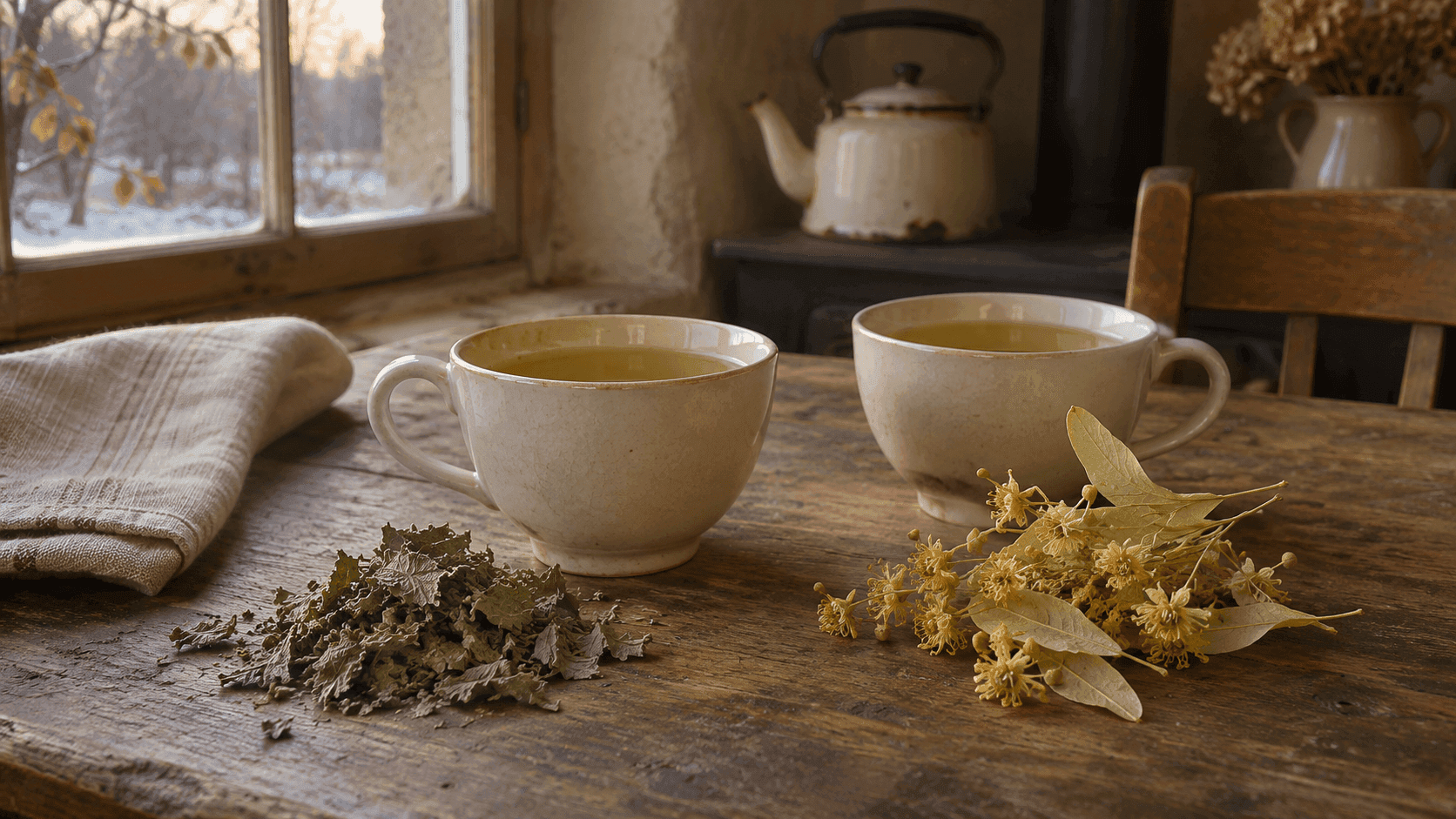
And then I have my two cups. In the afternoon, when my head is too full, it's lemon balm: 1.5 to 4.5 g of dried leaves in a cup, 150 ml of boiling water poured over, ten minutes with a lid on, and I strain it. Up to three cups a day, from 12 years old, and not during pregnancy or breastfeeding. In the evening, it's linden: 1.5 g of dried flowers to 150 ml of boiling water, ten minutes with a lid on, up to four cups a day, from 12 years old, and not during pregnancy or breastfeeding either. I've told you about my lemon balm and my linden each in turn, and for the evenings when your nerves are frayed, come and have a look over here.
If the tiredness goes on in spite of rest, if you can't get through your days any more, if it makes you anxious or knocks your spirits flat, or if it comes with fever, pain, a change in weight you weren't trying for or a great thirst, it's no longer a matter for a cup: go and see your doctor.
What to know before you buy rhodiola
If you still want to try it, I won't scold you. But it's for grown-ups: not under 18, not during pregnancy or breastfeeding, and not if you're allergic to it. The known complaints are headaches, nausea, stomach ache, diarrhoea, spots and itching.
If you already take something on a doctor's orders, ask your doctor first, especially if it's for your mood: together, your heart could start beating very fast. The same goes if it's for blood sugar, for blood pressure, for thinning the blood or for holding back the body's defences. It's also advised against if you have multiple sclerosis or rheumatoid arthritis. And if your skin or the whites of your eyes turn yellow, go and see your doctor without waiting.
When you buy it, look for the full Latin name, Rhodiola rosea, from someone reliable who tells you where it comes from. All the details are in what I know about rhodiola.
This evening the wind is turning to the north and the first real frost is forecast. I've brought the pots in from the balcony, and the cup of linden is steaming next to my open books. Get plenty of rest, and I'll write again soon.