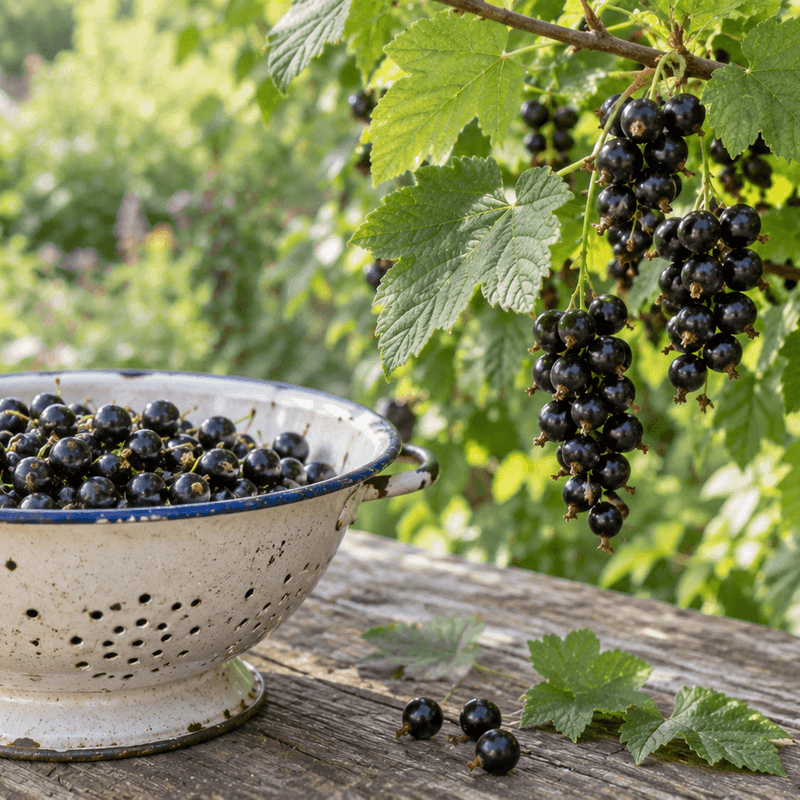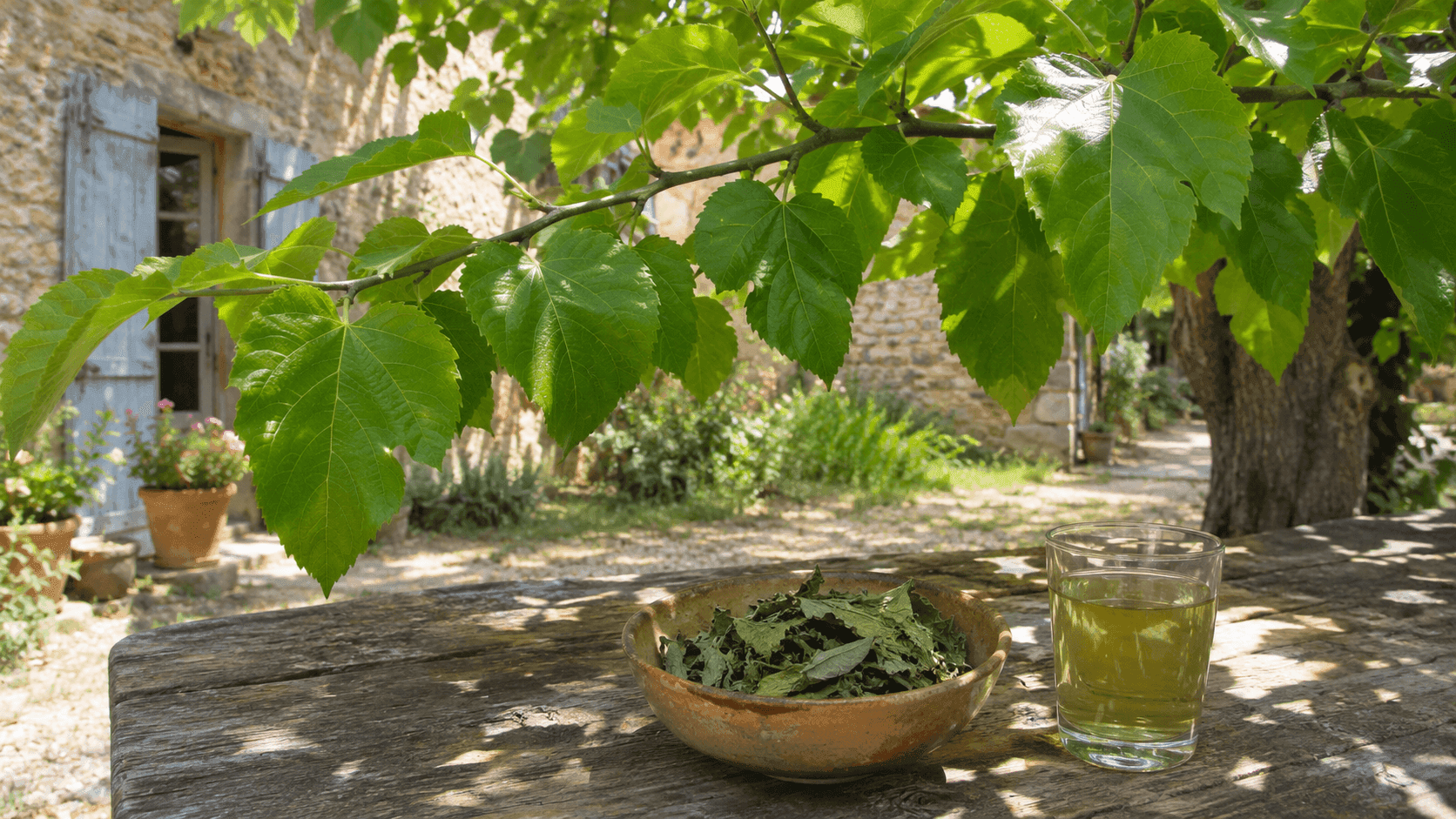
The white mulberry is the silkworm's tree, from China and planted all over France: summer shade, berries to eat when properly ripe, and its dried leaves in a cup.
Who it really is
Family: Moraceae. The white mulberry comes from China; in France, it has been planted since Henri IV for the silkworm.
Part used: the leaves, dried, and the fruit, the mulberries.
A mulberry is a tree, not a bramble. The white mulberry has light green leaves that the silkworm feeds on, and little white, pink, purple or black berries you can eat when they're properly ripe. I love it for its summer shade, for its berries, and for its leaves, which I dry in autumn.
Its story
Where I live, when we say mulberry, we first mean the white mulberry: a tree that came from China, whose leaves feed the silkworm and whose little mulberries you can eat straight off the branch. I have one near the house, for summer shade. And at the end of the lane, my neighbour has an old black mulberry that gives me enough for my jam.
The white mulberry, the silkworm's tree
Its proper name is Morus alba, from the Moraceae family. It comes from China, and people have grown it since ancient times, from China all the way to the Near East. It can reach 30 m, but in a garden a mulberry rarely goes much past ten metres. And if it's called "white", that's for the colour of its buds, not its fruit.
Its leaves are light green, smooth, toothed, 5 to 12 cm long, and on the same tree you'll find whole ones and others cut into lobes. Snap a twig or a leaf and a little white milk comes out. Remember that, I'll come back to it further down.
Those leaves are the silkworm's favourite food, the caterpillar of the silk moth: that's what it spins its finest silk from. My daughter, who lives in Shanghai, told me the legend from over there. Empress Leizu was drinking her tea under a mulberry tree when a cocoon fell into her cup. As she tried to fish it out, she pulled a thread, and the more she pulled, the longer the thread got. That's how, so they say, silk was discovered.
In France, it was Henri IV who really got things going, with Olivier de Serres, a farming scholar from the Vivarais. In 1601, the first white mulberry was planted in the Tuileries garden. In the Cévennes and the Ardèche, they were planted by the million, and people nicknamed it "the golden tree", because it made the Cévennes rich. Then silk faded away: in Cros, in the Gard, the two spinning mills closed in the 1920s, for lack of cocoons. Around the village, some of the mulberries that fed the worms are still standing.
White mulberry, black mulberry, "plane-leaf" mulberry: don't mix them up
There are 17 species of mulberry, from Asia and the Americas. The black mulberry, Morus nigra, comes from western Asia, from the Caucasus to Iran, and has been grown around the Mediterranean since ancient times for its fruit. Its leaves are bigger than the white one's, up to 18 cm, thick and rough. It grows slowly, and it can live up to 120 years. The red mulberry, Morus rubra, comes from eastern North America.
Don't go by the colour of the fruit: the white mulberry, depending on the variety, gives white, pink, purple or black ones. Look at the stalk instead, long on the white, almost missing on the black.
The "mûrier platane", the plane-leaf mulberry, is the terrace mulberry. It was chosen for its big leaves, which look like plane-tree leaves, and for its good thick shade in summer. Nurseries sell it as Morus kagayamae, or as Morus alba 'Fruitless'. It bears no fruit: its flowers drop before they can turn into berries.
The "wild mulberry", the "hedge mulberry", the vegetable patch's "thornless mulberry"? Those are brambles, Rubus, from the rose family. So a thornless "mulberry" is pruned like a bramble: in autumn or winter, you cut the stems that have already fruited down to the ground, and keep the new shoots of the year.
Planting a plane-leaf mulberry near the terrace, and when to prune it
A plane-leaf mulberry grows to around 8 m high and just as wide; depending on the spot and the variety, anywhere from 5 to 15 m. Does it grow fast? Its young branches do: they can put on 2 m in a year. But for real shade, count 4 to 6 years after planting.
Plant it in autumn if you can, in the sun and out of strong winds, in ordinary soil that doesn't hold water. Near a terrace, yes, but leave 5 to 6 m between the tree and the walls: its crown gets very wide. Since it bears no fruit, it won't stain the paving, quite the opposite of the black mulberry. In summer, it's under a tree like that that I set down my jugs of cold herbal tea, on the days the sun beats down.
When should you prune a white mulberry? During its winter rest, once it has lost its leaves. It takes pruning well, but avoid cutting branches thicker than 5 cm. The plane-leaf mulberry gets cut back very short at the end of winter, in February or March: that's how it makes its nice wide-spreading branches.
Mulberries: can you eat them?
Yes, and they're a real delight. In French the mulberry's fruit is called a "mûre", like the blackberry, but it's not the same thing: a mulberry is made of little beads, each one from its own flower. It tastes like a hedgerow blackberry, only gentler, with no hard little seeds that crunch between your teeth.
White mulberries ripen from the end of spring, black ones around mid-August. They're so fragile you almost never find them for sale: the "mûres" in the shops, and in nearly every jar of jam, are blackberries from the bramble. So yes, wild hedgerow blackberries are fine to eat too: those are the ones.
One rule in my house: we only eat mulberries when they're properly ripe. Green mulberries, and that little white milk that runs from the leaves and stems, are a bit toxic: they can upset your stomach, and even make your head go funny. The toxicity is low, but I keep an eye on the little ones when they climb the tree.
In Iran, Pakistan and Central Asia, white mulberries get dried and used like raisins. The black ones, I eat a few under the tree and the rest goes into jam. In August my neighbour calls me over, I take my basket and an old apron, because black mulberry juice stains everything. What else I get up to in the garden in August, I told you about here.
Mulberry leaf in a cup: what they do with it in China and Japan
In China, the white mulberry's leaf is called sāng yè, and it has its place in the pharmacopoeia. It's picked after the first frosts and dried in the sun. The Chinese books give it by tradition when a cold comes with a fever, when a cough is dry, when your head spins or aches, and when your eyes are red and your sight goes blurry. Here, the pharmacopoeia does list it among traditional plants, but for that Chinese use: I haven't found an old book of ours that gives it a use of its own.
The amount, I take from the Chinese pharmacopoeia: 5 to 10 g of dried leaves for the whole day, no more, which I split into two or three cups. I mostly make it on the days my eyes are red from too much sewing. But a red, painful eye with blurred vision is no longer a job for a herbal tea: that's the eye doctor the same day. For tired eyes, I also have some very simple habits.
Watch out for one thing, it matters: mulberry leaf can lower your blood sugar. If you already take something on a doctor's orders to bring it down, don't drink it without talking to your doctor. I've put everything else further down, in what to know first.
Keiko, my friend in Tokyo, wrote to me that in Japan the mulberry is called kuwa, a word said to come from "the leaf that gets eaten", the silkworm's leaf. In some country areas, people used to drink the dried leaves instead of tea, and in spring, the very young leaves are eaten as fritters.
Me, what I love is sitting under my mulberry on a June evening, with a cup of its leaves picked the autumn before. Nothing new: just a tree that gives shade, fruit and a cup.
What I use it for
- · 01In summer, its shade: a plane-leaf mulberry near the terrace, no fruit, so no stains.
- · 02Its berries, only when properly ripe: by hand under the tree, or as jam for the winter.
- · 03Its dried leaves, in a cup. In China, people drink them by tradition when the head spins or aches, when the eyes go red, when a cold comes with a fever or a cough is dry.
- · 04I pick its leaves after the first frosts, dry them, and keep them somewhere dry in a closed jar.
How I prepare it
Granny’s little recipes
A cup of mulberry leaves, for the day
During the day, in two or three goes, on days when your eyes are red and tired
What you’ll need
- 2 to 3 g of dried white mulberry leaves per cup
- 150 ml of water per cup
How I go about it
- 01Bring the water to the boil.
- 02Pour it over the leaves, in the bottom of your cup.
- 03Cover and leave to steep for 10 minutes, then strain.
- 04Two or three cups during the day, never more than 10 g of leaves in all. Not during pregnancy or breastfeeding, not for children, and if you take something on a doctor's orders to bring your sugar down, ask your doctor first.
Black mulberry jam
In August, when the black mulberries are properly ripe (makes about 4 jars)
What you’ll need
- 1 kg of ripe black mulberries
- 800 g of sugar
- The juice of one lemon
How I go about it
- 01Rinse the mulberries quickly in cold water, drain them well and remove the leaves and stalks.
- 02Mix them with the sugar and lemon juice, and leave to rest for 1 to 2 hours.
- 03Put a small plate in the freezer.
- 04Bring to the boil over medium heat, stirring often, then let it boil hard for 10 to 15 minutes.
- 05Put a drop of jam on the cold plate and tilt it: if it sets and forms a little skin, it's ready.
- 06Pour it in hot into sterilised jars, leaving 1 cm at the top, close them and turn them upside down for 5 minutes. Keep them somewhere cool and out of the light; once open, the jar goes in the fridge and gets eaten within a few weeks.
What to know first
This information doesn’t replace advice from a healthcare professional. Health Disclaimer →
Its identity card
- Name
- White mulberry
- Other names
- Common mulberry; sāng yè (the leaf, in China)
- Latin name
- Morus alba L.
- Family
- Moraceae
- Part used
- The leaves and the fruit (the mulberries)
- Harvest
- Leaves after the first frosts; berries from the end of spring
- Form
- Infusion of dried leaves, fresh fruit or jam
- Origin
- China; planted in France since Henri IV for the silkworm
- Storage
- Dried leaves somewhere dry, in a closed jar; fresh berries to be eaten quickly
If you remember just one thing
- 01The white mulberry is the silkworm's tree: its leaves are the worm's favourite food, and that's why it was planted by the million in France.
- 02The plane-leaf mulberry is a mulberry chosen for its shade: it bears no fruit, so no stains on the terrace.
- 03Mulberries are only for eating when properly ripe: green ones, and the white milk from the leaves, can upset your stomach.
- 04The "wild mulberry" and the "thornless mulberry" are brambles, not mulberries.
- 05Mulberry leaf in a cup means 5 to 10 g for the whole day, no more. Not during pregnancy or breastfeeding, and if you already take something on a doctor's orders for your sugar, ask your doctor first.
Your questions
I'm not promising you anything, I'm telling you what the books say. In China, people drink its dried leaf when a cold comes with a fever, when a cough is dry, when the head spins or aches, and when the eyes are red and the sight goes blurry. Here, I haven't found an old book that gives it a use of its own. As for its berries, they're simply a fruit.
In French it's a "mûre", and yes, you can eat it, but only when properly ripe: green mulberries can upset your stomach. It looks like a bramble blackberry, only gentler and without crunchy seeds. Wild hedgerow blackberries, the ones in jam, come from the bramble: you can eat those too.
There's nothing to eat: the plane-leaf mulberry bears no fruit, its flowers drop before turning into berries. That's exactly why people plant it near terraces. If you want mulberries, plant a black mulberry or a fruiting white mulberry instead, away from pale paving.
Count on around 8 m high and just as wide; depending on the spot, anywhere from 5 to 15 m. Its young branches can put on 2 m in a year, but for real shade you'll wait 4 to 6 years. Plant it 5 or 6 m from the walls.
During its winter rest, once it has lost its leaves. It takes pruning well, but avoid cutting branches thicker than 5 cm. The plane-leaf mulberry gets cut back very short at the end of winter, in February or March, so it makes nice wide-spreading branches.
It's not the colour of the fruit: the white mulberry gives white, pink, purple or black ones. The black mulberry has bigger, thick, rough leaves, and berries with almost no stalk, sweet and a little tart, ripe around mid-August. The white mulberry has thinner, often lobed leaves, and long-stalked, very sweet berries from the end of spring.
References
- Morus alba L. · Plants of the World Online, Royal Botanic Gardens, Kew, 2026
- Sang ye, Morus alba Leaf (Pharmacopée chinoise 2020, édition 1) · Shennong Alpha, Westlake University, 2026
- Liste A des plantes médicinales utilisées traditionnellement (Pharmacopée française, janvier 2026) · ANSM, 2026
- White Mulberry Leaf · National Center for Complementary and Integrative Health (NIH), 2023
- Glossary on herbal teas (EMA/HMPC/5829/2010 Rev.1) · European Medicines Agency, HMPC, 2012
- Œil rouge : que faire et quand consulter ? · ameli.fr, 2026
- Morus alba · North Carolina Extension Gardener Plant Toolbox, NC State University, 2026
- Mûrier blanc · Wikipédia, 2026
- Mûrier · Wikipédia, 2026
- Mûrier noir · Wikipédia, 2026
- Bombyx du mûrier · Wikipédia, 2026
- Olivier de Serres · Wikipédia, 2026
- Morus (plant) · Wikipedia, 2026
- クワ · ウィキペディア, 2026
- Arbres fourragers : une ressource prometteuse · Réussir Agriculture Massif central, 2026
- Cros: the silk trail · Parc national des Cévennes, 2026
- Mûrier platane · Jardiner malin, 2026
- Morus kagayamae Fruitless · Truffaut, 2026
- Morus alba 'Fruitless' · Van den Berk Nurseries, 2026
- Mûres, mûrier · Jardiner malin, 2026
- Recette de confiture de mûres · Croq'Kilos, 2026