Comfort for tired eyes
Grandma’s gentle tricks for eyes tired by screens: look up, blink, a cold washcloth. And know when it’s time to see a doctor.
Reviewed by Ruosi Wu, PhD in Pharmacy, MD in Traditional Chinese Medicine
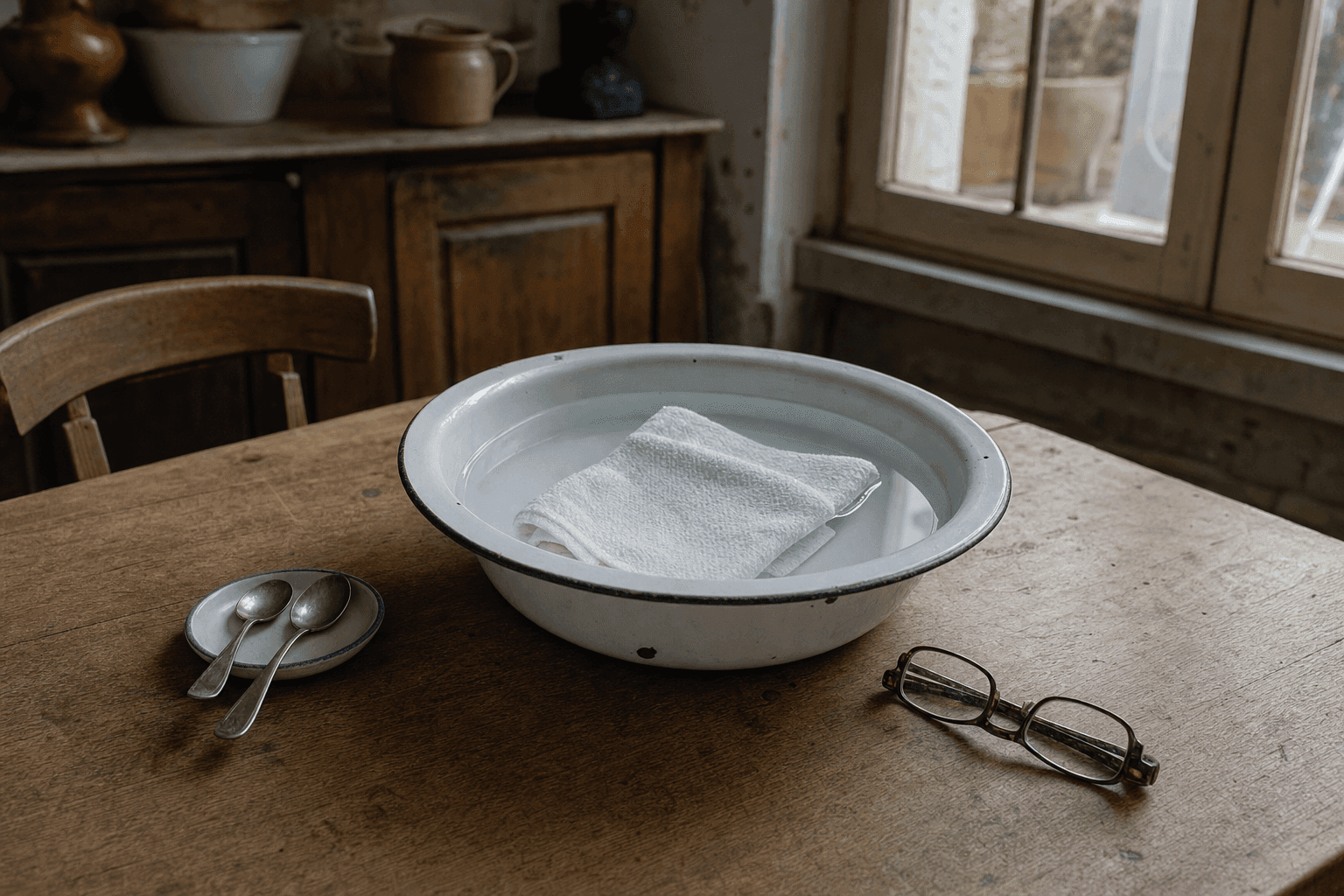
When your eyes are tired, start by resting them: look up from the screen, look into the distance, blink often, and lay a cold washcloth on your closed eyelids. In the evening, turn the screens off earlier and get your full night’s sleep. If your eyesight drops suddenly, or if your eye is red and very painful, don’t go looking for an herbal tea: get seen the same day.
Key takeaways
- Tired eyes need rest first: you look up from the screen, blink on purpose, close your eyes for a moment.
- Every 20 minutes of screen time, look into the distance, about six meters away, for 20 seconds: that’s the 20-20-20 rule.
- A clean washcloth run under cold water, laid on your closed eyelids, cools things down without putting anything in your eye.
- Chamomile and cornflower compresses, I don’t put them on my eyes anymore: an infusion made in the kitchen isn’t clean enough for the eye.
- Eyesight that drops suddenly, a red and very painful eye or a blow to the eye needs an ophthalmologist or the emergency room the same day.
Granny’s little steps
- Look up every 20 minutes
Every 20 minutes of screen time, look at something far away, about six meters off, for 20 seconds. After two hours straight, give your eyes a real quarter of an hour of rest.
- Blink on purpose
In front of a screen, we forget to blink. Do it deliberately, several times in a row: that’s what puts tears back on your eye.
- The cold washcloth
Run a clean washcloth under cold water, wring it out well and lay it on your closed eyelids. In the morning, two teaspoons straight from the fridge do the same for puffy eyelids.
- The screen in its place, and the air in the house too
The top of the screen at eye level, at arm’s length, a matte screen and not facing a wall. And an aired room, no tobacco smoke, with as little air conditioning as possible.
- Screens off before bed
An hour or two before you go to bed, put your phone away and turn off the television. Aim for seven hours of sleep, with an extra pillow if your eyelids swell overnight.
A recipe to try
The cold washcloth for when your eyes feel strained
As soon as your eyes feel strained, screen off
What you’ll need
- A clean washcloth
- Very cold tap water
- Or two little spoons left in the fridge
How I go about it
- Turn off the screen, or at least look up and move away from it.
- Wash your hands.
- Run the washcloth under cold water and wring it out well.
- Rest your head back, close your eyes and lay the washcloth on your closed eyelids for a few minutes, long enough to catch your breath. Nothing should run into your eye.
- No washcloth handy? Two little spoons from the fridge, rounded side down on your closed eyelids, do the same.
- When you open your eyes again, look into the distance and blink several times before going back to the screen.
Tired eyes are soothed first by rest: you look up from the screen, look into the distance, blink, and lay a good cold cloth on your closed eyes. I’ll tell you what I do, what I’ve stopped doing (yes, there are some), and when you need to go and see someone.
Tired eyes: the symptoms, and why they happen
You know these symptoms: eyes that sting or itch, eyeballs that feel heavy, a little redness, vision that blurs for a moment, and sometimes a headache at the end of the day. The books say most of these discomforts go away with rest.
Why does it happen? In front of a screen, we blink less. And it’s blinking that spreads the tears over the eye. The less you blink, the drier it gets, and the more it pulls. Add to that a screen that’s too high or too close, glare, a dry or air-conditioned room, cigarette smoke, wind: everything that dries the eye or makes it strain adds up.
There’s also what we forget: glasses that no longer match your eyesight. If you squint to read the newspaper, maybe that’s all it is. And with age, tears become scarcer. My mother already complained about it. After 65, it’s recommended to have your eyes checked at least every two years. I go, and I’m none the worse for it.
What to do when your eyes are tired: rest first
The first habit is to take your eyes off the screen. You may know the 20-20-20 rule: every 20 minutes of screen time, look at something far away, about six meters off (the bottom of the garden, the other end of the room, the window), for 20 seconds. After two hours straight, a real quarter of an hour of rest for your eyes is even recommended. Me, I set the kitchen timer.
Next, blink. On purpose, several times in a row, like a flirt fluttering her lashes. It seems silly, but it’s what puts water back on the eye.
Look at how you’re set up, too. The top of the screen goes at eye level, or a little lower if you wear progressive lenses, and roughly at arm’s length, between 50 and 70 centimeters. A matte screen is less tiring than a shiny one full of reflections. And don’t set it facing a wall: you need to be able to look into the distance when you lift your eyes. My grandson who’s studying had his laptop flat on the table; I slipped a pile of cookbooks under it. He laughed, but he kept it.
For the air in the house: air it out every day, avoid air conditioning if you can, keep away from tobacco smoke, and wear glasses in the sun and wind. If you wear contact lenses, don’t keep them in all the time, switch with your glasses. If your eyes stay dry, the pharmacist has artificial tears: choose single doses without preservatives, and ask for advice.
And don’t rub your eyes. I know, it’s the first reflex. If you have to touch them, wash your hands first.
Grandma’s remedies for tired eyes, and the ones I’ve put away
You may be surprised: I don’t put herbal tea on my eyes anymore. Let me explain.
Cornflower. It’s the little blue flower that grows in wheat fields. In the old days, people bathed irritated eyes and eyelids with its water, and they even called it the “casse-lunettes”, the glasses-breaker. The pharmacopoeia still lists it among traditional plants. But for the eyes, I haven’t found in serious books either a way to make it, or an amount, or a length of time. So I keep it for the bouquet and for the story, with no recipe for your eyes.
Eyebright. Another old eye herb: the old handbooks gave it as a compress on the eyelids. Today’s books are very clear about it: an infusion made in the kitchen and put on the eye isn’t clean enough, and no one knows whether it does any good. I believe them.
Chamomile. My grandmother used to soak cotton pads in cooled chamomile for the eyes. But chamomile belongs to the Asteraceae family, the daisy family, it gives some people allergies, and near the eyes it can irritate them. The books don’t give it for the eyes at all. Nowadays, I drink it after a meal, and that’s it. What I do with chamomile, I tell you there.
What I keep from the grandma’s remedies is plain cold. A clean washcloth, run under cold water, well wrung out, on your closed eyelids, long enough to catch your breath. Or the two little spoons I leave in the fridge and lay, rounded side down, on my eyelids in the morning when they’re puffy. Or two slices of well-chilled cucumber. It’s as simple as can be, nothing gets into the eye, and it cools.
And in the cup? For tired eyes, there’s no tea made for them: the books don’t give any. If it’s tension in the evening that keeps you from sleeping well, go and see my page on sleep instead.
“Eyes, you don’t put anything from the kitchen in them. You close them, you cool them, and you let them rest.”
Tired eyes when you wake up, dark circles and heavy eyelids
We always blame dark circles on tiredness. Sometimes it’s true: after a night that’s too short, the skin under the eyes turns pale and the little blood vessels show through. But dark circles also come from age, when the skin gets thinner, from family (in ours, we women all have them), from the sun, from rubbing your eyes, from eczema, tobacco, alcohol, or not drinking enough water. Most of the time, it’s nothing to worry about.
For puffy eyelids in the morning, I sleep with an extra pillow, my head a little higher, and I aim for seven hours of sleep. In the evening, I turn off the television and the phone an hour or two before going to bed: it’s recommended for children, and at my house it goes for everyone. For nights when sleep won’t come, I have other little habits.
And if your eyes are heavy because all of you is worn out, the cold washcloth won’t be enough. Slow down, eat at regular times, drink water. For the big passing bouts of tiredness, I’ve written you another page. Tiredness that lasts for weeks despite all that, or a dark circle that settles in under just one eye, is something to show your doctor: I’ve put the list just below.
Which plants?
White mulberryMorus alba
The white mulberry is the silkworm's tree, from China and planted all over France: summer shade, berries to eat when properly ripe, and its dried leaves in a cup.
CornflowerCentaurea cyanus
Cornflower is the little blue flower of the wheat fields and of 11 November in France: a pinch in the cup for colour, a few flowers on a salad, and nothing on the eyes any more.
What to know first
Nothing homemade in the eye: no chamomile, cornflower or eyebright infusion on the eyes, not as a compress or as an eye bath. The books say an infusion made in the kitchen isn’t clean enough for the eye, and chamomile can irritate it. The cold washcloth, the spoons and the cucumber go on closed eyelids, and always very clean.
Allergies: chamomile and cornflower belong to the Asteraceae family, the daisy family. If you’re allergic to any of these plants, keep them away from your face.
Artificial tears: they’re sold at the pharmacy. Choose single doses without preservatives, which limit the risk of infection and irritation, and ask your pharmacist for advice. If the discomfort lasts or gets worse, see an ophthalmologist.
Contact lenses: care for them as directed and don’t wear them all the time; switch with your glasses. Don’t rub your eyes, and wash your hands before touching them.
If you’re on a treatment: some medications taken by mouth dry out the eyes. Read the leaflet and talk to your regular doctor, but never stop a treatment on your own.
When to see your doctor
- Your eyesight drops suddenly, gets blurry, you see halos or wavy lines, or you can’t stand light anymore: see an ophthalmologist the same day or go to the emergency room.
- Intense pain in the eye, with a headache, vomiting or fever: ophthalmologist the same day or emergency room.
- A blow to the eye: ophthalmologist the same day or emergency room.
- A liquid product splashed into the eye, or something that went into it at high speed: ophthalmologist or emergency room without waiting.
- An eye operated on in the last few days that becomes red and painful: ophthalmologist the same day or emergency room.
- A swollen eye with a fever over 38 °C: ophthalmologist the same day.
- A red, painful eye with blurry vision: ophthalmologist the same day.
- Blurred vision that doesn’t clear when you blink: ophthalmologist the same day.
- A baby under 2 with a red eye that’s running (pus): their regular doctor or pediatrician the same day.
- A red eye with a thick discharge, like pus: make an appointment with your doctor.
- A red eye and you don’t know why, or redness that doesn’t get better in a few days while your eyesight is normal: make an appointment with your doctor.
- A speck of dust or an eyelash stuck that you can’t get out: don’t rub, and go and see your doctor.
- Dry eyes or discomfort that lasts despite rest and good habits, or gets worse: make an appointment with an ophthalmologist.
- You wear contact lenses and the discomfort doesn’t pass quickly: ophthalmologist, so they can check whether the lenses have damaged your eye.
- Your eyes have been dry since you started taking something new: read the leaflet and talk to your regular doctor, without stopping your treatment on your own.
- A dark circle or swelling that settles in under just one eye: talk to your doctor.
- Tiredness that lasts days or weeks despite rest and new habits: make an appointment with your regular doctor.
- Tiredness so bad you can’t get through your days anymore: make an appointment with your regular doctor.
- Tiredness that comes with a fever, weight loss or gain for no reason, pain or great thirst: make an appointment with your regular doctor.
Your questions
How can I quickly soothe tired eyes?
Leave the screen for a minute, close your eyes, then look into the distance and blink several times in a row. Then a clean washcloth run under cold water, well wrung out, on your closed eyelids: it cools things down without putting anything in your eye. Most of the time, tired eyes recover with rest.
What exercises can rest tired eyes?
The simplest is the 20-20-20 rule: every 20 minutes of screen time, you look about six meters away for 20 seconds. Add blinking on purpose, and after two hours straight, a quarter of an hour away from the screen. No need for complicated exercises.
How can I keep my eyes moist naturally?
Blink often: it’s blinking that spreads the tears over your eye. Air out the house every day, avoid air conditioning and tobacco smoke, and wear glasses in the sun and wind. If that’s not enough, the pharmacist has artificial tears, preferably in single doses without preservatives.
Is a chamomile compress on the eyes a good idea?
I don’t do it anymore. Chamomile belongs to the Asteraceae family, the daisy family, it gives some people allergies and can irritate the eyes, and the books don’t give it for the eyes. On top of that, an infusion made in the kitchen isn’t clean enough for the eye: my chamomile, I keep it for the cup.
And cornflower water for tired eyes?
Cornflower is a real grandma’s remedy: in the old days, people bathed irritated eyes and eyelids with its water, hence its French nickname “casse-lunettes”, the glasses-breaker. But I haven’t found in serious books either a way to make it or an amount for the eyes. So I won’t give you a recipe, and I prefer cold water on a clean cloth.
Why do we get dark circles under the eyes?
Lack of sleep often has something to do with it, but not always: age, family, the sun, rubbing your eyes, eczema, tobacco or alcohol play a part too. Most of the time, it’s nothing to worry about. A dark circle or swelling under just one eye, on the other hand, is something to show a doctor.
References
- Que faire quand on a les yeux secs ? · ameli.fr, 2024
- Sécheresse oculaire : définition, symptômes et causes · ameli.fr, 2024
- Œil rouge : que faire et quand consulter ? · ameli.fr, 2026
- Conjonctivite : que faire et quand consulter ? · ameli.fr, 2025
- Asthénie (fatigue) : que faire et quand consulter ? · ameli.fr, 2026
- Comment adapter l'usage des écrans à l'âge de l'enfant ou de l'adolescent ? · ameli.fr, 2025
- Travail sur écran : risques pour la santé · INRS, 2025
- Computer vision syndrome · American Optometric Association
- Dark circles under the eyes · Cleveland Clinic, 2022
- Assessment report on Euphrasia officinalis L. and Euphrasia rostkoviana Hayne, herba (EMA/HMPC/246799/2009) · EMA, HMPC, 2010
- European Union herbal monograph on Matricaria recutita L., flos (EMA/HMPC/55843/2011) · EMA, HMPC, 2015
- Chamomile · NCCIH, National Institutes of Health
- Liste A des plantes médicinales utilisées traditionnellement · ANSM, Pharmacopée française, 2026
- Centaurea cyanus · Wikipédia
Information. This information is provided for general knowledge and doesn’t replace medical advice. Check with a healthcare professional before any use.
Health Disclaimer