Soothe heartburn after meals
Grandma's remedies for heartburn: an early, light dinner, no lying down after eating, peppermint left aside, a gentle cup. And knowing when to see a doctor.
Reviewed by Ruosi Wu, PhD in Pharmacy, MD in Traditional Chinese Medicine
When it burns after a meal, start at the table: smaller meals, a light dinner at least three hours before bed, and no stretching out on the sofa right after. At night, raise the head of the bed. Leave peppermint aside, it can make the burning worse. If it comes back almost every day, if swallowing gets hard or if the pain squeezes your chest, that's beyond my kitchen: go and see someone.
Key takeaways
- Heartburn is a heat that starts in the pit of the stomach and climbs behind the breastbone, often after a meal, at night or when you bend forward.
- The first step happens at the table: a light dinner, at least three hours before bed, and no lying down straight afterwards.
- At night, raise the head of the bed by 10 to 20 cm with blocks under the bed legs, not with extra pillows.
- When it burns, the peppermint stays in the cupboard: it can make heartburn worse.
- Pain that squeezes your chest, with sweating, breathlessness or feeling faint, is no job for a herbal tea: you call 15.
Granny’s little steps
- Eat an early, light dinner
Smaller portions in the evening, and at least three hours between dinner and bed. Several small meals are better than one big one.
- Don't lie down after eating
Stay standing or sitting. No lying-down nap after lunch, no bending over the garden right after. A quiet little walk, yes.
- Raise the head of the bed
10 to 20 cm, with blocks under the bed legs at the head end, not with extra pillows. And sleep on your back, mostly.
- Spot what lights the fire
Fat, spices, chocolate, coffee, alcohol, fizzy drinks, orange or tomato juice, vinegar, lemon: try going without one, then another, and see.
- Loosen your belt
Nothing tight around the waist. And if you smoke, that's one more reason to stop.
A recipe to try
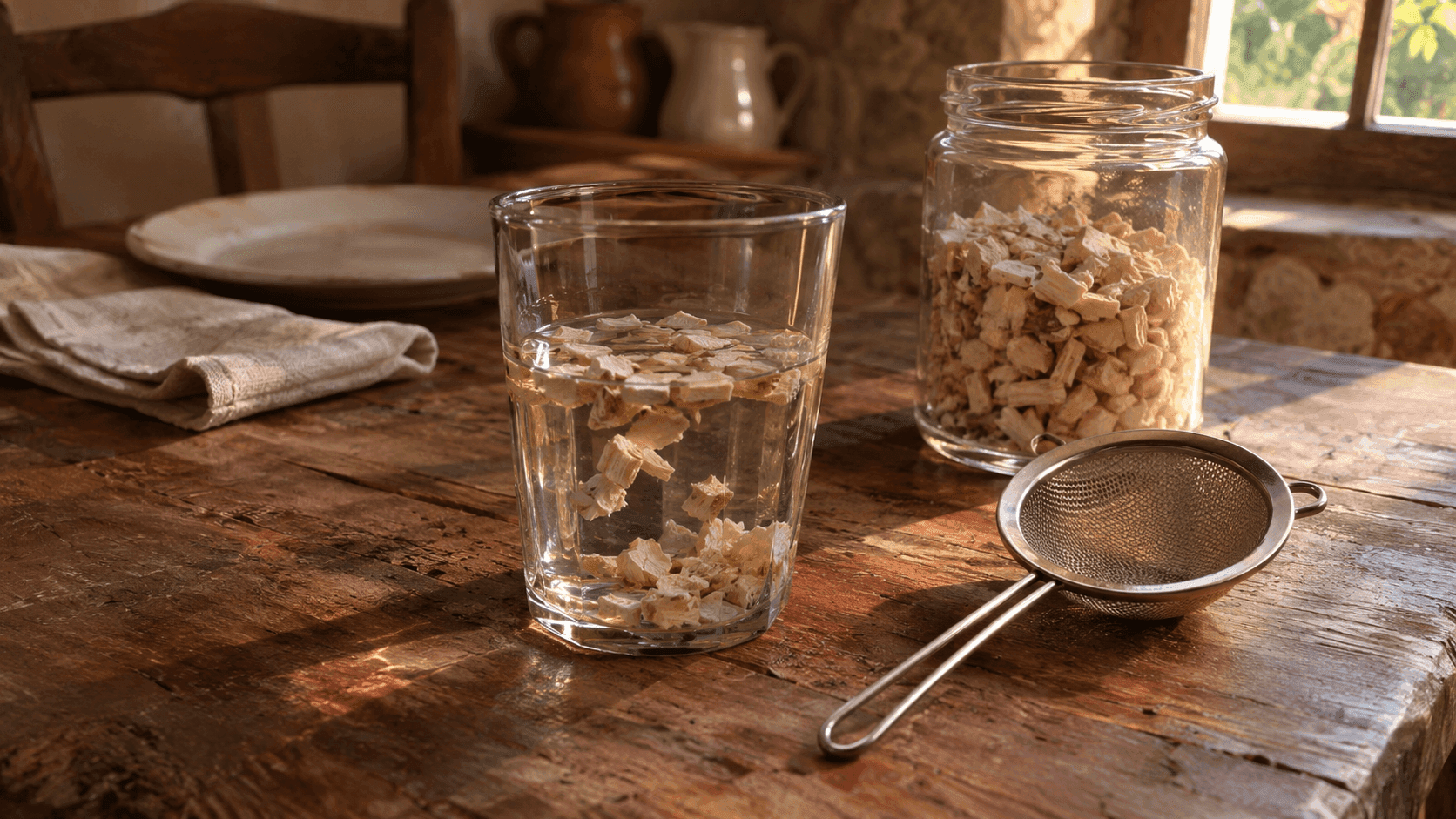
The cold marshmallow root glass after dinner
In the evening, when your stomach starts to burn after the meal
What you’ll need
- 2 to 5 g of cut marshmallow root (weigh it the first time)
- 150 ml of water at room temperature
- A glass
- A small strainer
How I go about it
- Put the root in the glass and pour the water over it. I set it up as I sit down to eat, so it's ready after dinner.
- Leave it to soak for half an hour, without heating.
- Strain, and drink straight away, in small sips, sitting down: it doesn't keep.
- No more than three glasses a day, or 15 g of root in the day, and only from age 12.
- Keep half an hour to an hour between this and anything else you take. Not during pregnancy or breastfeeding. If it lasts more than two weeks, or gets worse, see your doctor.
Heartburn calms down first at the table and in bed, long before the cup: you eat less in the evening, have dinner early, don't lie down after the meal and raise the head of the bed. I'll tell you where that fire comes from, what I do at home, the plants I keep for those evenings, and when you need to see someone.
Heartburn: that fire rising after a meal
You know the feeling. It starts in the pit of the stomach, just under the ribs, and climbs behind the breastbone, like heat rising. Sometimes a little acid comes up into your mouth too, a sour taste at the back of the throat: that's what we call acid reflux, or sour stomach. Often there's burping as well, and a stomach that feels a bit heavy.
It happens mostly after meals, at night, or when you bend forward. And you're not the only one: at least one adult in five gets it now and then. At home, it was the day after the holidays, when we'd eaten too well and gone to bed late, stomach still full.
A bit of heartburn now and then, after a big meal, happens to everyone. What should make you sit up is when it comes back almost every day: the signs to watch for are further down, one per line.
Why it burns: acid reflux and a sour stomach
The books explain that a little of what's in the stomach comes back up into the pipe that runs down from the throat. And what makes it come up, most of the time, is what we do ourselves.
A meal that's too big, especially in the evening. Fat, spices, chocolate, anything acidic. The glass of wine, the cigarette. Extra weight pressing on the belly. Pregnancy too, often. And some things you take on a doctor's orders: if your heartburn started at the same time as something new on a doctor's orders, tell your doctor.
My mother used to say you don't go to bed on a full stomach: lying down, it comes back up more easily. So we dried the dishes standing up, and that was one job done.
One more thing, and I'd rather tell you plainly: chest pain can come from the heart, and it can feel like heartburn. If it squeezes like a vice, if it spreads to the jaw, the arm or the back, if you're sweating, short of breath or feeling unwell, don't put it down to the meal. Call 15 or 112 (the French emergency numbers), right away.
Heartburn, what to do: my evening habits
At the table, first. I'd rather have several small meals than one big one. I take my time, twenty to thirty minutes, sitting down, and I chew well. In the evening, I eat a light dinner, at least three hours before I go to bed.
After eating, I stay standing or sitting. No lying-down nap on the sofa after lunch: if you want a rest, sit half upright. I don't bend down to weed right after, and no hard effort either. A quiet little walk, yes: it helps digestion.
At night, I sleep with the head of the bed raised by 10 to 20 cm, with wooden blocks under both legs at the head end. Not with three pillows: that bends your belly and presses on it. And I sleep on my back, mostly.
Then I look at what lights the fire for me. Fat, spices, fizzy drinks, coffee, alcohol, orange or tomato juice, vinegar, lemon, chocolate. Try going without one, then another, and see if it helps. And nothing tight around the waist: loosening your belt is as simple as can be, but it counts.
If that's not enough and it doesn't happen often, the pharmacist has something to tide you over for a few days. Tell them what you already take. But if you need it all the time, or if it comes back as soon as you stop, it's your doctor you need to see.
My grandma's remedies for heartburn, and what I keep of them
I'll be honest: a herbal tea won't put out one meal too many, the habits above count for much more. But for the evenings when my stomach is burning, I have a few jars, with their measures.
Marshmallow root, cold. The books give marshmallow root, soaked in cold water, when the stomach and belly are a little upset. 2 to 5 g of cut root in 150 ml of water at room temperature, half an hour to soak, strain and drink straight away, three glasses a day at most, from age 12. I drink it half an hour to an hour apart from anything else I take. The recipe is just below, and everything I do with marshmallow is over here.
German chamomile, lukewarm. The books don't give it for the burning itself. They give it for small tummy troubles after eating, when it bloats and knots up in little cramps, which often comes along with it. 1.5 to 4 g of dried flowers in 150 ml of boiling water, ten minutes covered, three or four cups a day. I let it cool to lukewarm before drinking: when the stomach is sensitive, the advice is to avoid anything very hot. My chamomile, I tell you about it here.
Fennel seeds and lemon balm, for the evenings when the stomach is heavy and full of wind on top of it. Fennel is 1.5 g of seeds in a big bowl of boiling water (250 ml), fifteen minutes covered, up to three bowls a day, no more than two weeks. Lemon balm is 1.5 to 4.5 g of dried leaves in 150 ml of boiling water, ten minutes covered, one to three cups a day, and it can make you drowsy. My fennel seeds and my lemon balm are over there.
Liquorice, with a lot of caution. The books do give it when the stomach burns. But too much, or for too long, it pushes your blood pressure up, and it hides in pastis, sweets, some shop-bought herbal teas. So it's now and then, never more than four weeks, never under 18, not during pregnancy or breastfeeding, and not with high blood pressure or a fragile heart, kidneys or liver. The amount, I ask my pharmacist. Everything you need to know about liquorice, I wrote it here.
And peppermint, which I love so much after a meal? When it burns, I leave it in the cupboard: it can make heartburn worse. I keep it for the days when digestion is simply heavy, with no fire rising.
Honey, people often ask me about. I haven't found it in my books for heartburn, so I won't promise you anything. A small spoonful in your lukewarm cup, for the taste, if you like it. But never honey for a baby under one year old.
« The fire in your stomach, you put it out first by eating dinner early and staying upright. The cup comes after, for the comfort. »
Which plants?
LiquoriceGlycyrrhiza glabra
Liquorice is a Mediterranean plant with a very sweet root, the one behind chewing sticks and black sweets. I keep it for now and then, never more than 4 weeks.
MarshmallowAlthaea officinalis
Common marshmallow is the tall, soft plant of the water's edge whose root gave its name to the sweet: a cold glass when your throat feels scratchy, and homemade marshmallows for the afternoon snack.
FennelFoeniculum vulgare Mill.
Fennel is the tall plant that smells of anise: its seeds go into a tea when your tummy bloats, the Florence bulb goes into the kitchen, and wild fennel grows along the roadsides.
ChamomileMatricaria chamomilla L.
Chamomile means two little flowers for your cup: German chamomile, mild, and Roman chamomile, bitter. For a bloated tummy, an irritated throat, skin that's got too hot.
Lemon balmMelissa officinalis
Lemon balm is the perennial garden herb that smells of lemon when you crush it: a cup in the evening, a cup when your tummy bloats, and a few leaves over summer fruit.
What to know first
Peppermint: if you have heartburn or acid reflux, leave it aside: the books say it can make them worse. It's the same rule as on my page about heavy digestion.
Pharmacy products: for heartburn that doesn't happen often, the pharmacist can suggest something to take for a few days. Tell them about your health problems and what you already take, read the leaflet and stick to the doses. If it doesn't work quickly, if the heartburn persists or comes back once you stop, see your GP. If you've been given a treatment for your stomach, don't stop it without talking to your doctor.
Pregnancy and breastfeeding: heartburn is common during pregnancy. Talk to your midwife or doctor before taking anything. No marshmallow root, fennel seeds, lemon balm or liquorice during those months. A plain German chamomile tea, the books say you can drink, in the usual amounts.
Marshmallow root: from age 12 for the stomach, 2 to 5 g of root in 150 ml of cold water, half an hour, three times a day at most, 15 g of root a day at most, and the glass is drunk straight away. It can slow down the passage of whatever you swallow at the same time, including a medicine: take it half an hour to an hour before or after. Not if you're allergic to it. If it lasts more than two weeks, or gets worse, see your doctor.
German chamomile: it belongs to the same family as ragweed, chrysanthemums, marigolds and daisies: if you're allergic to any of them, go without. Serious allergic reactions have been reported: if your face or throat swells, or you have trouble breathing, call 15 straight away. No tea before 6 months; then 0.5 to 1 g of flowers from 6 months to 2 years, 1 to 1.5 g from 2 to 6 years, 1.5 to 3 g from 6 to 12 years, two to four times a day. Interactions have been reported with warfarin, a blood thinner, with some medicines broken down by the liver, and in kidney transplant patients who drank a lot of it for a long time: if you take a long-term treatment, ask your doctor or pharmacist. If it's no better after a week, see your doctor.
Fennel seeds: not before age 4. Between 4 and 12, a smaller cup (1 g of seeds in 100 ml of boiling water, 15 minutes, up to three times a day, less than a week), and only with seeds known to be suitable for children: ask your pharmacist. No more than two weeks in a row. Not if you're allergic to fennel, to anethole, to a plant of its family (aniseed, caraway, celery, coriander, dill) or to mugwort pollen.
Lemon balm: not before age 12. 1.5 to 4.5 g of leaves for 150 ml of boiling water, one to three times a day, two weeks at most. It can make you drowsy: if it does, don't drive. The books say it might slow down a hormone that controls the thyroid: if you have a thyroid problem, ask your doctor first. Not if you're allergic to it.
Liquorice: taken for too long (more than 4 weeks) or in too large amounts, it makes you retain water, lowers potassium, raises blood pressure and can upset the heart rhythm. No liquorice at all, in any form, if you have high blood pressure, a fragile heart, kidneys or liver, or if you've been told your potassium is low; nor during pregnancy, breastfeeding, or if you could get pregnant without contraception; nor under 18. Not with diuretics, digoxin and other digitalis-based heart treatments, cortisone and other corticosteroids, stimulant laxatives, or anything that lowers potassium; it can work against a blood pressure treatment and slightly change the effect of other medicines, such as omeprazole, often taken for the stomach. Don't add it up: pastis with or without alcohol, sweets, syrups, chewing sticks and some shop-bought teas are liquorice too. The amount for a homemade tea, ask your pharmacist, and never more than 4 weeks. If your ankles swell, if you get cramps, headaches or your heart beats out of rhythm, stop and see your doctor. If your stomach still burns after 2 weeks, see your doctor too.
Honey: never before one year old, not even in the bottle or the yogurt.
When to see your doctor
- Chest pain that squeezes like a vice, which may spread to the jaw, the arm or the back, with or without sweating, breathlessness, paleness, feeling faint or nausea: call 15 or 112 (French emergency numbers) straight away, it may come from the heart.
- Very strong stomach pain that came on suddenly and spreads to the chest: get medical help immediately, call 15 or 112.
- You vomit blood: get medical help immediately.
- Your stools are black: get medical help immediately.
- You have red blood in your stools: get medical help immediately.
- With your stomach pain, you turn pale, feel dizzy, feel unwell or very weak: get medical help immediately.
- You have constant pain behind the breastbone, or a feeling of being squeezed: see your GP the same day.
- You have great difficulty swallowing: see your GP the same day.
- Swallowing hurts, or the reflux is painful: book an appointment with your doctor in the next few days.
- There's blood in what comes back up into your mouth: book an appointment with your doctor in the next few days.
- You're losing weight quickly without trying: book an appointment with your doctor in the next few days.
- You're over 50 and this heartburn is new for you: book an appointment with your doctor in the next few days.
- The reflux comes with a cough or a hoarse voice: book an appointment with your doctor in the next few days.
- Your heartburn started with a new treatment, for example an anti-inflammatory or aspirin: book an appointment with your doctor in the next few days.
- The heartburn persists or gets worse despite good habits and the product suggested by the pharmacist, or comes back as soon as you stop it: book an appointment with your doctor in the next few days.
- You have heartburn almost every day: book an appointment with your GP.
- Your stomach has hurt for a week or more, or the pain goes away and comes back: book an appointment with your GP.
- You've lost your appetite, or you've been tired for a long time: book an appointment with your GP.
Your questions
Heartburn: what should I do?
Stay standing or sitting, loosen your belt, and don't lie down straight away. After that, smaller meals, a light dinner at least three hours before bed and the head of the bed raised. If it happens rarely, the pharmacist can tide you over for a few days; if it comes back almost every day, see your doctor.
How can I soothe heartburn naturally?
With habits first: eat less in the evening, have dinner early, stay upright after the meal, raise the head of the bed by 10 to 20 cm, and go without whatever lights the fire for you for a while. Then, if you want a cup, a glass of marshmallow root soaked in cold water for half an hour, or a lukewarm chamomile. But leave peppermint aside.
Is honey good for heartburn?
I haven't found it in my books for that, so I won't promise you anything. A small spoonful in a lukewarm cup, for the taste, if you like it. And never honey for a baby under one year old.
Why do I get acid reflux at night?
Because lying down, it comes back up more easily, especially after a big, rich or boozy dinner eaten late. Have a light dinner, at least three hours before bed, and raise the head of the bed with blocks rather than pillows. If it wakes you up often, talk to your doctor.
Which herbal tea for a sour stomach?
At home, it's marshmallow root soaked cold, 2 to 5 g in 150 ml of water, half an hour, three glasses a day at most, from age 12. Or a lukewarm German chamomile when the belly bloats as well. No peppermint, it can make heartburn worse, and liquorice only with your pharmacist's advice.
Heartburn or heart: how can I tell?
I don't tell them apart on my own, and neither should you. Pain that squeezes your chest like a vice, spreads to the jaw, the arm or the back, with sweating, breathlessness or feeling faint, may come from the heart: call 15 or 112 straight away, even if you've just left the table.
References
- Reflux gastro-œsophagien (RGO) de l'adulte : définition, symptômes et causes · ameli.fr, 2025
- Remontées acides et reflux gastro-œsophagien de l'adulte : que faire ? · ameli.fr, 2025
- Mal à l'estomac et brûlures d'estomac : que faire ? · ameli.fr, 2024
- Reconnaître un infarctus (ou crise cardiaque) et agir au plus vite · ameli.fr, 2026
- La diversification alimentaire · ameli.fr, 2026
- Heartburn and acid reflux · NHS, 2026
- European Union herbal monograph on Althaea officinalis L., radix (EMA/HMPC/436679/2015) · European Medicines Agency, HMPC, 2016
- European Union herbal monograph on Glycyrrhiza glabra L.; Glycyrrhiza inflata Bat.; Glycyrrhiza uralensis Fisch., radix, Revision 1 (EMA/HMPC/108399/2024) · European Medicines Agency, HMPC, 2026
- Réglisse : attention à la surconsommation pour éviter les risques d'hypertension · Anses, 2025
- European Union herbal monograph on Matricaria recutita L., flos (EMA/HMPC/55843/2011) · European Medicines Agency, HMPC, 2015
- European Union herbal monograph on Foeniculum vulgare Miller subsp. vulgare var. vulgare, fructus, Revision 1 · European Medicines Agency, HMPC, 2024
- Community herbal monograph on Melissa officinalis L., folium · European Medicines Agency, HMPC, 2013
- European Union herbal monograph on Mentha x piperita L., folium, Revision 1 · European Medicines Agency, HMPC, 2020
Information. This information is provided for general knowledge and doesn’t replace medical advice. Check with a healthcare professional before any use.
Health Disclaimer