A wild vine from West Africa, a cousin of the beans, whose seeds factories turn into the 5-HTP in supplements. Over there, it's mostly the stems and leaves that people use.
Who she really is
Family: Legume family (Fabaceae), the same family as beans and peas.
Parts used: the seeds, for the trade. In West Africa, people also use the leaves, stems, bark and roots.
Griffonia (Griffonia simplicifolia) is a wild vine from West Africa that grows from Liberia to Gabon. Over there, its stems, leaves and roots are used for a thousand things around the house. Here, we mostly know its seeds: factories extract a powder from them, 5-HTP, which is sold in food supplements. It's not a grandmother's herbal tea, and it's never taken with an antidepressant: read carefully what to know first.
Her story
Griffonia is a vine from West Africa, Griffonia simplicifolia, whose seeds are used today to make a powder sold in food supplements: 5-HTP. Over there, though, it's mostly the stems, leaves and roots that people use, for a thousand little things around the house.
I'm going to be straight with you. This one, I've never seen growing, and it doesn't go in my jars. But one of my neighbours came by one morning with a little box she'd bought from the village pharmacist, and asked me what I thought of it. So I got the books out again. I'll tell you what I found: the plant first, and what to know after.
Griffonia, a vine of the West African savannas
Picture a shrub, or more often a big vine, with smooth blackish brown branches. Its leaves are oval, six to twelve centimetres long, with veins clearly marked on both sides. Its flowers come in clusters: a small orange calyx shaped like a tube, and fleshy, greenish petals. The books say it's the birds that pollinate it.
It grows from Liberia to Gabon, and you find it just about everywhere over there: in grassy savanna, on termite mounds in the coastal plains, in scrub, in forests growing back and at the edge of the big forests. In West Africa, it flowers from July to November, and its pods ripen from August onwards.
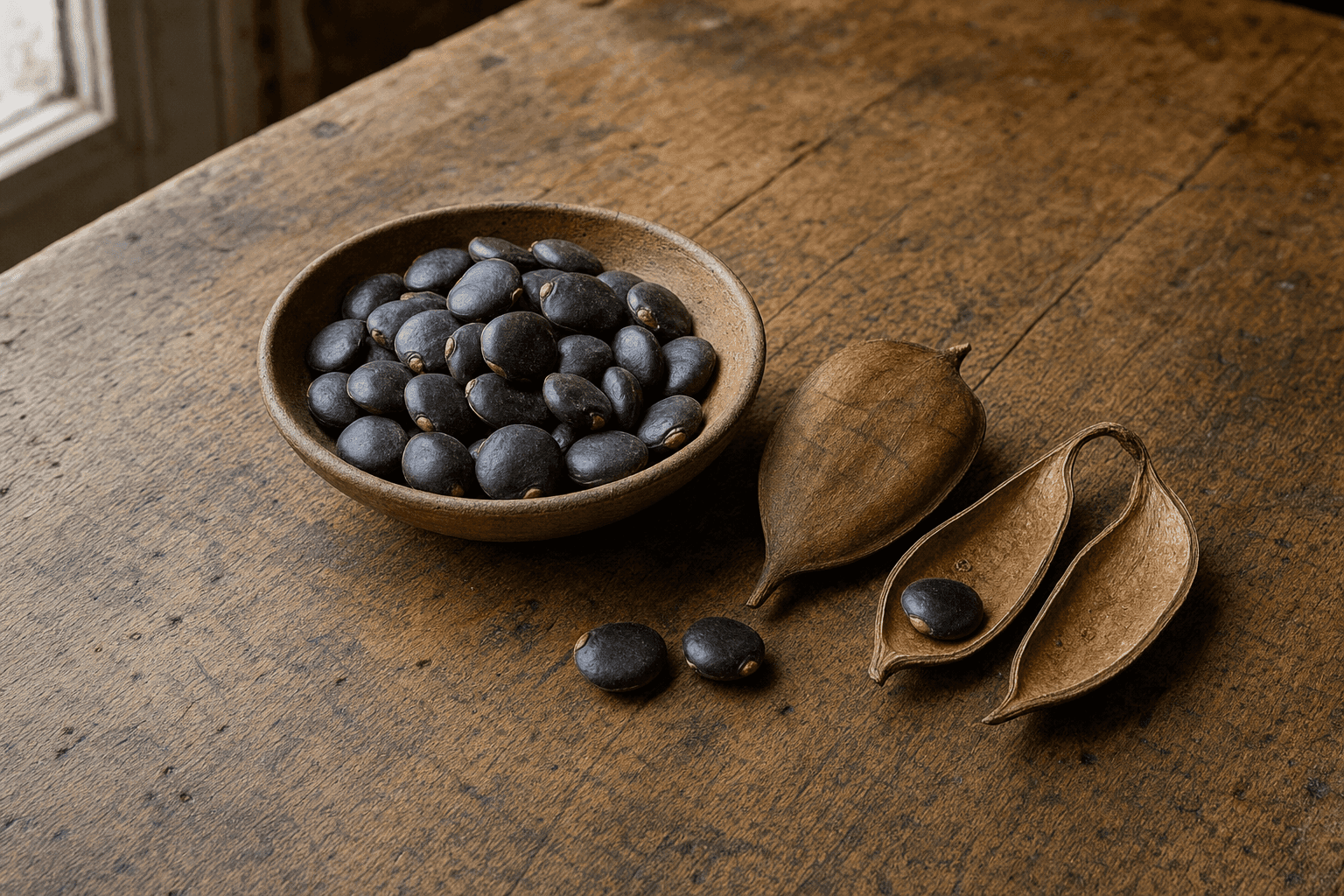
The pod is swollen, tough as leather, about eight centimetres long. Inside, one to four round seeds, a little under two centimetres across. When it opens, it flings out its seeds, but not very far. And it's a plant nobody cultivates: people have tried to get it to sprout, to grow it from cuttings, and it hasn't worked well. So everything that's harvested comes from the wild.
Griffonia simplicifolia: a name from a navy doctor
Its scholarly name has a very French story. The genus Griffonia was named in 1865 by Henri Baillon, a French botanist, in honour of Marie-Théophile Griffon du Bellay. He was a navy surgeon, born in Rochefort in 1829. In 1862, he tried to travel up the Ogooué river, in Gabon. Later, he was a doctor on a floating hospital moored there, and he studied the plants of the country, including the one that bears his name.
Simplicifolia is Latin: “with simple leaves”. And it's true, each leaf is all in one piece. In the past it was also called Bandeiraea simplicifolia, an old name you'll sometimes come across in books. And hold on to your hat: griffonia is a Fabaceae, from the big legume family, the family of my beans, my peas and my broad beans. A cousin from the vegetable patch, but one that climbs trees in the tropics.
In French, you'll hear both “le griffonia” and “la griffonia”. I say le griffonia, just as we say le tilleul.
What griffonia is used for in West Africa
Over there, griffonia is first of all an everyday plant. In Ghana, people chew its stems and roots like sticks, and its fibres, once beaten, make little chewing sponges: a common way of cleaning your teeth. Its wood is hard and strong, so people make walking sticks from it, and with the stems they make baskets and chicken coops.
Some of the uses made me smile. The leaves go into palm wine, giving it a bitter taste. The sap that runs from a cut stem is drunk to quench your thirst. The pods become whistles to play with, or spoons. The leaves give a black dye. In Ghana, people also chew the roots, dry them, and the women make a white powder from them to powder their faces. Leaves are laid in henhouses against lice. And the animals love it: cows roaming free happily graze on its bushes.
And then there are the old remedies from over there, with their own ways of doing things. The old collections say that people took the leaves as a decoction for coughs, made a lotion from the stems and leaves to wash wounds, or a paste of leaves to put on burns. For these uses, only small amounts are picked. What struck me is that in all this tradition, it's mostly about the stems, the leaves and the roots. The seeds are a much more recent story.
From griffonia seeds to the 5-HTP in supplements
That story has been going on for about fifty years. Factories, in the United States, in Germany and elsewhere, learned to extract a greyish white powder from the seeds, called 5-HTP. It then turns up in food supplements, sometimes mixed with vitamins, green tea or maté.
By the end of the 1980s, Ghana was already sending 75 to 80 tonnes of seeds a year to Europe, and it was the top remedy plant the country sold abroad. Today, five countries export it: Côte d'Ivoire, Ghana, Liberia, Nigeria and Togo. The seeds mostly go to China, where the powder is extracted, and nearly half of it then goes on to North America.
All of it comes from wild vines. From Ghana alone, between 2005 and 2013, at least 5,550 tonnes of seeds left the country. And to go faster, people sometimes cut the vine to get at the pods. It grows back well after cutting, that's its luck. But the forests are shrinking, animals graze its leaves, and each pod gives only one to four seeds. The books say the high value of its seeds has become a real threat to it.
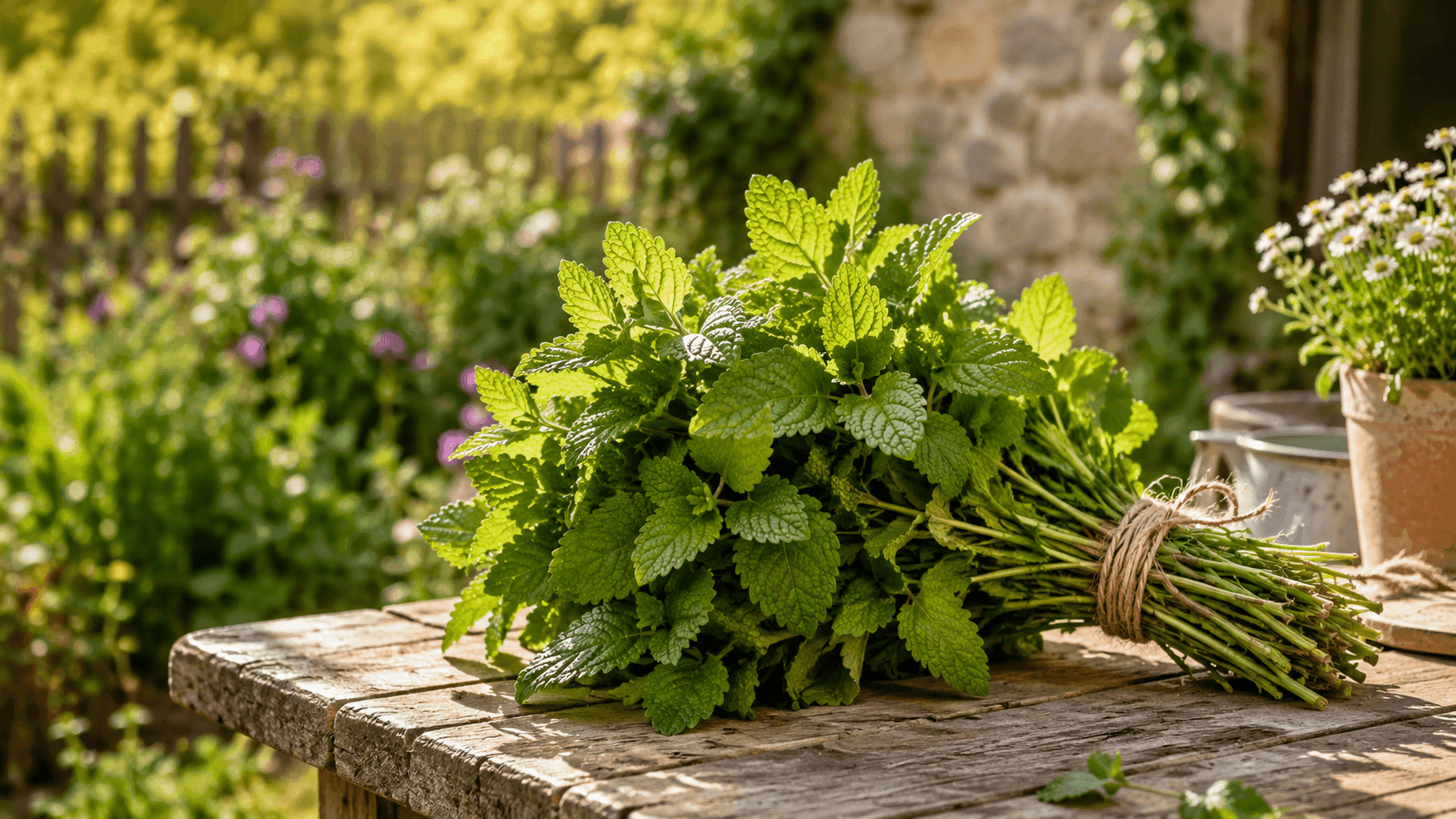
When I read that, I thought of my bunches of lemon balm drying upside down in the kitchen, picked by hand, sprig by sprig. It's not the same story, that's all.
Griffonia and me: why it doesn't go in my cups
Nothing new, as you can guess. I look at griffonia with respect, as a plant from another world that does a thousand services over there. But what's sold here isn't the vine any more: it's what's extracted from its seeds. And when the French health authorities took a close look at 5-HTP, they couldn't say from what amount you can take it without risk. With an antidepressant, you don't touch it, and the list of things to know is long.
So I told my neighbour what I'm telling you: if you're thinking about it, talk to your doctor first, especially if you already take something on a doctor's orders, and read carefully what to know first, just below. And no grinding the seeds yourself to make a tea: nobody can tell you how much to put in.
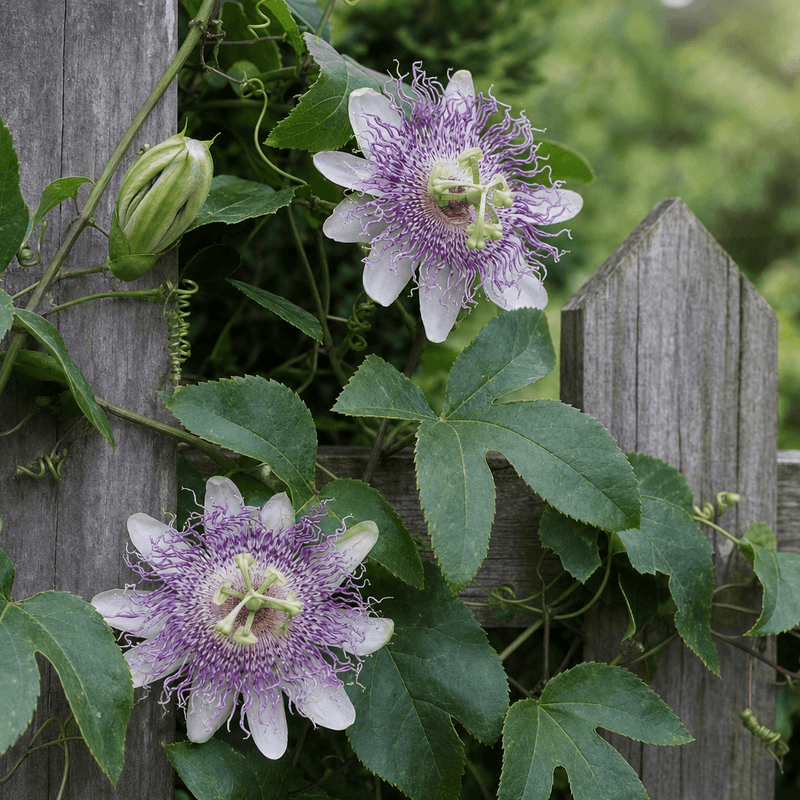
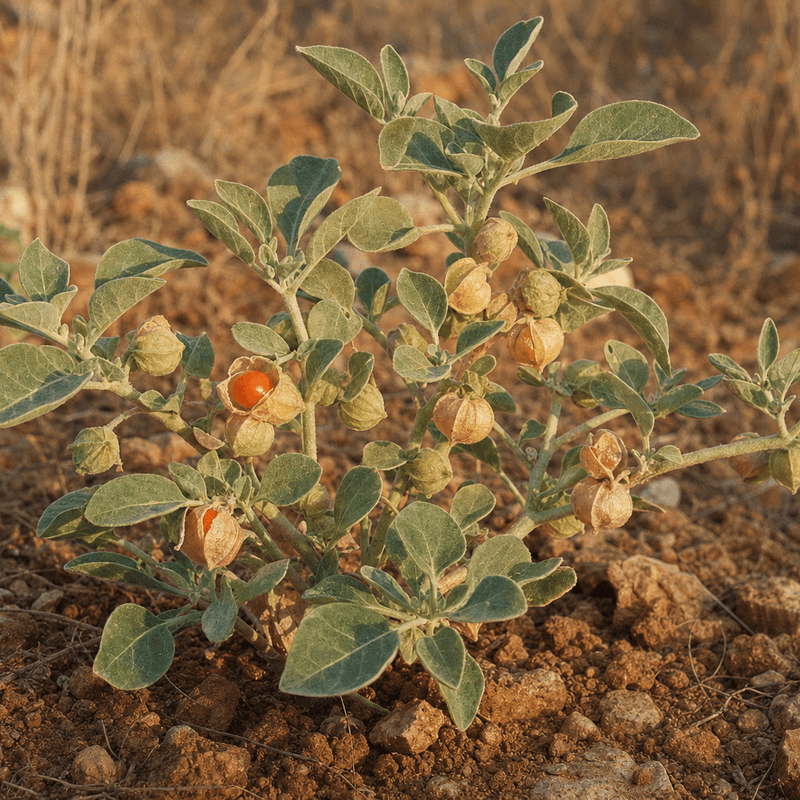
For evenings when your head spins too much and sleep keeps you waiting, I stick with my old faithful plants: my lemon balm, which smells of lemon when you crush it between your fingers, and the passion flower, with its funny flowers. I've put my two cups in the recipes. If it's your nights that are bothering you, I've written down my little habits for difficult sleep. For the days when your nerves give way, come and have a look over here. And if you're wondering what those other faraway plants sold as powders are worth, I've also told you about ashwagandha: it's a bit the same story.
And if your mood has been at rock bottom for weeks, it's not a plant you need, it's an appointment. Go and see someone, all right? What I love is a cup I know, drunk slowly, with the window half open onto the garden.
What people do with her, over there and here
- · 01In Ghana, people chew its stems and roots to clean their teeth, and make walking sticks, baskets and chicken coops from it.
- · 02Its leaves give a black dye, give palm wine a bitter taste, and animals happily graze on them.
- · 03In the old remedies over there, people took the leaves as a decoction for coughs, or made a paste of them for burns. For these uses, only a little is picked.
- · 04Its seeds, gathered from the wild, go off to factories that extract the 5-HTP in food supplements.
- · 05Me, I don't use it: for my restless evenings, I stick with lemon balm and passion flower.
How she’s prepared, over there
My evening cups, in her place
For griffonia, I won't give you a recipe: nobody can say how much of its powder is risk-free, and you don't grind its seeds at home. For the evenings when you were thinking of it, here are my two faithful cups instead.
The lemon balm infusion for bedtime
In the evening, before you go to bed
What you’ll need
- 1.5 to 4.5 g of dried lemon balm leaves
- 150 ml of water
How I go about it
- 01Bring the water to the boil.
- 02Pour it over the lemon balm leaves, in a cup.
- 03Cover and let it steep for 10 minutes, then strain.
- 04Up to 3 cups a day, from age 12, and not during pregnancy or breastfeeding. If you're not feeling better after two weeks, go and see your doctor.
The passion flower cup for restless evenings
In the evening, half an hour before bed
What you’ll need
- 1 to 2 g of dried, cut aerial parts of passion flower
- 150 ml of water
How I go about it
- 01Bring the water to the boil.
- 02Pour it over the passion flower, in a cup.
- 03Cover and let it steep for 10 minutes, then strain.
- 04Drink it slowly. Up to 4 cups a day, from age 12, not during pregnancy or breastfeeding, and not with anything you already take for sleep on a doctor's orders. It can make you drowsy: no driving afterwards. If you're not feeling better after two weeks, go and see your doctor.
What to know first
This information doesn't replace advice from a healthcare professional. Health Disclaimer →
Her identity card
- Latin name
- Griffonia simplicifolia (Vahl ex DC.) Baill.
- Former name
- Bandeiraea simplicifolia Benth.
- Family
- Legume family (Fabaceae)
- Parts used
- Seed; leaves, stems, bark and roots in West Africa
- Harvest
- Ripe pods gathered from the wild, from August
- Form
- Seeds, from which factories extract the 5-HTP in supplements
- Origin
- West Africa, from Liberia to Gabon; wild, not cultivated
- Storage
- No advice: I don't keep any at home
- In France
- Mostly in food supplements; no risk-free amount of 5-HTP could be set
If you remember just one thing
- 01Griffonia is a wild vine from West Africa, from Liberia to Gabon, from the same family as beans and peas.
- 02Over there, it's mostly the stems, leaves and roots that people use: chewing sticks for the teeth, walking sticks, baskets, dye, fodder for the animals.
- 03Its seeds go off to factories that extract 5-HTP from them, a powder sold here in food supplements.
- 04Nobody has been able to set an amount of 5-HTP that's risk-free, and you never take it with an antidepressant.
- 05For my restless evenings, I stick with lemon balm and passion flower. Nothing new.
Your questions
It's a vine, or a shrub, that grows wild in West Africa, from Liberia to Gabon. Its scholarly name is Griffonia simplicifolia, and it belongs to the legume family, like beans. Over there, people use its stems, leaves and roots; here, we mostly know its seeds, through food supplements.
Griffonia is the plant. 5-HTP is a powder that factories extract from its seeds, and that then goes into food supplements. It's for this 5-HTP that its seeds are gathered by the thousands of tonnes in West Africa today.
What people see most are tummy troubles: nausea, vomiting, diarrhoea. It can also make you sleepy, so be careful at the wheel. And if your heart races, if you shake, if you feel agitated or confused, if your muscles or joints hurt or if your skin hardens, stop and go and see your doctor.
Never with an antidepressant: the combination can turn serious. Also ask your doctor first if you take carbidopa, a cough syrup with dextromethorphan, painkillers, or something for nausea or migraine. The same goes for other supplements for your mood.
I won't give you a timeline or a promise: it's not a plant I prepare, and nobody has been able to say how much of its powder is risk-free. If your mood or your sleep has been off for weeks, it's not a supplement you need, it's an appointment with your doctor. For restless evenings, I make myself a cup of lemon balm.
References
- Griffonia simplicifolia (Vahl ex DC.) Baill. (PROTA, Ressources végétales de l'Afrique tropicale) · PROTA, Wageningen University (C.H. Bosch), 2008
- From forest to pharmacy: Should we be depressed about a sustainable Griffonia simplicifolia (Fabaceae) seed supply chain? · Journal of Ethnopharmacology (Cunningham, Brinckmann, Harter), 2021
- Avis sur un projet d'arrêté relatif à l'emploi de substances à but nutritionnel ou physiologique et de plantes dans les compléments alimentaires (saisine 2007-SA-0231), section L-5-HTP · Afssa (aujourd'hui Anses), 2008
- Natural Health Products Ingredients Database, monograph: 5-Hydroxytryptophan (5-HTP) · Health Canada, 2024
- Griffonia simplicifolia · GBIF
- Griffonia simplicifolia · Wikipédia, 2026
- Marie-Théophile Griffon du Bellay · Wikipédia, 2026
- Community herbal monograph on Melissa officinalis L., folium · European Medicines Agency (HMPC), 2013
- Community herbal monograph on Passiflora incarnata L., herba · European Medicines Agency (HMPC), 2014