Liquorice is a Mediterranean plant with a very sweet root, the one behind chewing sticks and black sweets. I keep it for now and then, never more than 4 weeks.
Who she really is
Family: Pea family (Fabaceae). The family of peas and beans. Liquorice comes from south-eastern Europe and reaches as far as Central Asia; it grows wild around the Mediterranean.
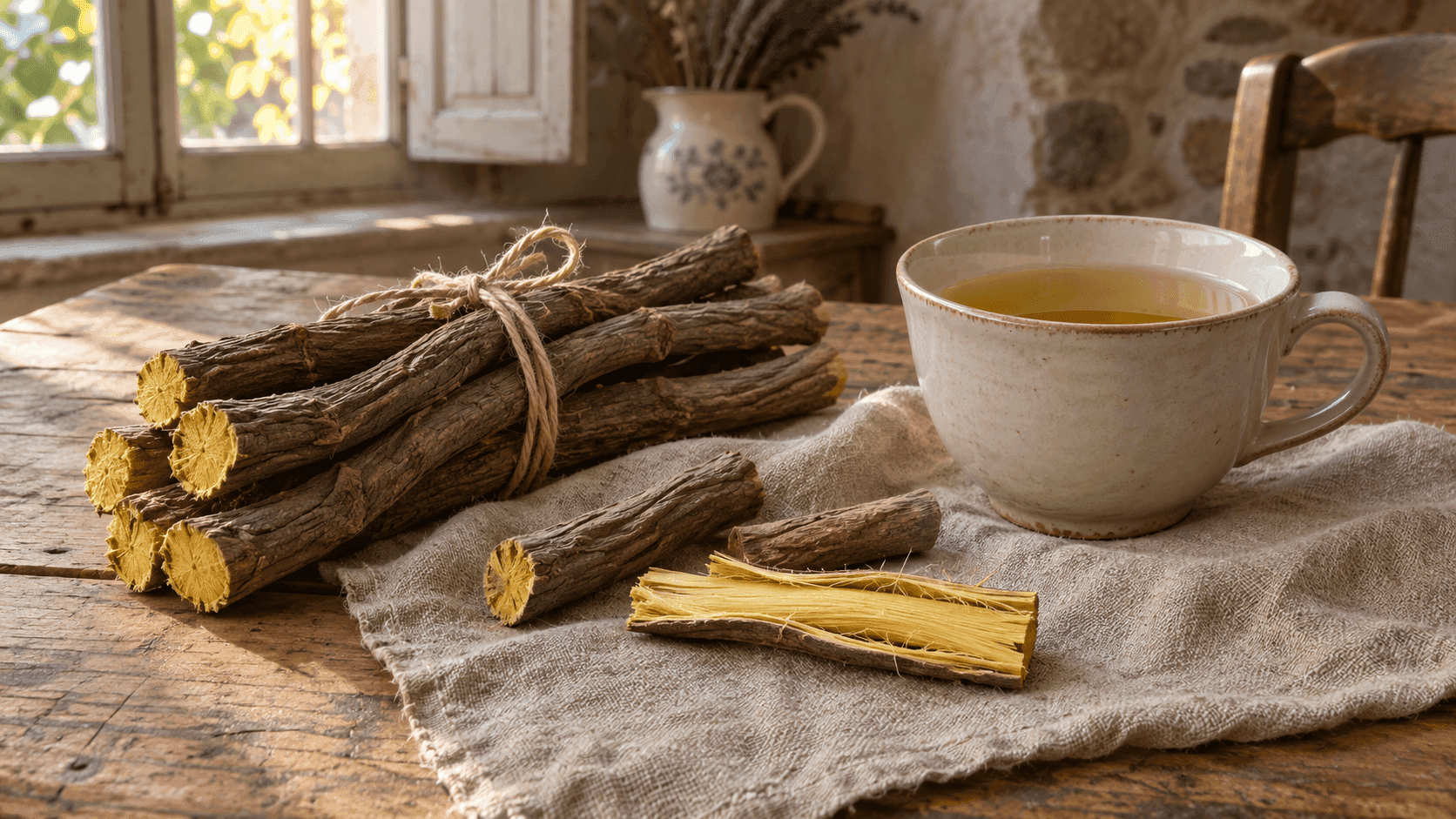
Part used: the root, or rather the root and its underground stems, dried.
Liquorice is a big perennial plant, not a tree, and its root is very sweet. It's what gives its flavour to the sticks we chew, to black sweets and to some aniseed drinks. Me, I drink it as a tea, now and then after a heavy meal, and never more than four weeks.
Her story
Liquorice is a big perennial plant from the pea family, and its root is very sweet. With that root, people make sticks to chew, teas, and the black juice that gives sweets their flavour. I always keep a box of cut root in my cupboard, but I use it very little, and you'll soon see why.
What is liquorice: a plant, not a tree
Its proper name is Glycyrrhiza glabra. It belongs to the Fabaceae family, like peas and beans. In French it's also called réglisse glabre, and in the old days bois doux, bois sucré (sweet wood), racine douce (sweet root) or régalisse.
People often ask me if liquorice is a tree. No: it's a big plant that comes back from its crown every year and grows 1 to 1.5 m tall. Its leaves are long, cut into 9 to 17 small leaflets. In spring, it makes small blue-violet flowers in clusters, then flat pods 2 to 3 cm long, like little beans. But what matters is underground: a long root, and stems that run under the soil and come up a bit further on.
The name comes from the Greek glykyrrhiza, the "sweet root". The Latin speakers made it liquiritia, and we French made it réglisse. It even had its own day in the French Republican calendar: 9 Fructidor, towards the end of August.
Where does liquorice grow? It comes from south-eastern Europe and reaches as far as Central Asia. Wild liquorice grows around the Mediterranean, and in Calabria, on the Ionian coast, it has been gathered since Antiquity where it grows on its own. The old books say it was grown in Italy, Spain and the south of France; today, Turkey, Greece, Iran and Iraq produce it too.
In the garden, it wants full sun, rich, cool soil that drains well, and room for its roots. Be careful: once it's settled, it spreads, and the smallest bit of root left in the ground grows a new plant. You need patience too: the roots are dug up in autumn, from the third year on, then washed and dried.
Where the liquorice stick comes from: a bit of history
Liquorice has been known for a long time. The Greeks and the Romans already knew it, and in the Middle Ages, so did Saint Hildegard.
Here, the simplest way to take it was the stick. You pulled up the root, washed it, dried it, and chewed on it. In Italy, Spain and France, people still do. My mother used to buy me some at the chemist's counter, little brown sticks, and I chewed them until the end turned into a little brush.
There was also coco. In Paris, this liquorice drink was sold in the street, very cheap, and you could also find it as a powder. And in hospitals, in the old days, the ordinary tea, the one on the bedside table, was liquorice with barley and couch grass.
Liquorice sweets: from the zan of Uzès to the mistral gagnant
How are liquorice sweets made? It all starts with the root. It's boiled several times in water, then the water is evaporated: what's left is liquorice extract, a shiny black paste. If you only evaporate half of it, you get liquorice juice, a dark brown liquid.
For sweets, that extract is mixed with sugar and something to bind it: starch, flour, gum arabic or gelatine. It's heated, poured into moulds pressed into starch, left to dry, and a thin coat of beeswax makes it shine. The flavour is often strengthened with anise oil, so there's less liquorice than you'd think. But it's still liquorice, and it's precisely with sweets and drinks that trouble comes most often.
The old-fashioned liquorice sweets, I've known almost all of them. Zan, the little black sweet to crunch or suck, made with liquorice extract, comes from Uzès, in the Gard, where the company was born in 1862. Carensac, little coloured sugar-coated sweets with a liquorice heart, was made from 1866 in Brignon, in a factory people called "La Réglisserie" (the liquorice works). Coco Boer, named after the powdered coco, disappeared in the 1970s, but everyone remembers it thanks to a song by Renaud, Mistral gagnant. And the mistral gagnant itself was a sweet-and-sour powder you sucked up through a liquorice straw.
And Uzès has stayed a liquorice town. In 1987, Carensac production moved there, to Pont des Charrettes, into the liquorice works that used to make zan. Today there's a sweet museum there.
The benefits of liquorice, and its dangers
I'll tell you things as they are. The serious books recognise two uses for liquorice root, as a tea, and not one more. The first: a cup after a meal, when your stomach burns or digestion feels heavy (for meals that sit on your stomach, I have other little habits for slow digestion). The second: a cup when a cold makes you cough, to help bring things up.
What people say at the market, about the skin for example, the books say nothing about it, so neither do I.
And then there are the dangers, and with liquorice, they're very real. Taken for too long or in too large amounts, it makes you hold water, it lowers the potassium in your blood and raises your blood pressure, and your heart can start beating out of rhythm. It can happen without you feeling a thing, or with headaches, cramps, aching muscles.
The trap is that it's everywhere: in pastis, even alcohol-free, in syrups, in sweets, in some shop-bought teas. In France, more than a hundred cases of this kind of trouble have been recorded, most of them after lots of liquorice drinks and sweets, day after day. So me, I never pile them up: the day I drink my cup, no sweets, no pastis.
"Liquorice is sweet and looks like nothing at all: that's exactly why you have to count it."
The pharmacy books keep these teas for short spells: never more than 4 weeks. They do give an amount, but a single cup like theirs already brings far more than the benchmark we're advised here in France not to go over each day. So I won't give you a measure for a home-made tea: if you want to drink it for a few days, ask your pharmacist how much. Me, it's a cup now and then, after a feast, and that's all. On other days, I have fennel after the meal, and for the cough that comes with a cold, my thyme, which I introduce on its own page: you'll find both recipes further down. No liquorice tea before 18, and no liquorice at all, in any form, if you're pregnant, breastfeeding or have high blood pressure: it's all explained further down, in what to know first.
Liquorice, lemon balm, anise: don't mix them up
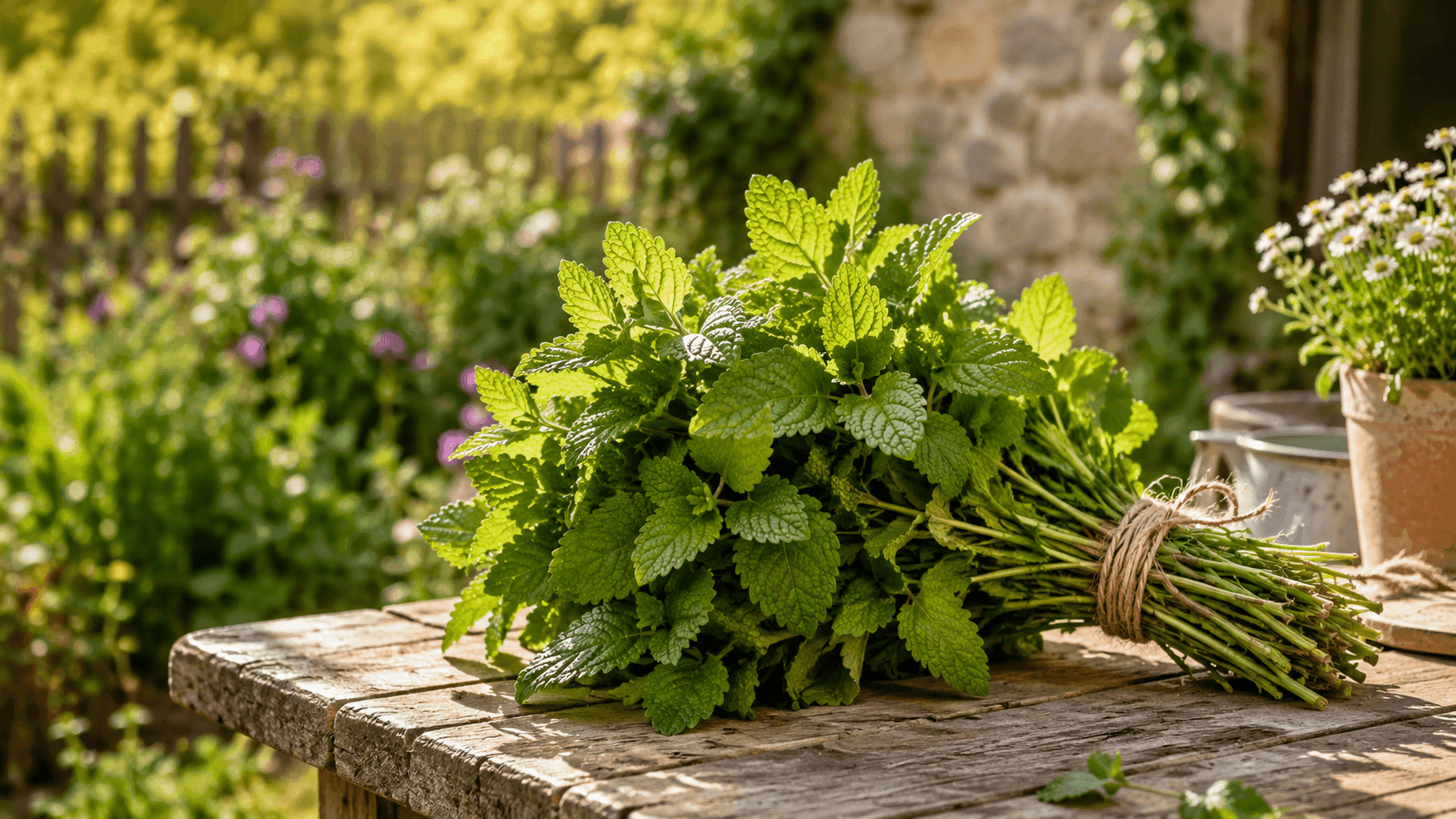
People sometimes ask me the difference between lemon balm and liquorice (in French, mélisse and réglisse almost rhyme). Apart from that, they have nothing in common! Lemon balm is a leaf that smells of lemon, from the mint family; liquorice is a sweet root, from the pea family. I introduce my lemon balm on its own page.
With anise, it's easier to get confused, because the tastes are alike. Green anise, Pimpinella anisum, is a small plant from the same family as fennel, and we keep its seeds. That aniseed taste is the one you find in the fennel from my vegetable patch, and it's often added to "liquorice" sweets. And aniseed drinks like pastis often contain real liquorice: one more reason to count.
What I use her for
- · 01After a feast, when my stomach burns: a cup of root simmered for 15 minutes, now and then, never more than 4 weeks; my pharmacist tells me how much.
- · 02When a cold makes me cough, the books give it as a tea too, for a few days; I'd rather have my thyme, and if the cough lasts more than a week, I go and see the doctor.
- · 03A stick to chew, now and then, like when I was little: that counts in the day's liquorice too.
- · 04A liquorice sweet for the pleasure of it, but never on the same day as my cup.
How I prepare her
Granny’s little recipes
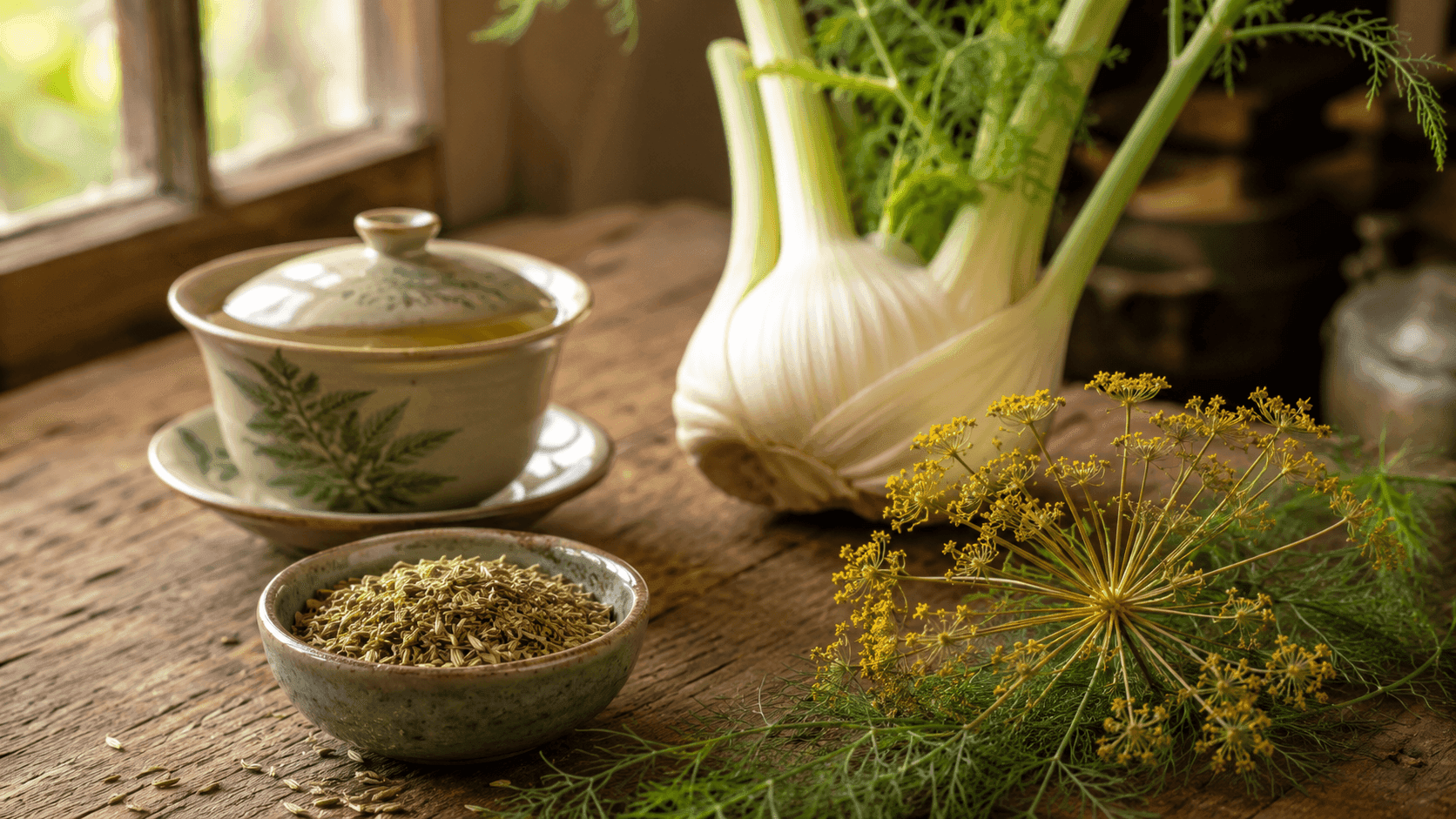
Without liquorice: fennel tea after a meal that bloats you
After lunch or dinner, when your tummy bloats and pulls
What you’ll need
- 1.5 g of dried fennel seeds (weigh them the first time, after that you'll know by eye)
- 250 ml of water, a big bowl
How I go about it
- 01Bring the water to the boil.
- 02Put the seeds in the bottom of the bowl and pour the boiling water over them.
- 03Set a saucer on top and leave to steep for 15 minutes.
- 04Strain it and drink it hot, nice and slowly.
- 05Up to three bowls a day, no more than two weeks in a row, and only from age 12.
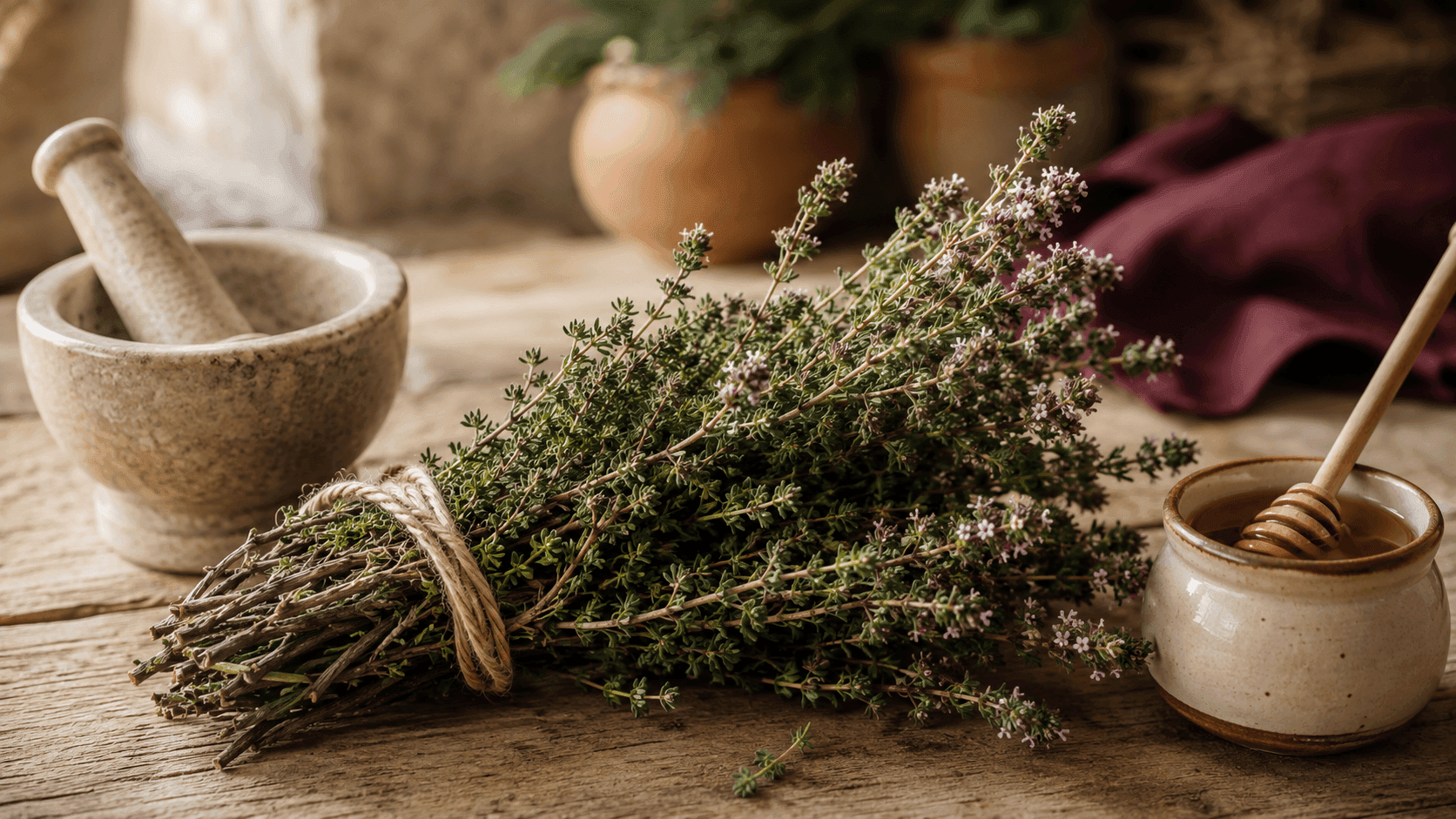
Without liquorice: the cup of thyme with honey when a cold makes you cough
In the evening, when a cold gives you a chesty cough and your throat is scratchy
What you’ll need
- 1 to 2 g of dried thyme
- 150 ml of water
- 1 teaspoon of honey
How I go about it
- 01Bring the water to a boil.
- 02Put the thyme in your cup and pour the boiling water over it.
- 03Cover with a saucer and let it steep 10 minutes.
- 04Strain, wait a few minutes until the cup is hot but not scalding, then add the honey.
- 05Sip it slowly. Three or four cups through the day, for a week at most, and not before age 12.
Elsewhere: how others know her
Fatima, my friend from Marrakech, taught me the Arabic name for liquorice: ʿirq sūs (عرق سوس). She told me that in Egypt and the Levant, it's also the name of a drink. The dried root is left to soak overnight with a little bicarbonate, simmered for twenty to thirty minutes in water, strained, and drunk iced, especially during Ramadan. I told her it was very nice, but that it counted in the day's liquorice too. She laughed and said I'd never change.
My childhood friend, the one who went to live in England, once had me taste Pontefract cakes: little black liquorice lozenges, about the size of a coin, stamped with a castle. They come from Pontefract, in Yorkshire. There, liquorice was grown in the gardens behind the houses, and that's where, in the eighteenth century, people started sweetening it to make sweets like today's.
Me, what I like is simpler: a piece of root simmering in the little pan after a festive meal, and that sweet smell in the kitchen. One cup, and that's all for the day.
What to know first
This information doesn’t replace advice from a healthcare professional. Health Disclaimer →
Her identity card
- Name
- Liquorice
- Other names
- Réglisse glabre, sweet wood, sweet root
- Latin name
- Glycyrrhiza glabra L.
- Family
- Pea family (Fabaceae)
- Part used
- The root and its underground stems
- Harvest
- In autumn, from the third year on
- Form
- Cut root as a decoction, sticks to chew
- Origin
- From south-eastern Europe to Central Asia
- Storage
- Dry, in a closed box, away from light and damp
If you remember just one thing
- 01Liquorice is a plant, not a tree: a big perennial from the pea family, and what we keep is its root, which is very sweet.
- 02A liquorice sweet is the root's juice boiled down into a black paste, with sugar: it's real liquorice, and it counts.
- 03The books recognise two uses for it as a tea: a cup after a meal when your stomach burns, and a cup when a cold makes you cough.
- 04Never more than 4 weeks, no tea before 18, and no liquorice at all, in any form, if you're pregnant, breastfeeding, have high blood pressure, or a fragile heart, kidneys or liver.
- 05Liquorice is sweet and looks like nothing at all: that's exactly why you have to count it, and never pile up pastis, sweets and tea.
Your questions
It's a plant, not a tree: a big perennial from the pea family, which comes back from its crown every year and grows 1 to 1.5 m tall. In spring, it makes small blue-violet flowers in clusters. What we keep is its root, long and very sweet.
The books recognise two uses for it as a tea: after a meal, when your stomach burns or digestion feels heavy, and when a cold makes you cough. The danger is taking too much or for too long: it makes you hold water, lowers your potassium and raises your blood pressure, and your heart can start beating out of rhythm. So now and then, 4 weeks at most, no tea before 18, and no liquorice at all, in any form, if you're pregnant, breastfeeding, have high blood pressure, or a fragile heart, kidneys or liver.
The trouble seen in France comes mostly from large amounts of liquorice sweets or drinks, swallowed day after day: blood pressure goes up and potassium goes down. So you don't make a habit of them, you don't add them on top of pastis or the tea, and children, who are more sensitive to it, don't eat them every day. If you're pregnant, breastfeeding, or have high blood pressure or a fragile heart, you go without them altogether.
The plant is always « la réglisse ». For the stick, the juice or the sweet, the dictionaries accept both: « du réglisse » as well as « de la réglisse ». Me, I've always said « la ».
They're two different plants. Green anise is a small plant from the fennel family, and we keep its seeds; liquorice is from the pea family, and we keep its root. Their tastes are so alike that "liquorice" sweets are often strengthened with anise, and aniseed drinks like pastis often contain real liquorice.
It's ʿirq sūs (عرق سوس), often pronounced "erk sous". It's also the name of a liquorice root drink people take iced in Egypt and the Levant, especially during Ramadan. And that drink is liquorice too: it counts in your day.
References
- European Union herbal monograph on Glycyrrhiza glabra L.; Glycyrrhiza inflata Bat.; Glycyrrhiza uralensis Fisch., radix, Revision 1 (EMA/HMPC/108399/2024) · European Medicines Agency (HMPC), 2026
- Glossary on herbal teas (EMA/HMPC/5829/2010 Rev.1) · European Medicines Agency (HMPC)
- Réglisse : attention à la surconsommation pour éviter les risques d’hypertension · Anses, 2025
- Consommation de réglisse : quels sont les risques ? · Anses, 2025
- Glycyrrhiza glabra L. · Plants of the World Online, Royal Botanic Gardens, Kew, 2026
- Réglisse (TLFi) · CNRTL, 2026
- Réglisse · Wikipédia, 2026
- Liquorice · Wikipedia, 2026
- Liquorice (confectionery) · Wikipedia, 2026
- Pontefract cake · Wikipedia, 2026
- Erq sous · Wikipedia, 2026
- Uzès · Wikipédia, 2026
- Réglisse sauvage · Wikipédia, 2026
- Anis vert · Wikipédia, 2026
- La plante de la semaine : la réglisse chez vous · Futura, 2026
- Réglisse et risque d'HTA : l'Anses émet des recommandations pour les professionnels de santé · VIDAL, 2025
- Réglisse : à consommer occasionnellement et avec modération · Ordre national des pharmaciens, 2023
- Assessment report on Glycyrrhiza glabra L. and/or Glycyrrhiza inflata Bat. and/or Glycyrrhiza uralensis Fisch., radix · European Medicines Agency (HMPC)