Soothe your travel sickness
For travel sickness, a good seat, your eyes on the horizon, a light meal and a little powdered ginger before you leave. And when to see your doctor.
Reviewed by Ruosi Wu, PhD in Pharmacy, MD in Traditional Chinese Medicine
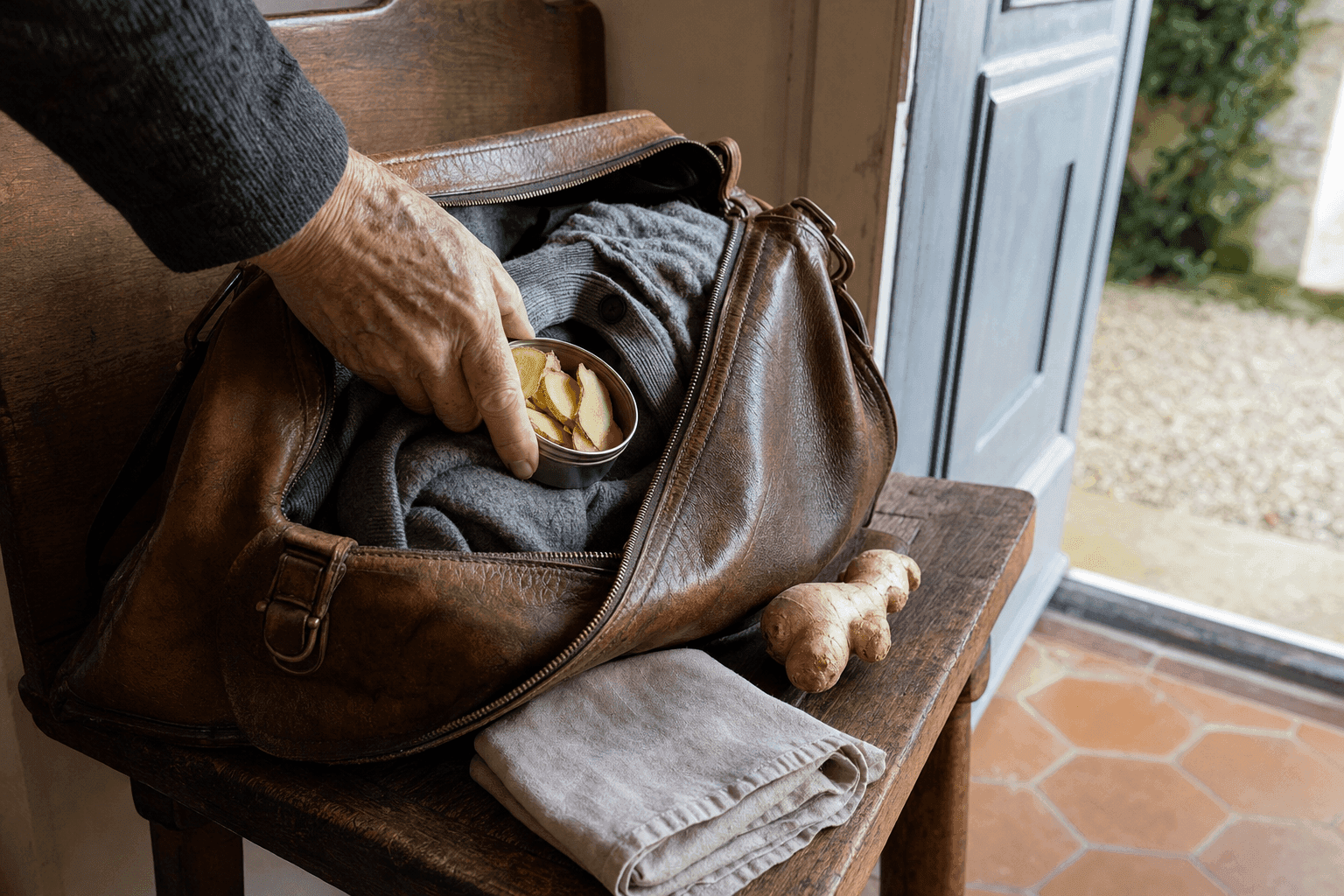
For travel sickness, pick a seat where there’s little movement, keep your eyes on the horizon and eat light before you leave, without setting off on an empty stomach. My old-fashioned remedy is a little powdered ginger half an hour before the road. If you’re sick on almost every trip, or if there’s fever or dizziness, go and see your doctor.
Key takeaways
- Travel sickness comes from a misunderstanding: the eyes see movement, the inner ear feels the body sitting still, and the brain gets muddled.
- For travel sickness, your seat matters: up front in the car, over the wings on a plane, in the middle of the boat, and your gaze on the horizon.
- Before you leave, eat light without setting off on an empty stomach, and leave aside fatty food, spicy food, alcohol and cigarettes.
- My old-fashioned remedy is powdered ginger half an hour before departure: 500 to 750 mg from age 12, 250 to 500 mg from 6 to 12, nothing before 6.
- Sick on almost every trip, nausea before you even get in, fever or dizziness: that’s something to show a doctor.
Granny’s little steps
- Eyes on the horizon, head propped
Look far ahead, outside, and prop your head against the headrest or a little cushion. No book or screen during the trip.
- Take the seat that moves the least
Up front in the car, or at the wheel. At the front of the coach, facing forward by the window on the train, over the wings on a plane, and in the middle of the boat, close to the water.
- Eat light, but not on an empty stomach
Before you leave, a small, simple meal: hunger doesn’t help. No fatty food, nothing spicy, no big meal, no alcohol or cigarettes before or during the trip.
- Fresh air and breaks
Let air in, don’t let the car turn into an oven, and stop to walk a little on long trips. Breathing calmly or listening to music helps too.
- As soon as your stomach turns
Close your eyes for a moment, open the window, get out and take a few steps or go up on deck. Then lie down for a few minutes with a cool, damp cloth on your forehead.
A recipe to try
The little ginger compote before you leave
Half an hour before you hit the road or board the boat
What you’ll need
- 500 to 750 mg of powdered ginger from age 12, roughly a third of a level teaspoon
- Between 6 and 12: 250 to 500 mg, roughly a quarter of a level teaspoon (no ginger before age 6)
- 1 small pot of apple compote (about 100 g)
How I go about it
- Half an hour before you leave, tip the compote into a bowl.
- Add the powdered ginger and mix well, until there are no more lumps.
- Eat it slowly, sitting down, without rushing: it also counts as a light little meal before the road.
- If the trip lasts more than four hours, you can take the same dose again every four hours, without going over 2.5 g in the day (1.5 g between 6 and 12).
For travel sickness, I start with the simplest things: a good seat, your gaze on the horizon, a light meal before you leave, and a little powdered ginger half an hour before the road. I’ll tell you where it comes from, and the point where it stops being my department.
Why we get travel sickness
Travel sickness comes from a misunderstanding in your head. Your eyes see the bends going by, and meanwhile your inner ear, the one that keeps your balance, feels your body sitting there nice and still. The brain gets two messages that don’t go together, and it gets muddled.
It often starts with discomfort at the top of your belly, then queasiness. After that come paleness, cold sweats, a mouth filling with saliva, sometimes vomiting, dizziness, headache and tiredness. In little ones, it shows differently: they won’t eat anymore, they cry, they get restless or they yawn.
The boat is the worst of all, then the plane, the car, the coach and the train. And the more the road twists, climbs and drops, the harder it is. Children aged 2 to 12 get it very often, then it calms down in the teenage years. In grown-ups, it’s more often women, especially during their period or pregnancy, and people who get migraines.
The good news is that it usually stops a few minutes after you get out. And it eases off when you often make the same trips, or after two or three days on a long journey.
My grandson, when he was little, turned green at the third bend, and he knew it before he even got in. That’s how it is: once you’ve been sick, you dread the next trip, and it can come back stronger, sometimes before you’ve even left.
My old-fashioned remedy for travel sickness: ginger
For the road, my books give only one plant: ginger. Not as an evening tea: as a powder, half an hour before you leave. It’s a traditional use, nothing more, and I don’t promise you’ll arrive fresh as a daisy.
The measure, from age 12: 500 to 750 mg of powdered ginger, half an hour before departure. In the spoon, that’s roughly a third of a level teaspoon. If the trip lasts more than four hours, you can take more every four hours, without going over 2.5 g in the day. Between 6 and 12, the dose is smaller: 250 to 500 mg (roughly a quarter of a level teaspoon), and no more than 1.5 g in the day. Before 6, you don’t give any.
Me, I mix it into a little apple compote, I give you the recipe below. The books say it doesn’t get in the way of driving, which matters when you’re the one at the wheel. During pregnancy and breastfeeding, on the other hand, you go without. I tell you everything I know about ginger over here.
And my cup of fresh ginger with lemon? I drink it in winter, for the warmth and the taste. For the road, the books count in powder, so I stick with powder: at least I know what I’m taking.
People often ask me about peppermint. My books give its leaf for digestion that drags and a gassy belly, not for travel sickness. So I keep it for when I arrive, after a meal that sits heavy, like the days when digestion is hard going. I tell you about peppermint there.
“Ginger half an hour before, eyes on the horizon, and a window open a crack. The rest, the road decides.”
By car, by boat, by plane: my steps against travel sickness
Before you leave, eat light, but don’t set off on an empty stomach: being hungry doesn’t help. No fatty or spicy dishes, no big meal just before, no alcohol, no cigarettes. Hit the road when there isn’t too much traffic: sudden braking and accelerating make you queasy. And if you can avoid the road with a thousand bends, avoid it.
On the way, your seat matters. In the car, sit up front, or take the wheel if you can. On the coach, at the front. On the train, facing the direction of travel, by the window. On a boat, a cabin in the middle, close to the waterline, and up on deck whenever the weather allows.
For travel sickness on a plane, take a seat in the middle of the plane, over the wings, where it moves the least, and turn the little air vent toward your face. On a short flight in a small plane, it’s better not to eat or drink anything.
Next, your gaze on the horizon, outside, and your head propped against the headrest or a little cushion. No book, no screen. Breathe calmly, put some music on, let air in, and don’t let the car turn into an oven. On a long trip, you stop to walk a little.
With the children, I always did the same: frequent stops, a seat high enough for them to see outside, and leaving at nap time, because they’re less sick when they’re asleep. Once they’re awake, we tell stories and sing.
If the queasiness comes anyway, close your eyes for a moment, open the window, and as soon as you can, get out and take a few steps, or go up on deck. Lie down for a few minutes with a cool, damp cloth on your forehead. A few salty crackers, or a fizzy ginger drink in little sips, can help with nausea. And if you vomit, drink sweet or salty drinks so you don’t dry out, especially children and older people.
If dread ties you in knots before you’ve even left, that counts too: fear and worry make travel sickness more frequent. I have other steps for frayed nerves. And if all that isn’t enough, ask your pharmacist for advice before the trip: they’ll tell you what suits your age.
Travel sickness that lasts, or that isn’t like usual
After a boat crossing, you sometimes feel like you’re still rocking once you’re back on land. That’s called land sickness. It can last a few hours, sometimes a few days. If you feel like you’re still on a boat when you get back from a cruise, that may be it.
But dizziness that lasts for hours or keeps coming back, a headache, ringing ears, fever, or queasiness that comes with no car or boat in sight, that’s not my department anymore. Same if you’re sick on almost every trip, or if the nausea starts before you even get in. That’s your doctor’s job. I’ve put the list just below, sign by sign.
Which plants?
GingerZingiber officinale
Ginger is the hot, peppery rhizome of a tall Asian plant. At my place, it goes in the cup with lemon, into dishes grated at the last minute, and into the gingerbread.
What to know first
Ginger, the measure: from age 12, 500 to 750 mg of powder half an hour before you leave; if the trip lasts more than four hours, one more dose every four hours, without going over 2.5 g in the day. Between 6 and 12, 250 to 500 mg, and no more than 1.5 g in the day. Not before 6. If it gets worse on the way, see your doctor.
Ginger, pregnancy and breastfeeding: as a precaution, the books prefer that you avoid ginger taken as a remedy during pregnancy, and they don’t advise it while breastfeeding, for lack of data. These warnings are about ginger on top of what’s in your meals. For pregnancy nausea, ask your doctor or your midwife.
Ginger, what it can do: it sometimes upsets the stomach, gives burps, heartburn or nausea. If it does that to you, don’t keep at it. If you’re allergic to it, go without. The books don’t list any interaction, but a few people on anticoagulants who were taking a lot of it bled more than they should have: if you’re on a treatment to thin your blood, ask your doctor first. Some leaflets also ask you to see your doctor if you have gallstones.
Medicines for travel sickness: always ask your pharmacist for advice. Some aren’t given before age 2, others not before 6, and for a child who’s vomiting, certain products are not allowed before 12 or 18. Don’t combine several, and don’t keep going on your own if it lasts after the trip. They can lower your alertness and make you sleepy: no alcohol with them, and no driving.
Still about these medicines: you don’t take them if you have glaucoma or a urinary problem linked to the prostate. During pregnancy and breastfeeding, in older people or if you tend to get constipated, it’s only on a doctor’s advice.
Peppermint essential oil: never before age 2, never on a little one’s face, especially around the nose. No drop on a sugar cube: you don’t swallow it neat, by mouth only pharmacy preparations made for that, with their leaflet. Not during pregnancy or breastfeeding.
If you vomit, drink sweet or salty drinks so you don’t get dehydrated. Young children and older people get dehydrated faster: make sure they drink enough.
When to see your doctor
- Travel sickness that doesn’t give in to the right steps or to what the pharmacist suggested: make an appointment with your regular doctor.
- Getting sick almost every time you get in a car, you or your child: make an appointment with your regular doctor.
- Travel sickness that really bothers you a lot: talk to your regular doctor about it.
- Nausea that starts before you even get into the vehicle: talk to your regular doctor about it.
- Fever with travel sickness: see your doctor.
- Dizziness, or signs that aren’t like your usual travel sickness: see your doctor.
- Dizziness with a headache, ringing in the ears, hearing that gets worse, heavy vomiting or confusion: see a doctor the same day.
- Dizziness that lasts several hours or keeps coming back, even once you’ve arrived: see a doctor in the next few days.
- Dizziness after a knock on the head, within the last 48 hours: call 15 or 112 (the emergency numbers in France) right away.
- Suddenly, an arm or a leg that goes weak or numb, or a face that goes numb or droops: call 15 or 112 right away, it may be a stroke.
- Suddenly, trouble speaking, finding your words or understanding what’s said to you: call 15 or 112 right away.
- A sudden loss of balance, as if you’d been drinking: call 15 or 112 right away.
- A sudden, intense, unusual headache: call 15 or 112 right away.
- Your vision blurring or going double, even for a moment, or one eye that can’t see anymore: call 15 or 112 right away.
- A child who vomits nonstop and stops drinking, or who no longer eats or drinks anything: see a doctor without delay or go to the emergency room.
- A little one who vomits and becomes very floppy, sleeps a lot, is hard to wake, has sunken eyes or a dry tongue: see a doctor immediately.
Your questions
How do you make travel sickness pass?
As soon as it starts, close your eyes for a moment and open the window. If you can, get out and take a few steps, or go up on the deck of the boat, then lie down for a few minutes with a cool, damp cloth on your forehead. Usually, it passes a few minutes after you get out.
What’s a grandma’s remedy for travel sickness?
Powdered ginger, half an hour before you leave: 500 to 750 mg from age 12, roughly a third of a level teaspoon. Between 6 and 12, 250 to 500 mg, and nothing before 6. Along with that, a seat up front and your eyes on the horizon.
What should I drink when I feel sick while travelling?
A fizzy ginger drink in little sips, or a few salty crackers, can help with nausea. If you’ve thrown up, drink sweet or salty drinks so you don’t dry out. And no alcohol: it makes nausea worse.
Why put a sticking plaster on your belly button?
It’s an old trick people keep passing on, but I found nothing in my books to explain it. As for the bands that press on your wrist, the books say it hasn’t been proven, even if some people find them useful. Me, I count first on the right seat and the horizon.
Is it normal for travel sickness to last after the trip?
After a boat, you can feel like you’re still rocking on land for a few hours, sometimes a few days: that’s land sickness. But if the dizziness lasts for hours or keeps coming back, go and see your doctor in the next few days. With a headache, ringing ears or heavy vomiting, it’s the same day.
What can I do if my child gets travel sickness?
Stop often, adjust their seat so they can see outside, and leave at nap time: asleep, they get less sick. Ginger, not before 6, then 250 to 500 mg half an hour before leaving, up to age 12. If they vomit nonstop and can’t drink anymore, go and see a doctor without waiting.
Also worth reading
- The LetterWhat ginger is good for, and my cup for the cold daysGinger, that rhizome that tingles on your tongue, comes out as soon as the first cold days arrive. I'll tell you where it comes from, what my books say about it, my lemon cup, and what to know first.
- The LetterMy holiday plant kit: let me show you what I take with mePacking your suitcase? Let me show you my natural first-aid kit: ginger for the road, peppermint and chamomile for when you get there, and what I leave at home.
References
- Mal des transports : symptômes et causes · ameli.fr, 2025
- Malade en voiture, en car, en bateau... : que faire contre le mal des transports ? · ameli.fr, 2025
- Diarrhée et gastro-entérite de l'enfant : que faire et quand consulter ? · ameli.fr, 2025
- Vertiges · Santé.fr, Service Public d'Information en Santé, 2026
- Mal des transports · Manuel MSD, version pour le grand public, 2025
- European Union herbal monograph on Zingiber officinale Roscoe, rhizoma, Revision 1 (EMA/HMPC/885789/2022) · European Medicines Agency, HMPC, 2025
- Assessment report on Zingiber officinale Roscoe, rhizoma, Revision 1 (EMA/HMPC/765220/2022) · European Medicines Agency, HMPC, 2025
- European Union herbal monograph on Mentha x piperita L., folium, Revision 1 (EMA/HMPC/572705/2014) · European Medicines Agency, HMPC, 2020
- European Union herbal monograph on Mentha x piperita L., aetheroleum, Revision 1 (EMA/HMPC/522410/2013) · European Medicines Agency, HMPC, 2020
- Spices, ground, ginger · NutritionValue.org (données USDA)
Information. This information is provided for general knowledge and doesn’t replace medical advice. Check with a healthcare professional before any use.
Health Disclaimer