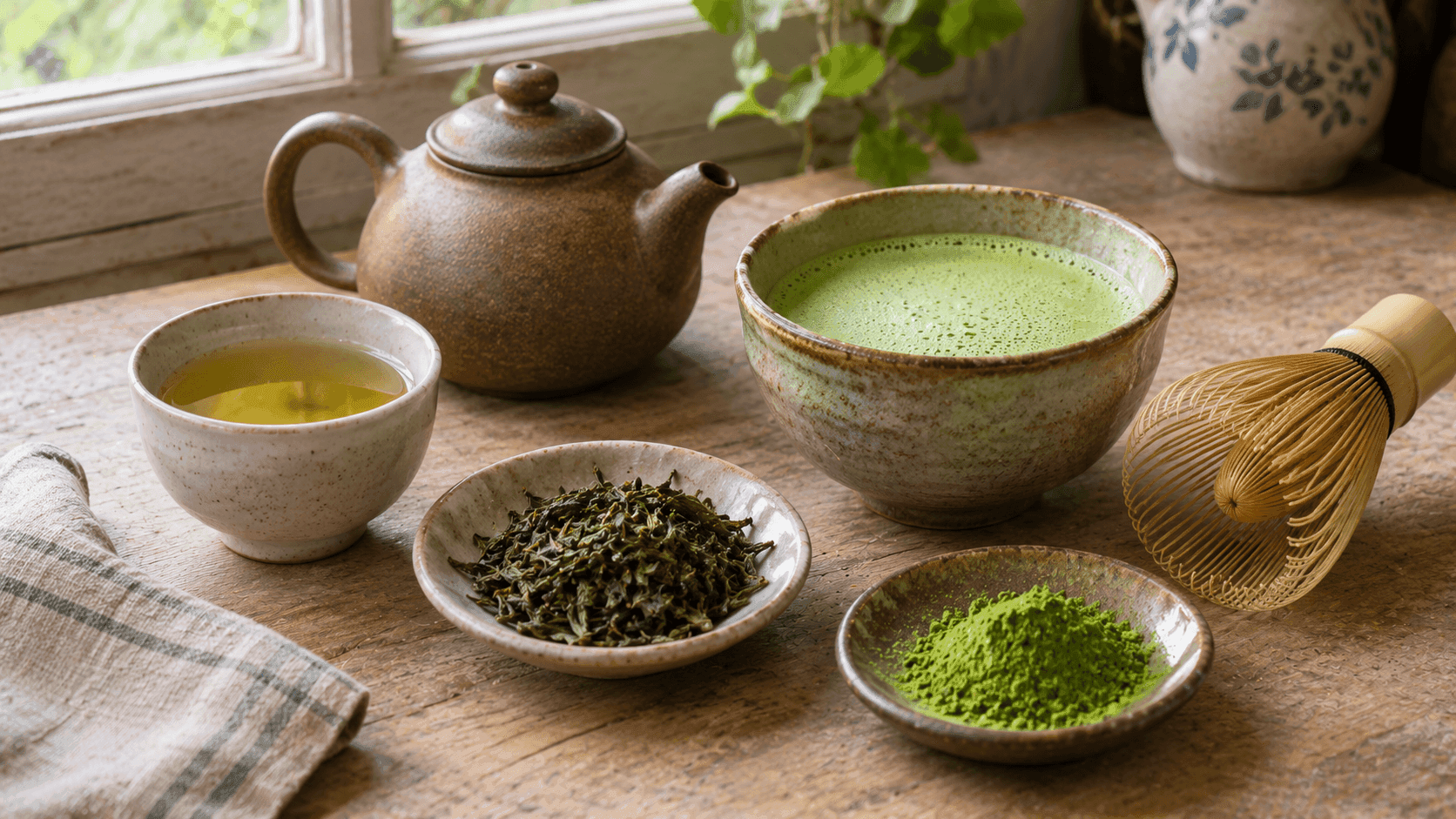
Green tea is the leaves of the tea plant, heated straight away so they stay green. I drink it in the afternoon, water at 70 to 80 °C, and on Sundays as a matcha latte. It has caffeine.
Who he really is
Family: Tea family (Theaceae). The tea plant comes from the Far East, from the eastern Himalayas to southern China. Green tea is drunk above all in China and Japan.
Part used: the young leaves, heated and then dried, or ground into powder for matcha.
Green tea is tea from the tea plant whose leaves haven't been left to oxidise: they're heated right after picking, then rolled and dried. It contains caffeine, like all tea. I drink it in the afternoon, never in the evening, and no more than three cups in a day.
His story
Green tea is the leaves of the tea plant, heated right after picking so they stay green, then rolled and dried. It's the same shrub as black tea, but its leaves aren't left to oxidise. I drink a cup or two in the afternoon, never in the evening, and on Sundays I make myself a matcha latte.
Green tea: what kind of plant is it?
Its learned name is Camellia sinensis. It's a shrub from the Far East, of the tea family (Theaceae), a close cousin of the camellias in our gardens. Its long leaves stay on the branches all year round, and its white flowers have a whole little bunch of yellow stamens in the middle.
Green tea, black tea: it's the same shrub. Everything happens after picking. For black tea, the leaves are left to wilt and oxidise, a bit like a cut apple turning brown. For green tea, they're heated straight away to stop that: with steam in Japan, in a copper pan or a wok over the fire in China. Then the leaves are rolled and dried. That's why it stays green.
And what about theine? Theine and caffeine are the same thing, one single molecule under two names. Tea contains it, like coffee, but usually less per cup. A chamomile or peppermint tisane has no tea leaves in it, and no caffeine. That's the whole difference between tea and a tisane.
Where green tea comes from: from China to my teapot
Green tea was born in China, more than two thousand years ago. It reached us on the ships of the Dutch East India Company, around 1610, and just imagine: the first tea ever drunk in Europe was green tea.
There are dozens of Chinese green teas. The best known is probably Long Jing, the "dragon well". There's also Bi Luo Chun, the "green spiral of spring", and gunpowder, which owes its English name to its leaves rolled into little balls. That's the one Fatima, my friend in Marrakech, puts in her tea, with a big bunch of spearmint and plenty of sugar. I told you about her trays of mint tea in a letter.
In Japan, everyday tea is sencha: on its own, it makes up three quarters of the country's production. There's also genmaicha, mixed with toasted rice grains, and hojicha, whose leaves are roasted and turn brown. Over there, tea is picked four times a year, from mid-April to the end of September, and the first harvest, in April and May, is the most sought after. And then there's matcha. I'm coming to that.
Green tea benefits: the good and the not so good, without overdoing it
People often ask me what the benefits of green tea are. I'll tell you how it is. The old European manuals put green tea leaf among the cups people took when they felt tired, with no get-up-and-go. It's the caffeine that wakes you up, there's no mystery to it. As for the rest, the skin, the lungs, the liver that it would supposedly "clean": I've heard it all at the market, and I'm not promising you anything.
As for the downsides, there are some, and it's better to know them. The first is caffeine: too many cups, and you get jittery, you shake; in the evening, it keeps sleep away. The second is iron: drunk with a meal, tea gets in the way of the iron from your food, and an hour after the meal, it gets in the way much less.
And then there's the question I'm asked more and more: is green tea bad for the liver? Drunk by the cup, the way it's always been drunk, green tea is generally considered safe; a few cases of liver damage have been reported, but they're rare. The real worry is food supplements concentrated in green tea extract. At high doses, some people showed early signs of liver trouble. Since 2022, in Europe, these supplements are regulated and carry warnings: I've put them further down, in what to know first.
"Green tea in a cup is a drink. Concentrated extract is a whole other story."
Matcha, and my Sunday matcha latte
Matcha is a Japanese green tea ground into a very fine powder. Two to three weeks before picking, the tea bushes are covered to shield them from the sun. That gives leaves called tencha, which are ground between two stone millstones. A stone mill grinds only 40 g an hour: you can see why good matcha isn't cheap.
Powdered tea was already drunk in China under the Song dynasty, nearly a thousand years ago. It was Zen monks who carried it to Japan; they say the monk Eisai brought powdered tea there in 1191. In Japanese, "cha" means tea, and "ma" means powder.
With matcha, you're not drinking an infusion: you swallow the whole leaf, suspended in the water. So I choose it carefully, because whatever is on the leaf, you swallow too.
A matcha latte is matcha whisked with a little hot water, with frothy milk on top. It tastes of tea softened by the milk, with a little bitterness at the bottom that I rather like. The secret is to sift the powder and whisk briskly in "W" shapes: that's why you froth matcha, otherwise it stays lumpy. My matcha latte recipe is further down, with its cold version for summer. And remember it's a cup of tea, caffeine and all: I count it in my day, and I don't give it to little ones.
How to make green tea, and how many cups a day
Green tea is delicate: no boiling water, water at 70 to 80 °C. For a 150 ml cup, I put in a heaped teaspoon of leaves, about 2 g. I let it steep 1 to 3 minutes for a Japanese tea, 2 to 4 minutes for a Chinese tea. The longer it steeps, the harsher it gets: for a cup that's too bitter, I wrote down my little tricks. Good teas can take three or four infusions with the same leaves, and most of the caffeine goes into the first.
What's the best time of day to drink green tea? Not before bed, at any rate, because it can disturb your sleep. I have mine in the afternoon, and in the evening I switch to my lemon balm, my evening cup. If your nights are hard, I'll tell you what I do to sleep well. And first thing in the morning on an empty stomach? For a cup of tea, the books say nothing in particular; it's for concentrated supplements that they say "never on an empty stomach". If you're short of iron, save your cup for an hour after the meal.
How many cups a day? A cup of green tea holds 20 to 90 mg of caffeine, depending on the tea and how long it steeps. The old manuals count five cups for about 300 mg, and say that beyond that, you can get jittery and shaky. For all the caffeine in the day, coffee, tea, matcha and cola included, a healthy adult stays under 400 mg, and no more than 200 mg at once. I stop at three cups, and the morning coffee counts too.
I keep my green tea in a tightly closed tin, away from light and damp, somewhere cool, away from kitchen smells. It loses its aroma fast, so I never buy too much at a time.
What I use him for
- · 01In the afternoon: a cup of plain green tea, the water at 70 to 80 °C, two or three minutes, and never in the evening.
- · 02At Sunday teatime: a matcha latte, the matcha whisked and the frothy milk on top.
- · 03On afternoons when I feel tired and flat: a cup, as in the old manuals, without going over my three cups for the day.
- · 04When I have guests: Fatima's mint tea, with gunpowder, spearmint and sugar.
- · 05In the kitchen: Keiko's green tea rice, ochazuke, at lunchtime when I eat alone.
How I prepare him
Granny’s little recipes
My afternoon cup of green tea
In the afternoon, well before bedtime (5 minutes)
What you’ll need
- About 2 g of loose green tea leaves (a heaped teaspoon)
- 150 ml of soft water
How I go about it
- 01Heat the water without letting it boil: it should be at 70 to 80 °C.
- 02Put the leaves in the teapot or in a strainer, and pour the water over them.
- 03Let it steep 1 to 3 minutes for a Japanese tea, 2 to 4 minutes for a Chinese tea, then take out the leaves.
- 04Drink it as it is. Good teas can take a second, even a third infusion with the same leaves.
My matcha latte, hot or iced
At Sunday teatime (one large cup, 5 minutes)
What you’ll need
- 1 teaspoon of matcha
- 2 tablespoons of water
- 250 ml of milk, dairy or plant, as you like it
- 1 teaspoon of honey, if you like it sweeter (optional)
How I go about it
- 01Heat the water to about 80 °C, without letting it boil.
- 02Sift the matcha into a bowl through a small fine sieve: that's what stops lumps.
- 03Pour a little hot water over the powder and stir into a paste, then add the rest of the water and whisk briskly in "W" shapes, with a bamboo whisk (chasen), until smooth and frothy.
- 04Heat the milk and froth it until it doubles in volume, then pour it into a large cup.
- 05Pour the matcha on top, add the honey if you like, and drink while it's hot. It's a cup of tea: count it in your caffeine for the day, and not for children.
- 06In summer, for a cold matcha latte: whisk the matcha the same way, put it in the freezer for 10 minutes to cool, then pour it over 250 ml of cold milk and a few ice cubes in a tall glass.
Keiko's green tea rice (ochazuke)
At lunchtime, when I eat alone (one bowl, 10 minutes)
What you’ll need
- 1 bowl of cooked short-grain rice, hot (leftovers are perfect)
- 1 teaspoon of sencha or genmaicha
- 1 cup of water, about 250 ml
- A small piece of cooked salmon, flaked
- A little nori seaweed in strips and a few toasted sesame seeds
- Half a teaspoon of soy sauce (optional)
How I go about it
- 01Heat the water to just below boiling, pour it over the tea and let it steep 3 minutes.
- 02Meanwhile, put the rice in a bowl, lay the salmon on top, then the nori and the sesame.
- 03Strain the tea and pour it gently around the edge of the bowl, up to halfway up the rice. Add the soy sauce if you like.
- 04Let the rice soak it up for a moment, and eat it hot. In summer, Keiko makes it with cold rice and cold tea.
Elsewhere: how others know him
My daughter, who lives in Shanghai, brings me Long Jing when she comes home. In Chinese, green tea is lǜchá, and Long Jing means "dragon well", after an old well near the village of Longjing, by West Lake, in Hangzhou. The best is picked at the very start of spring, before the Qingming festival in early April, and it's shaped by hand while it's heated in a pan. She told me the legend of the Qianlong emperor, who is said to have given imperial status to eighteen tea bushes near the lake. She's also the one who introduced me to the herb of immortality, my cup from Guizhou.
Keiko, my friend in Tokyo, says ryokucha for green tea. At her house, everyday tea is sencha. Matcha is also drunk at the tea ceremony: you eat the little sweet first, and drink the tea after, to taste it properly. And when she eats alone at lunchtime, she pours hot tea over a bowl of rice: that's ochazuke, eaten in Japan since the middle of the Edo period, when tea became everyone's drink. I've put her way of making it in my recipes.
What I like is simpler: a cup of my daughter's Long Jing on a November afternoon, with the window looking onto the garden. And on Sundays, my matcha latte with honey, which Keiko finds far too sweet.
What to know first
This information doesn’t replace advice from a healthcare professional. Health Disclaimer →
His identity card
- Name
- Green tea
- Other names
- Tea, tea plant leaf; lǜchá in Chinese, ryokucha in Japanese
- Latin name
- Camellia sinensis (L.) Kuntze
- Family
- Tea family (Theaceae)
- Part used
- The young leaves
- Harvest
- In spring for the most sought after; in Japan, from mid-April to the end of September
- Form
- Dried leaves to steep; as a powder (matcha)
- Origin
- From the eastern Himalayas to southern China and northern Indochina
- Storage
- Airtight tin, away from light, damp and smells
If you remember just one thing
- 01Green tea is the leaves of the tea plant, Camellia sinensis, heated straight away so they don't oxidise: it's the same shrub as black tea.
- 02Green tea contains caffeine: for the whole day, a healthy adult stays under 400 mg, and a pregnant woman under 200 mg.
- 03Green tea in a cup is a drink; it's supplements concentrated in green tea extract that have damaged livers.
- 04Matcha is the whole leaf, ground: in a matcha latte, you drink the leaf, caffeine and all.
- 05Green tea isn't a potion: it's a cup you take the time to make, in the afternoon, with water that isn't boiling.
Your questions
I'm not promising you anything, I'm telling you what the old manuals say. They put green tea leaf among the cups people took when they felt tired and worn out, and it's the caffeine that wakes you up. For the skin, the lungs or the liver, I won't tell you stories: it's a good drink first and foremost, to be drunk in moderation.
Drunk by the cup, as a beverage, green tea is generally considered safe; rare cases of liver damage have been reported. The real worry is supplements concentrated in green tea extract: at high doses, they have caused early signs of liver damage. If your liver is fragile, these supplements are a no, and nobody takes them on an empty stomach.
A cup of green tea holds 20 to 90 mg of caffeine depending on the tea and the steeping. The old manuals say that beyond about five cups, you can get jittery and shaky. For all the caffeine in the day, coffee included, a healthy adult stays under 400 mg, and no more than 200 mg at once. I stop at three cups, and never in the evening.
When pregnant, all the caffeine in the day stays under 200 mg, tea, matcha and coffee included. Caffeine also passes into breast milk: when breastfeeding, keep it moderate and ask your midwife. For children, no tea or matcha before age 3, and after that, caffeine is best avoided for children and teenagers. Green tea extract supplements, never in any of these cases.
A matcha latte is matcha whisked with a little hot water and frothy milk: a cup of tea with milk, caffeine and all. With matcha, you swallow the whole leaf, so choose a good one. Every day if you like, as long as you count it in your caffeine for the day and don't drink it in the evening.
Tea always comes from the leaf of the same shrub, the tea plant: green tea, black tea or matcha, it's him. A tisane is other plants steeped in water, like chamomile or peppermint, and it has no caffeine. That's why in the evening, I leave the tea aside and switch to a tisane.
References
- Community herbal monograph on Camellia sinensis (L.) Kuntze, non fermentatum folium (EMA/HMPC/283630/2012) · European Medicines Agency (HMPC), 2013
- Assessment report on Camellia sinensis (L.) Kuntze, non fermentatum folium (EMA/HMPC/283629/2012) · European Medicines Agency (HMPC), 2013
- Scientific opinion on the safety of green tea catechins · EFSA Journal, 2018
- Commission Regulation (EU) 2022/2340 (green tea extracts containing (-)-epigallocatechin-3-gallate) · Union européenne, 2022
- Caffeine · European Food Safety Authority (EFSA), 2015
- La caféine : une substance pas si anodine · Anses, 2020
- Recommandations nutritionnelles chez l'enfant · Vidal, 2026
- Green Tea · National Center for Complementary and Integrative Health (NIH), 2025
- A 1-h time interval between a meal containing iron and consumption of tea attenuates the inhibitory effects on iron absorption · American Journal of Clinical Nutrition (PubMed 29046302), 2017
- Camellia sinensis (L.) Kuntze · Plants of the World Online, Royal Botanic Gardens, Kew, 2026
- Théier · Wikipédia, 2026
- Thé vert · Wikipédia, 2026
- Green tea · Wikipedia, 2026
- Longjing tea · Wikipedia, 2026
- Matcha · Wikipédia, 2026
- 抹茶 · Wikipedia(日本語版), 2026
- 茶漬け · Wikipedia(日本語版), 2026
- Thés verts : guide d'achat · UFC-Que Choisir, 2026
- Recette matcha latte · iRASSHAi, 2026
- Matcha latte glacé et chaud · Panda Tea, 2026
- Ochazuke: A Bowl of Green Tea with Rice · Stir Tea, 2022