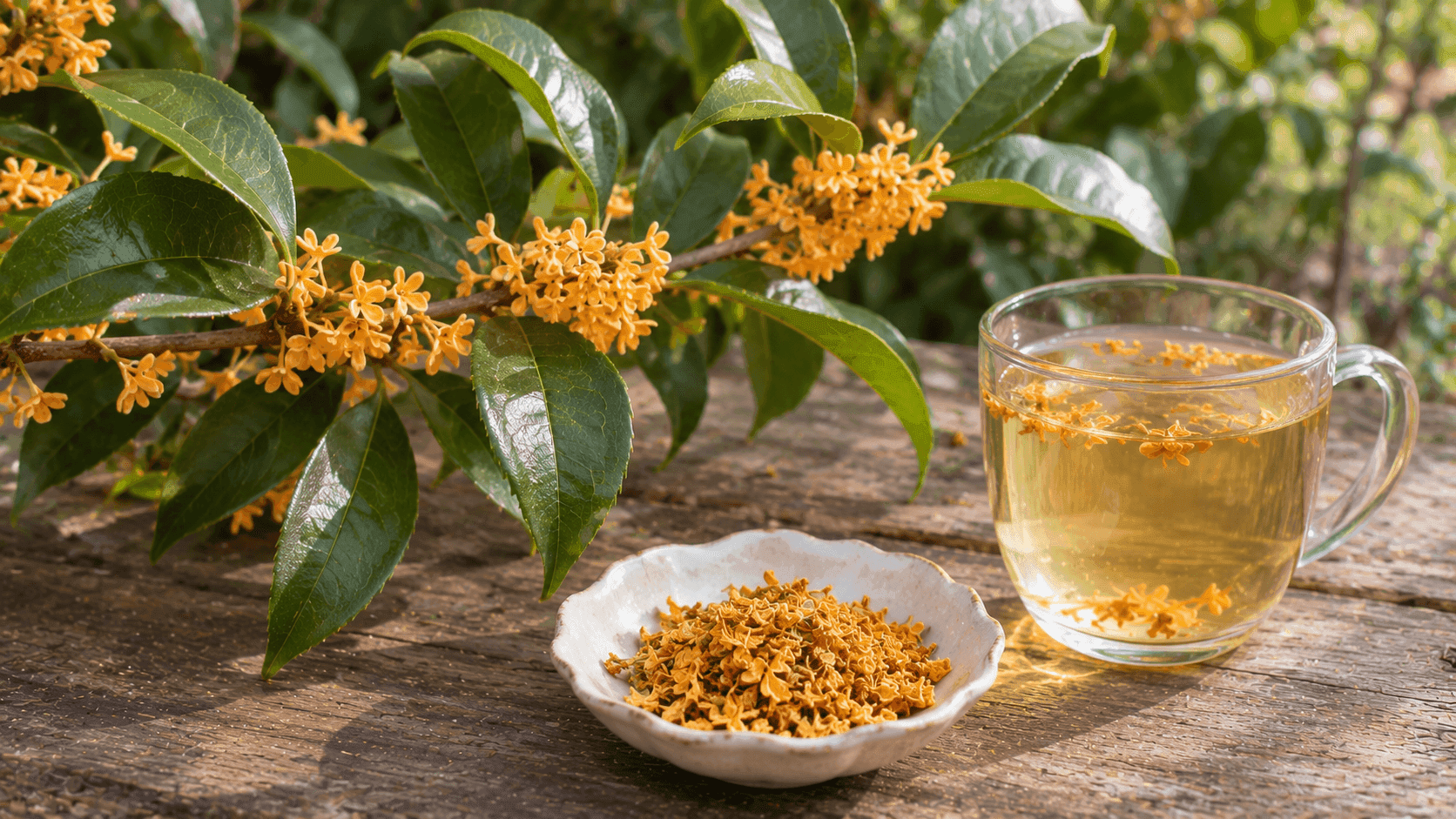
Osmanthus is sweet osmanthus, an evergreen shrub from the olive family: its tiny flowers smell of apricot in autumn, and once dried, they scent my tea.
Who he really is
Family: Olive family (Oleaceae). It grows wild from the Himalaya to southern Japan and Indochina, and it has been grown in East Asian gardens for a very long time.
Part used: the flower, dried.
Osmanthus is sweet osmanthus, which people also call fragrant olive. It’s a shrub that keeps its leaves all year, and its tiny flowers smell of apricot in September and October. I only use it one way: its dried flowers, to scent my tea, a little honey or a syrup.
His story
Osmanthus is an evergreen shrub from Asia, in the olive family, and its tiny flowers smell of apricot. They open in September and October, for barely ten days or so, and while they last, you smell them before you see them. I mostly know them dried, at the bottom of a jar, to scent my tea.
What is osmanthus? And what do the French call it?
Its learned name is Osmanthus fragrans. In English people say sweet osmanthus, sweet olive, tea olive or fragrant olive; in French it’s osmanthe parfumé or olivier odorant. The name comes from Greek: osma, smell, and anthos, flower. The flower that smells, that’s all. For once, the scholars didn’t go looking very far.
It belongs to the olive family, the Oleaceae. It grows wild from the Himalaya to southern Japan and Indochina, and it has been grown in East Asian gardens for a very long time. In Chinese, its flower is called guìhuā.
It’s a shrub, or a small tree: over there, it reaches 3 to 10 m. Its leaves stay on the branches all winter, thick and leathery, 7 to 15 cm long. Its flowers are no bigger than a centimetre. They are white, pale yellow, yellow or orange depending on the variety, and they grow in small tight clusters along the branches. Then comes a little purple-black fruit, which takes about six months to ripen, until spring.
There are about thirty species of osmanthus, not counting the hybrids. The one I’m telling you about here, the one whose flowers go in tea, is sweet osmanthus. The others, we’ll come back to further down, because there’s one you’ve surely walked past in a hedge.
The scent of osmanthus: apricot in the middle of autumn
What does osmanthus smell like? Ripe peach or apricot, with something flowery on top. English garden books say it has a touch of the tropics about it, especially on a warm evening, and that a handful of flowers is enough to scent a big conservatory.
It flowers at the end of summer and in autumn, mostly in September and October. The flowering is short, about ten days. Some varieties put out a few more flowers through the winter, and on into spring. Its flowers don’t look like much: small, hidden under the leaves, you’d walk right past them. It’s your nose that finds them.
It’s for that scent that the flower is used above all in fine perfumery. I don’t have a bottle of perfume: I have my jar of dried flowers. When I open it in November, the kitchen smells of apricot while it rains outside. It’s like my lavender, which I dry in summer to keep its scent: a smell you put in a jar for the winter.
“Osmanthus flowers don’t look like much: your nose finds them before your eyes do.”
Osmanthus fragrans in the garden: size, hardiness, care
People ask me whether they can grow it at home. Sweet osmanthus likes warmth. It puts up with moderate frosts, no lower than minus 8 °C, and only for a short while. So in Europe, it’s kept for regions with mild winters. It also needs summer heat to be happy. Here it stays more of a shrub than a tree, even though one was measured at 6 m in Cornwall, in the south-west of England.
Is osmanthus deciduous or evergreen? Evergreen: it keeps its leaves all year round, like all osmanthus. And it grows slowly. You mustn’t be in a hurry with it.
How do you look after an osmanthus? It wants light soil, fairly rich, that drains well in winter and stays cool in summer; a little lime doesn’t bother it. Put it in sun or partial shade, out of draughts if you live somewhere cold. You plant it in spring or early autumn, never when it’s freezing. Pruning is simple: the ones that flower in autumn, like sweet osmanthus, you prune at the end of winter; the ones that flower in spring, just after their flowers.
Burkwood osmanthus, the osmanthus of hedges
If you’ve seen an osmanthus in a hedge, it’s often a different one: Burkwood osmanthus, Osmanthus × burkwoodii. It’s a hybrid between two cousins, Osmanthus delavayi and Osmanthus decorus, raised in England by a nursery, Burkwood and Skipwith.
When does Burkwood osmanthus flower? In spring, in April, sometimes into May: little white flowers that smell lovely, a bit like jasmine. Its leaves are small, oval, a dark glossy green. It makes a dense rounded bush that grows to about 3 m, but it takes ten to twenty years to get there.
For a hedge, it’s a good shrub: very hardy, it gets through winters down to about minus 10 to minus 15 °C, in sun or partial shade, and it takes clipping well. But it grows slowly. If you’re looking for a shrub to make a hedge quickly, it isn’t the one; if you want a hedge that smells lovely in April and stays green all winter, it has its place. You trim it just after flowering. As for planting distance, ask your nursery: it depends on the height you want and how many rows.
There’s also holly-leaved osmanthus, Osmanthus heterophyllus, whose leaves look like holly. My neighbour has a Burkwood osmanthus hedge along her path, and in April I slow down on purpose as I go by. But its flowers don’t go in my cup: for tea, it’s sweet osmanthus, and dried flowers bought for that.
What is osmanthus good for? Mostly a scent, in tea and in cooking
What is osmanthus good for? I’m not going to make things up. Here, it’s a garden shrub and a perfume. It’s in Asia that people commonly put it in their cooking, as a flavouring.
In China, its flowers are mixed with green or black tea leaves to make a scented tea. They also go into jam, cakes, dumplings, soups, and even a liqueur. They go into sweets, and the flowers are steeped in honey.
This is how I use it: a teaspoon of dried flowers in the teapot, with an oolong or a green tea, and water that isn’t too hot, around 85 °C. Two or three minutes, no more, or it turns bitter: I explained in a letter why an infusion turns bitter.
I buy the flowers already dried, in a tea shop. Before using them, I rinse them for a moment with hot water in the tea strainer, to get rid of the dust. And I keep them in a tightly closed jar, like the herbs I dry in July.
I’ll give you my recipes further down: the tea, osmanthus honey and a little syrup for desserts. And for pregnancy, children and everything we don’t know, read what to know first carefully.
What I use him for
- · 01In the afternoon, a teaspoon of dried flowers in the teapot, with an oolong or a green tea: 2 to 3 minutes at 85 °C.
- · 02In winter, a little jar of osmanthus honey: a teaspoon in a cup of hot water.
- · 03On desserts, an osmanthus syrup: on a pancake, a soy milk pudding, shaved ice.
- · 04In November, I open the jar of dried flowers just for the smell of apricot.
How I prepare him
Granny’s little recipes
Afternoon osmanthus tea
In the afternoon, when it’s raining (5 minutes)
What you’ll need
- 1 teaspoon of dried osmanthus flowers
- 2 teaspoons of oolong, or 2 and a half teaspoons of green tea (or nothing, if you want it on its own)
- 250 ml of water
How I go about it
- 01Boil the water and let it cool a little, to about 85 °C.
- 02Put the flowers in the tea strainer and rinse them for a moment with hot water.
- 03Add the tea to the strainer, pour the water and let it steep 2 to 3 minutes, no more, or it turns bitter.
- 04Take out the strainer. If you like, put two or three flowers in the cup, just to please the eye.
Osmanthus honey for winter
On an autumn Sunday, ready in 2 to 3 days
What you’ll need
- 2 tablespoons of dried osmanthus flowers
- 4 tablespoons of a mild, light-tasting honey
- A small glass jar
How I go about it
- 01Scald the jar with boiling water and let it dry completely.
- 02Fill it about halfway with flowers.
- 03Pour in the honey a little at a time, so the flowers have time to soak it up, until the jar is full.
- 04Close it and leave it 2 to 3 days in the fridge: the flowers rise to the top. Then, a teaspoon in a cup of hot water, and stir.
Osmanthus syrup for desserts
For Sunday teatime (20 minutes)
What you’ll need
- 100 g of sugar
- 120 ml of water
- 3 tablespoons of dried osmanthus flowers
How I go about it
- 01Put the sugar and water in a small saucepan and bring to the boil over a medium heat, until the sugar has melted.
- 02Lower the heat, add the flowers and let it simmer gently for 3 to 5 minutes.
- 03Take it off the heat and let it steep for 10 minutes, then strain it, or keep the flowers in.
- 04Let it cool, close it tightly and keep it in the fridge, two weeks at most. A drizzle on a pancake, a pudding or shaved ice.
Elsewhere: how others know him
My daughter, the one who lives in Shanghai and who introduced me to the herb of immortality, writes to me every autumn when the osmanthus flowers over there, around the Mid-Autumn Festival. In Guilin Park, in Shanghai, there are more than a thousand osmanthus, and she tells me the whole neighbourhood smells of apricot.
She told me they make osmanthus sugar, which goes into desserts and into little glutinous rice balls, tangyuan. At Mid-Autumn, families drink osmanthus wine together, the reunion wine. And the story goes that an osmanthus grows on the moon: a man called Wu Gang is condemned to cut it down, but after every blow of the axe the tree closes up again, so he chops forever.
Keiko, my friend in Tokyo, wrote to me that where she lives, autumn smells of kinmokusei, the orange-flowered osmanthus. It flowers in September and October, and its scent is strongest in the evening. In Japan it’s counted among the three most fragrant trees, and in haiku it’s an autumn word. She also taught me that you never see its fruit there: around the 17th century, only male plants came over from China, and it was spread everywhere by cuttings.
What I love is simpler: opening my jar on a November evening, putting a spoonful of flowers in the teapot, and smelling apricot while it rains outside. A flower from far away, that makes me think of my daughter and of Keiko on the same evening.
What to know first
This information doesn’t replace advice from a healthcare professional. Health Disclaimer →
His identity card
- Name
- Sweet osmanthus
- Other names
- Sweet olive, tea olive, fragrant olive; in French, osmanthe parfumé, olivier odorant
- Latin name
- Osmanthus fragrans Lour.
- Family
- Olive family (Oleaceae)
- Part used
- The flower, dried
- Harvest
- In September and October, at flowering
- Form
- Infusion, on its own or with tea; scented honey and syrup
- Origin
- From the Himalaya to southern Japan and Indochina
- Storage
- Dried, in an airtight jar
If you remember just one thing
- 01Osmanthus is sweet osmanthus: an evergreen shrub from the olive family, from Asia.
- 02Its little flowers open in September and October, for about ten days, and they smell of apricot.
- 03The osmanthus in hedges is often Burkwood osmanthus: white flowers in April, slow growth, and not for the cup.
- 04In China, its flowers scent tea, honey, cakes and the Mid-Autumn wine.
- 05For me, osmanthus is a scent: a teaspoon of dried flowers in the teapot, not a daily regimen.
Your questions
Ripe peach or apricot, with something flowery on top. It’s strong for such a small flower: a handful is enough to scent a big conservatory, garden books say. And you smell it best in the evening.
Evergreen: it keeps its leaves all year round, like all osmanthus. Sweet osmanthus reaches 3 to 10 m in Asia, but here it stays more of a shrub, because it needs mild winters and hot summers.
Give it light soil that drains well in winter and stays cool in summer, in sun or partial shade, out of cold draughts. Plant it in spring or early autumn, when it isn’t freezing. Prune the ones that flower in autumn at the end of winter, and the ones that flower in spring just after their flowers.
It flowers in April, sometimes into May, with little fragrant white flowers. It grows slowly: it takes ten to twenty years to reach about 3 m. It makes a lovely evergreen, fragrant hedge, but not a quick one.
I’m not going to make things up. Here, it’s a garden shrub and a perfume; in China, its flowers go into tea, honey, cakes and wine. I drink it for the pleasure, a teaspoon of flowers in the teapot now and then.
The French say osmanthe, and for Osmanthus fragrans, osmanthe parfumé or olivier odorant; it’s also called olivier de Chine or olivier à thé. The name comes from Greek and means “flower that smells”. In Chinese, its flower is called guìhuā, and in Japan, the orange osmanthus is called kinmokusei.
References
- Osmanthus fragrans Lour. · Plants of the World Online, Royal Botanic Gardens, Kew, 2026
- Osmanthus fragrans · Trees and Shrubs Online, 2026
- Osmanthus × burkwoodii · Trees and Shrubs Online, 2026
- Osmanthus × burkwoodii · Royal Horticultural Society, 2026
- Osmanthe : plantation, entretien · Truffaut, 2026
- Osmanthus fragrans · Wikipédia, 2026
- Osmanthus · Wikipédia, 2026
- Osmanthus fragrans · Wikipedia, 2026
- 桂花 · 维基百科, 2026
- Wu Gang · Wikipedia, 2026
- キンモクセイ · ウィキペディア, 2026
- Popular spots to view osmanthus flowers · Shanghai Municipal People’s Government, 2024
- Golden Osmanthus Tea (Gui Hua Cha) · Greedy Girl Gourmet
- Osmanthus Flower Tea · The Hong Kong Cookery, 2021
- Osmanthus Syrup · Sift & Simmer
- Dried Osmanthus Flowers: How It's Made · Teasenz
- Pas de miel pour les enfants de moins d’un an · Anses, 2026