Cornflower is the little blue flower of the wheat fields and of 11 November in France: a pinch in the cup for colour, a few flowers on a salad, and nothing on the eyes any more.
Who she really is
Family: Daisy family (Asteraceae). Cornflower comes from the central and eastern Mediterranean, and it followed the wheat fields across almost all of Europe.
Part used: the flowers (the flower heads), fresh or dried.
Cornflower is the little blue flower of the wheat fields, from the same family as chamomile and daisies. In France it's called bleuet, and also barbeau, or casse-lunettes ("glasses-breaker"). It's the one the French pin on in fabric on 11 November. Me, I put a pinch in my herbal teas for colour and a few flowers on my salads. On my eyes, never again.
Her story
Cornflower is the little blue flower that grows among the wheat, from the same family as chamomile and daisies. In France, people know it best as the Bleuet de France pinned to a lapel on 11 November. Me, I sow a strip of it at the end of the vegetable patch: for bouquets, to give my herbal teas some colour, and for a few flowers on salads.
Cornflower: what kind of flower is it?
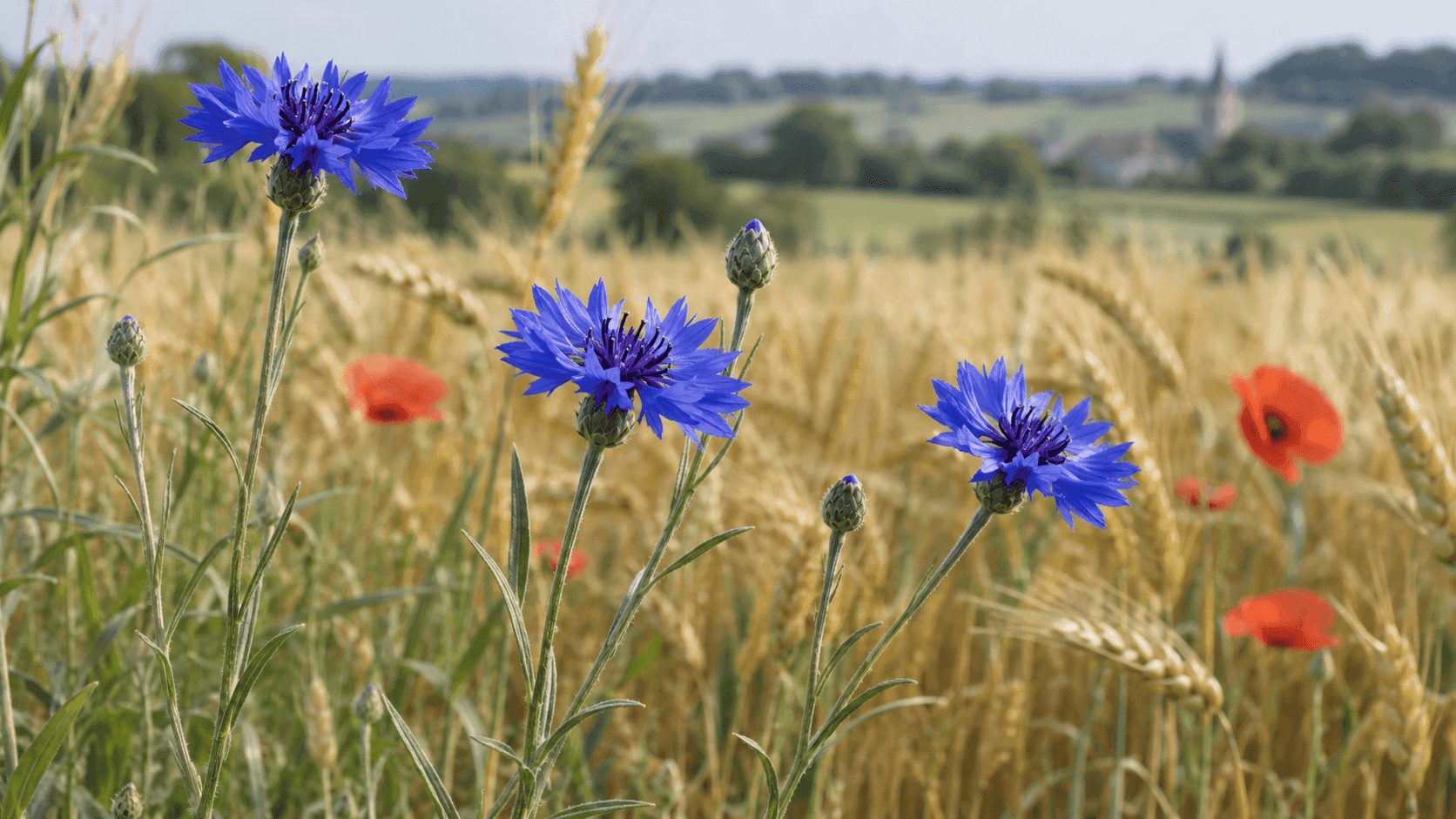
Its scientific name is Centaurea cyanus. It belongs to the daisy family, Asteraceae, like chamomile and the ox-eye daisy. The books say it comes from the central and eastern Mediterranean, and it spread across almost all of Europe by following the cereal fields. It's a harvest flower: it lives alongside wheat, barley and rye, and it's happy in light soils.
It's an annual: it sprouts, flowers, sets seed and is gone within the year. Depending on the soil, it grows from 25 cm to 1 m tall, with thin, stiff stems and narrow, lance-shaped leaves. Its flowers are 3 to 4 cm across, a clear blue, sometimes white, pink or purple. Cornflower blooms from late spring to the end of summer, and in some places you still see it in autumn.
When I was little, the edges of the fields were all blue with it. With weedkillers and machines it has drawn back a great deal, and in some regions it has become rare. So when I see one by the roadside, I stop.
It has been given a whole crowd of names in French: barbeau, blavelle, aubifoin, fleur de Zacharie, and casse-lunettes (I'll come back to that one). And when the revolutionaries remade the calendar, they gave it a day of its own, 21 Prairial, which falls around 9 June.
Bleuet de France: why the French wear a cornflower on 11 November
During the Great War, the very young soldiers of the class of 1917, who arrived at the front in their horizon-blue uniforms, were nicknamed « bleuets », cornflowers. And people say the cornflower was the only flower still growing on the battlefields.
After the war, in 1925, two nurses, Charlotte Malleterre and Suzanne Leenhardt, who looked after the wounded at Les Invalides in Paris, had a very simple idea: have wounded soldiers make cornflowers out of fabric, to give them something to do and a small income. That's where the Bleuet de France comes from. The State made it an official sale every 11 November from 1935, and 8 May was added in 1957.
The cornflower became the symbol of remembrance, and of standing by those left behind: veterans, the war-wounded, grieving families, the children the Nation took under its wing, and today the victims of terrorism too. In the old language of flowers, the cornflower spoke rather of delicacy and shy love. Both suit it.
When do you wear it? Around 11 November and 8 May, on the lapel of your jacket or coat. Elected officials and the military wear it from 1 to 11 November, from 1 to 8 May, on 14 July and on 11 March. Where do you find one? Volunteers sell it in the street during the commemorations, and the Bleuet de France charity has its own online shop. In 2018, France even struck a 2-euro coin with a cornflower on it. That little cornflower is made of fabric or paper: nothing to do with the dried flowers in my pantry.
Cornflower water and the eyes: the old grandma's remedy
If it's called casse-lunettes, it's because of the eyes. In the old days, people bathed irritated eyes and eyelids with cornflower water, or with a decoction of its flowers, hence the nickname. The old books say Hildegard of Bingen already wrote about it in the 12th century, and the pharmacopoeia still lists it among the traditional plants. My grandmother made compresses with it for the eyelids, I can still see her.
Me, I don't do it any more, and I'll tell you why. A brew made in the kitchen isn't clean enough for the eye: the books say so about the plants people used to put on their eyes, and they're right. And for cornflower, I found no method, no amount and no length of time in any serious book. So I'm not giving you a recipe for the eyes, not as a compress and not as an eye bath.
When my eyes are tired, I put a clean washcloth, run under cold water, on my closed eyelids, and I leave the screen alone for a while. To rinse an eye, it's saline solution from the pharmacy, with well-washed hands first. For eyes that feel strained in the evening, I've put all my little habits over here.
And an eye that's red and hurts, vision that goes blurry, an eye that runs, or discomfort that won't go away when you wear contact lenses: that's no longer a job for flowers, that's an appointment. I've put it all further down, in what to know first.
« Cornflower, I keep for bouquets, for the plate and for 11 November. My eyes get cold water. »
Cornflower on the plate and in the cup
The flowers are edible. The taste is very faint: you use them mostly for the blue. People scatter them over desserts, mousses, fruit salads and cakes, and you find them in some teas, like Lady Grey. In spring, I make a salad of new vegetables, green asparagus, peas, radishes, with a few cornflowers on top at the last minute. I'll give you the recipe further down.
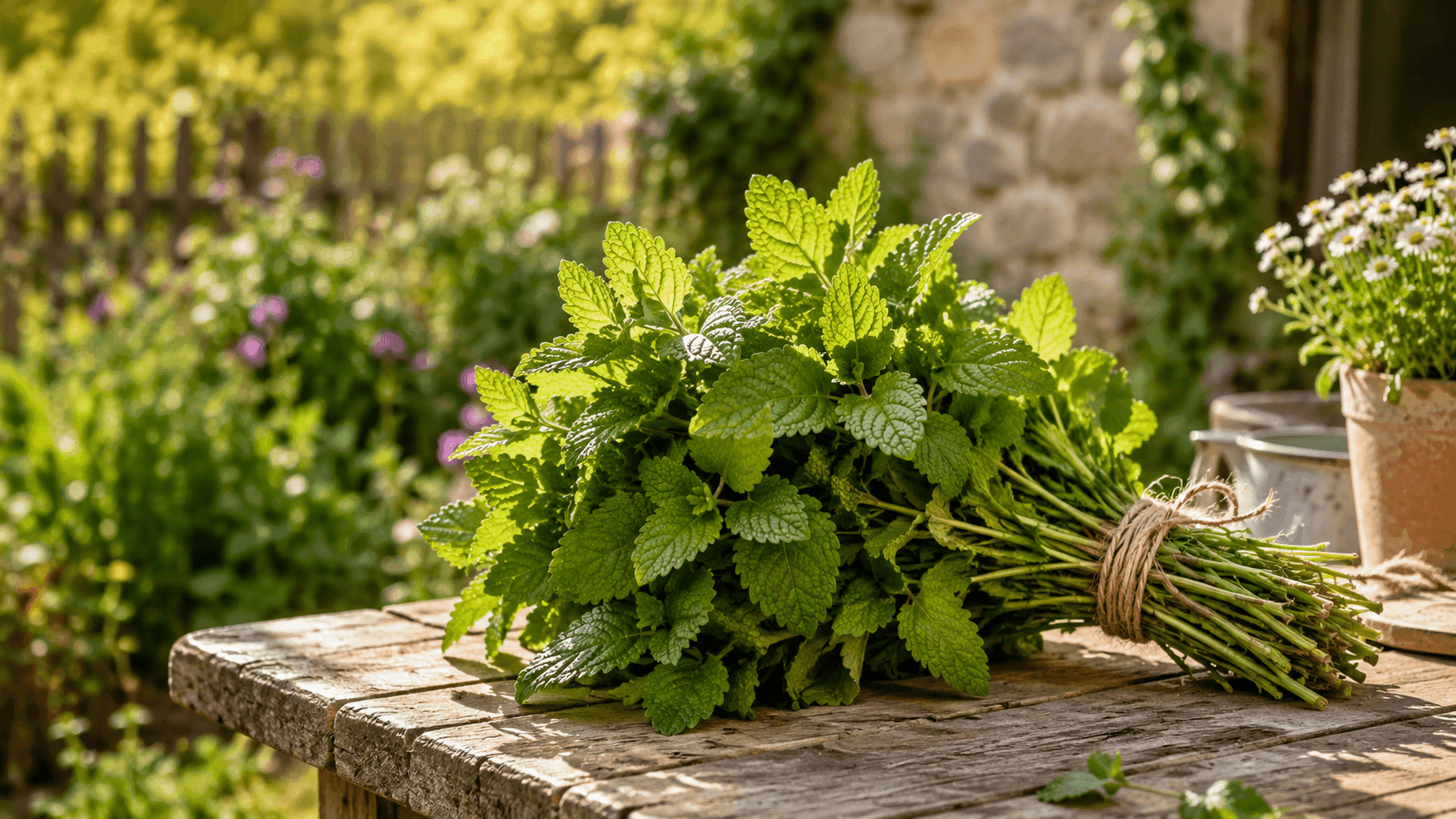
In the cup, I don't make a tea of it on its own: the books give no amount for that. I slip a pinch of dried flowers into a blend, just for the colour, for example in my evening cup of lemon balm.
One important thing: only eat flowers you know are clean. Flowers from the florist or the garden centre have almost always had products on them that have no business on a plate. Mine come from the garden, with nothing on them.
I pick them in the morning, once the dew has gone, when they've only just opened. For winter, I spread them out in a single layer on a rack, somewhere dry, airy and shady, and count five to ten days depending on the weather. Light eats away the blue, so afterwards it's a well-closed glass jar in the cupboard. Cornflower dries well and keeps its colour. I told you how I dry my herbs in my July letter.
Sowing cornflowers in the garden, and not mixing them up with Canadian bleuets
Cornflower is the easiest flower in the world. It wants sun and soil that drains well, and it's happy in light, slightly sandy ground. I sow it straight where it will grow, in spring or in autumn.
Does it need pruning? Not really. I snip off the faded flowers as I go: that keeps it flowering longer, and I have bouquets all summer.
Is it a perennial? No. The field cornflower does its whole round in one season, so you sow it again. The "perennial cornflower" sold in little pots is a cousin, the mountain cornflower, Centaurea montana: that one comes back every year in a clump in the same spot.
And if someone in Quebec talks to you about « bleuets », they mean little blue berries, from the bilberry family, that grow on a shrub. Over there, the bleuet is the berry. Same name, two plants that have nothing in common: everything I'm telling you here is about the field flower, and only about it. And if you're looking for another flower from the same family for your cup, my chamomile is waiting for you here.
What I use her for
- · 01For colour: a pinch of dried flowers in a herbal tea blend.
- · 02In the kitchen: a few fresh flowers on a salad, a fruit salad or a cake, at the last minute.
- · 03In the garden and in a vase: a strip of cornflowers in the sun, for the buzzing insects and for bouquets.
- · 04On 11 November and 8 May: the fabric Bleuet de France, pinned to the lapel, for remembrance.
- · 05What I don't do any more: cornflower water on the eyes. For tired eyelids, a clean washcloth run under cold water.
How I prepare her
Granny’s little recipes
The first-fine-days salad, with cornflowers
In spring, as a starter (serves 4, 20 minutes)
What you’ll need
- 50 g sprouted leek shoots
- 6 green asparagus spears
- 50 g shelled peas
- 4 radishes
- 8 snow peas (or green beans)
- 2 tablespoons olive oil
- 2 teaspoons balsamic vinegar
- 4 sprigs fresh thyme
- 6 cornflowers from your garden, with nothing sprayed on them
- 1/2 teaspoon flaky sea salt (fleur de sel)
How I go about it
- 01Wash and peel the radishes, then slice them into rounds. Cut the asparagus lengthwise into quarters and top and tail the snow peas.
- 02Cook the peas, snow peas and asparagus for 5 minutes in boiling water, then run them under cold water and drain.
- 03Arrange the leek shoots, the cooked vegetables and the radishes on the plates, and drizzle with oil and vinegar.
- 04Sprinkle with sea salt and thyme leaves, scatter the cornflower petals and flowers on top, and serve straight away.
The evening cup with a touch of colour
In the evening, after dinner (from age 12)
What you’ll need
- 1.5 to 4.5 g dried lemon balm leaves
- A pinch of dried cornflowers, for colour
- 150 ml water
How I go about it
- 01Bring the water to the boil.
- 02Pour it over the lemon balm and cornflower in the bottom of your cup.
- 03Cover and leave to steep for 10 minutes.
- 04Strain and drink slowly. No more than three cups of lemon balm a day, not during pregnancy or breastfeeding, and not before age 12.
What to know first
This information doesn’t replace advice from a healthcare professional. Health Disclaimer →
Her identity card
- Name
- Cornflower
- Other names
- Bleuet, barbeau, casse-lunettes
- Latin name
- Centaurea cyanus L.
- Family
- Daisy family (Asteraceae)
- Part used
- The flowers (flower heads)
- Harvest
- Flowers just opened, from late spring to the end of summer
- Form
- Dried flowers to colour herbal teas, fresh flowers in cooking
- Origin
- Central and eastern Mediterranean
- Storage
- Dried in the shade, in a glass jar away from the light
If you remember just one thing
- 01Cornflower is the little blue flower of the wheat fields, from the same family as chamomile and daisies.
- 02The Bleuet de France is worn on 11 November and 8 May, in memory of the soldiers and for those left behind.
- 03It was called casse-lunettes because people bathed their eyes with it. Me, I don't put anything homemade in my eyes any more.
- 04Its flowers are edible: a few on a salad, a pinch in the cup for colour, but never the florist's.
- 05Field cornflower is an annual: sow it in spring or autumn, in the sun, and snip off the faded flowers so it blooms longer.
Your questions
Today, the cornflower is first of all the flower of remembrance: the Bleuet de France recalls the soldiers of the Great War and says we stand by veterans, the wounded, grieving families and the victims of terrorism. In the old language of flowers, it spoke of delicacy and shy love. Me, I find it modest, and that's why I love it.
During the Great War, the very young soldiers of the class of 1917, in their horizon-blue uniforms, were nicknamed « bleuets », and people say the cornflower was the only flower still growing on the battlefields. In 1925, two nurses had wounded soldiers make fabric cornflowers, to give them work again. The State made it an official sale every 11 November from 1935, then on 8 May as well from 1957.
I'm not promising you anything. In the old days, people used it to bathe irritated eyes, hence its French nickname casse-lunettes, but I found no method and no amount in any serious book, and something made in the kitchen isn't clean enough for the eye. So at my place, cornflower is for colour in the cup, for the plate and for bouquets.
It blooms from late spring to the end of summer, and you sometimes see it into autumn. Field cornflower is an annual: it does its whole round in one season, so you sow it again in spring or autumn. The "perennial cornflower" at garden centres is a cousin, the mountain cornflower, which comes back every year in a clump.
Yes, the flowers are edible. The taste is very faint, you use them mostly for the blue: on a salad, a fruit salad, a cake, and you find them in some teas like Lady Grey. But only flowers with nothing sprayed on them: the florist's don't belong on a plate.
Yes, in Quebec a « bleuet » is a little blue berry from the bilberry family, growing on a shrub. Nothing to do with my field flower, which belongs to the daisy family. Same name, two plants.
References
- Centaurea cyanus L. · Plants of the World Online, Royal Botanic Gardens, Kew, 2026
- Liste A des plantes médicinales utilisées traditionnellement (Pharmacopée française, janvier 2026) · ANSM, 2026
- Assessment report on Euphrasia officinalis L. and Euphrasia rostkoviana Hayne, herba (EMA/HMPC/246799/2009) · European Medicines Agency, HMPC, 2010
- Conjonctivite : que faire et quand consulter ? · ameli.fr, Assurance Maladie, 2025
- Œil rouge : que faire et quand consulter ? · ameli.fr, Assurance Maladie, 2026
- HMPC meeting report on European Union herbal monographs, guidelines and other activities, 24-26 November 2014 (EMA/HMPC/744424/2014) · European Medicines Agency (HMPC), 2014
- European Union herbal monograph on Matricaria recutita L., flos · European Medicines Agency (HMPC), 2015
- Community herbal monograph on Melissa officinalis L., folium (EMA/HMPC/196745/2012) · European Medicines Agency, HMPC, 2013
- Centaurea cyanus · Wikipédia, 2026
- Bleuet de France · Wikipédia, 2026
- Portons le Bleuet de France · Élysée, 2020
- Bleuet de France : 100 ans d’histoire, un nouveau souffle et un nouveau logo (communiqué de presse) · Ministère des Armées, 2025
- Le bleuet · Fondation Klorane Botanical, 2026
- Centaurea cyanus (cornflower) · Royal Horticultural Society, 2026
- Centaurea montana · VASCAN, Canadensys, 2026
- bleuet · Office québécois de la langue française, Vitrine linguistique, 2026
- Fleurs comestibles de l'été · Jardiner Malin, 2026
- Salade fraîcheur à la fleur de bleuet (recette Cuisine Actuelle) · Circulaire-en-ligne.ca, 2026