Skin that has had too much sun
Sunburn? Into the shade, cool tap water for a quarter of an hour, a good drink, then a marigold compress in the evening. And the signs that need a doctor.
Reviewed by Ruosi Wu, PhD in Pharmacy, MD in Traditional Chinese Medicine
For sunburn, get into the shade right away, put the red skin under cool tap water for a quarter of an hour, and drink plenty. In the evening, a still-lukewarm marigold compress helps the skin get through the night. Big blisters, fever, a violent headache, or a child under 5: that’s the doctor or 15.
Key takeaways
- Sunburn is a burn of the skin: you get into the shade right away, and the burnt skin doesn’t go back into the sun in the days that follow.
- The first thing to do is tap water, neither hot nor ice-cold, for about a quarter of an hour on the red skin, then a big glass of water.
- In the evening, a still-lukewarm marigold compress, or a well-cooled chamomile one, is the old way my books give for skin that got too hot.
- No butter, no oil, no ice cube on sunburn, and you never pop a blister.
- Big blisters, fever, a violent headache or vomiting need showing to a doctor; for a child under 5, you call 15 (the emergency number in France).
Granny’s little steps
- Into the shade, right away
Go inside or get into the shade as soon as your skin feels hot, and take off anything tight. In the days that follow, the burnt skin doesn’t go back into the sun.
- Tap water, for a quarter of an hour
Cool water, between 15 and 25 degrees, on the red skin for about 15 minutes, or a lukewarm bath if it’s a big area. Never ice cubes, and no shower to cool off if you have a fever or shivers.
- Drink and keep an eye on your temperature
Drink plenty, water above all, and leave coffee and tea for later. Take your temperature: if the fever rises, it’s the doctor.
- Leave the skin alone
Don’t pop the blisters, don’t pull off the peeling skin, and don’t put on butter or oil. For a soothing cream, ask your pharmacist.
- The evening marigold compress
A still-lukewarm marigold infusion, laid on as a compress for half an hour to an hour on the red skin, two to four times a day, from 6 years old.
A recipe to try
The evening marigold compress, in the shade
In the evening, when your skin got too hot and you’ve already cooled it with water
What you’ll need
- 1 to 2 g of dried marigold flowers (weigh them the first time, after that you’ll know by eye)
- 150 ml of water
- Compresses or a clean, thin cotton cloth
How I go about it
- Bring the water to the boil and pour it over the flowers, in a bowl.
- Cover with a saucer and leave to infuse for 10 minutes, then strain well.
- Let it cool to lukewarm: you lay the infusion on while it’s still lukewarm, not hot.
- Soak the cloth, wring it out a little and lay it on the red skin, not on a burst blister.
- Take it off after 30 to 60 minutes. You can do it again two to four times in the day, not under 6, and if it isn’t better after a week, go and see your doctor.
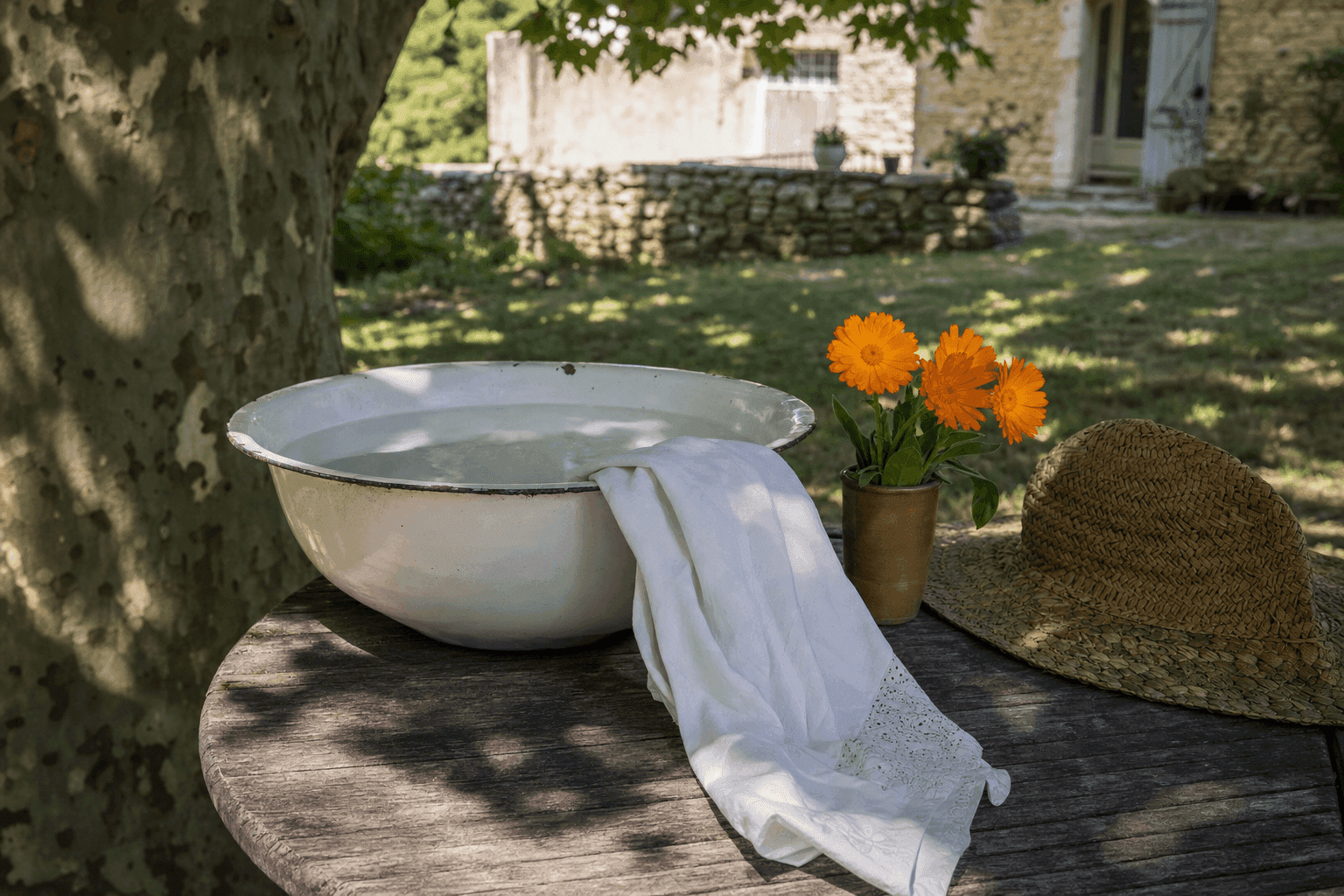
Sunburn first calms down with shade, cool water and a big glass of water. After a day outside, when the skin feels tight, goes red and burns, I always do the same thing: a bowl of cool water under the linden tree, a white cloth, my straw hat on the chair, and a cup of marigold cooling down next to me. Here are my ways, and when it’s no longer something for me.
Sunburn: the signs, and why your skin burns like that
Sunburn is a burn of the skin. My childhood friend, who went to live in England, calls it "sunburn", the sun that burns. At least it’s clear.
The catch is that you don’t see it straight away. The redness comes later, between six hours and a day afterwards. You come home happy, and it’s in the evening that the skin starts to feel tight: red, hot, it hurts when the sheet rubs, and sometimes it itches for a few days. If you press it with your finger, the redness goes white for a moment, then comes back.
Sunburn without blisters passes in about a week, without leaving a mark. When it was stronger, the skin peels. If there are blisters filled with a clear liquid, it’s deeper: it closes up on its own in about two weeks, and it can leave brown marks for a good while. And if, under the blisters, the skin is pale and hurts strangely little, it’s deeper still. That’s not one for home.
The sun sneaks in everywhere. Under the clouds, it still gets through. Water, sand and even more so snow send it back onto you. I got caught one day in June weeding the strawberries, under a sky all grey: in the evening, the back of my neck was like a tomato.
And when it’s your bare head that got the sun, there’s sunstroke: a violent headache, wanting to sleep, nausea, sometimes a high fever. For that one, a compress won’t change a thing.
What to do after sunburn: shade, cool water, and drinking
First, you stop the sun, right away: you get into the shade and take off anything tight.
Then, water. Tap water, neither hot nor ice-cold (between 15 and 25 degrees, the books say, cool without making you shiver), on the red skin for about a quarter of an hour, until the pain calms down. If it’s a big area, a lukewarm bath; if it’s a small spot, a wet cloth. But if you have a fever or shivers, no shower or bath to cool off: call your doctor instead.
No ice cubes, no ice-cold water: sudden cold harms the skin even more. And no butter or oil on the burn, even if your neighbour swears her grandmother did it that way. Mine too.
Then you drink, a big glass of water and more through the evening. Coffee and tea, you leave for another day: they tend to make you lose water. To drink more willingly, I have my little herbal teas for the big heat, cooled in the jug. I also keep an eye on the temperature. If your head hurts, or for a soothing cream on red skin without blisters, ask the pharmacist.
And you leave the skin alone. You don’t pop blisters: after sunburn, they get infected easily. You don’t pull off the peeling skin, even if your fingers are itching to. In the days after, the burnt skin doesn’t go back into the sun. If you have to go out, loose cotton clothes, a wide-brimmed hat, and on whatever stays uncovered a sunscreen with a factor above 50, in a thick layer, every two hours.
You’re going to ask me how to get the redness out of sunburn in one night. I’ll tell you things as they are: there’s no magic remedy. Burnt skin takes a week to mend when there are no blisters, two when there are.
The grandma’s remedy for sunburn: marigold and chamomile
For skin that got too hot, my books give two flowers. I’ll give them to you with the measures, because a compress gets weighed out just like a herbal tea.
Marigold. Pot marigold, Calendula officinalis, is those bright orange flowers that sow themselves at the end of my vegetable patch. The pharmacopoeia gives it, by tradition, for small redness of the skin like sunburn. You put 1 to 2 grams of dried flowers in 150 ml of boiling water, leave to infuse for about ten minutes, and it’s the still-lukewarm infusion you lay on as a compress. You leave it for half an hour to an hour, two to four times a day, from 6 years old. It’s my recipe for tonight, further down.
German chamomile. The one for the after-meal cup, the books also give it as a compress for sunburn. Here, you make it stronger: 3 to 10 grams of flowers for 100 ml of boiling water, ten minutes covered, strain well and let it cool completely. You soak a cloth, wring it out a little, lay it on away from the eyes, and you can do it again several times in the day. Not under 12. What else I do with chamomile, I tell you there.
Both are in the same family as ragweed and chrysanthemums: if you’re allergic to them, you go without. And I don’t put any perfume or essential oil on skin that’s going into the sun: some make it much more sensitive. In my holiday plant kit, there’s always a little bag of dried flowers and a clean cloth.
"The sun is good when you respect it. A compress doesn’t wipe out one day too many: it just helps the skin get through the night."
Sunburn on the face, on the head, in little ones: when it’s no longer something for me
My compresses are for mild sunburn that doesn’t cover much. There are places where you don’t take chances: the face and the neckline, because it can leave scars; the hands, where the skin is thin and gets infected more easily; and the genitals, where infection can travel up to the bladder. Then you go and see your doctor.
To know whether it’s big, look at your palm: it’s about one hundredth of your body. Sunburn bigger than ten palms, or a whole arm, is more than 10% of the body: that needs showing to a doctor, even without blisters. Blisters bigger than 3 cm by 3, the same.
Little ones are another story. For a burn, the health books count a baby or a child under 5 as a serious case, even if it’s tiny: you call 15. A baby never stays in the sun anyway: in the shade, with a wide-brimmed hat and clothes on. Us old folk dry out faster: when my grandchildren come in summer to the garden, it’s hats for everyone, me included.
And if after the sun your head is pounding, you have a fever, you’re vomiting or your thoughts are muddled, it’s no longer the skin talking: it may be sunstroke, heatstroke, or the body short of water. I’ve put the list just below, sign by sign, with what to do. Read it through calmly once before the summer.
Which plants?
Aloe veraAloe vera
Aloe vera is a succulent from dry countries. The clear gel inside its leaves goes on skin and hair; the yellow sap hiding under the green skin gets thrown away.
ChamomileMatricaria chamomilla L.
Chamomile means two little flowers for your cup: German chamomile, mild, and Roman chamomile, bitter. For a bloated tummy, an irritated throat, skin that's got too hot.
What to know first
Marigold and chamomile are in the daisy family (the Asteraceae). If you’re allergic to one of these plants, to ragweed or to chrysanthemums, you don’t put them on your skin. It also happens that the skin becomes allergic to marigold over time: if it itches, gets redder or spots appear, stop the compress.
Marigold as a compress: not under 6, and not during pregnancy or breastfeeding, for lack of enough data. You take the compress off after 30 to 60 minutes, two to four times a day at most. The books don’t report any interaction with a treatment.
Chamomile as a compress: not under 12, and away from the eyes, which it can irritate. If you put some on your chest while breastfeeding, clean the breast well before the feed, so the baby doesn’t become allergic.
How long: if it isn’t better after a week of compresses, if the skin shows signs of infection (redness that spreads, swelling, pus) or if it gets worse, stop and go and see your doctor.
Blisters: you don’t pop them, and the compress goes on the red skin, not on a burst blister. After sunburn, blisters get infected easily: clean them with soap and a skin antiseptic, and ask the pharmacist for a suitable dressing.
On the burn, no butter, no oil, no ice cube, no ice-cold water. No shower or bath to cool off if you have a fever or shivers: call your doctor.
For the pain or a headache, a painkiller taken as directed; ask your pharmacist for advice. Over-the-counter hydrocortisone creams are only used on sunburn that doesn’t cover much, and for no more than three days in a row.
Some medicines, but also perfumes, creams, deodorants, essential oils and certain plants make the skin very sensitive to the sun: then a tiny bit of sun is enough for a violent redness. If you’re on treatment, ask your pharmacist whether it has that effect before you go out in the sun.
Children: a baby must never stay in the sun. For a child under 6, no marigold or chamomile compress, only cool water; and for a baby or a child under 5 who has caught sunburn, you call 15.
When to see your doctor
- Sunburn without blisters but covering a lot, more than 10% of the body (a whole arm, or more than ten times the palm of your hand): go and see a doctor the same day.
- Blisters bigger than 3 cm by 3: see a doctor the same day.
- Blisters on more than 10% of an adult’s body: call 15 or 112 (the emergency numbers in France).
- Blisters with a pale or whitish base, on skin that hurts strangely little: it’s a deep burn, don’t deal with it on your own, go and see your doctor.
- Sunburn on the face or the neckline: show it to your doctor, there’s a risk of scarring.
- Sunburn on the hands: see your doctor, the skin there is thin and gets infected more easily.
- Sunburn on the genitals: see your doctor, the infection can reach the bladder.
- Redness that spreads, pain that increases, swelling, pus, or burst blisters that get infected: see your doctor in the next few days.
- Fever or intense headaches after the sun: see a doctor the same day.
- Violent headaches, wanting to sleep, nausea or a high fever after having your head in the sun (sunstroke): get the person into the shade, cool them with water or a lukewarm shower, get the air moving, and if it doesn’t pass, call your regular doctor.
- A young child who passes out after the sun: call 15 or 112 right away.
- A high fever, vomiting, feeling faint, great thirst, a dry mouth and dry eyes (the body is short of water): see your doctor.
- Someone who becomes dazed, feels faint or passes out after the sun: see a doctor the same day.
- A feeling of intense heat, red skin, strange behaviour, staggering, cramps or vomiting in strong heat (heatstroke): get the person into the shade, undress them, cool them with water, wet cloths, a fan, and call 15 or 112 right away.
- Red, painful eyes that can’t bear the light any more: see your doctor, who will send you to an eye specialist if needed.
- A baby or a child under 5 who has caught sunburn, even a small one: call 15 or 112, at that age any burn counts as serious.
- A child over 5 burnt on more than 5% of their body: call 15 or 112.
- An older person burnt on 5% of the body or more: call 15 or 112, they dry out quickly.
- Pain that’s too sharp in the burnt areas: see a doctor in the next few days.
- Violent sunburn after very little sun: see a doctor in the next few days, a medication or a product put on the skin may be the cause.
- No better after a week of compresses, or it’s getting worse: stop and go and see your doctor.
- A new mark, or a mole that changes how it looks or doesn’t look like the others: show it to your regular doctor.
Your questions
What should I do for sunburn?
Get into the shade right away, then put the red skin under cool tap water for about a quarter of an hour, or take a lukewarm bath if it’s a big area. Drink plenty and keep an eye on your temperature. Don’t pop the blisters, don’t put on butter or oil, and if there are big blisters, fever or a violent headache, go and see your doctor the same day.
How long does sunburn last, and can you get rid of it overnight?
Not overnight, no: there’s no magic remedy. Without blisters, the skin mends in about a week, and it peels if the burn was strong. With blisters, count on about two weeks, and sometimes brown marks that take a while to go.
What’s the grandma’s recipe to soothe sunburn?
Mine is the marigold compress: 1 to 2 g of dried flowers in 150 ml of boiling water, ten minutes, and the still-lukewarm infusion laid on the red skin for half an hour to an hour, two to four times a day. The well-cooled chamomile compress is fine too. Marigold not under 6, chamomile not under 12, and neither if you’re allergic to ragweed or chrysanthemums.
What cream should I put on sunburn?
On red skin without blisters, a soothing cream: ask your pharmacist which one suits you. If there are blisters, they’ll rather advise a suitable dressing, because blisters get infected easily. And for a baby or a child under 5, you don’t go looking for a cream: you call 15 first.
Is aloe vera good for sunburn?
I don’t have any in the garden: when my neighbour passes me a leaf, I put a little on, otherwise I stick to marigold and chamomile. The old manuals give aloe vera gel for small burns and light sunburn, but the pharmacy books over here don’t count it as a remedy: it’s a traditional use, nothing more. If you use it, a thin layer on red skin without blisters, after the cool water. In some people, it stings, itches or brings out patches: if that’s you, you stop.
Is sunburn on the face dangerous?
The face and the neckline are fragile skin: a strong sunburn can leave scars there, so you show it to a doctor. The same if your eyes are red, hurt and can’t bear the light any more. In the days after, a wide-brimmed hat and the shade, no arguing.
Also worth reading
- The LetterMy herbal oils: golden marigold and my mother's red oilAn herbal oil is a plant left to soak in oil for weeks. Here are my two end-of-summer jars, marigold and St John's wort, and how to keep them from going mouldy.
- The LetterMy homemade plant cosmetics: marigold, chamomile and cautionMy homemade plant cosmetics don't amount to much: a marigold oil and a chamomile compress. I'll show you how I make them, and what I never put in my jars.
- The LetterCome into my summer garden: my cooling herbs, picked at dawnA July morning under the arbour: peppermint, lemon verbena, chamomile and lavender. I'll show you when I pick them, how I dry them, and what I do with them in summer.
What I’ve made with
References
- Coup de soleil : que faire et quand consulter ? · ameli.fr, 2026
- Coup de soleil et conséquences sur la santé de l'exposition au soleil · ameli.fr, 2026
- Brûlures de la peau · ameli.fr, 2026
- Coup de soleil (érythème solaire) · Santé.fr, 2026
- Tout savoir sur le coup de chaleur · Santé.fr, 2026
- European Union herbal monograph on Calendula officinalis L., flos · EMA, HMPC, 2018
- European Union herbal monograph on Matricaria recutita L., flos · EMA, HMPC, 2015
- Glossary on herbal teas · EMA, HMPC
- Chamomile · National Center for Complementary and Integrative Health (NIH), 2026
- Aloe Vera · National Center for Complementary and Integrative Health (NIH), 2025
- Aloe - Aloe vera, Topical (monograph) · Health Canada, Natural and Non-prescription Health Products Directorate, 2025
- Assessment report on Aloe barbadensis Mill. and on Aloe (various species, mainly Aloe ferox Mill. and its hybrids), folii succus siccatus (EMA/HMPC/759585/2015) · European Medicines Agency (HMPC), 2016
- coup de soleil · Wiktionnaire, 2026
Information. This information is provided for general knowledge and doesn’t replace medical advice. Check with a healthcare professional before any use.
Health Disclaimer