Heart comfort and peaceful sleep
When your heart pounds from nerves and sleep won’t come, I breathe out, leave the coffee alone and make myself a cup of hawthorn, once the doctor has said it’s nothing. With chest pain, it’s 15 (the French emergency number).
Reviewed by Ruosi Wu, PhD in Pharmacy, MD in Traditional Chinese Medicine
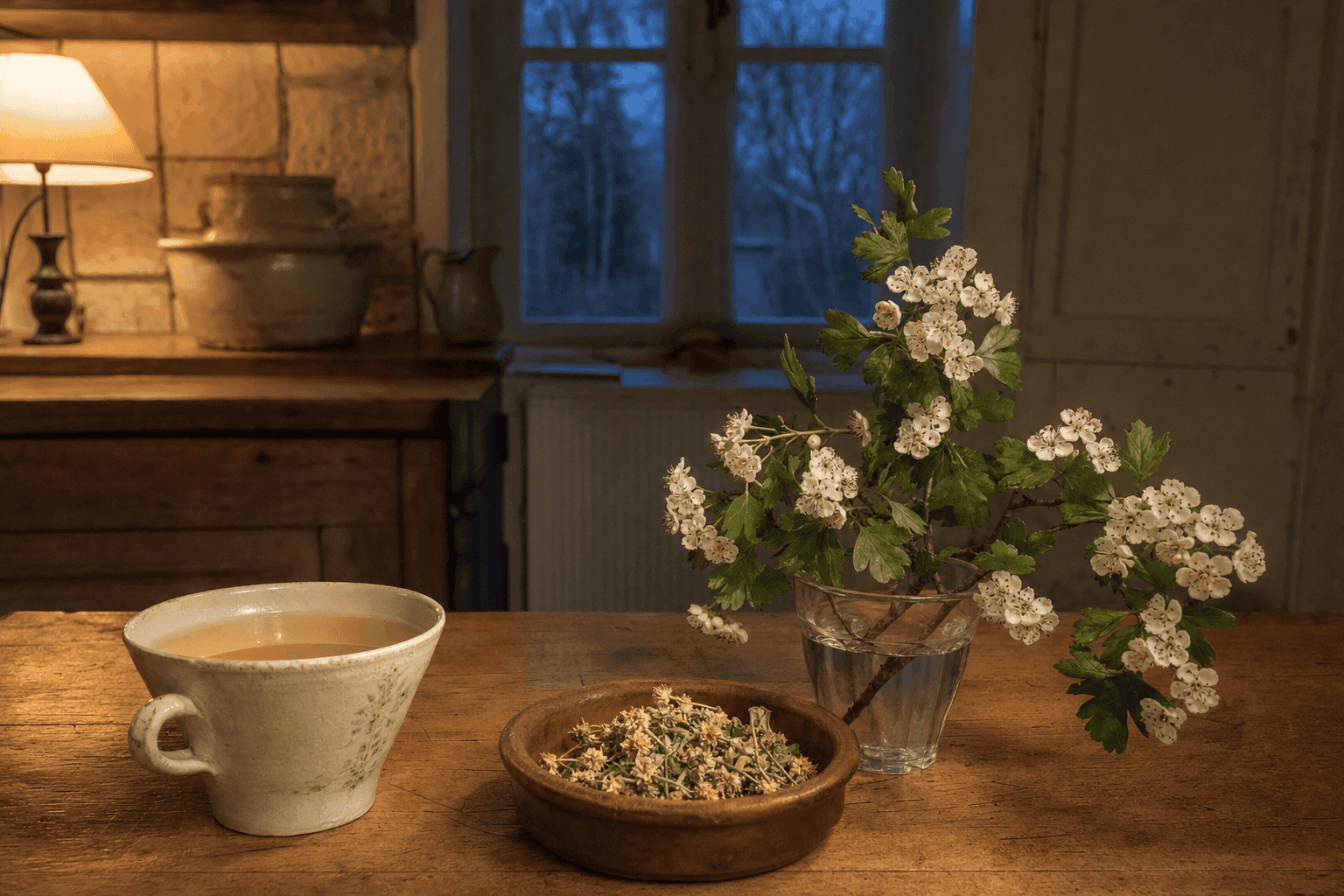
When your heart pounds in the evening, sit down, breathe slowly and set the coffee aside. If your doctor has told you it’s nerves, a cup of hawthorn helps put the day to rest before bed. With chest pain, feeling faint or short of breath, don’t wait: call 15 (the French emergency number).
Key takeaways
- Palpitations means feeling your heart beat too fast, too hard or out of rhythm; most often they follow an emotion, an effort or a wave of anxiety.
- My tea for the heart is hawthorn: 1 to 2 g of dried flowers and leaves in 150 ml of boiling water, up to four times a day, no more than 6 g, and not before age 18.
- Doctor first, cup second: hawthorn only comes once your doctor has ruled out anything serious.
- No tea unblocks your arteries, and oleander, foxglove and lily of the valley never go in a cup.
- Palpitations with chest pain, feeling faint, shortness of breath, sweating or dizziness: call 15 or 112 (the emergency numbers in France), right away.
Granny’s little steps
- Sit down and notice how it beats
Note when it starts and when it stops, whether it comes all at once or little by little, steady or not, at rest or after an effort, and what you were doing. If you have a blood pressure monitor, note your heart rate during the palpitations: your doctor will be glad to have it.
- Less coffee, and no more cigarettes
Cut down on coffee, and no more tea or coffee after 2 p.m. Cigarettes, you stop, and you get help if it’s hard.
- A few minutes of slow breathing
In the evening, sitting down, take a few minutes to breathe slowly, or do whatever relaxes you. It’s as simple as can be, but it helps the day wind down.
- Move by day, sleep more at night
A little activity every day, but not after 5 p.m. And longer nights: go to bed and get up at the same times, even on Sundays, and put screens away an hour before bed.
- The evening cup of hawthorn
1 to 2 g of dried hawthorn flowering tops in 150 ml of boiling water, ten minutes covered, up to four cups a day, no more than 6 g. For adults, once your doctor has said there’s nothing serious with your heart, and not during pregnancy or breastfeeding.
A recipe to try
The cup for evenings when nerves set your heart pounding
In the evening, when nerves set your heart pounding (for grown-ups, once the doctor has ruled out anything serious)
What you’ll need
- 1 to 2 g of dried hawthorn flowering tops (a good teaspoonful)
- 150 ml of water
- A drop of honey, if you like
How I go about it
- Bring the water to the boil.
- Pour it over the flowers in the bottom of your cup.
- Cover and let it steep for 10 minutes.
- Strain, add the honey if you like, and drink it slowly. Up to four cups a day, no more than 6 g in all, and if it lasts more than two weeks, go back and see your doctor.
When your heart pounds from nerves in the evening and sleep won’t come, my tea for the heart is hawthorn. But only once your doctor has told you these palpitations are nothing serious. The rest of the time, I sit down, I breathe out, and I set the coffee aside. And if your heart races with chest pain, feeling faint or out of breath, it’s no longer a matter for a cup: it’s 15 (the French emergency number).
Palpitations in the evening: why your heart races
You know, feeling your own heart happens to everyone. You feel it beating too fast, too hard, or out of rhythm, sometimes with the feeling of a thump in the chest followed by a little gap. Those are palpitations. My mother used to say her heart jumped into her throat.
Most of the time, it’s not serious. The medical books say they often follow an effort, an emotion or a wave of anxiety, and that they last only a few seconds or a few minutes. Stress brings them on, so does lack of sleep, and then coffee, tea, energy drinks, alcohol and tobacco. Some things taken on a doctor’s orders can bring them on, and so can pregnancy.
The evening is often when you notice them: the house goes quiet, and you hear your heart in the pillow. The more you listen to it, the less you sleep. I know that one.
But I’ll tell you how it is: where a pounding heart comes from isn’t for me to say, nor for you on your own. Palpitations that worry you, that come back, that last or that change, you show them to the doctor. And with chest pain, feeling faint, trouble breathing, heavy sweating or dizziness, you don’t wait: you call 15. I’ve put it all further down, one sign per line.
My tea for the heart, to calm palpitations from nerves
In my cupboard, the heart plant is hawthorn, the white thorn of our hedges. You drink its flowering tops, the flowers with their leaves. The books recognise one very precise traditional use for it: when your heart races a little under the strain of nerves, when you feel it pounding harder or skipping a beat because you’re on edge. It’s for grown-ups, and only once the doctor has looked and ruled out anything that might be serious. Doctor first, cup second.
A cup is 1 to 2 g of dried flowering tops, a good teaspoon, in 150 ml of boiling water. I cover it, let it steep for ten minutes, and strain. Up to four cups a day, no more than 6 g in all, and not before age 18. If it’s no better after two weeks, you go back to the doctor. My hawthorn, I’ve told you all about her.
On evenings when I can’t drop off, I’d rather make lemon balm, which smells of lemon, in a cup of its own. The books keep it for little signs of stress and to help you fall asleep. A cup is 1.5 to 4.5 g of dried leaves per 150 ml of boiling water, ten minutes covered, one to three times a day, from age 12. It can make you drowsy: no driving if that’s the case for you. For lemon balm, it’s this way.
When it’s mostly nerves keeping you awake, linden does the job too: 1.5 g of flowers with their bract per 150 ml of boiling water, ten minutes covered, two to four times a day, no more than 6 g, from age 12. If you have a heart problem, ask your doctor all the same. My linden, let me introduce her to you here.
Passion flower I keep for evenings when sleep is slow in coming: 1 to 2 g of dried aerial parts per 150 ml of boiling water, ten minutes covered, one to four times a day, from age 12. But on this page, I owe you one thing: the books have reported, rarely, a racing heart after taking it. If it happens to you, you stop and you call your doctor. No alcohol alongside it, and no driving if it makes you sleepy. What I know about passion flower.
“A cup in the evening doesn’t replace the doctor. But once they’ve reassured you, it helps put the day to rest.”
Plants dangerous for the heart: the ones that never go in my cup
People also ask me which plants are dangerous for the heart. There are some, and a few of them grow in our gardens. Oleander, so pretty in pots on terraces, is very toxic. So are foxglove and lily of the valley: the books say that, swallowed, they can make you vomit, give you diarrhoea, muddle your head and make your heart beat out of rhythm. With foxglove, in the most serious cases, the heart slows down, to the point of stopping.
So those plants, you look at them, you don’t steep them, and you keep them away from the little ones. If someone has swallowed some, even a child who seems fine, you call a poison control centre without waiting for signs, and you take a photo of the plant so it can be recognised. If they’re struggling to breathe or pass out, it’s 15 or 112, right away.
Unclogging arteries, cleansing the heart: what a cup doesn’t do
You see teas going around to unclog your arteries, grandma’s remedies to cleanse the heart or the blood vessels. I’d rather tell you straight: I don’t know of any plant, in any of my books, that does that. And when you read that there’s a new technique for unclogging arteries, that happens at the doctor’s, not in my kitchen. Blood pressure, arteries, cholesterol: your doctor keeps an eye on those with you.
What I do, on the other hand, is what the medical books advise when your heart races over nothing. First, I watch how it goes, when it starts and when it stops, and I write it down for the doctor.
Next, I cut down on coffee, and no more tea or coffee after 2 p.m. Cigarettes, you stop, and you get help if it’s hard. I move a little every day, I take a few minutes to breathe slowly, and I try to sleep more: the same hours, even on Sundays, and screens put away an hour before bed. For nights that are slow to come, I’ve gathered all my habits, and for days when your head won’t stop too.
And if you take something on a doctor’s orders, look at the leaflet: some things make your heart beat faster. But you don’t stop anything without talking to your doctor or your pharmacist.
A word of wisdom: Grandma helps with the little everyday troubles. Real worries are your doctor’s job. A pounding heart, show it to them at least once, and never rely on a cup if it comes with chest pain, feeling faint or shortness of breath: then, it’s 15.
Which plants?
HawthornCrataegus monogyna
Hawthorn is the white thorn of our hedges. Its May flowers go in a cup when nerves set your heart pounding, and its red haws end up as syrup in the autumn.
Passion flowerPassiflora incarnata
Passion flower, Passiflora incarnata, is a vine from North America. Its dried stems and leaves are drunk as a tea in the evening, when your nerves are wound tight.
LindenTilia cordata / Tilia platyphyllos
Linden is the big tree on village squares. Its dried flowers, with their bract, make the evening cup and the one for days when you've caught a chill.
Lemon balmMelissa officinalis
Lemon balm is the perennial garden herb that smells of lemon when you crush it: a cup in the evening, a cup when your tummy bloats, and a few leaves over summer fruit.
What to know first
Doctor first. If your heart races, pounds or skips beats, it’s your doctor who looks first at where it’s coming from. The cup of hawthorn only comes after, if they’ve ruled out anything that might be serious. And if you already have a heart problem, even a small one, you ask them before taking it.
Pregnancy and breastfeeding: no hawthorn, no lemon balm, no linden, no passion flower. We don’t know enough about whether it’s safe, so the books say to go without. Passion flower, in animals, even caused contractions of the uterus.
Children: hawthorn as a tea, not before age 18. Lemon balm, passion flower and linden for nerves, not before age 12. The books lack data for younger ones.
Amounts: hawthorn, 1 to 2 g of dried flowering tops per 150 ml of boiling water, up to four times a day, no more than 6 g in the day. Lemon balm, 1.5 to 4.5 g of leaves per 150 ml, one to three times a day. Linden, 1.5 g of flowers per 150 ml, two to four times a day, no more than 6 g. Passion flower, 1 to 2 g per 150 ml, one to four times a day.
How long: if it’s no better after two weeks, or if it gets worse while you’re taking it, see your doctor or your pharmacist. For linden, if your nerves don’t settle, talk to your doctor too.
Drowsiness and driving: lemon balm and passion flower can make you drowsy. If that’s the case for you, don’t drive or use machinery. No alcohol alongside passion flower.
If you’re on a treatment: don’t stop it or change it without your doctor. With hawthorn, no interaction has been reported so far, including with heart medication; but if you already take something on a doctor’s orders, for your heart, your blood pressure or your mood, talk to your doctor or your pharmacist before drinking it regularly. Passion flower isn’t to be taken with a treatment that makes you sleep or calms you (sleeping pills, tranquillisers, antidepressants) without their agreement, nor with an anticoagulant, whose effect it could strengthen. Lemon balm might hold back a hormone that controls the thyroid: if you have a thyroid problem, ask your doctor before drinking it regularly. For linden, the books report no interaction, but with a long-term treatment, ask anyway.
The heart and passion flower: rare cases of a racing heart have been reported with passion flower, along with nausea. If it happens to you, you stop and call your doctor. On a page like this one, I’d rather tell you.
The heart and linden: you sometimes read that linden should be avoided when your heart is fragile. The books say no one knows what this idea is based on. If you have a heart problem, ask your doctor, that’s simplest.
The liver: if you have liver disease, or if you take a medication that strains the liver, ask your doctor before passion flower.
What can happen: with hawthorn, the books know of no side effects; only minor stomach upsets have been seen, nothing serious, and they pass. With passion flower, rare allergic reactions, sometimes severe. If anything unusual happens after a cup, you stop and ask for advice.
Allergies: if you’re allergic to any of these plants, go without. Linden pollen sometimes causes allergies.
Plants you don’t drink: oleander, foxglove and lily of the valley are toxic to the heart. Never as a tea, and keep them away from children.
When to see your doctor
- If your palpitations come with pain or tightness in your chest: call 15 or 112 (the emergency numbers in France) right away.
- If you have chest pain that’s sudden, that squeezes, that lasts more than five minutes and doesn’t ease with rest, or that spreads to your jaw, arms, back, neck or stomach: call 15 or 112, even without palpitations.
- If your palpitations come with feeling faint, whether or not you pass out: call 15 or 112.
- If your palpitations come with trouble breathing or shortness of breath: call 15 or 112.
- If your palpitations come with heavy sweating or dizziness: call 15 or 112.
- If your palpitations come with a severe headache, an arm or leg that loses its strength, or a numb face: call 15 or 112, it could be a stroke.
- If your palpitations start after an electric shock: call 15, you need to go to the emergency department.
- If your ankles or legs start to swell while you’re taking hawthorn: see a doctor right away.
- If your palpitations worry you, or before you take hawthorn for the first time: make an appointment with your regular doctor.
- If your palpitations come back often, last, get worse or aren’t like they used to be: make an appointment with your regular doctor.
- If your heart beats more than 100 times a minute while you’re resting, with no fever or panic attack: see your regular doctor.
- If you’ve already had a heart problem (angina, heart attack), high blood pressure, diabetes or high cholesterol, and palpitations appear: talk to your regular doctor.
- If you’re being followed for asthma or excess weight and palpitations appear: talk to your regular doctor.
- If your palpitations started with a new medication, or after stopping one: talk to your doctor, without stopping or restarting anything on your own.
- If you’re losing weight for no reason at the same time: see your regular doctor.
- If someone tells you that you stop breathing in your sleep: see your regular doctor.
- If you’ve been sleeping badly for several weeks, despite good evening habits: make an appointment with your regular doctor.
- If the teas change nothing after two weeks, or if things get worse while you’re taking them: see your doctor or your pharmacist.
- If someone has swallowed oleander, foxglove, lily of the valley or a plant you don’t know: call a poison control centre without waiting for signs, and 15 or 112 if they’re struggling to breathe or pass out.
Your questions
What tea can calm palpitations?
At my house, it’s hawthorn: 1 to 2 g of dried flowering tops in 150 ml of boiling water, ten minutes covered, up to four cups a day, no more than 6 g. The books keep it for a heart that pounds from nerves, in adults, once the doctor has ruled out anything serious. Palpitations with chest pain, feeling faint or short of breath: that’s 15, not tea.
What’s the best tea for the heart?
I don’t know of a best one, and I’m wary of anyone who promises one. My tea for the heart is hawthorn, for nights when nerves make your heart pound, and not before age 18. Blood pressure and arteries are for your doctor to look at with you.
Is there a tea to unclog your arteries?
No, and I’d rather tell you straight: no plant in my books unclogs arteries or cleans out blood vessels. The techniques for unclogging arteries happen at the doctor’s. If you’re worried about your arteries, talk to your doctor: they’re the one who knows what needs looking at.
Which plant is dangerous for the heart?
Oleander, which is very toxic, foxglove and lily of the valley: swallowed, they can make you vomit, muddle your head and make your heart beat out of rhythm. They never go in a cup, and you keep them away from children. If someone has swallowed some, even with no signs at all, call a poison control centre right away, and 15 or 112 if they’re struggling to breathe or pass out.
When should palpitations worry you?
Right away, if they come with pain or tightness in the chest, feeling faint, trouble breathing, heavy sweating, dizziness or a bad headache: call 15 or 112. Without those signs, most aren’t serious, but talk to your doctor if they worry you, come back, last or change. Same if your heart beats more than 100 times a minute at rest, with no fever or anxiety.
Can you drink hawthorn in the evening to sleep better?
As a tea, the books keep hawthorn for a heart that pounds from nerves, in grown-ups, after the doctor’s say-so; for sleep, they mention it in forms other than tea. So my evening cup of hawthorn is for a pounding heart, not for sleep. To help you fall asleep, the books give lemon balm instead, in a cup of its own: 1.5 to 4.5 g of dried leaves per 150 ml of boiling water, ten minutes covered, from age 12.
What I’ve made with
References
- European Union herbal monograph on Crataegus spp., folium cum flore (EMA/HMPC/159075/2014) · European Medicines Agency, HMPC, 2016
- Feuille et fleur d'aubépine : résumé à l'intention du public (EMA/268358/2016) · European Medicines Agency, HMPC, 2016
- Community herbal monograph on Melissa officinalis L., folium (EMA/HMPC/196745/2012) · European Medicines Agency, HMPC, 2013
- Community herbal monograph on Tilia cordata Miller, Tilia platyphyllos Scop., Tilia x vulgaris Heyne or their mixtures, flos (EMA/HMPC/337066/2011) · European Medicines Agency, HMPC, 2012
- Assessment report on Tilia cordata Miller, Tilia platyphyllos Scop., Tilia x vulgaris Heyne or their mixtures, flos (EMA/HMPC/337067/2011) · European Medicines Agency, HMPC, 2012
- Community herbal monograph on Passiflora incarnata L., herba (EMA/HMPC/669740/2013) · European Medicines Agency, HMPC, 2014
- Glossary on herbal teas (EMA/HMPC/5829/2010 Rev.1) · European Medicines Agency, HMPC, 2010
- WHO monographs on selected medicinal plants, vol. 3 : Herba Passiflorae · Organisation mondiale de la santé, 2007
- Aubépine (Crataegus laevigata) · Vidal, 2017
- Passiflore (Passiflora incarnata) · Vidal, 2026
- Palpitations cardiaques : définition et causes · ameli.fr, 2026
- Que faire en cas de palpitations cardiaques ? · ameli.fr, 2026
- Reconnaître une douleur thoracique qui nécessite des soins urgents · ameli.fr, 2026
- Comment mieux dormir à l'âge adulte ? · ameli.fr, 2026
- Cet été, à quelles plantes faire attention pour éviter les intoxications ? · Anses, 2022
- Intoxication par des plantes et des arbustes · Manuel MSD, version pour le grand public, 2025
Information. This information is provided for general knowledge and doesn’t replace medical advice. Check with a healthcare professional before any use.
Health Disclaimer