The shiitake mushroom is the French lentin du chêne, from China and Japan: a brown, fleshy mushroom with a woodland taste that I eat fresh or dried, always well cooked.
Who he really is
Family: he isn’t a plant, he’s a mushroom, from the Omphalotaceae family. He grows on the dead wood of broadleaf trees in the Far East; the one we eat is cultivated.
Part used: the cap, fresh or dried, always well cooked; the stem, too tough, flavours broths.
Shiitake is the French lentin du chêne, also called lentin comestible or fragrant mushroom: a brown mushroom with a domed, fleshy cap that comes to us from China and Japan. First of all he’s a kitchen mushroom, with a deep woodland taste. Fresh or dried, I always eat him well cooked.
His story
The shiitake mushroom is the lentin du chêne: a brown, fleshy mushroom that grows on the dead wood of broadleaf trees and has been cultivated in China and Japan for centuries. At my house, we eat him fresh or dried, and always well cooked. He’s a kitchen mushroom above all, so it’s in the kitchen that I’ll tell you about him.
The shiitake mushroom, or lentin du chêne: where he comes from
His scientific name is Lentinula edodes. He isn’t a plant, he’s a mushroom, from the Omphalotaceae family. In French we call him lentin du chêne, lentin comestible, or champignon parfumé, the fragrant mushroom, which is the translation of his Chinese name. But everyone says shiitake, like the Japanese.
Shiitake is a Japanese word in two pieces. The shii is a tree over there, and it was on its fallen wood that people found him; take means mushroom. The mushroom of the shii tree, simple as that.
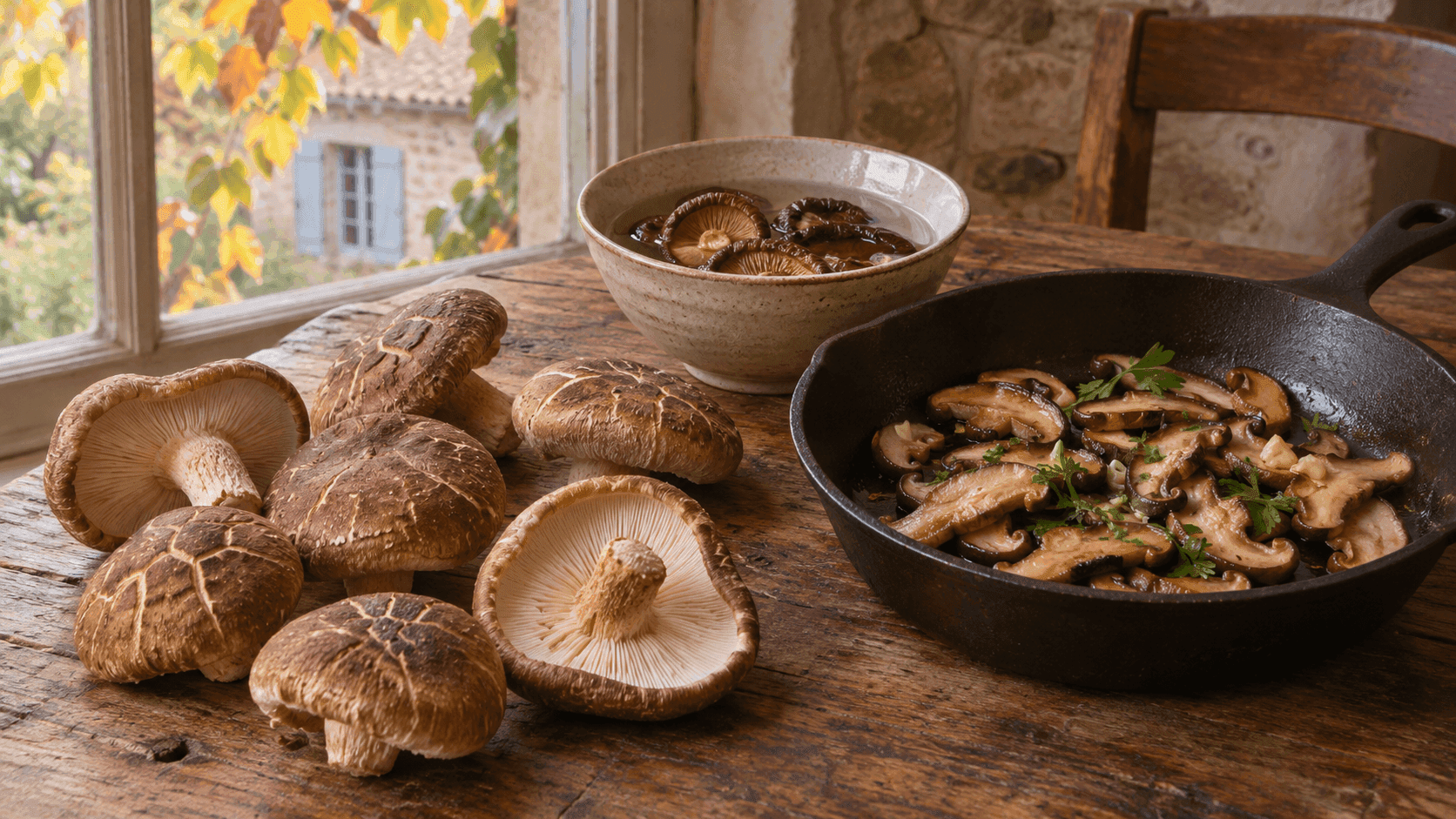
Have a look: a domed cap, reddish brown, nice and fleshy; underneath, tight gills, white turning to beige; a white stem, solid and firm. In the wild, he grows in clumps on rotting broadleaf wood, in the Far East. Here, he doesn’t grow wild in the woods: the one we buy is cultivated, and he’s even grown in France.
He’s an old kitchen companion. In China, the oldest text about growing him dates from 1209: it’s the records of a district called Longquan. In Japan, in the Edo period, people started cutting notches in tree trunks to bring him in. Today he’s the most eaten mushroom in the world after our button mushroom.
He’s still grown on logs, the old way: logs of oak, beech, birch or maple, drilled with little holes where you slip in seeded plugs. But most of them today grow in mushroom farms, on seeded compost blocks.
How to cook fresh shiitake mushrooms
The taste first, since that’s what people ask me most. Shiitake has a rich taste, a little woody, almost meaty: what the Japanese call umami. Once you’ve tasted it, you understand why they love him so much over there.
When I buy him, I choose him firm and dry, never soft or slimy. I don’t wash him under lots of water: he’d drink it up like a sponge. A damp cloth over the cap, and that’s it. The stem is as hard as wood: I cut it off and keep it to flavour a broth.
In the pan, I cook him in a drizzle of olive oil, over medium-high heat, for about ten minutes, stirring, until he’s golden and tender right to the heart. No lightning-fast wok cooking for him: two minutes in a very hot pan is too short. I’ll explain why a bit further down.
A clove of garlic, a little parsley, some salt: that’s my evening pan-fry, with an omelette or rice. He’s also good in a risotto, on a slice of toast, or with chicken stir-fried with soy sauce and ginger, the one that warms you right to your fingertips.
To keep him, he goes in the fridge in a paper bag, and he lasts about a week. But at my house, I’ll tell you, he never lasts that long.
Dried shiitake: soak it, then cook it
The dried shiitake mushroom is something else. As he dries, he takes on a stronger scent than the fresh one, and he keeps a long time, somewhere dry, cool and away from the sun. The finest have a thick cap, with deep white cracks on top. If you have too many fresh ones, you can dry them yourself, a bit like I dry my herbs in summer.
Before cooking him, you have to soak him. I brush him first, without rinsing, and put him in cold water, in the fridge, with a saucer on top so he stays under the water: about five hours for thin ones, about ten hours, so a whole night, for thick ones. Soaking slowly in the cold is what gives the best taste. When I’m in a hurry, I leave him an hour in the fridge, cut him into four, and put him back in the water for another half hour. But if he hasn’t soaked enough, he stays tough, even after long cooking. Then I squeeze him over the bowl, and I keep the water.
Whatever you do, don’t throw that water away. Strained, it makes a brown, fragrant broth, the one the Japanese put in their miso soup.
But careful, and this matters: a soaked mushroom isn’t a cooked mushroom. Once rehydrated, dried shiitake is cooked like fresh: I let him simmer for about twenty minutes over a low heat. And the broth itself, I always bring it to the boil, with the mushrooms in it, before serving.
Always well cooked: why we don’t eat shiitake raw
You see more and more raw shiitake, in salads or in thin slices. Me, I’ll tell you straight: never. Raw or not cooked enough, this mushroom can give some people a strange skin reaction, called shiitake dermatitis, or flagellate dermatitis.
It looks like whip marks: red streaks in lines that itch terribly, on the trunk, the arms, the legs, the back of the neck, sometimes the face. It shows up a few hours or a few days after the meal, often around the third day, and it can last two to three weeks before it goes away. If you eat him again, it can come back. It doesn’t happen to everyone, and the amount eaten counts too.
That goes for all his forms: fresh, dried then soaked, as a powder or as an infusion. The books say to cook him right through, and they point out that a quick toss in the wok may not be enough. They don’t give minutes: I count about ten minutes in the frying pan, about twenty in the saucepan, and I taste; he has to be tender right to the middle. In France, there are cases every year, and surely more than we think, because people don’t always make the link with the mushroom.
If it’s happened to you once, don’t put shiitake on your plate again, keep your skin out of the sun, which can bring the patches out more, and go and see your doctor, telling them what you ate.
“Shiitake isn’t for crunching raw: you cook him right through, and then you enjoy him.”
Shiitake mushroom benefits: what I can tell you
You read all sorts of promises about this mushroom, on jars of powder as on screens. Me, I won’t promise you anything. What I know is that people have eaten him for centuries in China and Japan, that he gives flavour to everything he touches, and that a bowl of his broth on a November evening is a pleasure. That’s enough for me.
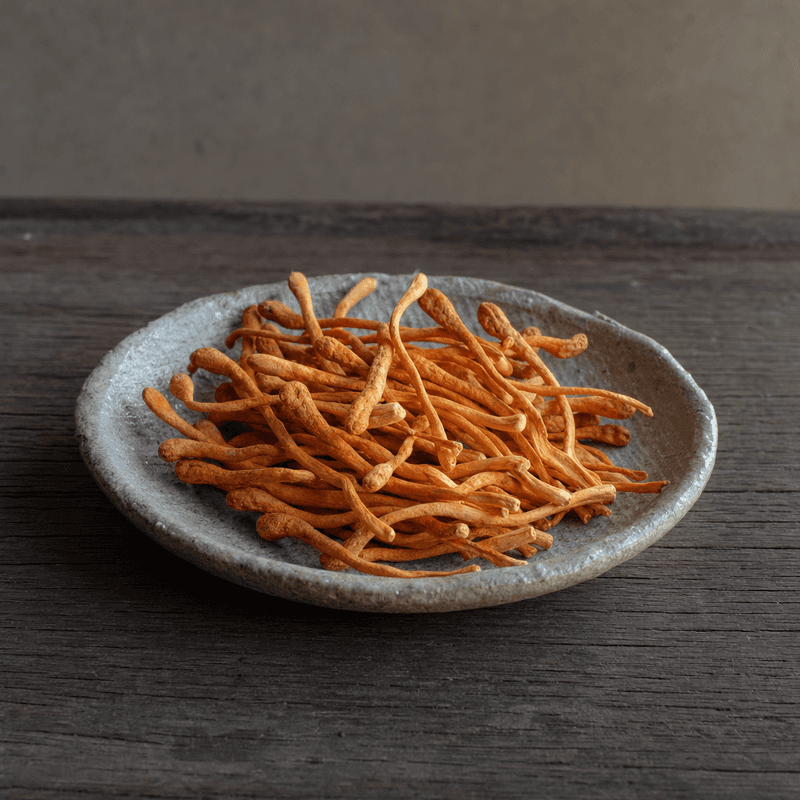
For powders and supplements, there’s no known safe amount, so I won’t give you one. Taken as a powder every day for weeks, he has even given some people stomach aches and blood problems. For the other mushrooms everyone talks about, like cordyceps, whose story I’ve already told you, I do the same: I tell you what I know, no more.
If you’re pregnant, breastfeeding, or already taking something on a doctor’s orders, stick to what goes on the plate, well cooked, and read what to know first, further down. It’s not to frighten you, it’s so that you know.
What I use him for
- · 01In the evening, pan-fried in olive oil with a clove of garlic and some parsley, next to an omelette or a bowl of rice.
- · 02Dried, put to soak the night before, for a brown, fragrant broth that ends up as miso soup.
- · 03Simmered for about twenty minutes in a sweet and savoury broth, the Japanese way, to go with rice.
- · 04His stems, too tough, I keep to flavour a broth.
- · 05In a risotto or on a slice of toast, when I want a taste of the woods.
How I prepare him
Granny’s little recipes
The evening pan-fry with garlic and parsley
In the evening, as a starter or beside an omelette, for four (20 minutes)
What you’ll need
- 300 g of fresh shiitake
- 1 tablespoon of olive oil
- 1 clove of garlic, chopped
- 1 sprig of parsley, chopped
- Salt and pepper, to taste
How I go about it
- 01Wipe the caps with a damp cloth, without soaking them, and cut off the tough stems (keep them for a broth).
- 02Cut the caps into quarters.
- 03Heat the oil in the pan over medium-high heat and put in the mushrooms, uncovered.
- 04Let them brown for about ten minutes, stirring.
- 05Lower the heat, add the garlic and parsley, and cook gently for 5 more minutes, until they’re tender right to the heart.
- 06Season with salt and pepper and serve piping hot.
Dried shiitake simmered the Japanese way
For a bowl of rice, for two (5 hours soaking in the cold, 20 minutes cooking)
What you’ll need
- 6 dried shiitake
- 250 ml of water for soaking
- 250 ml of dashi (Japanese stock)
- 1 tablespoon of sake (or water)
- 1 tablespoon of mirin
- 1 tablespoon of soy sauce
- 1 tablespoon of sugar
How I go about it
- 01Brush the mushrooms without rinsing them.
- 02Soak them in the 250 ml of cold water, in the fridge, for about 5 hours (overnight if they’re thick), with a small plate on top so they stay under the water.
- 03Squeeze them and remove the tough stems.
- 04Put the caps in a small pan with the dashi, sake, mirin, soy sauce and sugar.
- 05Heat over medium-low heat, then let simmer gently for about 20 minutes, until the liquid has almost completely reduced.
- 06Serve warm with rice. They keep 4 to 5 days in the fridge, in a closed container.
Miso soup from my shiitake broth
Soaked the night before, served in the evening, for two (25 minutes cooking)
What you’ll need
- 3 dried shiitake (5 to 10 g each)
- 500 ml of cold water
- 2 cm of fresh ginger
- 200 g of firm tofu, diced
- 3 tablespoons of miso
- 1 spring onion, sliced
How I go about it
- 01The night before, brush the mushrooms without rinsing them and put them in the cold water, with a saucer on top, in the fridge overnight.
- 02The next day, squeeze them over the bowl, strain the soaking water, remove the stems and slice the caps.
- 03Pour the soaking water into a pan with the sliced caps and the ginger in thin slices, and bring to the boil over medium heat.
- 04Turn down the heat and let simmer for 20 minutes, covered.
- 05Add the tofu and let it warm through for 3 or 4 minutes over low heat.
- 06Off the heat, dissolve the miso in a ladle of broth, pour it into the pan, sprinkle with spring onion and serve without boiling again.
Elsewhere: how others know him
My daughter, who lives in Shanghai, wrote to me that over there they call him xiānggū, the fragrant mushroom. The finest ones, thick, with white cracks on the cap like a flower, are the huāgū, the “flower mushrooms”. She finds them in soups, in braised dishes, with stir-fried vegetables. She also told me that in an old farming book, more than seven centuries ago, people were already crumbling mushrooms into notches in the wood so they would take hold there.
Keiko, my friend in Tokyo, explained where his name comes from: the shii is the tree on whose fallen trunks people found him. For her, dried shiitake is essential for the broth of temple cooking, the kind that does without fish. She prefers the donko, thick, with a cap not quite open, and she soaks them slowly in cold water, because if they’re badly soaked, they stay tough even after long cooking. That water is her broth. She says that in the Edo period people were already cutting notches in trunks, and that it was an agronomist, Mori Kisaku, who invented the little seeded wooden plugs you drive into the logs.
Me, what I like is simpler: a nicely golden pan-fry, garlic, parsley. And in winter, a bowl of that brown broth, which I always bring to a good boil with the mushrooms in it.
What to know first
This information doesn’t replace advice from a healthcare professional. Health Disclaimer →
His identity card
- Name
- Shiitake
- Other names
- Lentin du chêne, lentin comestible, fragrant mushroom; xiānggū in China
- Latin name
- Lentinula edodes (Berk.) Pegler
- Family
- A mushroom, not a plant: Omphalotaceae
- Part used
- The cap; the stem for broths
- Harvest
- Grown all year round, on logs or on compost blocks
- Form
- Fresh or dried, always cooked right through
- Origin
- China and Japan; grown today as far as France
- Storage
- Fresh, about a week in the fridge; dried, somewhere dry and out of the sun
- Good to know
- Never raw or undercooked
If you remember just one thing
- 01The shiitake mushroom is the lentin du chêne: a brown, fleshy mushroom, cultivated in China and Japan for centuries.
- 02He’s always eaten cooked right through, fresh or dried: raw or undercooked, he can bring out red streaks that itch for weeks.
- 03He isn’t washed under lots of water: a damp cloth, then about ten minutes in the pan, until he’s tender right to the heart.
- 04Dried, you soak him in cold water, and that water, strained, makes a brown, fragrant broth that you boil with the mushrooms.
- 05For powders and supplements, there’s no known safe amount: I keep him for the plate.
Your questions
The shiitake mushroom is the lentin du chêne, Lentinula edodes: a brown mushroom with a fleshy cap that grows on the dead wood of broadleaf trees. It comes from China and Japan, where it’s been cultivated for centuries, and today it’s grown as far as France. You eat it fresh or dried, always well cooked.
A rich taste, a little woody, almost meaty: what the Japanese call umami. Dried, it’s even more fragrant than fresh. That’s why its soaking water makes such a good broth.
Never raw. Raw or not cooked enough, it can give some people a skin reaction, red streaks that itch for two to three weeks. In the pan, I cook it for about ten minutes over medium-high heat, until it’s tender right to the heart; a quick toss in the wok may not be enough.
Brush it without rinsing, then soak it in cold water in the fridge, about five hours if it’s thin, overnight if it’s thick. Keep the soaking water, strained, for a broth. Then cook it like the fresh one, for example about twenty minutes over a low heat: soaked isn’t cooked yet.
Never raw or undercooked, and if you’ve already had the skin reaction, don’t eat it again. Powders and supplements aren’t for pregnant or breastfeeding women, nor for children and teenagers, nor if your body’s defences turn against your own body, as in lupus. If you already take something on a doctor’s orders, especially after a transplant, ask your doctor.
The easiest way is a ready-made kit. The old way, you drill logs of oak, beech, birch or maple, slip in seeded plugs, and wait: count on about sixteen months before the first mushrooms. Before a flush, you soak the logs for a day and a night, then leave them in the shade, somewhere cool.
References
- Avis relatif à l'évaluation des effets indésirables liés à la consommation de compléments alimentaires contenant les champignons shiitaké, reishi et maïtaké (saisine 2022-AUTO-0158) · Anses, 2026
- Intoxication par champignons shiitaké : l'Anses et la DGCCRF rappellent l'importance de bien les cuire · Anses, 2021
- La DGCCRF met en garde contre la consommation du champignon Shiitaké à l'état cru (communiqué du 21 août 2015) · DGCCRF, via DREETS Nouvelle-Aquitaine, 2015
- Shiitake mushrooms: be sure to cook them if you want to avoid itching! (Vigil'Anses no. 1) · Anses, via Ruokavirasto, 2017
- Gesundheitliches Risiko von Shiitake-Pilzen (Stellungnahme vom 23. Juni 2004) · Bundesinstitut für Risikobewertung (BfR), 2004
- Shiitake mushroom · Natural Medicines (TRC Healthcare), via vital.ly, 2026
- La saison des champignons en avance cette année : soyez vigilant face aux risques · Anses, 2021
- Lentinula edodes (Berk.) Pegler · New Zealand Organisms Register, 2026
- Shiitaké · Wikipédia, 2026
- Shiitake · Wikipedia, 2026
- 香菇 · Wikipedia (zh), 2026
- シイタケ · Wikipedia (ja), 2026
- Culture du shiitaké · Interflora, le blog
- Shiitake mushrooms · GroCycle
- Recettes au shiitaké · Comptoir du champignon
- Shiitake Dashi · Just One Cookbook
- Simmered Shiitake Mushrooms · Just One Cookbook
- Miso Soup · Just One Cookbook
- Lentinula edodes (Berk.) Pegler · GBIF, 2026
- 上手な戻し方・使い方 · 日本産・原木乾しいたけをすすめる会
- Shiitakés (lentins des chênes) sautés ail persil · Ideoz Voyages (Orange balsamique)