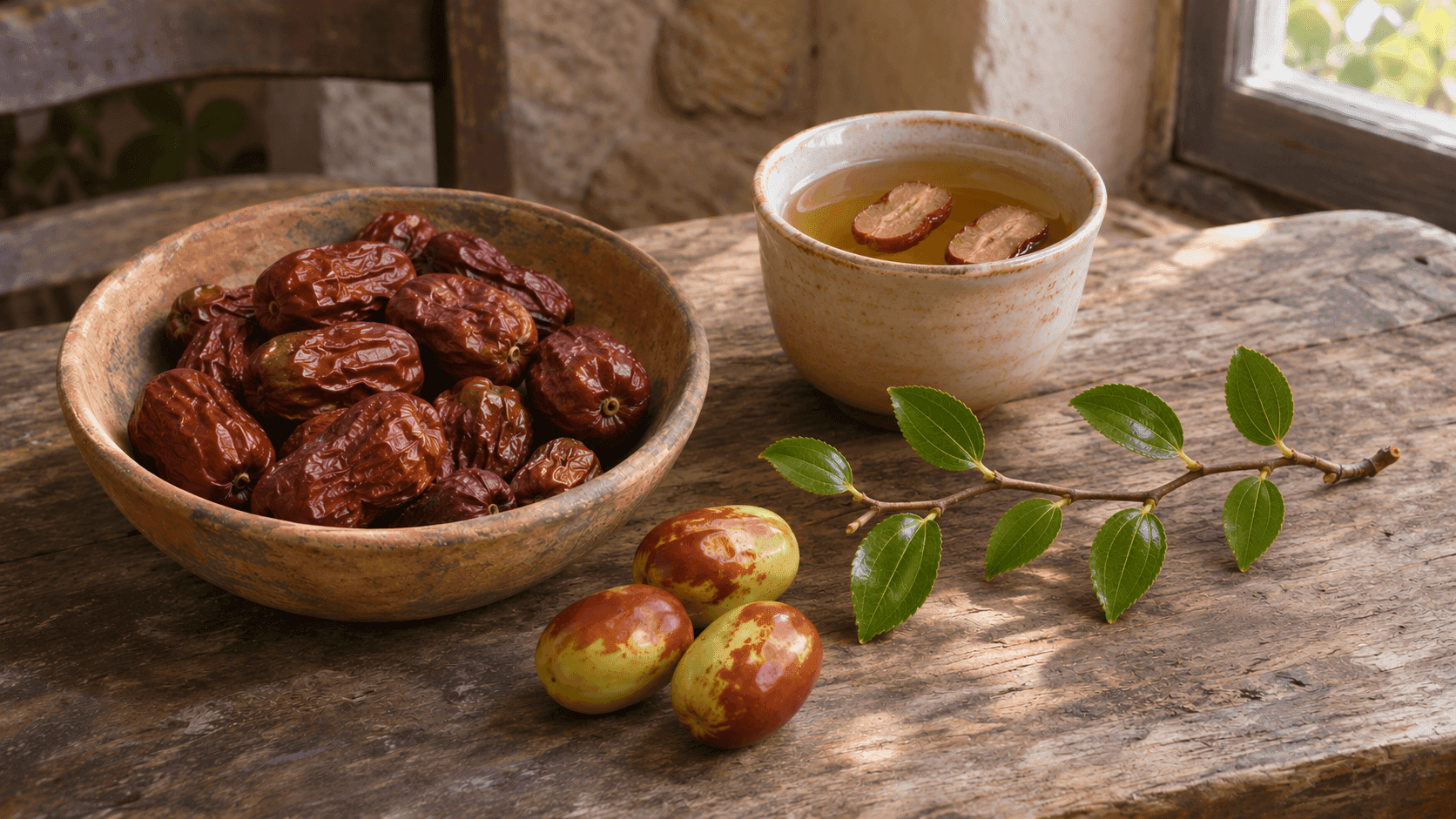
Jujube is the fruit of the jujube tree, a little red date from China that people also call Chinese date. Fresh in September, it crunches like an apple; dried, you nibble it like a date, or simmer it into a tea on grey days.
Who he really is
Family: Buckthorn family (Rhamnaceae). The jujube tree first grew in northern and eastern China, as far as Korea, and it has been grown around the Mediterranean for a long time.
Part used: the fruit, fresh or dried.
Jujube is the fruit of the jujube tree, a thorny tree from China. People also call it Chinese date or red date. Fresh, it crunches like an apple; dried, it tastes like a date. I simmer it in water, I nibble it, and I put it in my winter saucepans.
His story
Jujube is the fruit of the jujube tree, a little red date from China that people also call Chinese date. Fresh, at the end of summer, it crunches between your teeth like a little apple. Dried, it wrinkles, turns brown and soft: I nibble it like a date, and on grey days it ends up as a tea, in a saucepan simmering away.
Jujube: what is it, exactly?
Its proper name is Ziziphus jujuba. The tree is the jujube tree, from the buckthorn family, the Rhamnaceae. It first grew in northern and eastern China, as far as Korea, and over there people have been growing it for more than four thousand years. Four thousand years: next to that, my garden has only just been born.
It’s a tree that takes its time. It grows slowly, it twists, and its branches are full of thorns. It can reach 9 m. Its leaves drop in winter, and in autumn they turn a lovely yellow before they go. In June it makes tiny greenish-yellow flowers, 3 or 4 mm across, that you barely notice, but that smell wonderful.
The fruit is a drupe, like an olive: 15 to 30 mm long, with a hard, elongated stone in the middle. It starts green, turns yellow, then red, and goes brown as it ripens. People also call it Chinese date or red date, and in Languedoc and Provence, in the south of France, chichourle. The tree then becomes the chichourlier.
Watch out for a word trap. When our grandmothers in France asked the pharmacist for “jujube”, they didn’t always mean the fruit: it was also a soothing preparation made from it, often as a paste. That’s where jujube paste gets its name.
From the Chinese jujube tree to the farmyards of southern France
The jujube tree travelled long before we did. The books say a Roman consul, Sextus Papinius, brought it from Syria to Italy at the start of our era. They even say Homer talks about it in the Odyssey: the “lotus” the Lotus-eaters ate would have been the jujube. I wasn’t there, so I’m telling you as it was told to me.
In France, the word is old: people were already talking about a “decoction of jujubes” around 1256. Jujube was one of the four “chest fruits”, the quatre fruits pectoraux, along with dates, figs and currants. They were boiled together into a decoction. My mother always had her jar of chest fruits on the shelf, just above her recipe notebook, the one I’ve already opened for you.
In the south of France, the jujube tree had its place in gardens and Provençal farmyards. In the 70s and 80s, jujubes were still sold in the streets of Marseille, in paper cones like chips. Today hardly anyone grows them in France any more, but a few fruit growers are taking them up again. That’s why you see so few at the market, and why you wonder where to find jujubes: fresh, you have to watch out for them in autumn; dried, they keep, so you can find them all year round.
If you have a really warm spot, the jujube tree isn’t fussy. It takes winters down to minus 15 °C, and because it flowers late, in June, it escapes the spring frosts. But to bear fruit, it needs full sun and heat. It makes do with poor soil, even stony soil, prefers it dry and light, and hates heavy soil that holds water. Be patient: a grafted tree gives its first fruit three years after planting, and it’s in full production at around twelve years.
People often ask me whether the jujube tree is self-fertile. It depends on the variety. Some, like ‘Li’, fruit with a single tree. But the gardening books advise planting two different varieties: the fruit sets better, and it’s bigger. And jujube seeds? They’re inside the stone. You can sow them, but sowing is mostly for growing rootstocks: for good fruit, you take cuttings, layer or graft.
Jujube benefits: what the old books say
I’m not going to promise you the moon. In France, jujube was a fruit for the chest: the old manuals used it in a decoction, as something soothing, with the other chest fruits. In China, the pharmacopoeia gives it when you’re eating little and feeling short of strength. That’s what they say about it, not a word more.
For an everyday decoction, the Chinese pharmacopoeia counts 6 to 15 g of dried jujubes a day, split or stoned before use. I split them with a knife, put them in 500 ml of cold water, bring it to the boil and let it simmer gently for 20 minutes. I drink the broth through the day and eat the softened fruit. If you’re pregnant, breastfeeding, or already take something on a doctor’s orders, ask your doctor before making it a habit: I’ve put all that further down, in what to know first.
The jujubes in my decoction are my dried jujubes, the ones I keep in a jar. I weigh them the first time, and after that I go by eye.
“Jujube won’t change your life: it’s a sweet fruit that warms a saucepan on grey days.”
Fresh jujube, dried jujube: taste, picking and the larder
Fresh jujubes are picked by hand from early September to early October in the south of France. You have to wait until they’re fully ripe on the tree, because once picked, they don’t ripen any more. They’re ready when they come away on their own. And if it rains hard just then, they split very quickly.
What does jujube taste like? Fresh, it crunches and tastes like a green apple, only less sharp. The browner it gets, the sweeter it gets. Dried, it wrinkles like a date and takes on its taste, less sweet, with a little bitterness in the skin. Inside, the flesh is light and a bit sticky, like a marshmallow.
Fresh, it keeps a week in the kitchen, and a good two weeks in the fridge, at about 4 °C. For winter, you dry it in the sun on a rack for a fortnight or so; dried, it keeps for several years, somewhere dry, in a jar shut tight so the little creatures can’t get in. I told you how I dry my herbs in my July letter: it’s the same patience.
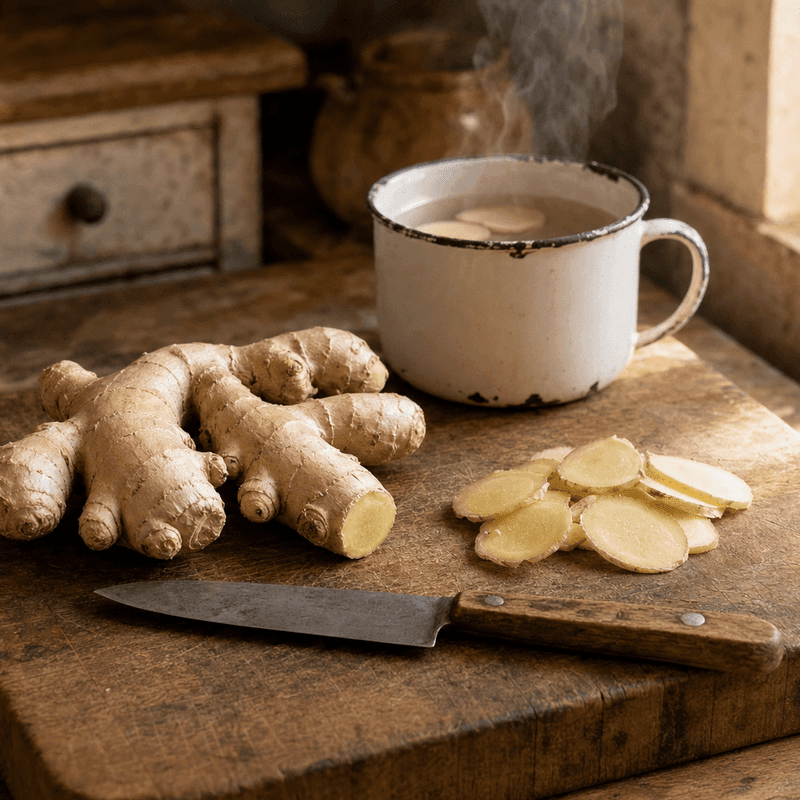
How do you eat jujube? Fresh, I crunch it just as it is, like an apple. Dried, I nibble it like dried fruit, or chop it into yogurt, porridge or a salad, anywhere I’d put raisins. And in winter it simmers with fresh ginger, the kind that warms you to your fingertips and a pinch of cinnamon. I give you the recipe further down.
African jujube, Yemeni honey: the jujube tree’s cousins
The jujube tree has cousins, and people often mix them up. The Indian jujube, Ziziphus mauritiana, grows in Africa and Asia, and it’s very common in the Sahel: in Senegal its fruit is called sidem. The Christ’s thorn jujube, Ziziphus spina-christi, known as sidr, gives the jujube honey gathered in the mountains and deserts of Yemen. And Ziziphus lotus is a very thorny bush you find in Tunisia, for instance, with tiny fruit.
Everything I tell you on this page is about the Chinese jujube, Ziziphus jujuba, and only about him.
What I use him for
- · 01On grey days, as a decoction: 6 to 15 g of dried jujubes, split, 20 minutes over a low heat; I drink the broth and eat the fruit.
- · 02On a winter Sunday, a saucepan for four, with fresh ginger and a pinch of cinnamon.
- · 03In September, fresh, crunched like an apple.
- · 04Dried, nibbled like dried fruit, or chopped into yogurt, porridge or a salad.
- · 05For winter: dried in the sun on a rack, then stored somewhere dry in a jar.
How I prepare him
Granny’s little recipes
The grey-day decoction
In the afternoon, when it’s grey and cold
What you’ll need
- 6 to 15 g of dried jujubes (for the whole day)
- 500 ml of cold water
How I go about it
- 01Split the jujubes with a knife, or take out the stone.
- 02Put them in a saucepan with the cold water.
- 03Bring to the boil, then let it simmer gently for 20 minutes.
- 04Drink the broth through the day and eat the fruit. No more than 6 to 15 g of jujubes over the day.
The Sunday saucepan: jujube, ginger and cinnamon
On a winter Sunday, for four cups (30 minutes)
What you’ll need
- 60 g of dried jujubes (15 g per person)
- 15 g of fresh ginger, peeled and thinly sliced
- 1 litre of water
- Half a teaspoon of ground cinnamon
- A little honey, if you like it sweeter
How I go about it
- 01Rinse the jujubes in cold water, then cut them in half, minding the stone.
- 02Put the jujubes, ginger, cinnamon and water in a saucepan.
- 03Bring to a simmer, then let it simmer for 15 to 20 minutes with the lid ajar.
- 04Strain, pressing the jujubes with a ladle so the pulp goes through, add honey if you like, and pour four cups, one each.
My dried jujubes for winter
In September, when the jujubes come away on their own (about a fortnight)
What you’ll need
- Fully ripe fresh jujubes, with no spots or splits
- A drying rack and a spot in full sun
- A jar that shuts tight
How I go about it
- 01Pick them fully ripe: once picked, they don’t ripen any more.
- 02Spread them in a single layer on the rack, in the sun.
- 03Leave them to dry for about a fortnight, until they’re brown and well wrinkled.
- 04Store them somewhere dry, in a jar that shuts tight: they keep for several years.
Elsewhere: how others know him
My daughter, who lives in Shanghai, once wrote to tell me that over there, dried jujube is called hóng zǎo, the “red date”. It goes into desserts, and with rice, in a sweet porridge left to simmer for a long time.
Mine is simpler: my split jujubes simmering in the saucepan, and the warm bowl in my hands. Just the sweetness.
What to know first
This information doesn’t replace advice from a healthcare professional. Health Disclaimer →
His identity card
- Name
- Jujube
- Other names
- Chinese date, red date, chichourle (in southern France)
- Latin name
- Ziziphus jujuba Mill.
- Family
- Buckthorn family (Rhamnaceae)
- Part used
- The fruit, fresh or dried
- Harvest
- From early September to early October, fully ripe
- Form
- Fresh fruit, dried fruit, decoction
- Origin
- Northern and eastern China, as far as Korea
- Storage
- Fresh, one to two weeks; dried, several years somewhere dry
If you remember just one thing
- 01Jujube is a little red date from China: fresh, it tastes like a green apple; dried, like a date.
- 02In France, it’s been known since the Middle Ages: with dates, figs and currants, it was one of the four chest fruits.
- 03For an everyday decoction, the Chinese pharmacopoeia counts 6 to 15 g of dried jujubes, split or stoned.
- 04Jujube doesn’t ripen any more once picked: you wait until it comes away from the branch on its own, in September.
- 05The Indian jujube of Africa and the tree behind Yemeni jujube honey are cousins, not the same tree.
Your questions
I’m not promising you anything, I’m telling you what people have done with it for a long time. In France, with dates, figs and currants, jujube was one of the four chest fruits that were boiled into a soothing decoction. In China, the pharmacopoeia gives it when you’re eating little and feeling short of strength. Beyond that, it’s a sweet fruit, and that’s already a lot.
Fresh, it crunches and tastes like a green apple, only less sharp. Dried, it wrinkles and reminds you of a date, less sweet, with a little bitterness in the skin. Fresh, I crunch it as it is; dried, I nibble it, chop it into yogurt or porridge, or simmer it into a decoction.
For an everyday decoction, the Chinese pharmacopoeia gives 6 to 15 g of dried jujubes a day. I weigh them the first time, then go by eye. If you’re pregnant, breastfeeding, or take something on a doctor’s orders, ask your doctor before making it a habit.
It’s also called Chinese date or red date, and in Languedoc and Provence, chichourle. The tree is the jujube tree, or chichourlier. In China, the dried fruit is called hóng zǎo, the red date.
It depends on the variety. Some, like ‘Li’, fruit with a single tree. But the gardening books advise planting two different varieties: the fruit sets better and it’s bigger.
No, they’re cousins. In Africa you often come across the Indian jujube, Ziziphus mauritiana, very common in the Sahel; in Senegal its fruit is called sidem. Yemeni jujube honey comes from the Christ’s thorn jujube, Ziziphus spina-christi, known as sidr. Everything I tell you here is about the Chinese jujube, Ziziphus jujuba.
References
- Ziziphus jujuba Mill. · Plants of the World Online, Royal Botanic Gardens, Kew, 2026
- Da-zao, fruit de Ziziphus jujuba (枣果实), Pharmacopée chinoise 2020 · ShennongAlpha, Westlake University, 2020
- Glossary on herbal teas (EMA/HMPC/5829/2010 Rev.1) · European Medicines Agency, HMPC
- Zizyphus · RxList, 2026
- Risques d'étouffement : à surveiller jusqu'à 4 ans · INSPQ, Mieux vivre avec notre enfant, 2026
- Fiche technique Jujubier (projet DiversiGO) · Bio de PACA, Ecophytopic, 2022
- Jujube: Chinese Date in New Mexico (Guide H-330) · New Mexico State University
- Jujube · CNRTL, Trésor de la langue française informatisé
- Pectoral · CNRTL, Trésor de la langue française informatisé
- Jujube (fruit) · Wikipédia, 2026
- Jujubier commun · Wikipédia, 2026
- Jujube · Wikipedia, 2026
- Sextus Papinius Allenius · Wikipedia, 2026
- Ziziphus mauritiana · Wikipédia, 2026
- Ziziphus spina-christi · Wikipédia, 2026
- Miel de jujubier · Wikipédia, 2026
- Dried jujubes are for snacking and steeping · Cook's Illustrated, America's Test Kitchen
- Jujube Ginger Tea · UCLA Health, Simms/Mann Center
- Healthy sweet congee · SBS Food, 2015