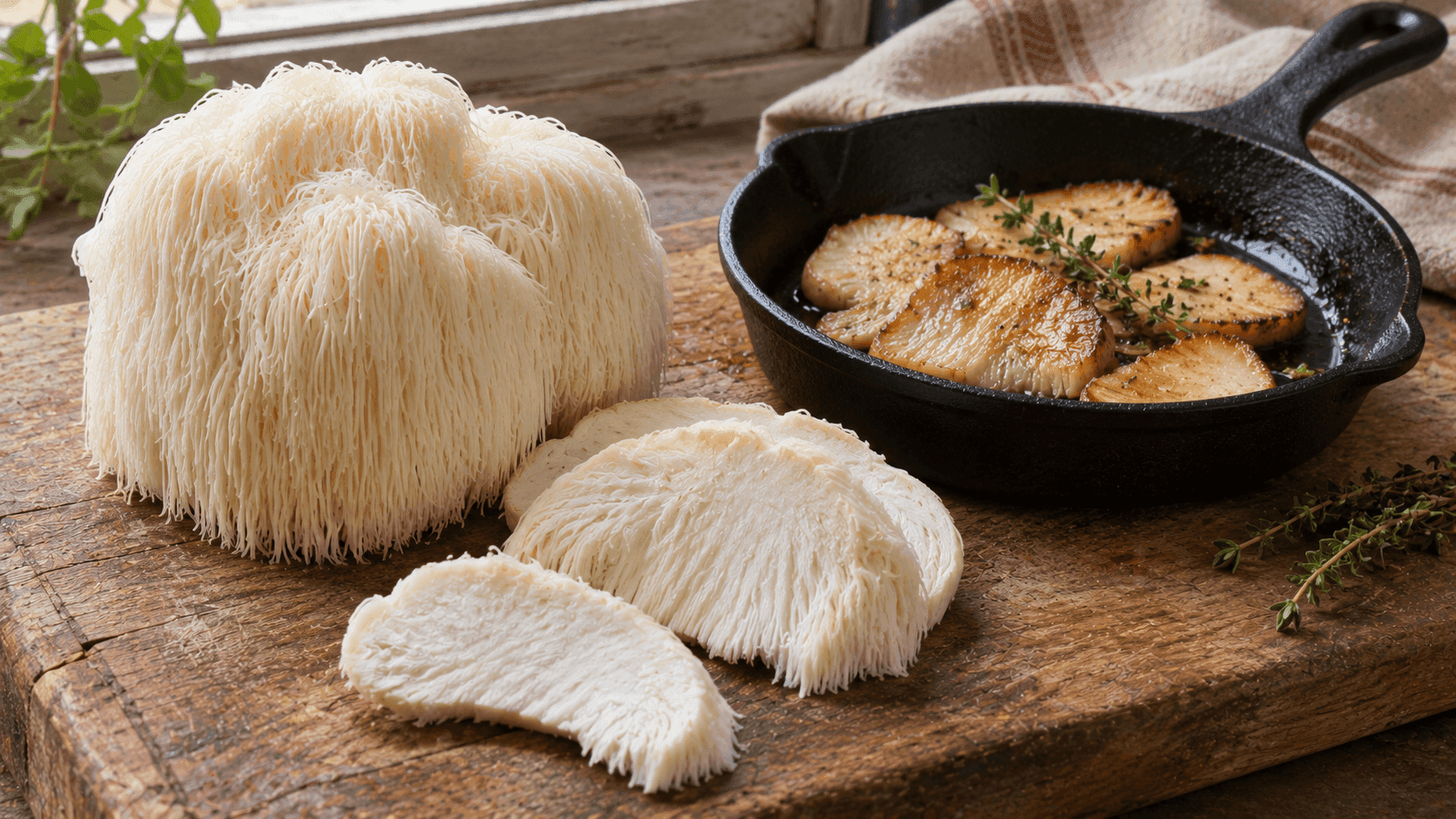
Lion’s mane, the French hydne hérisson or crinière de lion: a white mushroom made of spines, rare in our woods, that I buy cultivated and brown in butter.
Who he really is
Family: he isn’t a plant, he’s a mushroom, from the Hericiaceae family. He grows on the wood of broadleaf trees all over the Northern Hemisphere; the one we eat is cultivated.
Part used: the whole mushroom, fresh or dried, always cooked.
Lion’s mane is the mushroom the French call hydne hérisson, the hedgehog mushroom, also known as crinière de lion: a white mushroom with no cap, covered in long, soft, hanging spines. You eat him young and cooked, and his flesh is a bit like crab. He’s rare in our woods, so I buy him cultivated.
His story
Lion’s mane, in French hydne hérisson or crinière de lion, is a white mushroom made of spines, which grows on old broadleaf trees and is eaten cooked. It looks like a ball of wool stuck to a trunk, or an old wise man’s beard. I buy it cultivated, and I brown it in the frying pan.
Lion’s mane, hydne hérisson, crinière de lion: three names for one mushroom
His scientific name is Hericium erinaceus. He isn’t a plant, he’s a mushroom, from the Hericiaceae family. The first person to describe him was a French botanist, Pierre Bulliard, in 1781, in his Herbier de la France. He called him “hydne hérisson”, the hedgehog hydnum: erinaceus means hedgehog in Latin. In 1797 another scholar, Persoon, put him in the genus Hericium, and the name stuck.
Lion’s mane is the English name, and in French it becomes crinière de lion. That’s the name you come across most often today, on market stalls and on labels alike. So if you’re wondering what lion’s mane is called in French, there you are: hydne hérisson, or crinière de lion. He’s also called pompon blanc, the white pompom, and in China, monkey head. One mushroom, and everyone sees their own animal in it.
He looks like nothing else. No cap, no stem: a hanging white mass, ten to twenty centimetres or so, covered in long soft spines of 2 to 7 cm, packed close like a fringe. Fresh, he’s pure white. As he dries, he turns yellow, then brown. His flesh is white, soft and thick.
The hydne hérisson in our woods: rare, so we leave him be
In the wild, the hydne hérisson grows alone, on the wood of broadleaf trees, living or freshly cut: mostly beech and oak, but also walnut, fruit trees, ash or plane trees. He’s found all over the Northern Hemisphere, and in Europe he comes up mostly from August to November.
That doesn’t mean he’s common here, quite the opposite. In France, several regions have put him on their red list of threatened mushrooms: critically endangered in Franche-Comté, endangered in Poitou-Charentes, vulnerable in Alsace and Midi-Pyrénées, near threatened in Auvergne-Rhône-Alpes. Elsewhere, from Lorraine to Occitanie, he’s one of the species used to spot the most precious corners of nature. In 2003 there was even a proposal to list him among 33 mushrooms to protect in Europe; it didn’t go through.
So I’ll tell you what I think: if you see one on an old beech tree, have a good look, take a photo if you like, and leave him where he is. And the old rule applies to him as to all the others: you only pick mushrooms you know perfectly, and at the slightest doubt, you don’t eat them.
Bulliard already wrote that he was eaten “in several of our provinces, and notably in Lorraine”. The old mushroom books say he’s good when young, even if he can be tough. But today, the one we eat is the cultivated mushroom, and that’s just fine.
How to cook lion’s mane
Where can you find lion’s mane? At some mushroom growers, at a few markets, in shops that sell mushrooms from elsewhere: he’s even grown in France. Fresh, he should be pure white, with no yellow or brown patches.
The taste is what surprises people. He’s mild, a little sweet, and his flesh pulls apart in strands, so much so that many people find his texture like crab or lobster. I wouldn’t go as far as lobster, but it’s true that he’s a bit like crab meat.
First thing: don’t put him under the tap. He soaks up water like a sponge. A brush, or a barely damp cloth, and that’s it. I only cut him at the last minute, into slices a good centimetre thick, or I pull him apart with my fingers.
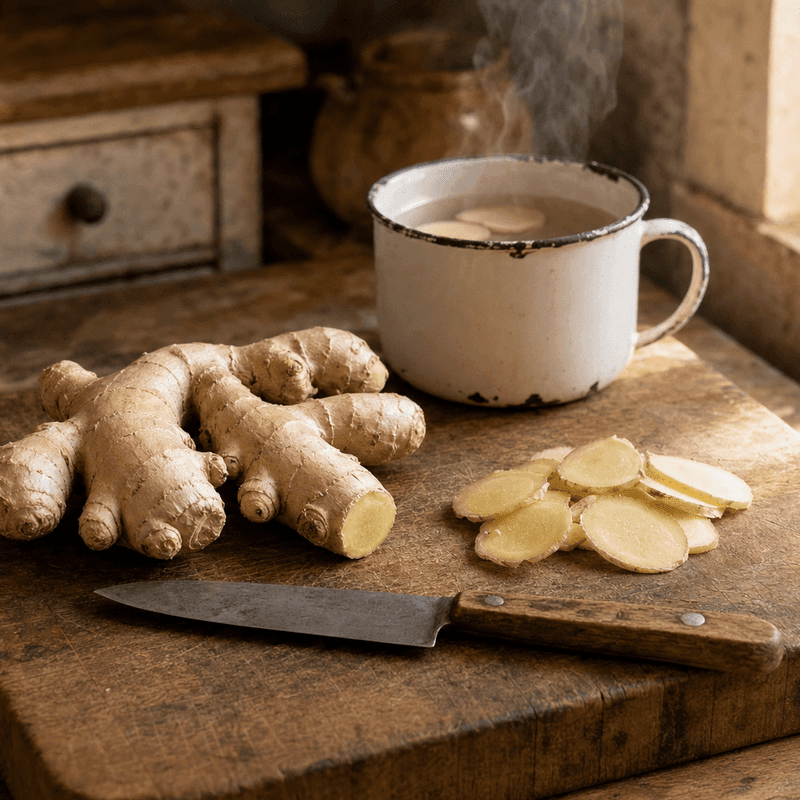
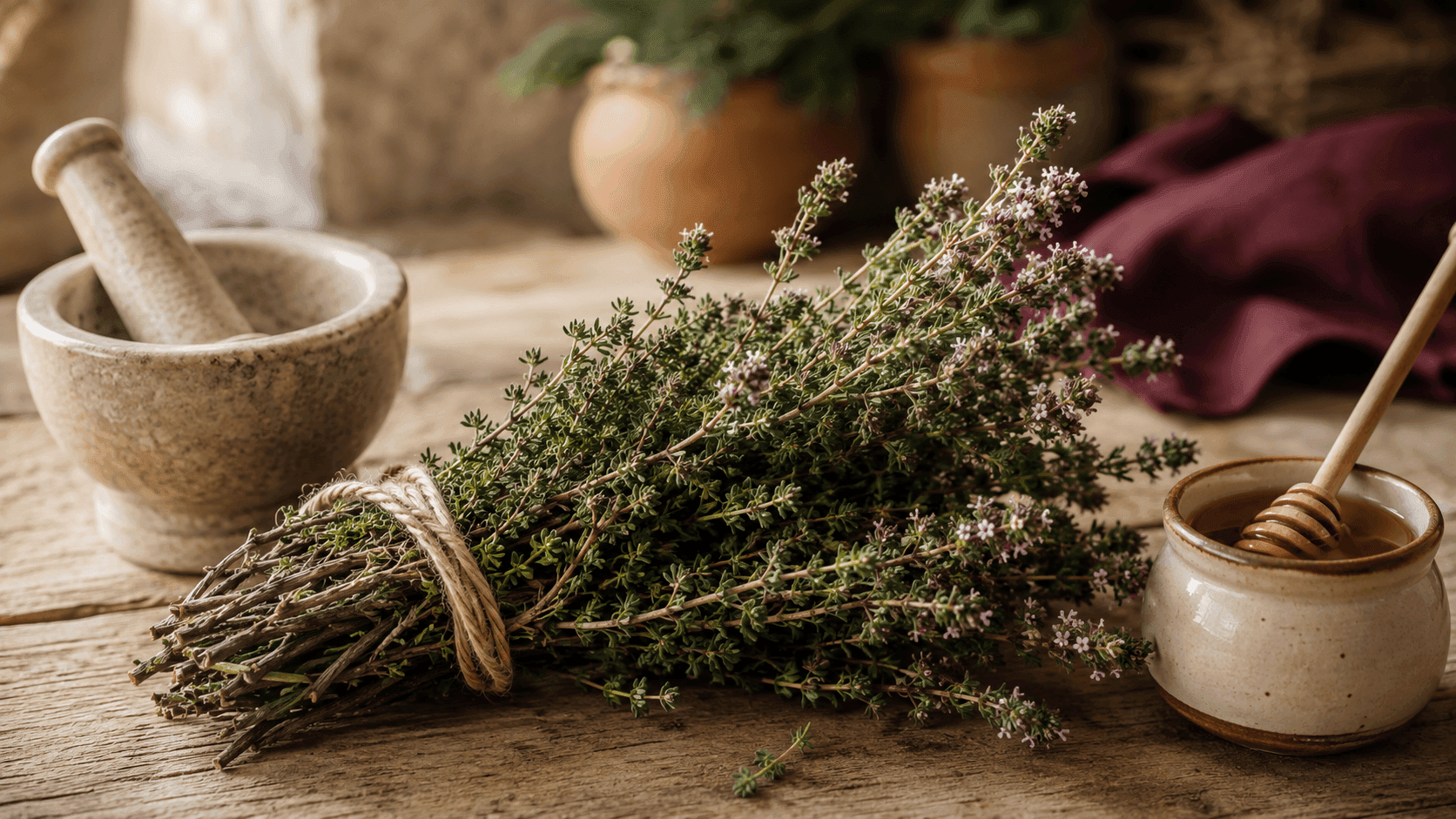
Second thing: I always eat him cooked. Raw, he’s stringy and a bit bitter. In the pan, I brown him for 3 minutes on each side in a mix of butter and olive oil, with a sprig of thyme, the one I put in everything and a pinch of salt. When I have a lot, I start in a dry pan so he gives up his water, and I add the butter afterwards. In a broth, I pull him into pieces and let him simmer for a few minutes, with a little grated fresh ginger, the kind that warms you to your fingertips. I give you my three recipes further down.
To keep him, he goes in the fridge, in a paper bag, never in plastic: he’ll last up to a week, but I cook him within two or three days. Cooked, he keeps for five days in the fridge. Dried, in a tightly closed jar, somewhere cool and dark, he keeps up to six months; you soak him for about twenty minutes in warm water before cooking.
“Lion’s mane isn’t a potion: he’s a good mushroom, eaten cooked, browned in butter.”
Growing lion’s mane at home
How do you grow lion’s mane? The simplest way is a ready-made grow bag: sawdust and grain, already taken over by the mushroom’s white threads, what we call mycelium.
He needs coolness, between 16 and 21 °C, lots of humidity, and a little light, but no direct sun and no draughts, which dry him out. You cut a cross in the bag, without cutting what’s inside, and you set the bag above 2 cm of water, in a big tub, without letting it sit in the water.
You pick when the ball is the size of a fist, before it releases its spores. After the harvest, the bag rests a few days in the fridge, then you dip it in water for a few minutes and start again. Usually you get up to three harvests.
My grandson gave me a bag one winter. The morning the first white ball came out of the cut, I called the whole house to come and see. At my age, you take your wonders where you can.
Lion’s mane benefits: what I can tell you
You read a lot about the benefits of lion’s mane these days, on labels and on screens. I won’t promise you anything. What I know is that he’s a mushroom people have eaten for a long time, here as in China, and that he’s good on the plate, cooked.
As for what’s sold as powder, you need to know what it is. The mushroom itself, dried and ground, is a food in Europe. But many powders are made from mycelium, the white threads that grow in the wood before the mushroom. And mycelium powder isn’t yet authorised as a food in Europe. Read the label carefully.
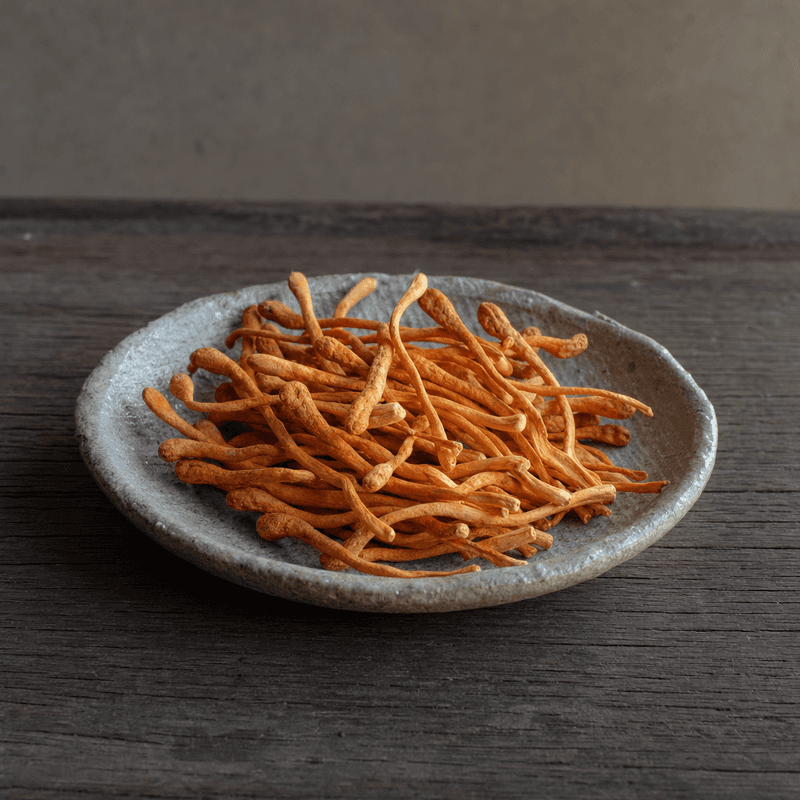
For powders and supplements, there’s no official amount in Europe, so I won’t give you one. For the other mushrooms everyone talks about, like cordyceps, whose story I’ve already told you, I do the same: I tell you what I know, no more.
If you’re pregnant, breastfeeding, already taking something on a doctor’s orders, or due for an operation soon, read what to know first, further down. It’s not to frighten you, it’s so that you know.
What I use him for
- · 01At lunchtime, in slices browned in butter and thyme, on a piece of toast.
- · 02On Sundays, cooked in a dry pan then browned in butter, with a dash of soy sauce, as a side dish.
- · 03On autumn evenings, pulled apart into a miso soup, with fresh ginger.
- · 04Grown at home in a grow bag, and picked when he’s the size of a fist.
- · 05In the woods, I look at him and leave him: here, he’s rare.
How I prepare him
Granny’s little recipes
Golden slices with thyme
At lunchtime, for two (10 minutes)
What you’ll need
- 225 g of fresh lion’s mane
- 1 tablespoon of olive oil
- 1 tablespoon of butter
- 2 sprigs of fresh thyme
- 1 pinch of salt (a quarter of a teaspoon)
- 2 slices of toast, if you like
How I go about it
- 01Clean the mushroom with a brush, no water, and cut it into slices a good centimetre thick.
- 02Heat the oil and butter over medium heat until the butter melts and sizzles.
- 03Lay the slices in a single layer and let them brown for 3 minutes.
- 04Turn them over and let them brown for another 3 minutes.
- 05Add the thyme leaves and the salt, and cook 1 more minute, stirring gently.
- 06Serve piping hot, on the toast if you like.
Dry-pan lion’s mane for the Sunday table
On Sunday, as a side dish, for four (15 minutes)
What you’ll need
- 450 g of fresh lion’s mane
- 2 to 4 tablespoons of butter or olive oil
- 1 tablespoon of soy sauce
- Salt, to taste
How I go about it
- 01Clean the mushroom with a brush, no water, and cut it into slices.
- 02Put the slices in a dry frying pan over medium-high heat and cook them for a few minutes on each side, so they give up their water.
- 03Add the butter or oil and let them brown for about 2 minutes.
- 04Sprinkle with soy sauce, salt to taste, and serve straight away.
Miso and ginger soup
An autumn evening, for two (15 minutes)
What you’ll need
- 225 g of fresh lion’s mane
- 500 ml of dashi stock
- 3 to 4 tablespoons of white miso (start with 3)
- 250 ml of warm water
- 2 cloves of garlic, thinly sliced
- 1 teaspoon of grated fresh ginger
- 2 to 3 handfuls of baby spinach
- 2 or 3 spring onions, thinly sliced
How I go about it
- 01Clean the mushroom with a brush and pull it apart into bite-sized pieces.
- 02Bring the stock to a simmer, add the mushroom and let it simmer for 2 to 3 minutes.
- 03Separately, whisk 3 tablespoons of miso into the warm water until there are no lumps.
- 04Pour this miso into the pan with the garlic, ginger, spinach and spring onions, and heat until the spinach wilts, without letting it boil.
- 05Taste: too salty, add a little water; not enough, a little more miso. Serve hot.
Elsewhere: how others know him
My daughter, who lives in Shanghai, wrote to me that over there they call him hóutóugū, the “monkey head” mushroom. In fact it was in Shanghai, around 1960, that people learned to grow him, and today China grows enormous amounts of him, in bags, on sawdust. In the old days he was a dish for grand tables: he was counted, with bird’s nest, shark fin and sea cucumber, among the four most famous dishes. People even said he had the savour of meat, while being a mushroom.
Keiko, my friend in Tokyo, calls him yamabushitake. The yamabushi are mountain hermits, and the mushroom looks like the big round pompoms they wear on their chests. In one corner of Kagoshima, he’s even nicknamed the drinking mushroom, because once dried, he soaks up water like nobody else. Over there, since he hasn’t much taste of his own, they mostly put him in soups, so he takes on the taste of the broth.
What I like is simpler: a slice well browned in butter, a pinch of thyme, and some bread. No grand table and no pompom, just a good mushroom.
What to know first
This information doesn’t replace advice from a healthcare professional. Health Disclaimer →
His identity card
- Name
- Lion’s mane
- Other names
- Hydne hérisson and crinière de lion in French, pompom mushroom; hóutóugū in China, yamabushitake in Japan
- Latin name
- Hericium erinaceus (Bull.) Pers.
- Family
- A mushroom, not a plant: Hericiaceae
- Part used
- The whole mushroom, fresh or dried
- Harvest
- Grown in bags; in the wild from August to November, not to be picked
- Form
- Fresh mushroom, cooked; dried mushroom
- Origin
- Northern Hemisphere; grown mostly in China
- Storage
- Fresh, up to a week in the fridge; dried, up to six months
- In France
- Rare, on the red list of several regions
If you remember just one thing
- 01Lion’s mane is the hydne hérisson, or crinière de lion: a white mushroom made of spines, eaten young and cooked.
- 02In France he’s rare in the woods and on the red list of several regions: we leave him, and eat the cultivated one.
- 03He isn’t washed with water: a quick brush, then into the pan, browned in butter, 3 minutes on each side.
- 04His flesh pulls apart in strands, and many people find his texture like crab.
- 05For powders and supplements, there’s no official amount in Europe, and mycelium powder isn’t yet authorised there as a food.
Your questions
In French, lion’s mane is called hydne hérisson, or crinière de lion. It’s Hericium erinaceus, a white mushroom with no cap, covered in long soft spines, that grows on the wood of broadleaf trees. You eat it young and cooked.
I won’t promise you anything. First of all it’s a good mushroom, eaten for a long time: in 1781 Bulliard already said it was eaten in Lorraine, and in China it was a dish for grand tables. I eat it for the pleasure of it, browned in butter.
There’s no official amount in Europe for powders and supplements, so I won’t give you one. Know that the dried, ground mushroom is a food, but mycelium powder isn’t yet authorised as a food in Europe. If you want to take some, talk to your doctor or pharmacist, especially if you already take something on a doctor’s orders.
Mostly stomach upsets have been reported, and a few allergies: a skin one in someone who handled it at work, and a serious lung reaction in a man who was taking an extract. The books also say it might lower blood sugar and slow blood clotting. If you’re pregnant, breastfeeding, or taking something on a doctor’s orders, ask your doctor first.
Don’t wash it, it soaks up water: brush it, then cut it into slices a good centimetre thick. Brown it 3 minutes on each side in butter and a little olive oil, with thyme and a pinch of salt. You can also pull it apart into a broth. Always cooked, never raw.
Cultivated, at some mushroom growers and a few markets, or as a grow bag to raise at home, between 16 and 21 °C. In the woods, leave it: it’s rare in France and on the red list of several regions. And you never eat a mushroom you don’t know perfectly.
References
- Hericium erinaceus (Bull.) Pers., 1797 : statuts (listes rouges régionales, ZNIEFF) · INPN, Muséum national d'Histoire naturelle (TAXREF), 2026
- Novel Food Status Catalogue : Hericium erinaceus (POL-NF-00396) · Commission européenne, 2026
- Lion's mane mushroom · Natural Medicines (TRC Healthcare), via vital.ly, 2026
- Occupational allergic contact dermatitis from the mushroom White Pom Pom (Hericium erinaceum) · Contact Dermatitis (PubMed), 1999
- Hericium erinaceum (yamabushitake) extract-induced acute respiratory distress syndrome monitored by serum surfactant proteins · Internal Medicine (PubMed), 2003
- La saison des champignons en avance cette année : soyez vigilant face aux risques · Anses, 2021
- Hericium erinaceus · Wikipédia, 2026
- Hericium erinaceus · Wikipedia, 2026
- ヤマブシタケ · Wikipedia (ja), 2026
- Hydnum repandum (pied-de-mouton) · Wikipédia, 2026
- 猴頭菇的生理功能 · Université nationale d'Ilan (Taïwan), centre de vulgarisation agricole
- Étrangeté du vivant : un curieux champignon blanc et velu pousse sur les arbres · Futura Sciences
- Lion's Mane (Hericium erinaceus) cultivation · Mycoboutique
- How to Cook Lion's Mane Mushroom · GroCycle
- Sauteed Lion's Mane Mushroom · Immigrant's Table
- Lion's Mane Mushroom Miso Soup · Babaganosh