The goji berry is the little red fruit of the wolfberry, a thorny shrub from China, cousin to the tomato. Dried, I nibble it, steep it or drop it in soup, 6 to 12 g a day.
Who she really is
Family: Nightshade family (Solanaceae). The wolfberry comes from northern and central China. It's grown mostly in Ningxia, and a little in France too.
Part used: the fully ripe berries, most often dried, or fresh from the garden.
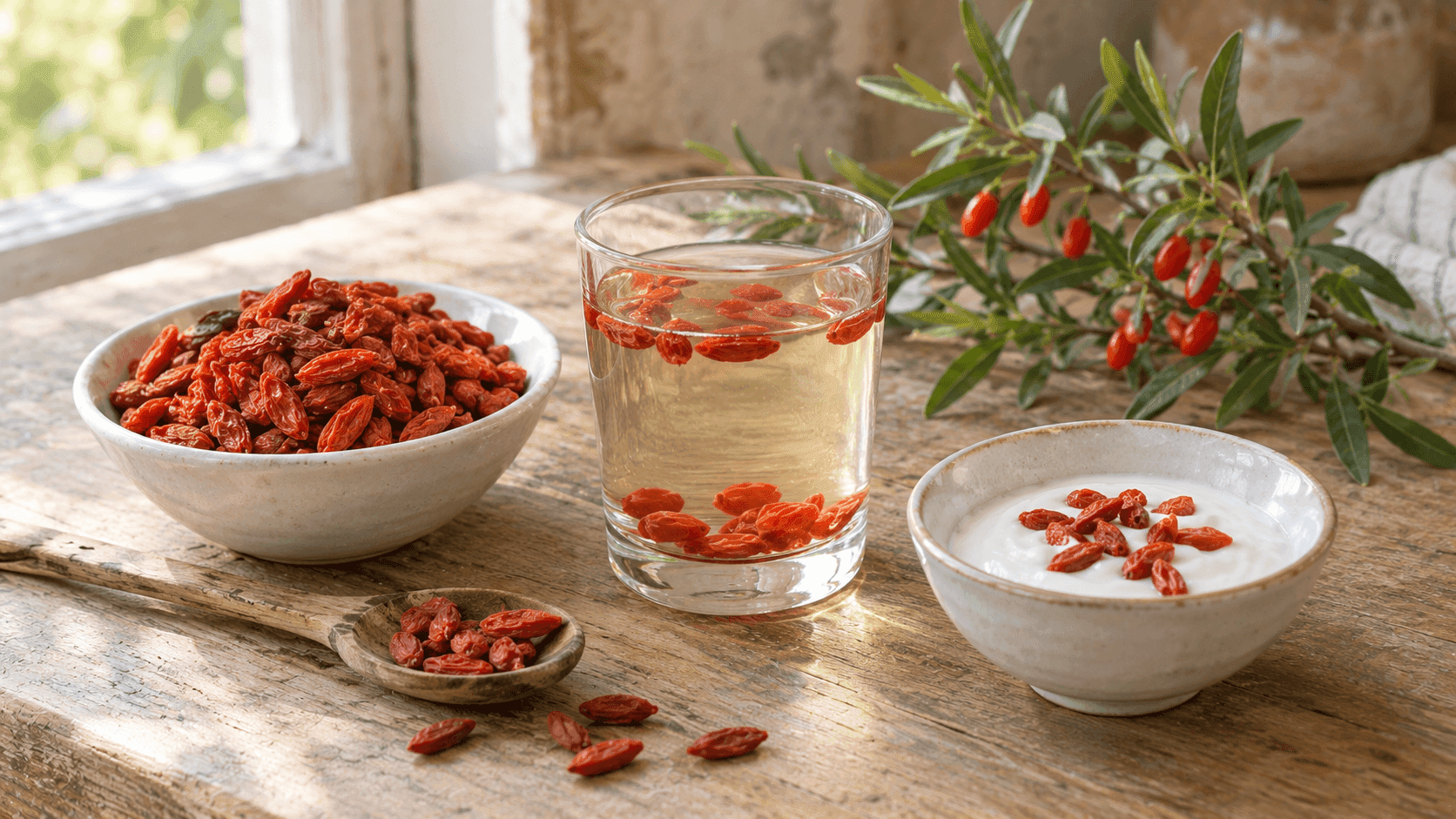
The goji berry is the fruit of the wolfberry, a thorny shrub from the same family as the tomato. Dried, it looks like a little red, elongated raisin, and tastes mild and sweet. Me, I nibble it, steep it or put it in soup, never more than 6 to 12 g in a day.
Her story
Goji berries are the little red, elongated fruits of the wolfberry, a thorny shrub from China, in the same family as the tomato. Me, I buy them dried. I nibble a few, I put a handful in my cup in winter, and a few in the Sunday broth. Nothing more, and that's plenty already.
Goji: what kind of plant is it?
Its proper name is Lycium barbarum. In French it's also called lyciet de Barbarie, or lyciet commun. It belongs to the nightshade family, like the potato and the tomato. A dried fruit that's cousin to the spud: you have to admit, it makes you smile.
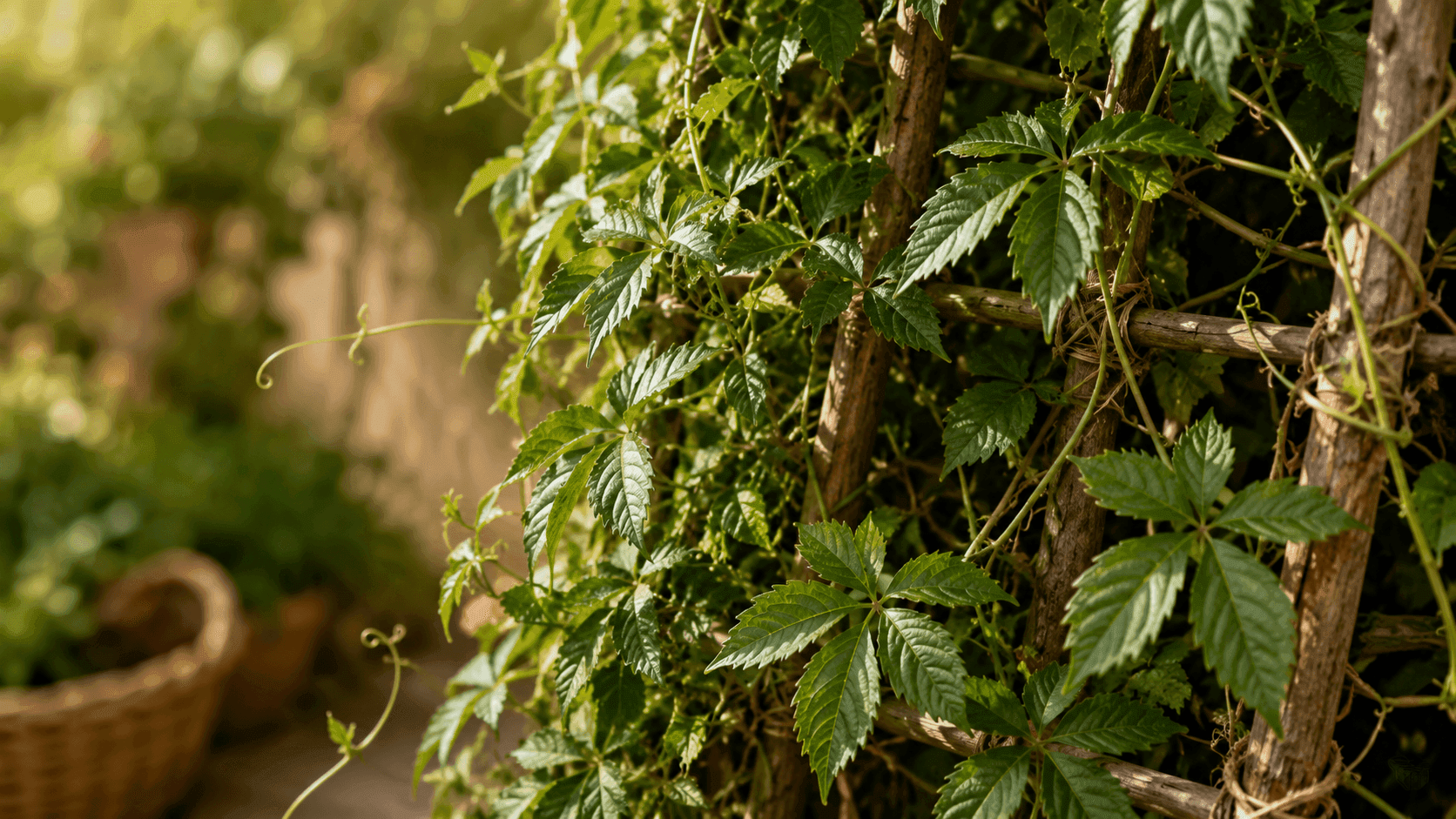
It's a shrub that loses its leaves in winter and grows 1 to 3 metres tall. Its branches are supple and arch over, and the little side branches often end in short spines. The leaves are narrow, shaped like a spearhead. At the start of summer it covers itself in small mauve flowers. Then come the berries: orange-red, elongated like a little egg, 1 to 2 cm long.
The word "goji" is our way of catching the plant's Chinese name, gǒuqǐ, on the fly. The Latin name was given by Linnaeus, in 1753: Lycium comes from Lycia, a region of ancient times. I'm telling you that for general knowledge; the berry doesn't taste any better for it.
From the banks of the Yellow River to our hedges: where goji berries come from
The wolfberry comes from northern and central China. It grows in abundance in the northwest of the country, and the region best known for its berries is Ningxia. There, it has been grown on the plains of the Yellow River for more than six hundred years, and today most of the fields are around Zhongning County.
The berries are picked when they're good and red, in summer and autumn. Then they're dried, with hot air or in the sun, until the skin wrinkles. That's how they reach us: a bit shrivelled, like raisins, but red.
Over here, the shrub is no stranger. The English brought it over in the 1730s, thanks to the Duke of Argyll, and they used it mostly for hedges, especially by the sea. Over there, it's still called "the Duke of Argyll's tea tree". Today goji is grown in France too, for example in Maine-et-Loire.
The dried berries have been sold everywhere these last years as some extraordinary fruit. The serious books say all the fuss owes more to advertising than to anything else, and I'm rather inclined to agree. One more thing: traces of pesticides above European limits have already been found on imported berries. So I always check where mine come from.
The benefits of goji berries: what the old books say
People often ask me what the benefits of the goji berry are. I'll tell you things as they are. In the Chinese pharmacopoeia, goji is one of the fruits people were given when they felt at the end of their strength, after a long spell of tiredness, or when their eyesight went blurry. That's what they've said over there for a very long time, and I'm passing it on as it is.
For the rest, I'm not promising you anything. The eyes, the skin, the kidneys, what's supposed to be good for women: I've heard it all at the market. The serious books say that what's been said about goji in recent years is very much overblown. And if your eyesight is going, it's not a jar of berries you need, it's an appointment with the eye doctor.
"Goji is no magic: it's a little dried fruit, and that's good enough."
What I can tell you about is the taste. Dried, the berries are mild and sweet. In a hot bowl they swell, soften, and give the broth a little orange colour. It's nothing fancy, and that's why I always have a jar.
Dried goji berries: how to eat them, and how much a day
The Chinese pharmacopoeia gives 6 to 12 g a day. I weighed them the first time; now I can judge by eye. And it's the day's total that counts: whether you nibble them, drink them or put them in a dish, you stay within those 6 to 12 g.
Me, I fix them four ways. I rinse them and nibble them just as they are, like raisins. In winter, I put a small handful in my cup, pour 250 ml of boiling water over, cover and wait ten minutes, then I drink it and eat the berries at the bottom. On Sundays they go into my chicken broth, with three slices of ginger (my ginger has a page all its own). And in the morning, I scatter some over porridge. The exact amounts are further down, in my recipes.
Can you eat goji berries every day? The pharmacopoeia gives them day by day, but it doesn't say for how long. So if you want to make them a habit for several weeks, talk to your doctor, especially if you already take something on a doctor's orders. And read the part about what to know first, further down: there's one important thing for people who take something to thin the blood.
I keep my dried goji berries in a tightly closed jar, in a cool, dry corner, away from damp and little critters.
A goji in the garden: where to plant it, and when to prune it
The goji, the tree (well, the shrub), grows very well here. It loves full sun, though it puts up with partial shade. It isn't fussy about soil: chalky, clay or poor, as long as it drains well. It holds out to about -20 °C, and once settled in, it puts up with wind, salty sea air and drought.
You plant it from late summer to autumn, leaving it at least 2 m of room. It also grows in a big pot, as long as water drains out well at the bottom. Be patient with it: you have to wait two or three years for the first berries.
Pruning is simple. At the start of spring, I prune lightly: I take out the dead wood and the badly placed branches. I don't do more than that, because the flowers and fruit come on the stems that grew the year before. Its real fault is that it suckers: it sends up shoots all around, and you have to pull them out unless you want a forest. And wear gloves, because of the spines.
The berries are picked from late summer until the first frosts, August to October here. Only eat the ones that are fully ripe, good and red. Fresh, they're tender and spoil quickly: you pick them gently, or shake the branch over a tray. My other late-summer harvests, I tell you about in my August letter.
What I use her for
- · 01To nibble: a small handful of dried berries, like raisins, staying within 6 to 12 g for the day.
- · 02In a cup, in winter: the berries steeped ten minutes, covered, in boiling water, and I eat the ones at the bottom.
- · 03In the Sunday broth: a few berries in the pot, with the chicken and the ginger.
- · 04At breakfast: on porridge, with an apple, a pear and a pinch of cinnamon.
- · 05In the garden: a sturdy shrub for a sunny hedge, with berries to pick from August to October.
How I prepare her
Granny’s little recipes
The winter-afternoon cup of goji
In the afternoon, when it's cold outside
What you’ll need
- 6 to 12 g of dried goji berries (a small handful)
- 250 ml of water
How I go about it
- 01Rinse the berries under cold water.
- 02Bring the water to the boil and pour it over the berries, in your cup.
- 03Cover and leave to steep for 10 minutes.
- 04Drink it slowly, then eat the berries at the bottom. That's your goji for the day: no other berries that day.
Chicken broth with ginger and goji berries
A winter Sunday, for 3 or 4 (2 hours to 2 h 30 on a low heat)
What you’ll need
- Half a boiling hen or half a chicken, about 700 g
- 3 slices of fresh ginger
- 15 g of dried goji berries
- 1.5 litres of water
- Salt
How I go about it
- 01Cut the bird into 2 or 3 big pieces. Dip them briefly in boiling water, then rinse and drain them.
- 02Put the chicken, the ginger and the rinsed goji berries in a big pot, and pour in the water.
- 03Bring to the boil over a high heat, then turn down to medium-low and let it simmer for 2 hours to 2 h 30.
- 04Salt and serve piping hot. That's about 4 g of goji per bowl: count it in your day.
Morning porridge with goji berries
In the morning, at breakfast (for 2, a quarter of an hour)
What you’ll need
- 80 g of fine oat flakes
- 500 ml of oat drink
- 20 g of dried goji berries
- 40 g of hazelnuts
- Half a teaspoon of ground cinnamon
- A pinch of salt
- 1 apple and 1 pear, sliced
- A little maple syrup, if you like it sweeter
How I go about it
- 01Heat the oat drink until it's just bubbling.
- 02Add the oat flakes, the cinnamon, the salt and the goji berries, and stir well.
- 03Let it cook for about 5 minutes, stirring.
- 04Pour into two bowls, add the chopped hazelnuts, the apple and pear slices, and a drizzle of maple syrup if you like. That's 10 g of goji per bowl.
Elsewhere: how others know her
My daughter, who lives in Shanghai, told me that in China goji is in every kitchen: it goes into soups, and with steamed fish. She also told me a story that got a good laugh over there, in 2017. A photo of a fifty-year-old rock drummer with a thermos in his hand went all over social media. Since then, the flask of hot tea has been the sign that you're getting on, and people joked: "at that age, you think even your beer needs two goji berries in it". She's also the one who introduced me to the herb of immortality.
Keiko, my friend in Tokyo, calls it kuko. Where she lives, a close cousin, Lycium chinense, grows on its own along the paths and on the banks, all over Japan. She wrote to me that they put the berries in rice porridge, on a dessert called annin-dōfu, and that they steep them in white spirit to make kuko wine.
Me, what I love is simpler: a handful of berries in my ginger chicken broth, on a November Sunday. No thermos; my cup does me fine.
What to know first
This information doesn’t replace advice from a healthcare professional. Health Disclaimer →
Her identity card
- Name
- Goji berry
- Other names
- Wolfberry; lyciet de Barbarie, lyciet commun (in French); gǒuqǐ
- Latin name
- Lycium barbarum L.
- Family
- Nightshade family (Solanaceae)
- Part used
- The berries
- Harvest
- Summer and autumn, berries good and red; August to October in France
- Form
- Dried berries, steeped, in cooking
- Origin
- Northern and central China; grown mainly in Ningxia
- Storage
- Dried, in a closed jar, somewhere cool and dry
If you remember just one thing
- 01Goji berries are the dried fruits of the wolfberry, Lycium barbarum, a thorny shrub from China, cousin to the tomato.
- 02The Chinese pharmacopoeia gives 6 to 12 g a day, all in: nibbled, in a cup or in soup.
- 03Goji is no magic: it's a little dried fruit, and that's good enough.
- 04If you take something to thin the blood, such as warfarin, no goji without your doctor's say-so. Pregnant or breastfeeding, go without.
- 05In the garden, goji wants sun and soil that drains well; prune it lightly at the start of spring, and only eat the fully ripe berries.
Your questions
I'm not promising you anything, I'm telling you what people say. In the Chinese pharmacopoeia, goji is one of the fruits people were given when they felt at the end of their strength, or when their eyesight went blurry. Beyond that, it's a little dried fruit with a mild taste, and if your eyesight is going, it's the eye doctor you need to see.
The Chinese pharmacopoeia gives 6 to 12 g of dried berries a day, all in: nibbled, in a cup or in a dish. It gives them day by day, but sets no duration. So if you want to make them a habit for several weeks, talk to your doctor, especially if you already take something on a doctor's orders.
If you take something to thin the blood, such as warfarin, no goji without your doctor's say-so: people have bled after a few days of goji tea, juice or wine. If you take something else on a doctor's orders every day, ask your pharmacist too. And if you're allergic to peach, tomato or nuts, be wary: reactions to goji have been reported.
Pregnant or breastfeeding, there isn't enough data to know whether it's safe: to be careful, go without. For children, the books give neither an age nor an amount. So before giving them some regularly, ask the doctor or the pharmacist.
Dried, they're mild and sweet, a bit shrivelled like raisins. Fresh, in the garden, they're tender and spoil quickly: you pick them gently, or shake the branch over a tray.
In full sun if you can, though it puts up with partial shade, in soil that drains well: chalky, clay or poor, it doesn't mind. It holds out to about -20 °C and puts up with wind and drought. Give it at least 2 m of room, because it sends up shoots all around.
References
- Gou-qi-zi, fruit de Lycium barbarum (宁夏枸杞果实), Pharmacopée chinoise 2020 · ShennongAlpha, Westlake University, 2020
- Lycium barbarum L. · Plants of the World Online, Royal Botanic Gardens, Kew, 2026
- Goji · Therapeutic Research Center (Natural Medicines), sur Vital.ly, 2026
- Possible interaction between warfarin and Lycium barbarum L. · Annals of Pharmacotherapy (PubMed 11675844), 2001
- Probable interaction between Lycium barbarum (goji) and warfarin · Pharmacotherapy (PubMed 22392461), 2012
- Bleeding due to a probable interaction between warfarin and Gouqizi (Lycium barbarum L.) · Toxicology Reports (PubMed 28962463), 2015
- Goji berries (Lycium barbarum): risk of allergic reactions in individuals with food allergy · Journal of Investigational Allergology and Clinical Immunology (PubMed 23101309), 2012
- Glossary on herbal teas (EMA/HMPC/5829/2010 Rev.1) · European Medicines Agency (HMPC)
- Baie de goji · Wikipédia, 2026
- Lycium barbarum · Wikipedia, 2026
- Goji · Wikipedia, 2026
- Lycium ruthenicum · Wikipedia, 2026
- クコ · Wikipedia(日本語版), 2026
- How to grow goji berries · Royal Horticultural Society, 2026
- La plante de la semaine : des baies de goji dans son jardin · Futura, 2026
- Chinese rocker's thermos becomes viral symbol of aging · Sixth Tone, 2017
- Ginseng goji chicken soup · Christine's Recipes, 2017
- Porridge végétalien aux fruits et à la cannelle · Cookidoo, 2026