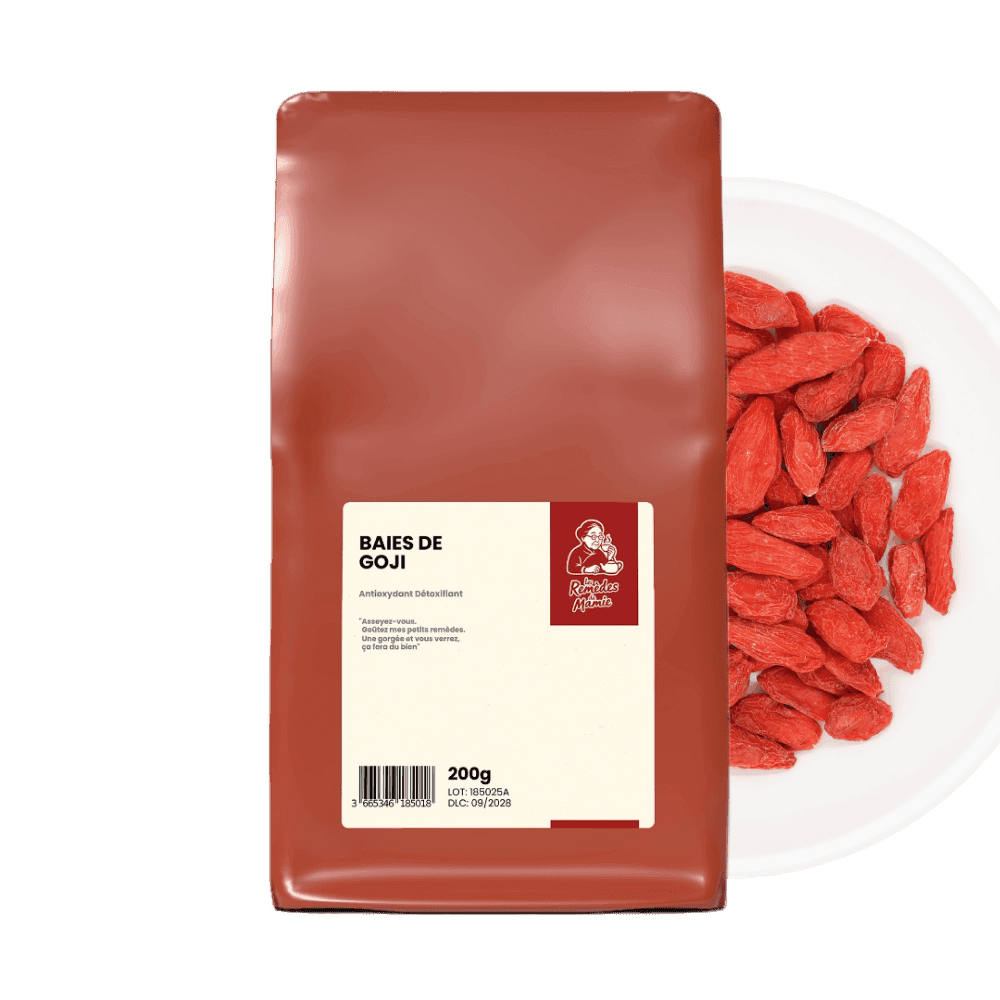
GOJI BERRIES
Goji berries are the little dried red fruits of the wolfberry shrub. I nibble them, steep them or put them in soup, 6 to 12 g a day.
What to know
Goji berries are the fruit of the wolfberry, a shrub of the same family as the tomato and the potato. These ones come from Lycium barbarum, the one the Chinese pharmacopoeia calls gǒuqǐzǐ. They're picked when they're red, in summer and autumn, then dried until the skin wrinkles.
The wolfberry grows mostly in north-west China, and the region best known for its berries is Ningxia. Over there, they put them in soups, with steamed fish, and they even make a liqueur from them. It's a hardy shrub: it grows in France too, in full sun, and its berries ripen from August to October.
In the old Chinese books, goji is one of the fruits people were given when they felt worn out, or when their sight was going blurry. That's what they've said over there for a long time. Me, I promise you nothing more than a little fruit, sweet and a bit tart, that does you good in a hot bowl.
Don't mix it up with black goji: that's a different plant, Lycium ruthenicum, a wild berry of the salt deserts. The goji of the books is the red one.
What's inside
Goji berries (Gou qi zi, Lycium barbarum) 200 g, of Chinese origin, pharmacopoeia quality.
How I use it
I count 6 to 12 g of berries a day, no more: that's the amount the Chinese pharmacopoeia gives. I always rinse them under the tap first.
As a tea: I put my berries in a bowl, pour on 250 ml of boiling water, cover and let it steep for 10 minutes. I drink it, then eat the berries at the bottom.
In soup or rice: I add them towards the end of cooking. And as they are, like raisins, in muesli or on a yoghurt.
Just one of these ways a day, staying within the 6 to 12 g.